The sociology of fame and celebrity is at the cutting edge of current scholarship in a number of different areas of study. Stargazing highlights the interactional dynamics of celebrity and fame in contemporary society, including the thoughts and feelings of stars on the red carpet, the thrills and risks of encountering a famous person at a convention or on the streets, and the excitement generated even by the obvious fakery of celebrity impersonators. Using compelling, real-life examples involving popular celebrities, Ferris and Harris examine how the experience and meanings of celebrity are shaped by social norms, interactional negotiations, and interpretive storytelling.
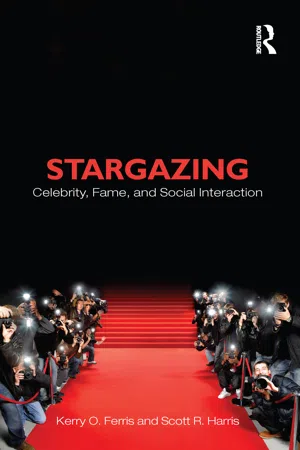
- 160 pages
- English
- ePUB (mobile friendly)
- Available on iOS & Android
eBook - ePub
About this book
Information
1
THE SOCIOLOGY OF CELEBRITY
CELEBRITY AND ITS PUBLIC
Celebrity: we can’t get enough of it. Just think of all the publications and broadcasts produced for those of us who are interested in the lives of celebrities. While fan magazines have been around since the early days of motion pictures, outlets like People magazine and E! television now feed a seemingly insatiable desire for celebrity news 24/7, focusing on the minutiae of celebrities’ lives, relying on the invasive tactics of paparazzi for photos, and even turning previously ordinary civilians into celebrities by covering “human interest” stories and supporting the rise of reality television.
These magazines and television shows are only growing in popularity. People magazine reported a circulation of 3.75 million in 2006, effectively “beat[ing] back its challengers” (Goldsmith 2006), and its website, People.com, drew a record 51.7 million page views on the day after the 2007 Oscars (Hackett 2007), an all-time high. TV Week reports 2.6 million viewers for E!’s 2009 premiere of “Kendra,” a reality show spin-off of yet another reality show, “The Girls Next Door” (Adalian 2009), and the same number of viewers for the 2009 finale of “Kourtney and Khloe Take Miami,” also a reality spin-off (of “Keeping Up with the Kardashians”) (Gilbert 2009). Each broadcast won its cable time slot.
Internet sites also feed the ravenous appetite for celebrity news. Gawker.com’s “Stalker” site offers real-time information on New York City celebrity sightings (e.g., “Just left the Russian Tea Room—Jude [Law] and Sienna [Miller] in a back corner booth, heavily making out”), and Perezhilton.com represents a new, particularly snarky breed of celebrity gossip outlets, including TMZ.com and WWTDD.com. These sites can almost instantly consolidate and present information that used to take at least a week to appear in traditional gossip magazines. They can also provide more explicit editorial commentary than print magazines can. Celebrities themselves may maintain Facebook or Twitter sites that keep fans updated on their every move. And Internet fan sites in general are an exploding phenomenon, part of a staggering proliferation of online celebrity information, providing an opportunity for fans to find each other and more easily share their love of particular stars.
Somehow, the phenomenon of celebrity has until recently escaped the scrutiny of the very people best equipped to explain it: sociologists. In this book, we attempt to remedy this neglect of a fascinating topic: fame, celebrity, and their sociological importance.
Studying Celebrity
Until very recently, the study of celebrity was widely held in “serious” academic circles to be a marginal pursuit. Fame and celebrity were seen as trivial topics, unimportant to a comprehensive understanding of the social world. Despite voracious public interest in celebrity, sociology stubbornly ignored it. Only in the last 15–20 years has sociology taken seriously the idea that celebrity is worthy of study. This is painfully ironic, since sociologists are the original theorists of inequality, and fame and celebrity are themselves hierarchical systems.1 The concerns of prominent sociologists such as Max Weber and C. Wright Mills suggested a sociology of fame and celebrity long before any of their fellows took up the gauntlet. Ultimately, though, it was trends in other disciplines such as literature, cultural and media studies and psychology that finally spurred sociologists to begin considering this most ubiquitous of modern status phenomena.
In this book we take for granted the notion that celebrity is an appropriate object of study for sociology. No defense of the topic will be mounted here. Instead we will offer a new perspective on the growing field of the sociology of celebrity—an empirically-grounded and meaning-centered approach to the topic. Contemporary celebrity deserves an approach, or set of approaches in this case, that can address its unique aspects sociologically. In particular, we make use of a combination of interactional approaches drawn from the traditions of microstructuralism, the negotiated order perspective, and discourse analysis.
Sociology on Celebrity
Despite sociology’s long disregard of celebrity, there are seeds of interest planted in several classical texts. You may remember Max Weber from an introductory class, or from a sociological theory course. Weber’s (1966) concepts of class, status and party, as well as his consideration of personal charisma as a source of power (1968:215), all beg contemporary application to the question of celebrity. Celebrity is the site of a surplus of contemporary society’s charisma––by its very nature it involves individuals with special qualities. From the truly gifted actor or athlete to the exquisitely beautiful supermodel to the simply photogenic “celebutante,” celebrities are people who are charismatic and appealing, qualities Weber recognizes as being possible sources of power over others (1968:241). This is visible in the presentation of celebrities (especially athletes) as role models (Fraser and Brown 2002; Kellner 2001; Lines 2001) and as figureheads in movements for social change (Meyer and Gamson 1995). While Weber himself did not (and surely could not) foresee today’s version of celebrity, he did hold out the prospect that modern capitalism could generate new forms of status, even beyond what he had theorized or anticipated (1966:27). And indeed it has.
Other early theorists who turned their attention to issues such as recognition, success or heroism, also helped lay the groundwork for later considerations of fame and celebrity (Boorstin 1961; Klapp 1949; Mills 1956). For example, C. Wright Mills (1956:71) acknowledges that fame and success often overlap, making celebrity the “American form of public honor.” But Mills also recognizes that not all successes are equal, and hence not all types of fame are equal. He identifies a class of what he calls “professional celebrities”—people who are famous just for being famous, and whose mere visibility is the key to their fame. Daniel Boorstin (1961:57), too, identifies celebrities as “people well-know for their well-knownness.” If Mills and Boorstin were alive today, they’d be fascinated with people like Paris Hilton and the Kardashian family, and would argue that their high visibility serves to distract an eager public while the more accomplished (but inevitably less attractive) economic, political, and military elites “really run things” (Mills 1956:93). Orin Klapp (1949:53) takes the separation of fame and true merit even further, and is concerned that awarding “great man” or “popular hero” status to those whose accomplishments in areas like sports or entertainment are “trivial” might actually be dangerous.
In different ways, these foundational theorists foreshadowed a sociology of fame by recognizing the reality of charisma-based social influence while also contemplating its instability and transience. And while these tidbits of theoretical insight have lain mostly undisturbed for decades, they serve as grounds both for sociology’s long disregard of fame as a suitable topic and for the discipline’s approach to the topic once it did enter the arena of subjects appropriate to study. Eventually, these early theoretical seeds grew into an area of study characterized by a certain moralism: when they do study it, scholars tend to treat celebrity with a certain suspicion.
Celebrity as Pathology
One of the most obvious themes in sociological and other social science research on fame and celebrity is that of “celebrity as pathology.” Researchers, theorists and social critics tend to proceed from the assumption that fame and celebrity, in all their manifestations, are scandalous, corrupt, or otherwise contemptible; given these assumptions, it should not be surprising that the resulting findings support the idea of celebrity as pathological.
Some of this pathologizing comes in the form of overt criticism; authors disparage the social and cultural systems that create celebrity (Postman 1984), or trash celebrity itself as an empty, valueless concept (Gitlin 1998). Critic Neal Gabler (1999) is among many who (like some of the theorists discussed in the section above) question the connection between contemporary fame and true achievement. According to these theorists, to be a celebrity in contemporary society does not necessarily mean that one possesses more talent, skill, intelligence or other gifts than the average person—it merely means that one has been more successfully packaged, promoted, and thrust upon the hungry masses (Boorstin 1961; Braudy 1986; Lowenthal 1961; Monaco 1978). This air of disapproval extends to other conceptual approaches to fame and celebrity as well.
S. Mark Young and Drew Pinsky (2006) find that celebrities are exceptionally narcissistic people, and numerous other social psychological analyses link celebrity (or interest in celebrity) to unflattering personality traits. The work of Lynn McCutcheon and her associates (Ashe and McCutcheon 2001; Maltby and McCutcheon 2001; McCutcheon 2002; McCutcheon and Maltby 2002; McCutcheon, Lange and Houran 2002) links fans’ “celebrity worship” with a host of negative personality traits, such as dependency and “game-playing” in romantic relationships, shyness, loneliness, authoritarianism, and even “Machiavellianism.” These and other takes on the topic seem to assume the worst: that celebrity is dangerous and fans and the rest of society are damaged by their contact with it.
Jake Halpern (2007) laments the perilous and costly extremes to which people are willing to go in order to become famous or to know celebrities. Leo Braudy (1986:618) describes our contemporary obsession with celebrity as a kind of compensation for a lack of “personal honor and responsibility.” Wendy Kaminer (2005:58) complains that celebrity culture diminishes our uniqueness and “impoverishes [our] imaginations.” West (2005) dubs the advent of celebrity politics a threat to democracy. Richard Schickel (1985) warns that celebrity and our obsession with it creates big-name killers like Mark David Chapman and John Hinckley, Jr.
Wow. Celebrity is pretty scary, isn’t it?
And yet fans love it—they (and we) desire it, pursue it, consume it, and can’t get enough of it. If, as these scholars posit, celebrity is so bad (and so bad for us) why are we so determined to get a piece of it one way or another?
Celebrity as Commodity
Answer: because it’s being sold to us—hard—and we’re buying. Many scholars also seem to favor the idea of “celebrity as commodity,” which is usually contextualized by a broader critique of capitalism that links it with the celebrity-as-pathology argument. In this argument, when citizens give themselves up to the easy pleasures of capitalism (like mass media, consumerism, and celebrity), they are more readily controlled by tyrants (Adorno and Horkheimer 1993; King 1992; Marcuse 1991). So, from the perspective of scholars, fans and consumers have been duped by capitalism into fancying something worthless and unhealthy.
P. David Marshall (1997) contends that the conspicuous commodification of celebrity is just an indication of capitalism’s broader power to commodify all persons. Celebrities therefore embody two of the dominant ideologies of contemporary Western culture: individualism and market capitalism, and they serve as signs through which these ideological discourses get passed on to the population. That makes the celebrity powerful both as an example and as a tool of “mass deception” (Marshall 1997:10). Chris Rojek (2001) also argues for celebrity as commodity—in his analysis, celebrities are the perfect products of capitalist markets, offered up as contemporary replacements for both god and monarch. Ellis Cashmore (2006) joins the refrain, presenting evidence for all of the above (celebrity as replacement god, as opiate of the masses, and as carrier of ideology) before rolling it all into an argument about celebrity as commodity. In addition to being the most glittering product of consumer culture, celebrities are its biggest boosters—in Cashmore’s view, celebrities both sell and are sold. In this argument, fans and consumers are taken in by the celebrities themselves, as well as by the system within which celebrity commodities are trafficked. It is yet another way in which contemporary scholars tend toward pathologizing views of celebrity, even as fans and consumers of celebrity enthusiastically seek it out. So far, though, only a few researchers have made attempts to understand the experience of celebrity consumption from the demand side. In order to understand fans’ perspectives on celebrity, we argue, interaction-based research is necessary.
Celebrity: Interactional Approaches
The bulk of contemporary research on celebrity is not empirically focused on the lived experiences of fans and consumers (or celebrities, for that matter). However, some scholars have begun to address this gap in the literature. In doing so, they do not reject out of hand the idea that there might be something appealing and attractive about celebrity, and instead consider what that appeal might be. Some of the writings in this vein are theoretical, but most are empirically based and meaning oriented, taking an interactional approach to the topic. This, in our opinion, is the key to unlocking what is distinctive about celebrity from a sociological perspective.
What needs to be done in order to approach a fully-developed sociology of celebrity? A focus on meaning, and on interactional practices of meaning making around the topic of celebrity, is needed. An exploratory spirit and a focus on questions of meaning are necessary to reach a more authentic understanding of the nature of celebrity. What does celebrity mean to the people who produce it, consume it, engage with it, and live it? A focus on appreciating the diversity and complexity of the meanings constructed by these participants is the key to studying the phenomenon of celebrity without pathologizing, romanticizing, or oversimplifying it (à la Matza 1969).
Joshua Gamson provides a model for coming to an appreciative grasp of contemporary celebrity culture in his Claims to Fame (1994). He avoids the assumption that celebrity culture is debased or shallow by instead asking “what does celebrity mean to fans?” His methodological strategy focuses on the interaction between the celebrity text, its producers, and its readers/consumers, and the meanings that are constructed in those interactions. He seeks the insights of actual audiences and us...
Table of contents
- Contemporary Sociological Perspectives
- TABLE OF CONTENTS
- SERIES FOREWORD
- PREFACE
- OVERVIEW
- ACKNOWLEDGMENTS
- 1 THE SOCIOLOGY OF CELEBRITY
- 2 THE DYNAMICS OF FAN-CELEBRITY ENCOUNTERS
- 3 SEEING AND BEING SEEN
- 4 “AIN’T NOTHING LIKE THE REAL THING, BABY”
- 5 “HOW DOES IT FEEL TO BE A STAR?”
- 6 “WHEN DID YOU KNOW THAT YOU’D BE A STAR?”
- 7 CONCLUSION
- NOTES
- REFERENCES
- SUBJECT INDEX
- CELEBRITY INDEX
Trusted by 375,005 students
Access to over 1.5 million titles for a fair monthly price.
Study more efficiently using our study tools.
Frequently asked questions
Yes, you can cancel anytime from the Subscription tab in your account settings on the Perlego website. Your subscription will stay active until the end of your current billing period. Learn how to cancel your subscription
No, books cannot be downloaded as external files, such as PDFs, for use outside of Perlego. However, you can download books within the Perlego app for offline reading on mobile or tablet. Learn how to download books offline
Perlego offers two plans: Essential and Complete
- Essential is ideal for learners and professionals who enjoy exploring a wide range of subjects. Access the Essential Library with 800,000+ trusted titles and best-sellers across business, personal growth, and the humanities. Includes unlimited reading time and Standard Read Aloud voice.
- Complete: Perfect for advanced learners and researchers needing full, unrestricted access. Unlock 1.5M+ books across hundreds of subjects, including academic and specialized titles. The Complete Plan also includes advanced features like Premium Read Aloud and Research Assistant.
We are an online textbook subscription service, where you can get access to an entire online library for less than the price of a single book per month. With over 1.5 million books across 990+ topics, we’ve got you covered! Learn about our mission
Look out for the read-aloud symbol on your next book to see if you can listen to it. The read-aloud tool reads text aloud for you, highlighting the text as it is being read. You can pause it, speed it up and slow it down. Learn more about Read Aloud
Yes! You can use the Perlego app on both iOS and Android devices to read anytime, anywhere — even offline. Perfect for commutes or when you’re on the go.
Please note we cannot support devices running on iOS 13 and Android 7 or earlier. Learn more about using the app
Please note we cannot support devices running on iOS 13 and Android 7 or earlier. Learn more about using the app
Yes, you can access Stargazing by Kerry O. Ferris,Scott R. Harris in PDF and/or ePUB format, as well as other popular books in Social Sciences & Popular Culture. We have over 1.5 million books available in our catalogue for you to explore.