![]()
Part I
The archetype of initiation and Joe Henderson
![]()
Chapter 1
In the footsteps
The story of an initiatory drawing by Dr Joseph Henderson
Thomas Singer
This chapter tells the story about a drawing – about its creation and its meaning to the man who drew it, Dr Joseph Henderson. The narrative unfolds on many different levels simultaneously. A few of the levels that the reader may want to keep in mind about this remarkable drawing and its even more remarkable creator are:
- This is the story of a young man's search for meaning, orientation, and even the renewal and transformation of his life at a critical moment in his development.
- This is the story of the making of a special kind of drawing – a drawing based largely on the inner reality of the psyche rather than the outer circumstances of a life – although the outer circumstances are essential to the inner events.
- The "language" of the drawing comes from the world of dreams, of the imagination, of myth, and it is expressed symbolically. The drawing itself tells a story just as there is a story behind the making of the drawing.
- This is a story that takes place at a particularly "ripe" time both in modern history and in the early development of the Jungian tradition –just between the two world wars and at the peak of the Great Depression – 1930 and 1931.
The telling of this story best begins with a recounting of how the drawing first came to my attention – just about seventy-five years after it was drawn. As part of celebrating Dr Henderson's one hundredth birthday in 2003, a fund honoring his remarkable career and life was established. A committee was formed to decide the most fitting way to use the fund's generous contributions and it became clear that republishing Thresholds of Initiation – Dr Henderson's seminal book – was the perfect tribute. About the republication, I wrote in the Foreword at the time:
For many, Thresholds of Initiation became the landmark, the talisman, and the model for both analysis and for analytic training at the C.G. Jung Institute in San Francisco. Based on Dr Henderson's work, the process of analysis was often framed in terms of the archetype of initiation. The book Thresholds of Initiation became a "threshold of initiation" on which both analysis and the analytic training program were patterned –not in the sense of prescribing a course of treatment or in designing a curriculum but in establishing an underlying purpose, value and meaning to the analytic endeavor.
(Henderson 2005: xiv–xv, original emphases)
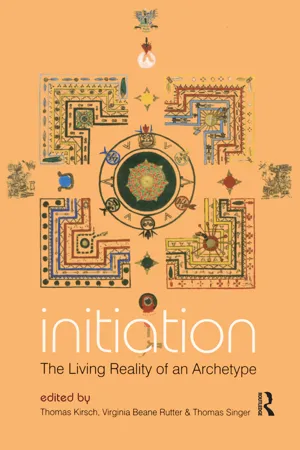
Shortly after writing that description, I received an email from Dyane Sherwood, the committee member who first suggested creating a fund in honor of Dr Henderson's birthday and one of the contributors to this book. Her message contained a PDF image of a drawing that Dr Henderson had made in 1931 (Figure 1.1, in the color plate section). Dyane thought the drawing might make a good cover for the reissue of Thresholds of Initiation.
When I opened the computer file, I was dazzled. Something inside me literally vibrated in response to the image on the screen. I don't know if anyone has made a study of the phenomena of "PDF files and the numinous" or "emails and the archetype of initiation" – but, based on my experience of seeing Dr Henderson's 1931 drawing on the screen for the first time in 2003 (Figure 1.1), I can testify to the fact that the numinous and the archetype of initiation can be experienced in cyber space.
Although I had seen the drawing on the wall in Dr Henderson's home office before, I had not really taken note of it. Suddenly – in Dyane's email – it came to glowing life on my screen. It seemed so fresh and full of energy –even brand new – although it had been drawn three-quarters of a century before. It spoke directly to my soul – as if I had known it all my life. I became an ardent advocate for this image to become the cover of the new edition of Thresholds of Initiation. Ultimately, Dr Henderson made the decision in favor of another image, which represented to him a coming to fruition of his initiatory journey, whereas the image of this chapter was more at the beginning.
Dr Henderson and I began a year-long discussion about the drawing of this study which I jokingly referred to as "the cover not chosen" – the subject of this chapter. Those talks in themselves became a journey between Dr Henderson and myself. As the chapters in this book demonstrate, many have followed in the footsteps of Dr Henderson – in their unique ways. This chapter tracks Dr Henderson's own footsteps in his reminiscences of this drawing, leading us back to the origins of his experience with the archetype of initiation.
Joe Henderson was born in 1903. He was 27 years old when he drew this image in 1931. It would be another thirty-six years before the material of his own personal experience would ripen into his professional account of the archetype of initiation, Thresholds of Initiation, first published in 1967. He would begin telling me the story of the making of the drawing in 2004, in his one hundredth and first year. This image, then, is a living symbolic bridge between Dr Henderson's own initiatory journey in the early 1930s, his clinical portrait of the archetype of initiation in Thresholds of Initiation in 1967, and the writing of this chapter in 2006. Over the years, Dr Henderson has shared many parts of this story with others, although this is perhaps the first time a narrative has been put together as a coherent story about this drawing which laid down the footsteps for one man whom so many came to love and to follow Of course, there was no real following in Dr Henderson's footsteps and none of the authors of this volume would either claim to be able to or want to follow too closely in his tracks because our tradition is fundamentally about finding one's own way. Still, we are all interested in Dr Henderson's footsteps.
The centerpiece of the story is an image that might best be thought of as a psycho-spiritual map that anticipates and guides the archetypal initiatory journey of Joseph Henderson – a kind of inner compass. It is not easy to stay oriented to person, place and time – the stuff of ordinary linear development and narrative – while simultaneously tracking an inner life in its archetypal unfolding. It is not easy to remain oriented in multiple dimensions simultaneously. In telling the story of this drawing, we are tracking biography, psychology, symbology, iconography – all in the context of the archetype of initiation as it unfolds in the life of an individual. Teasing these layers out and interweaving them has been the "ripening fruit" of my conversations with Dr Henderson. Every time I thought I had developed some sense of where we were in the narrative of the drawing – or thought I knew what a particular part of the picture was about – Joe would surprise me with new information that added incredible richness and texture to the story. For instance, at one point, Dr Henderson told me additional details about the upper right quadrant (which I will discuss later) and I remarked to him in some amazement, "I never knew that." He replied simply, "How could you? I never told you about it before." The image became richer and richer. The story is told mostly in Dr Henderson's own words and the interpretations of the drawing are exclusively his. It was not my role to interpret his drawing; my role was simply to ask questions.
Here is some context and basic chronology. Dr Henderson traveled from America to Zurich in the fall of 1929 to study and to analyze with Jung. He remained in Zurich until June of 1930. He settled in London to begin his premedical studies in the fall of 1930 which continued through the academic year into 1931. As he was completing these studies in the spring of 1931, Joe had two big dreams on consecutive nights in the midst of his premed course exams:
The dreams made me think I needed an analytic hour or two to talk to Jung. I booked travel to Zurich as soon as I could, and I went to see Jung in the early summer of 1931. Jung was not very helpful. All he said was that he was leaving in a day or so for summer vacation.
Jung was not there for Joe when he needed him.
I went to Zurich because I was in trouble. I needed to talk to Jung about myself. I needed someone. So, I decided to interpret the dreams myself and do this drawing – which took about three weeks. At stake was whether or not to go to medical school.
Joe never talked to Jung about the details of this drawing, but – at the age of 101 – Joe said, "I activated the archetype of initiation within myself and realized that I could interpret my own dreams."
Here are the two dreams that Joe had in the spring of 1931. These two dreams find abstract, symbolic expression in the top and near the bottom of the drawing. (The rest of this chapter will isolate parts of the drawing with close-up images, each of which tells a separate part of the story. To see these parts in relation to the whole, please refer back to Figure 1.1.)
A white horse (white circle in Figure 1.2) is running along the surface of a gray sea. An eagle flies down from the sky and bites the horse in the back of the neck where there is an exposed artery. Blood spurts up from the pierced artery and the horse dies. I awoke and knew that I was going to fail my premed course exams on the following day.
Even as we look at the image of the dream, as it appears in the top of the drawing today, the spurting blood seems fresh – as if it just happened this instant – which underlines the timelessness of archetypal reality. To some, the outer events and circumstances of Joe's life at the time of this dream might not suggest an "ordeal," but to those who know the reality of the inner world, this dream and its symbolic representation in the drawing convey grave danger and the onset of an ordeal.
Dream Two is represented in the drawing near the bottom and is shown in detail in Figure 1.3.
The dream of the following night is set in the depths of the ocean. A snake with a red head comes up from below – from the depths – and bites a flat, black fish. The snake bites the fish in exactly the same way that the eagle bit the horse on the back of the neck the night before.
Joe elaborated on the meaning of the dreams over time in the following way:
The dreams seemed very complicated to me. The "eagle"' bite (Figure 1.2, Dream One) was a "bad one" – a killer. It said to me that I was going to fail my examination on the next day. The red headed snake bite of the second night (Figure 1.3, Dream Two) suggested a renewal of life –life giving rather than death dealing. That surprised me and suggested that I was going to pass the examination somehow, but I didn't know how. The dreams seemed to be two pairs of opposites and I knew I had something to work on:
- – There was the snake coming up from below, biting the fish.
- – And there was the eagle coming down from above, biting the horse.
The pair of opposites above was matched by a pair of opposites from below. It presented to my eye a double vision, or two pairs of pairs.
While Jung was away on vacation, I told the dreams to one or two women. One woman especially reacted to it – Linda Fierz David who wrote a book about women's initiation in Pompeii (Fierz David 1988). She said that the dreams were "interesting'' and she saw me as dreading the whole process of becoming a doctor.
In that sense, the eagle was the medical profession itself. I was putting myself through something that was a trial of strength. The white horse symbolized my natural enjoyment of life and my not wanting to inhibit it. The serpent with the red head symbolized life energies coming from below and bringing new life. The flat fish lying on the bottom of the sea was like inertia itself, just heavy and unable to move. So there was a threat from above and a bite from below.
In medical school my body was heavy, like the fish on the bottom of the sea. I had to kill my inertia and the wish to remain a white horse instead of a red snake. I had to give up my passive identification with heroic youth (white horse). Both the inertia (the flat fish) and the passive identification with the heroic phase of life and its enjoyment (the white horse) needed to die. Linda Fierz pointed out that the white horse carried natural instinct and the enjoyment of life – it needed to "die."
In a way, all of the animals in the dreams were ambivalent. For instance, the black eagle of the first dream became – in subsequent dreams – blue and white rather than black and white. I saw that as more "favorable." The drawing that I made from these two pairs of opposites ( the two pairs of animals) became dynamic. It's complicated, but its complication is what makes it interesting. I came to think that the bite of the eagle showed my fear of failing – that's why it was so negative to me. Not just failing the examination, but failing at the whole process of becoming a physician. I was afraid that I would be unable to go through with a medical career.
The first dream said that I was convinced I had failed. The second dream suggested that there could be a positive meaning to this failure. The snake dream was hopeful to me, that I might still be able to proceed. The hope for renewal really came from the snake bite from below.
I also told the dreams to my great friend Cary Baynes. Cary wouldn't interpret the dreams at all, but she would listen to me "informally." She made me get an appointment with Jung when he returned at the end of the summer, after I had completed painting the image. We went to Bollingen and had supper with Jung. After supper, I showed him my painting. Jung said that it showed I had "unusual decorative ability." He also said that the left side or the feminine side was more finished and the right side, the masculine side, was less finished and I should get to work on my masculine side. He saw the right side as "breaking up" with different images. He didn't comment on the central area. I had already interpreted it to my own satisfaction.
Let's take a closer look at the iconography of the drawing as elaborated by Joe, keeping in mind that this is an interior story. The initiatory ordeal portrayed in this drawing is happening in the psyche – not outside in the world.
The symbolic rendering of the two dreams at the top and bottom of the drawing that Dr Henderson has already described in his own words can be seen as both stating the precipitating inner problem at the archetypal level and as framing the drawing.
At the very center of the drawing is a gold circle of "peaceful resolve." It is surrounded by pieces of blue turquoise and red coral (Figure 1.4).
This inner core was the first thing that Joe painted after going to an art supply store in Zurich and carefully picking out a piece of parchment on which he could work comfortably. He started drawing in the center using gold, coral, and turquoise. Joe told me that drawing the center first "put it all in motion." Just beyond this core of brilliant light that "centers" the drawing is an area of intense black about which Joe said the following:
This is the black obsidian mirror of Tezcatlipoca. I was very taken up with Mayan and Aztec art and archeology when I was drawing this. It is said that if you look into this mirror, you can see your essential Self.
About this god, I found the following:
Tezcatlipoca was the Aztec god of war. He carried a magic mirror that gave off smoke and killed enemies, and so he was called "god of smoking mirror." Whoever would gaze into this black mirror of obsidian might perceive the meaning of his soul.1
Joe said to me: "Looking into the black obsidian mirror symbolizes the ability to focus on the inner life."
Directly encircling the black mirror is a series of masks, some of which brought to my mind Donald Kalsched's archetypal defenses of the personal spirit. But, Joe noted particularly the one at the top: a "hermaphrod...