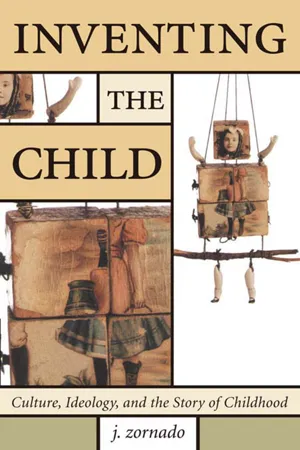
Now in paperback, Inventing the Child is a highly entertaining, humorous, and at times acerbic account of what it means to be a child (and a parent) in America at the dawn of the new millennium. J. Zornado explores the history and development of the concept of childhood, starting with the works of Calvin, Freud, and Rousseau and culminating with the modern 'consumer' childhood of Dr. Spock and television. The volume discusses major media depictions of childhood and examines the ways in which parents use different forms of media to swaddle, educate, and entertain their children. Zornado argues that the stories we tell our children contain the ideologies of the dominant culture - which, more often than not, promote 'happiness' at all costs, materialism as the way to happiness, and above all, obedience to the dominant order.
- 256 pages
- English
- ePUB (mobile friendly)
- Available on iOS & Android
eBook - ePub
Inventing the Child
About this book
Information
CHAPTER 1
History as Human Relationship
No universal history leads from savagery to humanitarianism, but there is one leading from the slingshot to the megaton bomb.—Theodor Adorno, Negative Dialects
A STARTING POINT
The story of Western culture is, according to conventional wisdom, a story of progress, growth, and development. Western culture it is said, has been a grand experiment, wildly successful in its ability to transform the natural resources of a continent—and a globe—into the finished material an advanced civilization requires, such as automobiles, computers, military hardware, medical technology, and common consumer goods. Not long after the first European settlers established themselves on the American continent, the story of the American experiment began to circulate as story. We told it to ourselves while at church, at home, at work, and at rest, and of course, we told it to our children. Words and ideas such as God, destiny, freedom, frontier, enlightened self-interest, and technological progress—along with many others—were invoked in order to justify and extend the story of Western culture as a process that would, ultimately, engulf the “new” world. First the Bible and later science became supported and defended by what appeared to be the American’s “God-given” right to dominate and subjugate.
That all would share in what became known as the “American dream” was part and parcel of the American mythos and as a result, helped to justify the exportation of the American ideology from coast to coast. Whatever human exploitation or habitat destruction that resulted—or results—in the exportation of American ideology was—and still is—according to conventional wisdom, acceptable and even, if the truth be known, inevitable. The destruction of the rain forests, for instance, is the price we all must pay for progress, civilization, and inexpensive fast food, or so the story goes.
The exploitation of workers—often children—in places like Indonesia, China, and India is, according to the American ideology, the necessary price the dominant culture must pay in order to keep its economic house in order, for cheap labor overseas keeps American inflation low and the Western consumer shopping. Moreover, as the story goes, cheap labor is good for first-world economies and, in the long run, for developing nations as well, for in sewing our shirts and making our children’s toys, developing nations participate in the “global economy” from the ground up. The ostensible logic is that soon the developing nations will become full partners in a global culture in which all players see eye to eye, in which all players have equal opportunity. Almost four hundred years have passed since the Pilgrims colonized America, and yet the story remains remarkably familiar: the American state, be it theocratic or economic, will lead by example and represent the leading edge of what an enlightened community can become.
Yet the self-same story that placed the Pilgrims and Puritans at the epicenter of their universe placed the Native American—among others—at its outer edge, casting the indigenous native as the perennial other and, as such, God’s tool to deepen His people’s commitment to their faith. God made the “savage” particularly susceptible to alcohol and smallpox for a reason. It seemed obvious to men such as John Winthrop, William Bradford, and even Benjamin Franklin that domination and subjugation were a part of God’s—or Nature’s—appointed way in the “new” world, just as it had been in the “old.”
The nature of the relationship between the colonists and the Native Americans—as well as between so-called first- and third-world cultures today—actively prohibits the growth and development of the “other” culture, except along the lines of the more “civilized” culture. For example, developing nations today struggle to become like the West in two ways: they desire economic power and, more often than not, weapons of mass destruction. If not the first, then the second path offers a way for developing nations to establish credibility defined as it is by the dominant ideology of Western culture. Both paths, however, spell doom for the human species and for the global habitat. If peace is contingent upon economic parity, that is, of “raising” developing nations to the standard of living Americans have grown used to, then peace may prove to be too expensive for Western culture to support. As populations rise around the world—even as Western populations are projected to remain largely flat—the twenty-first century will witness more and more people demanding their share of the progress and comfort enjoyed by the West, and rightly so, given the exportation of American ideology and the “superior” way of life it implicitly and explicitly celebrates.1
Sharing the wealth has never been a part of the American experiment. What has been a part of the dominant ideology of Western culture is the belief in the rugged individual who makes for himself the world he desires. If this belief is put into practice by India, China, and other growing populations— and it is in practice in many ways already—the resources of the global habitat will be stretched beyond its ability to sustain itself. Admittedly, no one knows how many human beings can fit on the head of this pin called earth. Even so, at six billion and counting, most signs point to high probability of another doubling of the global population sometime in the twenty-first century.
As natural resources continue to become strained with continuing global population growth, political tensions will naturally rise, in which case economic parity as a path to political credibility will give way to what may prove to be a shorter, cheaper path to global credibility, a path celebrated by American culture from its very beginnings: military technology, especially in the form of weapons of mass destruction. In 1998 India and Pakistan revealed their own nuclear capabilities, demonstrating yet again that the ability to destroy entire continents—and perhaps the entire global habitat—with a handful of nuclear bombs continues to be a temptation that developing nations have a hard time resisting.
As if it weren’t enough to ask the reader to take this doomsaying seriously, I want to complicate things even further by arguing that the predilection we have for ever-intensifying expressions of destruction is not the product of human nature but rather a predictable consequence of a style of human culture produced and reproduced in an ever-more-intensifying way over the past four hundred years, with roots dating back to the Agricultural Revolution some ten thousand years ago.2 The way in which the adult invents the child—and so reproduces the dominant culture—is key to understanding the history that leads from the slingshot to the megaton bomb, for the production and reproduction of our style of human culture occur first and foremost in our style of human relationships, which is first experienced by the child at the hands of the adult. The adult invents the child and constructs the world.
The stories we tell our children—and tell ourselves about the child—are my primary concern in this book, for in these stories a culture confirms itself and so reproduces itself. These are no innocent things, these children’s stories; rather, their innocence is an ideological projection by which we ignore their implications, their meanings, and the larger story they tell, for adults write the children’s books. The child is always already faced with an adult reification of the world presented as “neutral” and “obvious.” Children’s stories speak directly to the nature of the human relationship that produced them. If we want to understand the way in which a culture envisions itself, we might look no further than the stories adults tell and retell to their children. With this in mind, this study explores only those children’s stories that were unquestionably popular: from the New England Primer to the fairy tales of the Brothers Grimm’s, from Alice in Wonderland to Walt Disney’s Pinocchio, from Maurice Sendak’s Where the Wild Things Are to the PBS show Barney, understanding the way in which a culture reproduces itself through its children requires that the texts by adults for children actually reach a wide audience.
Seeing children’s stories as a cultural reproduction of the relationship between the adult and the child—determined as it is by the unconscious ideology harbored by the adult—offers a way of seeing diverse forms of children’s literature, human relationships, the story of Western culture, and the production and reproduction of the dominant ideology of Western culture as diverse expressions of the same story.
According to Louis Althusser, a culture’s ideology is the determining psychodynamic phenomenon by which human beings become “social subjects.” It follows that the rules by which social subjects interact produce lived relations—that is, relationships governed by an ideology that manifests itself in the practice, or the pedagogical expression, of those ideological assumptions, many of which are unconscious and invisible, even to the participants themselves. This is nowhere more true than when the adult interacts with the child. According to Althusser, social subjects are connected to the dominant relations of production—the material expression of a culture, its jobs, its economic base, its state institutions, and so on—and so, social subjects inadvertently reproduce the dominant culture as a result of the lived relations determined by the structure imposed on them by “the dominant relations of production.”
Understanding ideology as an affective process does not deny ideology its cognitive content, but rather shifts the focus from the individual’s intellectual development to the individual’s lived practices in human relations, practices that are, quite frequently, determined solely by the adult. Where the individual first learns his or her way of practicing human relations, then, becomes of primary concern to an affective theory of ideology. Further, the development of an affective theory of ideology requires an understanding of how affective and cognitive experiences impact on the biological system, and how this impact leads to the reproduction of the dominant culture in and through the individual’s conscious and unconscious mind, for it is the expression of and through that mind that structures human relationships, and so reproduces the dominant culture. The production and reproduction of the dominant culture require the production and reproduction of the dominant ideology as a necessary prerequisite, and this occurs in the relationship between the adult and the child, as the child learns to forget the felt experiences of the real conditions of her existence and then substitute for them an imaginary idea of her existence. “Unfortunately,” Althusser writes, “this interpretation leaves one small problem unsettled: why do individuals ‘need’ this imaginary transposition of their real conditions of existence in order to ‘represent to themselves’ their conditions of existence in imaginary, that is, in ideological forms?”3
THE DETACHMENT CHILD
From the infant’s first days, ideology interrupts his ability to meet basic biological needs: namely, in the first months of life, attachment to the mother remains a biological necessity, until the infant signals a readiness to separate from the mother. Ideology interrupts and structures the relationship of the adult and the child in the form of technology, medical science, and the belief in the salvific force that technology and science supposedly embody. Yet for the infant, technology augers something other than salvation. Technology in the form of baby formula, rubber nipples, cribs, intercoms, and even strollers goes hand in hand with premature detachment from the mother and the resultant emotional and physical deprivation. Ideology goes hand in hand with detachment and abandonment. Baby formula, nurseries, cribs, intercoms, and other tools that facilitate physical and emotional detachment from the infant influences the child’s development in profound ways and makes difficult, if not impossible, the child’s attempt to navigate a separation from the mother when an earlier state of oneness outside the womb never fully prevailed. There can be no separation without the child’s first having experienced attachment.4
Children have been prematurely detached from their mothers and fathers for millennia, but not everywhere. Jean Liedloff, in The Continuum Concept, makes the point quite clearly that other cultures, cultures described by Daniel Quinn as “Leaver” cultures, have a completely different way of understanding what they mean when they say “us.” For the “Leaver” culture, “us” includes the subject and the object, the adult and the child, the self and the other. Western dualism and its cultural manifestations maintain a gap between subject and object, knower and known, and in this gap posits a “unique” and “individual” personality often at war with everything else around it, including itself.
Detachment parenting is a distinctly cultural phenomenon practiced and perfected in particular by Western child-rearing ideologies for so long that it has become an ambient reality, an ideological obviousness. Blaming the child for adult detachment is a central element of this tradition. Western history might be read—and will be read in this book—as one long, intensifying series of responses to the suffering of emotional deprivation that the adult inflicts upon the child, and the child then inflicts upon the world.
LOOKING BACKWARD
Consider the book of Genesis. As text, it contains stories that define the Western mind. After creating Adam, God sets him in the Garden and gives him some rules to live by:
Then the Lord God took the man and put him in the garden of Eden to till it and care for it. He told the man, “You may eat from every tree in the garden, but not from the tree of the knowledge of good and evil; for on the day that you eat from it, you will certainly die.“ (Gen. 2:15–17)
Soon after, the Lord God gives Adam a helper, Eve, “and both were naked and were not ashamed.”
In spite of their ostensible happiness in the Garden of Eden, Eve chooses to disobey God, having first been led astray by the Devil dressed up as a snake, and so indulges her appetite and invites Adam to do the same. When God discovered their disobedience,
He said, “the man has become like one of us, knowing good and evil; what if he now reaches out his hand and takes fruit from the tree of life also, eats it and lives forever?” So the Lord God drove him out of the Garden of Eden … He cast him out. (Gen. 3:22–24)
According to the Judeo-Christian tradition, Adam’s sin defined the human race as a fallen race. Among the lessons we learn from the Book of Genesis one of the most ambient and so invisible has to do with the child: there is nothing worse in the history of the universe than the child’s disobedience of the father. The child’s disobedience is the seed and source for all human misery, and even the source for death itself. Finally, the child’s misery is, according to biblical myth, the child’s own fault. The child is wayward and destructive. Hence Solomon reminds his adult audience that to “spare the rod is to spoil the child.”
That the story of Adam and Eve may have been ideological propaganda for a dominant culture that produced it should not be ignored. For, as the agriculturists began to dominate Mesopotamia long before the books of the Old Testament were written, they required a source of labor to till their fields and bring into submission other uncultivated lands. The child undoubtedly offered one of the quickest, cheapest sources for a farmer in need of inexpensive labor, hence the biblical injunction: “Happy is the man whose quiver is full of them.”
In one sense, then, God sets His children up to fail and thus justifies His treatm...
Table of contents
- Cover
- Half Title
- Children's Literature and Culture
- Title Page
- Copyright Page
- Dedication
- Table of Contents
- Series Editor's Foreword
- Acknowledgments
- Introduction
- Excerpts
- CHAPTER 1 History as Human Relationship
- CHAPTER 2 Freud, Shakespeare, and Hamlet as Children's Literature
- CHAPTER 3 The Brothers Grimm, the Black Pedagogy, and the Roots of Fascist Culture
- CHAPTER 4 Victorian Imperialism and the Golden Age of Children's Literature
- CHAPTER 5 Walt Disney, Ideological Transposition, and the Child
- CHAPTER 6 Maurice Sendak and the Detachment Child
- CHAPTER 7 Conclusion: The Etiology of Consumerism
- Bibliography
- Index
Trusted by 375,005 students
Access to over 1.5 million titles for a fair monthly price.
Study more efficiently using our study tools.
Frequently asked questions
Yes, you can cancel anytime from the Subscription tab in your account settings on the Perlego website. Your subscription will stay active until the end of your current billing period. Learn how to cancel your subscription
No, books cannot be downloaded as external files, such as PDFs, for use outside of Perlego. However, you can download books within the Perlego app for offline reading on mobile or tablet. Learn how to download books offline
Perlego offers two plans: Essential and Complete
- Essential is ideal for learners and professionals who enjoy exploring a wide range of subjects. Access the Essential Library with 800,000+ trusted titles and best-sellers across business, personal growth, and the humanities. Includes unlimited reading time and Standard Read Aloud voice.
- Complete: Perfect for advanced learners and researchers needing full, unrestricted access. Unlock 1.5M+ books across hundreds of subjects, including academic and specialized titles. The Complete Plan also includes advanced features like Premium Read Aloud and Research Assistant.
We are an online textbook subscription service, where you can get access to an entire online library for less than the price of a single book per month. With over 1.5 million books across 990+ topics, we’ve got you covered! Learn about our mission
Look out for the read-aloud symbol on your next book to see if you can listen to it. The read-aloud tool reads text aloud for you, highlighting the text as it is being read. You can pause it, speed it up and slow it down. Learn more about Read Aloud
Yes! You can use the Perlego app on both iOS and Android devices to read anytime, anywhere — even offline. Perfect for commutes or when you’re on the go.
Please note we cannot support devices running on iOS 13 and Android 7 or earlier. Learn more about using the app
Please note we cannot support devices running on iOS 13 and Android 7 or earlier. Learn more about using the app
Yes, you can access Inventing the Child by John Zornado in PDF and/or ePUB format, as well as other popular books in Literature & Social History. We have over 1.5 million books available in our catalogue for you to explore.