Opening Up the Conversation leads practicing and preservice K-12 teachers through the process of creating more open, student-centered discourse in their classrooms. Readers are first introduced to types of teacher questions, student responses, and teacher follow-up moves that are associated with both open and closed discourse. Author John Henning then helps readers identify the most likely places for open and closed classroom discourse by examining an entire unit of instruction and by looking closely at three distinct types of discussions—framing, conceptual, and application. Readers are introduced to specific discourse moves, the patterns of discussion, the amount of preparation, and the types of accountability strategies needed to construct each of these discussions. The final chapter of the book shows readers how to videotape and analyze their classroom interactions in a teacher study group.
eBook - ePub
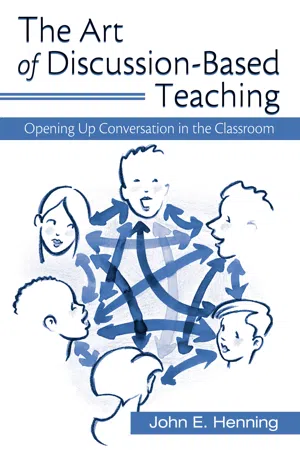
The Art of Discussion-Based Teaching
Opening Up Conversation in the Classroom
- 240 pages
- English
- ePUB (mobile friendly)
- Available on iOS & Android
eBook - ePub
About this book
Information
part one
Classroom Discourse Moves
The purpose of chapters 1–3 is to define and illustrate the different types of discourse moves made by teachers and students during classroom interactions. Recognizing them is essential to evaluating and systematically improving your discussion skills. These chapters can help you become aware of the discourse moves at which you are already proficient, pinpoint the discourse moves you use infrequently but would like to use more, and introduce some unfamiliar discourse moves that could be added to your repertoire. By understanding a wide array of discourse moves, teachers can better locate their current skill level and identify which additional strategies can best enhance their skill base.
one
Asking Questions
Framing Discussion
Below, you will find a description of a discussion written by a teacher of industrial technology. In the paper, he reflects on his discussion strategies, how his students responded to them, and the adjustments he made based on their responses. As you read his reflection, try to identify the different types of strategies he used. Pay particular attention to his strategies for asking questions. Consider the different ways he uses questions to advance the discussion. Then discuss the following questions:
1. How did this teacher use questions to guide this discussion?
2. What other kinds of strategies did this teacher use to create an effective discussion?
3. Rank these strategies in the order of their importance.
4. Do you think the relative importance of these elements would change if the grade level or ability level of the students changed? Explain.
5. Would the relative importance of these strategies change if the subject matter changed?
6. Based on your own experience, what are the most important strategies necessary to create an effective classroom discourse?
Purpose and Desired Outcomes
The purpose of this analysis is to check for adequate skills in conducting a classroom discussion. Several skills that I would like to focus on are my questioning techniques, my ability to extend student thinking without questions, and my ability to encourage a majority of my students to participate in the discussion.
To analyze proper questioning techniques, I will focus on whether I use questions that appropriately frame the dialogue, ask for supporting evidence, and summarize students’ ideas. To analyze my ability to extend student thinking without questions, I will study my ability to use appropriate wait time, to restate students’ comments to link together individual comments, and to contribute information to build on previous comments. To analyze whether I encourage the majority of my students to participate, I will study my ability to affirm students’ comments, credit individual students for their contributions, and express appreciation for student thinking.
The intended outcome I had for this discussion was to have the students brainstorm ideas for safety features that they would incorporate into their vehicles that they were to create. I wanted the students not only to discuss the obvious ideas of safety such as seatbelts, airbags, etc., but also to analyze the not so obvious features such as a roof or dashboard and how these features enhance safety in a vehicle. I wanted students to state the safety feature and why that feature was important to the safety of the driver or passenger. I then wanted the students to make connections between the safety features discussed and how they would incorporate the features into the car they were going to build. Technological developments have increased our ability to accomplish the feat of traveling farther and faster. But, because of these advancements, we have also created some problems. My introduction question for the discussion was “What type of problems have we created because of the developments in transportation?” With this type of question I was trying to explore student’s current understanding. I was also trying to frame the dialogue in such a way that I would receive responses that would guide the discussion toward safety features in a vehicle. The first response by a student was “Usage of fuel.” Since this was an adequate answer to the question of problems created by transportation vehicles, I confirmed the students’ answer with “That is correct; we now have a fuel shortage.” At this point, I thought my initial question was too broad and I had to close down the “frame” of the question. I then asked “Because of our ability to travel long distances in a quick amount of time, what type of problems do we encounter?” Student response: “Accidents.” I confirmed with a “That is right.” My next question was “What features do we have in our automobiles that are considered safety features that would protect a driver/passenger from injury or death?”
I feel that these two questions gave a dialogue frame that would create discussion toward my main goal of safety features in an automobile. I feel that they are not too closed where students could only respond with one correct answer and the questions were not too broad – such as the initial question about advancements in technology – guiding the students into a discussion that would not address my main goal.
Student responses at this point were along the lines of seatbelts, airbags, and bumpers. With each response, I asked the students to support their answers with evidence. The students responded with statements such as “Seatbelts keep us in the car” or “Airbags cushion us when we get hit.” I then wanted the students to think of safety features that were not so obvious. My next question was very simplistic, “What else?” Not a question that would develop a deeper level of thinking. The first response was “Transmission.” This answer caught me by surprise. I tried to reformulate the idea into a question, “Does a car’s transmission provide safety for the driver/passenger?” The student responded with “The transmission keeps the car from going down a hill too fast.” I then restated the student’s response by asking, “Do you mean a transmission gives the car the ability to slow down and speed up?” Student response, “Yes.” Immediately another student yells out, “A gas pedal is used for safety since it controls the speed of the car.” Even though the initial response by the first students seemed totally off the direction of the discussion, by my trying to reformulate and restate the student’s response into questions, it triggered another student to think of another related idea.
At this point in the discussion, I knew the students were stuck on the obvious safety features in a vehicle. My next question was “What are the parts of a car that have been part of a car over the last twenty, thirty, forty years?” A student responded with “Steering wheel.” I stated, “That is right, steering wheels are a guidance system to help us control vehicles.” The next response was “Horn.” Once again, I confirmed the answer was correct and then added, “A horn is used as a warning device that is used to prevent accidents.” With these types of responses, I feel that I am contributing technical information to a student’s response, helping the student shape his thoughts toward the application of the safety device they mentioned.
I still felt at this point the students were not getting to the part of the discussion that I thought was important. I wanted the students to understand that having a closed in vehicle with individual parts such as a roof, dashboards, and compartments for the engine and passengers are all safety features. When the students create their vehicles, there is not much thought about enclosing their vehicles. Many times, students will cut out their patterns traced on their cardboard, fold up the two sides of the vehicle, and call it quits, thinking they have a completed, safe vehicle. They have no roof, no method of keeping the engine from slamming into the egg on point of impact, and no windshield. I started to close down my statements and questions. “Most serious accidents happen when the driver/passenger get...
Table of contents
- Contents
- Acknowledgments
- Introduction
- part one Classroom Discourse Moves
- part two Guiding and Creating Discussions
- part three Keeping Students Involved
- Part four The “Bow Tie”
- part five Analyzing Discussions
- For Further Reading
- References
- Index
Trusted by 375,005 students
Access to over 1.5 million titles for a fair monthly price.
Study more efficiently using our study tools.
Frequently asked questions
Yes, you can cancel anytime from the Subscription tab in your account settings on the Perlego website. Your subscription will stay active until the end of your current billing period. Learn how to cancel your subscription
No, books cannot be downloaded as external files, such as PDFs, for use outside of Perlego. However, you can download books within the Perlego app for offline reading on mobile or tablet. Learn how to download books offline
Perlego offers two plans: Essential and Complete
- Essential is ideal for learners and professionals who enjoy exploring a wide range of subjects. Access the Essential Library with 800,000+ trusted titles and best-sellers across business, personal growth, and the humanities. Includes unlimited reading time and Standard Read Aloud voice.
- Complete: Perfect for advanced learners and researchers needing full, unrestricted access. Unlock 1.5M+ books across hundreds of subjects, including academic and specialized titles. The Complete Plan also includes advanced features like Premium Read Aloud and Research Assistant.
We are an online textbook subscription service, where you can get access to an entire online library for less than the price of a single book per month. With over 1.5 million books across 990+ topics, we’ve got you covered! Learn about our mission
Look out for the read-aloud symbol on your next book to see if you can listen to it. The read-aloud tool reads text aloud for you, highlighting the text as it is being read. You can pause it, speed it up and slow it down. Learn more about Read Aloud
Yes! You can use the Perlego app on both iOS and Android devices to read anytime, anywhere — even offline. Perfect for commutes or when you’re on the go.
Please note we cannot support devices running on iOS 13 and Android 7 or earlier. Learn more about using the app
Please note we cannot support devices running on iOS 13 and Android 7 or earlier. Learn more about using the app
Yes, you can access The Art of Discussion-Based Teaching by John Henning in PDF and/or ePUB format, as well as other popular books in Education & Education General. We have over 1.5 million books available in our catalogue for you to explore.