Feminist research is informed by a history of breaking silences, of demanding that women's voices be heard, recorded and included in wider intellectual genealogies and histories. This has led to an emphasis on voice and speaking out in the research endeavour. Moments of secrecy and silence are less often addressed. This gives rise to a number of questions. What are the silences, secrets, omissions and and political consequences of such moments? What particular dilemmas and constraints do they represent or entail? What are their implications for research praxis? Are such moments always indicative of voicelessness or powerlessness? Or may they also constitute a productive moment in the research encounter? Contributors to this volume were invited to reflect on these questions. The resulting chapters are a fascinating collection of insights into the research process, making an important contribution to theoretical and empirical debates about epistemology, subjectivity and identity in research. Researchers often face difficult dilemmas about who to represent and how, what to omit and what to include. This book explores such questions in an important and timely collection of essays from international scholars.
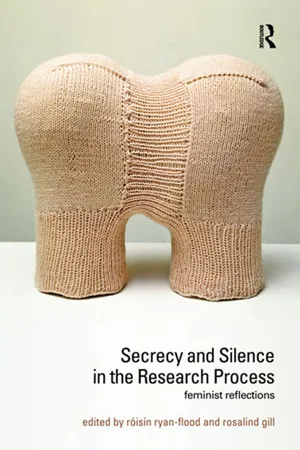
eBook - ePub
Secrecy and Silence in the Research Process
Feminist Reflections
- 336 pages
- English
- ePUB (mobile friendly)
- Available on iOS & Android
eBook - ePub
Secrecy and Silence in the Research Process
Feminist Reflections
About this book
Information
Part I
Interpreting and theorising
silence
1 Choosing silence
Rethinking voice, agency and women's
empowerment
empowerment
Jane L. Parpart
Introduction
Voice, or the act of speaking out, is often identified in the gender and development literature, and much of the feminist literature, as one of the key conditions demonstrating women's empowerment. Indeed, while silence has its defenders (Gal 1991; Mahoney 1996),1 for most feminists women's ability to make choices and speak their mind has been seen as proof of agency and empowerment (Gilligan 1982; Olsen 2003 [1978]), while silence has been deplored as ‘a symbol of passivity and powerlessness’ (Gal 1991: 175). The language of choice/voice also frames the thinking and writing about women's agency and empowerment produced by development scholars, policy-makers and practitioners. Women who cannot speak out are seen as disempowered, unable to act and to effect change. The search for empowerment has thus become a search for women's voices, particularly the moments when women demonstrate agency2 by speaking out against patriarchal authority (Kabeer 1999).
While keenly aware that a willingness to speak out and name oppressions and oppressors is a critical factor for challenging injustices, especially gendered injustices, I believe the assumption that voice equals agency needs to be rethought. The literature on women's empowerment, with its emphasis on voice and agency, is embedded in neo-liberal assumptions that individuals who speak hard truths will be protected by international and national institutions devoted to democracy, freedom of speech and human rights (Bishai 2004). Yet these assumptions are hard to sustain in a world where challenges to women's advancement and gender equality abound and where the World Health Organization warns of an epidemic of violence against women in ‘private’ and ‘public’ life (WHO 2002; UNRISD 2005). In such a world, can we assume that masculinist privilege can always be openly challenged?3 Do we need to consider other forms of voice/agency/empowerment? Can silences and secrecy be legitimate and even empowering strategies for dealing with difficult situations?
This chapter argues that the uncritical identification of silence with dis-empowerment, and voice with agency/empowerment, so common in the gender and development literature (Cornwall and Brock 2005), as well as much of the wider feminist literature, dismisses and obscures the potential of many subtle strategies attempting to improve women's lives and to foster gender equality. The chapter explores the possibility that silences and secrecy may be essential strategies for negotiating gender relations (Kandiyoti 1998; Mohammed 2002), and considers the ethical, analytical and methodological implications of researching and writing about silence/secrecy as empowered choices/agency for women in an often masculinist, dangerous and conflict-ridden world.
Agency/voice/empowerment and development
Empowerment, particularly women's empowerment, has not always been regarded as a development issue. Initially associated with the critical thinking of educationalists such as Paulo Freire (1970), empowerment was seen as a tool for the liberation of the poor and marginalized, particularly women. While initially dismissed by mainstream development agencies as a minor sideshow to the real issues — economic growth and modernization — the failures of neo-liberal solutions, particularly structural adjustment programmes, encouraged a search for new solutions. By the 1990s, empowerment had moved into mainstream development discourse, affirmed by the 1995 Beijing United Nations conference on women, and supported by the United Nations and other key development agencies (UNDP 2003; Batliwala 2007).
Despite the notoriously slippery character of the term, a core set of assumptions/definitions about empowerment emerged, with an emphasis on the ability to choose, act and speak out. The UK Department for International Development (DFID) defines empowerment as ‘individuals acquiring the power to think and act freely, exercise choice, and to fulfil their potential as full and equal members of society’ (2000:11; Smyth 2007: 584). In a similar tone, Naila Kabeer, a well-known development scholar, argues that ‘[t]o be disempowered means to be denied choice, while empowerment refers to the processes by which those who have been denied the ability to make choices acquire such an ability’ (2005: 13). The ability to voice concerns and to exercise choice in ways that challenge patriarchal power thus became the litmus test for ‘true’ empowerment (Cornwall and Brock 2005: 1055; Kabeer 2005: 13–16).4
The tone of this literature has been optimistic, even triumphalist; gender equality and women's empowerment are framed as laudable and reachable goals — encouraged by technical ‘fixes’ such as gender mainstreaming (GM) and micro-credit schemes. Women who fail to speak out and challenge masculinist power structures are portrayed as disempowered failures. The persistent, deeply held resistances to gender equality and women's empowerment are rarely discussed, despite repeated failures to achieve either of these goals (Heyser 2005; Rao and Kelleher 2005); nor is the fact that openly voicing dissent and opposition is often dangerous and even suicidal for many women (and men). Clearly new ways of thinking about agency and voice are needed, ones that take into account the many subtle forms of agency required to cope with an increasingly dangerous world.
The limits of voice: silence as a survival strategy
As we have seen, the discourses of gender equality and empowerment have focused on women's ability to make choices, to speak out, to choose and to challenge established gender hierarchies. This is understandable given development agencies' commitment to solving the problems of poverty, conflict and inequality, especially through expanded individual freedoms and democratic processes. Yet in many situations, particularly conflict and post-conflict zones as well as societies characterized by deeply masculinist practices, widespread criminal activities and gender violence, the choice to publicly challenge the powerful is often extremely dangerous and even foolhardy. Indeed, as Everjoice Win concludes for Zimbabwe, ‘[a]s any woman in a violent situation will tell you, there are no prizes for speaking out. If anything, you are ostracized by your own family and community. You are branded a bad woman, or worse, you are violated all over again for daring to open your mouth’ (2004: 76). Often personal survival is all one can seek, especially in a subverted state with no active civil society (Chan 2005: 372). At the same time, choices and actions are made, if not in easily recognizable forms. As the WHO study on health and violence points out:
Most abused women are not passive victims. … Some women resist, others flee, while others attempt to keep the peace by giving in to their husbands' demands. What may seem to an outside observer to be a lack of positive response by the women may in fact be a calculated assessment of what is needed to survive in the marriage and to protect herself and her children.(2002: 95)
How do we understand women's agency and empowerment in an increasingly dangerous and often sexist world, particularly given the widening gap between poor and rich, the rise in civilian casualties in conflict and post-conflict societies and the world-wide increase in crime, gender-based violence and health risks? Wars, of course, have long been sites of violence against women. The supposed ‘civility’ legislated by the rules of engagement and codes of war in interstate conflicts has never stopped gender-based violence during war, and while some men suffer as well, most sexual violence in war is perpetrated by men against women, particularly rape. Indeed, both domestic violence and sexual violence generally increase in militarized societies, especially during wars (Enloe 1993: 127; Kelly 2000). The diary of a German woman caught in the Russian occupation of Berlin towards the end of World War II reveals the limits of voice in war conditions. Rape became an everyday experience, undermining women's sense of security and personhood. The threat of starvation, housing and safety soon drove many women, including the author, into the arms of Russian soldiers. The women she knew ‘reached an unspoken agreement — all of a sudden no one is bringing up “that subject”’ (Anonymous 2005: 18). Thus silence became a survival strategy for dealing with the horrors of rape and war. While shared moments discussing private traumas provided some solace, survival depended largely on learning to seal off feelings, to negotiate better conditions for sex and just keeping going (ibid.; Bletzer 2006). Speaking out was not an option; judicious silence was a key survival strategy in a dangerous and brutal world — a strategy that may not have changed conditions but did promote/enable healing and allowed some women to carry on.
Since the end of the Cold War, conflicts have become even more deadly, particularly for civilians. Often led by warlords and other adventurers, these new wars are sustained through terrorizing and looting civilians while also benefiting from global economic connections, both legal and illegal. Fought largely by young disaffected, under- and unemployed young men who see war as a way to gain prestige and money, and led by men seeking enrichment and power, these new wars are characterized by a strong, often adolescent sex-ualization of violence, ‘ranging from almost daily orgies or veritable strategies of rape through to the ever more common mutilation of victims and the displaying of body parts as trophies’ (Munkler 2005: 14–15; Kaldor 2001). Rape as an act of war continues to be a way to humiliate their male opponents by symbolically (and physically) ‘marking’ enemy women's bodies with semen and physical domination. Group rape is frequent, providing an opportunity to assault enemy women while also performing loyal masculinity to one's comrades (Kelly 2000). Indeed, rape camps in Bosnia were vehicles for educating/training reluctant soldiers in the practices of violence (Kaldor 2001: 44–53). Sexual violence is thus one of the key characteristics of the new wars around the world, with Liberia, Sierra Leone and Rwanda being particularly gruesome examples (Dolan 2002; Pederson 2008). For most women direct confrontation risks swift and terrible revenge. As in Berlin, silence and secrecy have been one of the few choices for negotiating survival. Even deliberate attempts to thwart authorities, such as girls' education under the Taliban, have only survived under conditions of strict secrecy (Hans 2004: 235; Armstrong 2002; Povey 2004).
Post-conflict societies have often proven little better for women and girls. Even the transition to peace has often been marked by increased sexual violence. In Liberia, both government and rebel forces engaged in a ‘frenzy of rape’ during the ‘transition to peace’ (African Women and Peace Support Group 2004). Yet, little has been done to address the epidemic of sexual violence characterizing many post-conflict societies, particularly when it has been and is being perpetrated by the new ‘heroes of the nation’ (Kelly 2000; Silber 2005; Jones 2008). Despite a supportive constitution and a significant female presence in parliament, post-apartheid South Africa has one of the highest rape rates in the world (du Toit 2005). Moreover, the much praised Truth and Reconciliation Commission for the most part ignored evidence of sexual violence (Goldblatt and Meintjes 1998), and young men continue to believe women out alone after dark are ‘asking to be raped’ (field notes, Cape Town 2006). In Rwanda, many rape survivors are trying to rebuild their lives in communities with the very people who raped them. ‘There is little judicial redress and little sympathy from others’, who blame them for choosing rape over death (Kelly 2000: 55). Sexual violence continues, often carried out by current government forces (Twagiramariya and Turshen 1998). Despite their key role in the peace process, and a woman president, post-conflict Liberia is experiencing an epidemic of violent rapes, particularly of young girls (Jones 2008; Pedersen 2008).
Many women and children have fled war and post-conflict zones,5 yet refugee camps have provided disappointingly little protection. Sexual violence, particularly rape, is a common occurrence. Many refugee camps have become caught up in the new wars, inadvertently providing food and supplies as well as sex for marauding ‘warriors’. Even the camp administrators and peacekeepers demand sexual favours. For many women refugees, sex has become one of the few commodities they can ‘sell’ for survival. Yet such activities are widely censured; once again, silence and secrecy are weapons for survival (WHO 2002; Hyndman 2004; Munkler 2005). Even applicants for political asylum often experience sexual violence, but tend to deny it publicly, both to deal with the trauma and to minimize the consequences of disclosure (Crawley 2000: 93).
Sexual violence, particularly rape, threads through all these stories. The development literature on women and empowerment urges rape victims to become empowered by speaking out, taking their persecutors to court and obtaining retribution. Yet this ‘solution’ has largely been empty rhetoric given the trauma of rape, the unreliability of police and courts and the widespread, entrenched cultures supporting sexual violence. In post-conflict Yugoslavia and Rwanda, for example, women have been encouraged to take their assailants to court, but no provisions have been made to protect them. Not surprisingly, most women have chosen to exercise agency ‘by choosing to remain silent’ (Kelly 2000: 54; Twagiramariya and Turshen 1998). An UNRISD study concluded that ‘Somali women do not confess to having been raped because social rejection and divorce will follow’ (2005: 215). South African rape victims are often reluctant to speak out in public (du Toit 2005). Public disclosure is particularly dangerous in societies where honour killing is the norm (Mojab 2004). For example, in 2002 almost half the women raped in Alexandria, Egypt, were killed by a relative after a rape (WHO 2002: 93). Thus, given the high cost of disclosing rape or sex with the enemy, the decision to remain silent cannot be dismissed simply as disempowerment. Indeed, silence and secrecy offer one of the few possibilities for rebuilding lives and renegotiating gender relations, if often in precarious, highly militarized contexts. Silence can also provide a private space to deal with trauma, to regain self-esteem and to build a sense of empowerment in an often...
Table of contents
- Cover Page
- Half Title page
- Transformations: Thinking Through Feminism
- Title Page
- Copyright Page
- Contents
- Notes on contributors
- Foreword
- Acknowledgements
- Introduction
- Part I Interpreting and theorising silence
- 1 Choosing silence Rethinking voice, agency and women's empowerment
- 2 Forms of knowing and un-knowing Secrets about society, sexuality and God in Northern Kenya
- 3 Unknowable secrets and golden silence Reflexivity and research on sex tourism
- 4 The desire to talk and sex/gender-related silences in interviews with male heterosexual clients of prostitutes
- 5 Silencing accounts of silenced sexualities
- Part II The unspoken in the research process
- 6 Silencing differences The “unspoken” dimensions of “speaking for others”
- 7 Not telling it how it is Secrets and silences of a critical feminist researcher
- 8 Critiquing thinness and wanting to be thin
- 9 Inside ‘doorwork' Gendering the security gaze
- 10 Raising the curtain on survey work
- Part III Silence, secrecy and telling research stories
- 11 Avoiding the ‘R-word' Racism in feminist collectives
- 12 Suppressing intertextual understandings Negotiating interviews and analysis
- 13 Dirty work Researching women and sexual representation
- 14 Keeping mum Secrecy and silence in research on lesbian parenthood
- 15 Silenced by law The cautionary tale of women on the line
- Part IV Affective dilemmas
- 16 Animating hatreds Research encounters, organisational secrets, emotional truths
- 17 Breaking the silence The hidden injuries of the neoliberal university
- 18 Silence and secrets Confidence in research
- 19 Shameful silences Self-protective secrets and theoretical omissions
- 20 Living in the real world? What happens when the media covers feminist research
- 21 The place of secrets, silences and sexualities in the research process
- Index
Trusted by 375,005 students
Access to over 1.5 million titles for a fair monthly price.
Study more efficiently using our study tools.
Frequently asked questions
Yes, you can cancel anytime from the Subscription tab in your account settings on the Perlego website. Your subscription will stay active until the end of your current billing period. Learn how to cancel your subscription
No, books cannot be downloaded as external files, such as PDFs, for use outside of Perlego. However, you can download books within the Perlego app for offline reading on mobile or tablet. Learn how to download books offline
Perlego offers two plans: Essential and Complete
- Essential is ideal for learners and professionals who enjoy exploring a wide range of subjects. Access the Essential Library with 800,000+ trusted titles and best-sellers across business, personal growth, and the humanities. Includes unlimited reading time and Standard Read Aloud voice.
- Complete: Perfect for advanced learners and researchers needing full, unrestricted access. Unlock 1.5M+ books across hundreds of subjects, including academic and specialized titles. The Complete Plan also includes advanced features like Premium Read Aloud and Research Assistant.
We are an online textbook subscription service, where you can get access to an entire online library for less than the price of a single book per month. With over 1.5 million books across 990+ topics, we’ve got you covered! Learn about our mission
Look out for the read-aloud symbol on your next book to see if you can listen to it. The read-aloud tool reads text aloud for you, highlighting the text as it is being read. You can pause it, speed it up and slow it down. Learn more about Read Aloud
Yes! You can use the Perlego app on both iOS and Android devices to read anytime, anywhere — even offline. Perfect for commutes or when you’re on the go.
Please note we cannot support devices running on iOS 13 and Android 7 or earlier. Learn more about using the app
Please note we cannot support devices running on iOS 13 and Android 7 or earlier. Learn more about using the app
Yes, you can access Secrecy and Silence in the Research Process by Roisin Ryan-Flood, Rosalind Gill, Roisin Ryan-Flood,Rosalind Gill,Róisín Ryan-Flood in PDF and/or ePUB format, as well as other popular books in Social Sciences & Anthropology. We have over 1.5 million books available in our catalogue for you to explore.