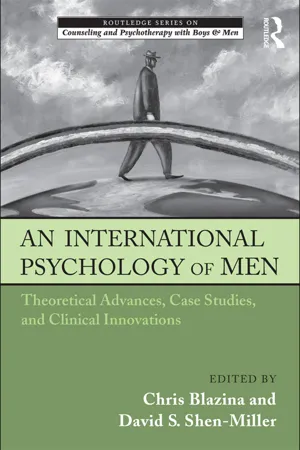
This text is the first to provide a contextual understanding of the clinical issues that affect men and masculinity across a wide range of cultural and national settings. It demonstrates that gender can no longer be viewed as an isolated characteristic; in an era of increased globalization, mental health professionals need to take ethnic and cultural issues into account to provide adequate care for male patients. Numerous international perspectives are offered by the contributing authors, authorities from countries such as Australia, Argentina, Denmark, Canada, India, Ireland, and South Africa, on theoretical and clinical innovations for working with men. Their chapters also offer insight into the socio-cultural contexts for counseling men in and from their respective countries by exploring the ways in which "being a man" is socially defined, what unique challenges men face, and how these challenges can be negotiated within their specific cultural settings. Topics addressed will include boyhood notions of manhood, relationship concerns and power, fatherhood, and men's body image across the life span. This text will ultimately enable mental health practitioners to have a better understanding of how to work more effectively with male clients.
eBook - ePub
An International Psychology of Men
Theoretical Advances, Case Studies, and Clinical Innovations
- 453 pages
- English
- ePUB (mobile friendly)
- Available on iOS & Android
eBook - ePub
An International Psychology of Men
Theoretical Advances, Case Studies, and Clinical Innovations
About this book
Information
SECTION I
Theoretical Models
CHAPTER 1
Masculinity Competency Typology for Men Who Migrate
WILLIAM MING LIU and SAMUEL J. SHEPARD
When I (Liu) taught Asian-American studies, most students taking the course were first-generation Asian-American college students from various ethnic groups. Korean, Chinese, Asian Indian, Cambodian, Thai, and Vietnamese students came together to discuss common histories as well as significant contemporary issues. We discussed topics that ranged from interracial dating to hate crimes to racial identity and acculturation. Racialization, the process by which individuals are ascribed racial and ethnic identities that may not refl ect their actual ethnic heritage but rather dominant sociopolitical pressures, was often a fertile issue. Often, when we discuss how Asian Americans are racialized in the United States, the students would start to discuss their personal experiences of traveling abroad.
What was remarkable for many students when they traveled to their native countries was the extent to which they did not fit in or identify with their country of heritage. They believed before their first encounter that they would feel an affi liation and identification with those in their native country simply because they shared a similar ethnic identity, such as Korean or Taiwanese. Yet for many of the students, they found themselves identified as “American” and therefore not of the native country, and as a result they were treated in a similar manner to any other person traveling through the country.
While there were some similar experiences across genders, there were also some differences. In particular, with the men, I wondered how they were identifi ed as American. When I posed the question, the students responded that natives in the country recognized a distinctly different way Americans dressed, regardless of race or ethnicity. Being that American-made products are highly prized in countries abroad, an individual clothed from head-to-toe in American clothing was either a sign of great wealth or an American. Related to dress was an American aesthetic in how clothing was worn, which refl ects delicate cues and norms only apparent to those who are immersed in American culture.
But clothing was only the first indicator. The men often remarked that their posture was different than those in the native countries. “Americans stand straight-up and carry with them a sense of wanting to be recognized,” said one student. Seeking and expecting personal recognition of course is practically an anathema in Asian countries which prize collectivism, conformity, and humbleness. “It’s also the way we talk—we can be pretty loud no matter the situation,” said another Asian-American man.
For all the students relating these experiences, I asked what it was like to be a man or woman in these countries. The men described how their internal sense of masculinity really did not change much, but they did fi nd themselves sometimes taking on new behaviors of the native men. Culturally congruent ways of eating and dining, relating to elders, and communication styles with men and women were sometimes adopted. Many of the Asian-American men compared their physical stature to those in the native country, and usually the Asian-American men were taller and larger. This physical difference was described as a way of feeling “more masculine” than the natives.
These ways of being American indelibly marked the Asian-American men as “American” (not-native) even though in the United States, the term and description of American is usually reserved for racially White individuals (Devos & Banaji, 2005). These Asian-American men acknowledged that they struggled with their racial, ethnic, and national identity as American since they did not belong to those in their country of origin, and as racialized minorities in the United States, they were not afforded all the privileges of White men. They were left to negotiate between sometimes competing identities and roles (Iwamoto & Liu, 2009; Liu & Chang, 2006). As men who were Asian American who had traveled to their country of origin and found themselves ascribed to similar roles and positions as White visitors, they were challenged to acculturate to the host country similar to other foreign travelers. As men, it was unclear to them how to be masculine in this host country. Were they to continue and hold on to their American masculinity or attempt to adapt and enculturate and subscribe to a culturally congruent form of masculinity that may or may not be consonant with the ways they had been socialized as men? These questions arising from the initial points of contact for men who travel to other countries is the focus of this chapter.
The second author of this chapter (Shepard) has experienced firsthand some of the difficulties of transitioning to a new culture. When I was 10 years old, my family and I moved from the United States to Spain. At the time, I had a pretty good sense of what was expected of me as a 10-year-old male in America and felt I had navigated these expectations fairly successfully. In this new culture, however, I initially found that meeting my culture’s standards of young manhood would be more dif-fi cult. For instance, in America I had played in a local soccer league with my friends. I was an average player, by no means outstanding, but to not have been a contributing member of my soccer team back home would have threatened my sense of young manhood. In Spain, as I would soon learn, they took soccer much more seriously than we did in America. On my first day of school I played soccer at recess, and to say that I was the worst player on the fi eld would have been a compliment. My skills were pathetic compared to the boys in Spain, and I had gone from being an average soccer player in America to a terrible soccer player abroad. Moreover, by my American schoolyard cultural standards, the inability to be competitive at a sport was defi nitely not “manly.”
Adjustment to life in Spain extended beyond soccer, of course. In retrospect, the language barrier was probably the most difficult everyday obstacle, as it was difficult to order and pay for even simple things like fast food on my own. But the dominant theme of the adjustment process was that I was simply not as competent at navigating through this environment as I had been in my home country. Also, as a young American man, being competent and independent were extremely important to me. Where I came from, needing your mother to order for you at McDonald’s would defi nitely have qualifi ed as “sissy stuff.”
These personal examples suggest to the authors that masculine gender role norms are an important aspect of men’s adjustment to international travel and migration. Currently, there is a scarcity of empirical or theoretical frameworks to understand how men negotiate their masculinity as they move from one geographic context to the next. This chapter will begin to address this lack of theory. First, research on masculinity and male gender role norms in the United States will be reviewed. Then, theories on acculturation, assimilation, and bicultural-ism will be examined. Finally, we propose a typological framework titled Masculine Competency, which will be used to explore and understand men’s experiences as they travel in and out of the United States.
MASCULINITY IN THE UNITED STATES
Masculinity in the United States has always been conflated with race and class (Liu & Chang, 2006). Dominant masculinity, frequently used synonymously with hegemonic masculinity, has meant the cultural normalization of one kind of man and masculinity. In the United States, normative masculinity is White, and it is a cultural standard to which other men aspire. Yet for men of color, this confounding of race, class, and gender that privileges one group of men has often meant a tenuous negotiation of masculinity that is largely predicated on norms and expectations that have historically excluded men of color (Liu, 2005).
In this chapter, we begin with the premise that masculinity in the United States is a refl ection of how the United States, as a nation, wants to be and is likely perceived by non-Americans. That is, it is important to discuss a “national” masculinity; since when men describe themselves as men or masculine, implicit in this articulation is the deployment of a particular culture’s norms and standards of masculinity. In the United States, this normative masculinity has been historically conferred, even before the founding of the original colonies, on one group of wealthy White men (Harris, 1993; Jacobson, 1998; Kimmel, 2005a, 2005b; Nelson, 1998; Roediger, 2005). Conferring and codifying privileges to one group of men meant that masculinity was conflated with Anglo, wealthy, land-owning men who had volition in policy, voting, marriage, sex, progeny, and legacy. Men of color, typically, were the deviant groups who were described in detail with respect to their sexuality, poor intellect, and abnormal culture (Kimmel, 2005a, 2005b); normative White masculinity was undefi ned but was assumed to be almost anything that was not the deviant (Said, 1979).
Given that socioculturally and sociohistorically dominant, normative, and hegemonic masculinity in the United States (hereafter synonymously used with American) was largely undefi ned and unarticulated, what does it mean for a man to be an American man when he changes his geographic context? How might we understand American masculinity in these changing geographic contexts? What can we learn from current psychological theories, and what is missing?
For over 30 years, psychology research in the fi eld of men and masculinity in the United States has endeavored to describe the construction of masculinity in the United States, as well as the consequences of this brand of masculinity on men, women, and society. One of the first taxonomies of traditional American masculine norms was completed by David and Brannon (1976). This explication of the ideology of masculinity in the United States is important since these masculine “beliefs” reflected the supposed history of men as great pioneers, capitalists, and strong and stoic builders of America. The authors described four core requirements of American masculinity: “no sissy stuff,” “the big wheel,” “the sturdy oak,” and “give ‘em hell.” The first aspect, “no sissy stuff,” refers to the idea that men should avoid anything considered feminine. “The big wheel” is meant to describe the importance that men should place on success, status, and achievement. As “sturdy oaks,” men should be self-reliant and stoic. As a result, men should not show signs of weakness, including emotions such as sadness or fear. Finally, men should adopt the attitude of “give ‘em hell,” meaning that men should value aggression and risk-taking, even in the face of potential harm or peril.
Current theories of masculinity have expanded on and dissected these four aspects of masculinity to create new categories and descriptions of male gender role norms. However, these basic tenets remain central to current theories of masculinity in the United States. These current theories have examined endorsement of male role norms (Levant et al., 1992), gender role conflict (O’Neil, Helms, Gable, David, & Wrightsman, 1986) conformity to masculine norms (Mahalik et al., 2003), and male reference group identity dependence (MRGID) (Wade, 1998). Each of these theories has led to the development of a measure intended to assess each construct. As a result, each theory will be reviewed in concert with its accompanying assessment tool.
Theories about masculinity have changed and evolved. Depending on the historic and social context, the standards of masculinity have been either valorized or condemned (Coltrane, 1994). As masculinity’s definition evolves, men adapt as well by “changing behavior, by changing their perceptions of gender role norms or by disengaging from them, or by changing their reference group” (Pleck, 1995, p. 14). As codes of masculinity change, as men fi nd new ways to adapt to these changes, and as new masculinities are created, different avenues of approaching the study of masculinity have been used. Today, the theories used to understand contemporary masculinity contain frameworks and artifacts from previous critiques.
The application of feminist analysis and methodologies has been used to understand American masculinity (Coltrane, 1994). Feminist analysis examined the norms of masculinity such as status seeking, toughness, and antifemininity (Thompson & Pleck, 1995). Another part of feminist analysis and critique was an analysis of power in relationships and how power is reproduced in society to favor certain groups and people (e.g., White men) over other groups. By examining the masculine mystique, or the “values and beliefs that defi ne optimal masculinity in a given society . . . [which] are based on unproven sex differences and sex role stereotypes that are assumed to have value but may have negative outcomes for men, women, and children” (O’Neil, 1981, p. 64), men were challenged to “avoid reproducing patriarchal consciousness . . . [and consider] the ways that men create and sustain gendered selves with the ways that gender influences power relations and perpetuates inequality” (Coltrane, 1994, pp. 43–44). As a result of using a feminist approach, a set of theories about masculinity in America developed with the common link of critiquing masculinity and examining the ways men understand themselves in relation to others and society.
In general, the theories examined the masculine standards in society and the belief, among many men, that living up to these expectations would be easy and without incongruencies or contradictions (Mosher & Tompkins, 1988). Some aspects of masculinity can be conceptualized as positive attributes, such as putting one’s family first, protecting and taking care of others, and being loyal and dedicated (Levant, 1996). However, as men attempted to live up to all the masculine expectations, and as they were socialized into the dominant culture’s defi nition of masculinity, psychological strain resulted from their attempts to fulfill these expectations. Feminist discourse provided masculinity theorists with a tool to investigate the psychological strain and coping mechanisms of men within a society that demanded compliance.
Pleck (1995), in response to the strain that men were experiencing, proposed three types of strain related to fulfi lling masculine expectations: discrepancy strain, dysfunction strain, and trauma strain. In discrepancy strain, the person “fails to live up to one’s internalized manhood ideal” (Levant, 1996, p. 261). Inventories such as the Male Gender Role Conflict Scale (GRCS; O’Neil et al., 1986) and the Masculine Gender Role Stress (MGRS; Eisler & Skidmore, 1987) reflect this type of gender role strain. Dysfunction strain describes someone who fulfi lls the expectations of contemporary masculinity, but experiences negative effects because the expectations for men are often psychologically toxic (Levant, 1996). Some of the toxic effects of fulfi lling masculine expectations include (a) violence, especially spousal abuse, rape, and sexual assault; (b) promiscuity and “sexual excess” (Levant, 1996, p. 262); (c) irresponsible actions such as drug and alcohol abuse, and risk-taking behaviors; and (d) problematic relationships (Brooks & Silverstein, 1995; Levant, 1996). Finally, trauma strain refers to the “male socialization process . . . which is recognized as inherently traumatic” (Levant, 1996, p. 261). The result of this traumatic socialization is estrangement from their affective life, and development of sexual feelings and attitudes toward women to replace “caring emotions” (Levant, 1996, p. 263). The objectifying attitudes toward women also refl ect an impaired ability of men to achieve emotional intimacy with women (Brooks, 1998). Through these three types of strains, Pleck (1995) provided a developmental profi le of masculine experiences that men struggle through and the dysfunctional relational patterns that result from adherence to society’s masculine expectations.
In measuring masculinity, Thompson and Pleck (1995) found that most inventories tap either into (a) ideologies about masculinities or (b) the way men experience their gender. Many of the measures also approach the study of masculinity either through the trait or through the normative perspective (Thompson & Pleck, 1995). The trait perspective posits a real gender difference between men and women that makes gender orientation possible, since masculinity becomes an “individual property” (Thompson & Pleck, 1995, p. 130). Within the trait perspective, the individual either has the masculine attribute or is deficient. The normative perspective assumes no actual gender difference, but instead assumes that there is a socially desirable masculine ideal with concomitant gender-specific characteristics, which men either endorse or deny (Thompson & Pleck, 1995). Research on normative aspects of masculinity has focused on the different cultural manifestations of masculinity, the social and cultural...
Table of contents
- Cover Page
- Half Title Page
- The Routledge Series on Counseling and Psychotherapy with Boys and Men
- Title Page
- Contents
- Series Editor’s Foreword
- Foreword
- Editors
- Contributors
- Introduction
- Section 1 Theoretical Models
- Section 2 Masculinity, Sexuality, Health Behaviors, and Body Image
- Section 3 Clinical Innovations and Programs for Men
- Index
Trusted by 375,005 students
Access to over 1.5 million titles for a fair monthly price.
Study more efficiently using our study tools.
Frequently asked questions
Yes, you can cancel anytime from the Subscription tab in your account settings on the Perlego website. Your subscription will stay active until the end of your current billing period. Learn how to cancel your subscription
No, books cannot be downloaded as external files, such as PDFs, for use outside of Perlego. However, you can download books within the Perlego app for offline reading on mobile or tablet. Learn how to download books offline
Perlego offers two plans: Essential and Complete
- Essential is ideal for learners and professionals who enjoy exploring a wide range of subjects. Access the Essential Library with 800,000+ trusted titles and best-sellers across business, personal growth, and the humanities. Includes unlimited reading time and Standard Read Aloud voice.
- Complete: Perfect for advanced learners and researchers needing full, unrestricted access. Unlock 1.5M+ books across hundreds of subjects, including academic and specialized titles. The Complete Plan also includes advanced features like Premium Read Aloud and Research Assistant.
We are an online textbook subscription service, where you can get access to an entire online library for less than the price of a single book per month. With over 1.5 million books across 990+ topics, we’ve got you covered! Learn about our mission
Look out for the read-aloud symbol on your next book to see if you can listen to it. The read-aloud tool reads text aloud for you, highlighting the text as it is being read. You can pause it, speed it up and slow it down. Learn more about Read Aloud
Yes! You can use the Perlego app on both iOS and Android devices to read anytime, anywhere — even offline. Perfect for commutes or when you’re on the go.
Please note we cannot support devices running on iOS 13 and Android 7 or earlier. Learn more about using the app
Please note we cannot support devices running on iOS 13 and Android 7 or earlier. Learn more about using the app
Yes, you can access An International Psychology of Men by Chris Blazina, David S. Shen-Miller, Chris Blazina,David S. Shen-Miller in PDF and/or ePUB format, as well as other popular books in Social Sciences & Mental Health in Psychology. We have over 1.5 million books available in our catalogue for you to explore.