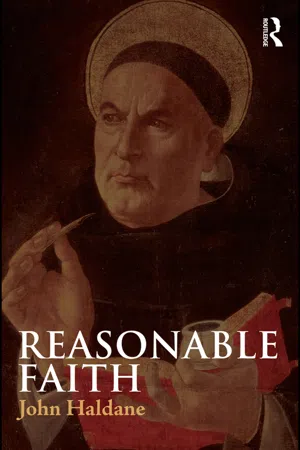
In this awaited follow up to his book Faithful Reason, the well-known philosopher and Catholic thinker John Haldane brings his unrivalled insight to bear on questions of the existence of God and the nature and destiny of the human soul. His arguments weave elements drawn from philosophy of mind, epistemology and aesthetics, together with recurrent features of human experience to create a structure that simultaneously frames and supports ideas such as that the cosmos is a creation, human beings transcend their material composition, and that human fulfilment lies beyond death. As in many of his other writings this volume blends themes from Aquinas with insights drawn from analytical philosophy and further establishes John Haldane as the leading 'analytical thomist'.
- 212 pages
- English
- ePUB (mobile friendly)
- Available on iOS & Android
eBook - ePub
Reasonable Faith
About this book
Information
Part I
Reason, faith and God
Chapter 1
Introduction: the prospects for religious philosophy
Philosophy is questions that may never be answered. Religion is answers that may never be questioned.
Anonymous, cited by Daniel Dennett, Breaking the Spell1
Introduction
In following chapters I shall be elaborating the terms of a metaphysical system based on the thought of Thomas Aquinas (1225–74) and presenting arguments in favour of theism. I shall also be exploring issues concerning the human soul, its origins and destiny, and discussing aspects of value: spiritual, aesthetic and moral.
I begin, however, with a chapter that is not an exercise in metaphysics, value theory or philosophical theology, let alone a linear argument to a particular conclusion in support of theism, though I shall refer appreciatively to Aquinas’s epistemology and natural theology. Rather I wish to open with a set of reflections on the theme of the relation in contemporary thought of religion to philosophy. In very broad terms this might perhaps be conceived of as another attempt to traverse the terrain between the two peaks of faith and reason, but I suggest it may be more apt to think of it as an effort at reorientation in a changing cultural and intellectual landscape.
For his 1999 Edinburgh Gifford Lectures, Charles Taylor chose the theme Living in a Secular Age. He described his project as follows: ‘I want to examine what it means to live in a secular age … Put simply: why was it so difficult – almost impossible – not to believe in God in 1500, while in many milieu today that is easy, and it is often faith which is hard?’ In 2007 Taylor published a book derived from the Gifford’s and readers are now in a position to consider the details of his answer to that question.2 Those already familiar with his previous major work Sources of the Self 3 will not be surprised, however, to learn that his examination takes the form of looking at the history of ideas and the ways in which those ideas shape, and are shaped by, social practices and institutions.
There is, of course, an implied context in all of this – one with which all readers will be familiar, though it is not easy to specify it. Taylor has in mind, principally, liberal democratic Western societies. As we know, however, there are many hundreds of millions of religious believers throughout the world and many of them live in Europe and North America in the midst of what is held to be postmodern secularity. Even so, the suggestion of a felt difficulty of belief in an intellectual milieu is certainly worth exploring. My own interest is related to this, but I am concerned with the exclusion or the ‘silencing’ of religion within philosophy rather than with its general absence from intellectual culture.
In general terms philosophy is now more widely practised and studied than ever before, and readers may be surprised at the suggestion that religion is excluded or silenced within a discipline that historically was closely aligned with it. Admittedly late-twentieth and early-twenty-first-century philosophy is neither narrowly a priori nor extensively verificationist, confining meaningfulness to what can be empirically tested. Nevertheless, religion has become an unwelcome presence and efforts to introduce it are generally resisted. I write this notwithstanding the rise of philosophy of religion and philosophical theology, and the fact that among those interested in fashioning a large-scale view of reality and of the human condition there is often a personal interest in religious ideas, as is the case with Charles Taylor. Further examples of this, to whose ideas I will return, include Michael Dummett, Hilary Putnam and Nicholas Rescher.
Compare and contrast
To begin with it may help to highlight this exclusion by contrasting religion with another and analogous department of thought and practice, namely morality.
For reasons largely to do with the expansion of the profession, area specialization, and the development of publication-based research and scholarship assessment, there is now a vast amount of philosophy available to be read. To give but one example, thirty years ago a single individual might have kept abreast of publications in the area of English-language moral philosophy. This would have involved his or her reading half a dozen monographs, a couple of edited collections and perhaps thirty articles per annum. Nowadays, the very idea of reading everything of quality that appears in print is absurd. For one thing, very much more is published, for another (and more significantly) what appears is thematically and methodologically too diverse to constitute a single subject matter. Let me develop this point since it raises issues relevant to the theme of the exclusion of religion.
Moral philosophy is practised extensively at three levels: first, as meta-ethics, second as moral theory, and third as normative or first-order ethics. Those currently engaged in the first of these favour a variety of approaches involving, variously, epistemology, philosophy of language, philosophical logic, metaphysics and philosophy of mind, and they advocate a series of positions from quasi-Platonic realism to eliminativism, taking in along the way non-realist-objectivism, non-objective cognitivism, reductive and non-reductive naturalisms, expressivism, and error theory. Moral theorists focus on the structure of moral reasoning or justification (or apparent reasoning and justification) and currently offer a wide range of consequentialist, deontological and virtue-based options, in either universalist or particularist versions, and with or without internalist or externalist moral psychologies.
The very fact that first-order moral problems are now considered appropriate business for philosophy, itself marks a contrast with the first half of the twentieth century. It is not so long ago that, feeling the need to illustrate the sort of thing whose meta-theory was held to be the only proper business for analysis, a philosopher would indicate the subject matter of morality by considering the dilemma of one forced to choose between a family picnic and college business; or, moving from the sublime to the ridiculous, that of one who could save the lives of many millions by killing a single individual. Now, by contrast, many philosophers work exclusively on such issues as the legitimacy of war and terrorism, reproduction, abortion and euthanasia, parents and children, capital and other punishment, torture, state compensation, sexual perversion, prostitution, pornography, blackmail, lying and gossip, and a multitude of other practical realities great and small.
The situation is further complicated by the diversity of methods and approaches. Where once the first and often only task was to achieve clarity, philosophers now seek conclusions and solutions; and to that end they deploy a number of non-deductive strategies. At the level of moral theory, for example, there is a fashion for using the method of reflective equilibrium in combination with avowed or concealed ‘intuitions’ about particular values and norms. It is no accident that this fashion emanates from the United States for, like the currently favoured use of indispensability arguments (reasoning of the form: if reference to Fs is indispensable in our thinking, then nihilism about Fs is excluded), it derives its rationale from a basic philosophical pragmatism.
This constitutes one kind of departure from the standpoint of pure, ahistorical, decontextualized, disinterested reasoning. Another, or range of others, is represented by the adoption of theories drawn from the natural and social sciences and from cultural theory. When Gilbert Harman at Princeton and John Mackie at Oxford argued against moral cognitivism on grounds of the ‘queer’ or non-natural character that values and requirements would have to possess, they took a science-inspired view of the natural and presented it as philosophical ontology.4 Something similar has gone on as others have drawn upon history or psychology or politics to encourage the adoption of one thing or the rejection of another. When Charles Taylor and Alasdair MacIntyre write against individualism and the morality of rights and in favour of social identities and the claims of virtue, they do so in no small part by offering historical analyses and contrasts.5 The upshot is not to show that a given outlook is rationally obligatory sub specie aeternitatis, as, say, the precondition of the possibility of action; but rather to recommend one way of living over another as more attractive given who and what we are. In this context ‘we’ has to mean people of a certain time, place, disposition and sensibility. A related example is the development of feminist theorizing about the social construction of moral consciousness and the concepts that shape it. Carol Gilligan’s examination of Kohlberg’s theory of moral development led her to question the priority given to rules and principles and to suggest that it misrepresented women’s moral thinking; while Nel Noddings claimed that this priority is both male and inadequate.6
The appeal to moral consciousness and to social history has also served to reduce the gap between English-language philosophy and the traditions of phenomenology and cultural critique practised in Continental Europe and, under the influence of European thinkers, in North America. Readers of Charles Taylor, Hilary Putnam, Bernard Williams and John McDowell have become accustomed to seeing appreciative references to Ricoeur, Derrida, Nietzsche and Gadamer, as the first set of writers seek to explore the human world.7
In summary, moral philosophy has become enormously varied in its subject matter, methods of enquiry and conclusions; and it draws extensively on non-analytical traditions as well as upon non-philosophical sources not just for examples and analogies but for ideas and values. Yet the attempt to introduce religious sources into moral philosophy would genuinely be regarded as inappropriate, in fact as an embarrassment akin to the announcement by one party in a seminar discussion that ‘Jesus loves us’.
Religion as a source of philosophical ideas
I am not at all concerned to suggest that expressions of personal piety or conviction have a place akin to arguments. If someone were to cite special revelations, invoke the intercession of saints, undertake a novena or draw upon analogous religious claims and practices, then, and quite apart from any offence to current social sensibilities, that would indeed be highly inappropriate. Philosophy is concerned with what is knowable by experience and reason, and investigates the general structure of reality (metaphysics), the nature of thought (logic and epistemology), and the source and character of norms (value theory). Though not necessarily at odds with philosophical seriousness, expressions of conviction are liable to emanate from those ill-attuned to the rigours of analysis and argument, and certainly such expressions enjoy no special status when it comes to gathering evidence or marshalling reasons.
None of this, however, serves to explain or justify the fact that while academic philosophy is now hospitable to a wide variety of sources of ideas it is not generally willing to give serious attention to expressions of religious thought. For example, there is now a growing consensus that the prospect of an effective resolution of the mind–body problem along lines drawn by the late Donald Davidson and other non-reductive materialists, is diminishing. If it were to be concluded (to the extent that anything in philosophy ever is) that anomalous monism must join the other fatalities in the graveyard of mind–body theories, then we would be in the position that no option extensively entertained and explored during the second half of the twentieth century seemed viable. One response to this prospect is that advocated by Colin McGinn: to insist that some form of materialism is true but to concede that we do not, and never will, understand how it could be so.8 It is an interesting fact about the condition of philosophy that this view is coming to be taken seriously. It is in part, I believe, because many and perhaps most contemporary philosophers are just not seriously willing to allow that anything but materialism could be true. That attitude, however, forecloses, prematurely and unphilosophically, on the option of considering certain other possibilities, some of which come into view if one is willing to give serious attention to ideas drawn from religious thought.
Here I will just mention two suggestions, in both cases taken from Christianity. It is held that in the person of Jesus Christ, divine and human natures were conjoined, that Jesus died and subsequently rose from the dead, and that he later ascended into heaven. In his First Letter to the Corinthians St Paul goes on to identify the Easter event as one that prefigures our bodily resurrection. Suppose one now enquires as to what account of the nature of the mind–body relation and associated metaphysics could make sense of these ideas. It will soon be clear that neither traditional substance dualism nor contemporary physicalism is adequate, and to that extent one may concur with the secular consensus. However, retaining hold of the religious claims one will be forced to think again and this time more radically. Perhaps it is necessary to entertain the idea of phasal existence: in particular that one and the same thing can in different stages of its existence be material, quasi-material and then immaterial.9 Or again, if one is to take the Pauline notion of resurrection seriously then it may be that one has to rethink the orthodoxy that no thing can have more than one beginning of existence, or put differently and less contentiously that objects can be gap-inclusive in their histories. Straining to make sense of the religious example one may then be moved to consider that precisely this seems to be the case with many artefacts that can be dismantled and later reassembled, their component elements having been stored or put to other use in the meantime. And to the objection that what may be true of artefacts does not extend to natural substances, one may then recall that according to the religious point of view that distinction lapses, for all objects are artefacts – the Lord God having made them all.
Moral and political philosophy
Returning to the field of moral philosophy something similar might be considered. That is to say, observing first, the series of deadlocks in the meta-ethical arguments between realists and irrealists; second, the moral theoretical dispute between consequentialists and their opponents; and third, the multitude of disagreements about first-order moral questions, one might wonder whether progress may be achieved by looking to religious thought which, after all, has had most to say in human history about the conduct of life. Here, though, one is likely to be reminded of a philosophical argument which is supposed to show the irrelevance of any such appeal. According to the Euthyphro dilemma either something is good because God commands it, or God commands it because it is good. The latter disjunct immediately establishes the priority of value to any religious revelation of the fact, and the former robs us of any genuine idea of value, or at best offers a form of divine subjectivism.
This deployment of the Euthyphro represents both too quick and too superficial a rejection of the possibility of illumination from the side of religion. To begin with, if one adopts the latter disjunct a question remains of the metaphysical ground of value as it is then conceived of. Suppose, as many have, that value pertains to proper functioning and that this latter can only be understood in terms of final ends, then an argument to design looms with the prospect of a transcendental deduction of the existence of God as a condition of the possibility of value. Or again, suppose one takes value to be proximately independent of divine will, if not ultimately of divine creation, the question still remains of whether obligation can be explained in terms of value alone. Suppose it cannot, then we face the choice of either rejecting obligation...
Table of contents
- Reviews of Faithful Reason (Routledge 2004)
- Contents
- Preface
- Acknowledgements
- Part I Reason, faith and God
- Part II Reason, faith and the soul
- Notes
- Index
Trusted by 375,005 students
Access to over 1.5 million titles for a fair monthly price.
Study more efficiently using our study tools.
Frequently asked questions
Yes, you can cancel anytime from the Subscription tab in your account settings on the Perlego website. Your subscription will stay active until the end of your current billing period. Learn how to cancel your subscription
No, books cannot be downloaded as external files, such as PDFs, for use outside of Perlego. However, you can download books within the Perlego app for offline reading on mobile or tablet. Learn how to download books offline
Perlego offers two plans: Essential and Complete
- Essential is ideal for learners and professionals who enjoy exploring a wide range of subjects. Access the Essential Library with 800,000+ trusted titles and best-sellers across business, personal growth, and the humanities. Includes unlimited reading time and Standard Read Aloud voice.
- Complete: Perfect for advanced learners and researchers needing full, unrestricted access. Unlock 1.5M+ books across hundreds of subjects, including academic and specialized titles. The Complete Plan also includes advanced features like Premium Read Aloud and Research Assistant.
We are an online textbook subscription service, where you can get access to an entire online library for less than the price of a single book per month. With over 1.5 million books across 990+ topics, we’ve got you covered! Learn about our mission
Look out for the read-aloud symbol on your next book to see if you can listen to it. The read-aloud tool reads text aloud for you, highlighting the text as it is being read. You can pause it, speed it up and slow it down. Learn more about Read Aloud
Yes! You can use the Perlego app on both iOS and Android devices to read anytime, anywhere — even offline. Perfect for commutes or when you’re on the go.
Please note we cannot support devices running on iOS 13 and Android 7 or earlier. Learn more about using the app
Please note we cannot support devices running on iOS 13 and Android 7 or earlier. Learn more about using the app
Yes, you can access Reasonable Faith by John Haldane in PDF and/or ePUB format, as well as other popular books in Teologia e religione & Teologia cristiana. We have over 1.5 million books available in our catalogue for you to explore.