![]()
CHAPTER 1
Teacher's notes
This book requires you to do no further preparation for your drama club. It is designed to be a ‘pick up and go’ style manual for a weekly drama class spanning three terms. Ideally, you should start your new club with term 1 (rather term 2 if starting during the spring term) as the sessions are designed to gradually build up the skills of the members. Be aware that new members will join your drama club at each intake, but this shouldn't derail the overall progressive nature of the work. The core members will embrace the new members and continue to carry the work forward.
Repetition
Remember that children like familiarity to some extent, so you will notice that each session during the first term starts with the name game. This provides the children who lack confidence with instant reassurance, knowing what will be expected from them before the new experience is explored. I have been running drama clubs for over ten years and I still do the name game at the beginning of most sessions due to its popularity.
Success
You may already be familiar with some of the exercises or even witness them daily in the school playground. It is my opinion and experience that the value of these exercises outweighs any view that states that they are ‘dated’ or past their ‘use-by’ date. These elected ‘golden oldies’ provide trusted, rock-solid guarantees of success, and any teacher who is starting out in drama also needs that assurance. Therefore I have carefully collated these into a working format that complements the unison of old and new.
Performances
Everyone has a perception of what drama is and none more so than parents. Everyone will be expecting a performance of sorts, and at first you may think this book doesn't contain one. In fact it contains three performances: one at the end of each term – Parental Sessions. It's not a traditional performance, scripted and rehearsed, but a more developmental approach of involving parents by observing their children at work/play where they can assess their child's personal development from term to term. This innovative approach has proved to be very popular in my experience and parents love to come along with grandparents in tow to watch the ‘show and tell’ approach and believe it to be just as (if not more) valuable to the cause. So this book is designed to complement and work in coalition with the school's current production programme and hopefully spur on members from the drama club to more demanding roles in curriculum scheduled performances.
Social science
Each game/exercise has detailed instructions on how best to deliver the content in a punchy and child-friendly way. I have also explained in expressive detail in ‘The purpose of exercise’ the objectives each exercise is aiming to achieve within the social spectrum and personal development of each child. Having the theory of practice enables the teacher to manipulate and direct the work in the proven direction. The highlighted key phrases are designed to provide a quick-glance reference guide to help remind the teacher at an instant.
Timings
Most clubs for this age range is based on a time-frame of approximately one hour. However, once everyone has reached the designated space, refreshed themselves with either a snack and a drink (highly recommended due to the style of work to be endeavoured) and settled down for the register, you really only have a 45-minute session. So these plans are designed around that format. However, if you choose to extend the actual club time to 60 minutes you will find it very easy to extend each exercise by five minutes by just allowing more turns or for the creative play to continue a little longer. The teacher will be the best judge at allocating the time, and at first delivery of the content you will feel pressurised to actually fit it all in!
Space relocation
Experience has proved that on occasion you will find your normal space is unavailable and in order to continue the club programme you will find yourself in a classroom. Therefore, I have provided a selection of three emergency
session plans designed specifically for the smaller space. Normal session plans will not adapt to a smaller space and this back-up plan is in place, ready if needed.
Keeping safe within the space
When children are outside their normal boundaries they tend to get a little over-excited. Be sure to assess each space for risks and try to move bags and coats etc. to one side of the space, so tripping up and spilling drinks do not occur where the drama takes place. Be sure to explain to the children that this is a drama club and not a gym club. You will be amazed how many handstands and football dives appear (for example in the name game). Try to influence the children to create and invent more dramatic movements rather than the typical PE-based moves. For reference only, I have included a generic risk assessment form for you to base your assessment on. Schools have their own systems in place, but you can never be too careful with after-school clubs and the extra diligence will pay off.
![]()
CHAPTER 2
Relating to the
National Curriculum
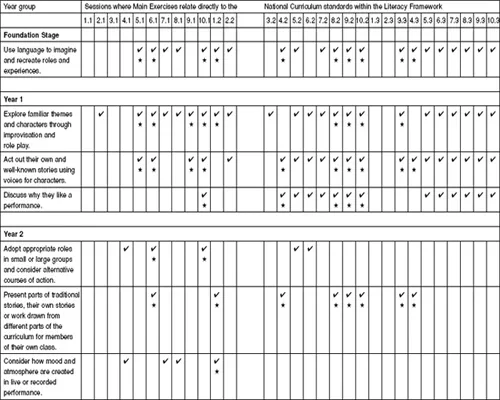
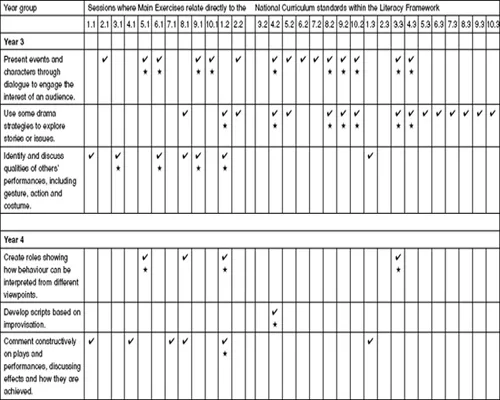
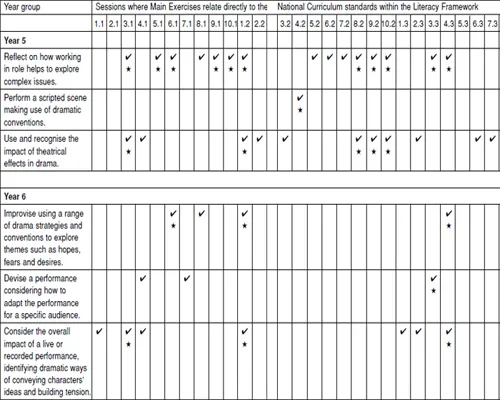
Drama has a significant part in the primary National Curriculum and I wanted this book to be a direct reference guide for teachers implementing drama within the current literacy framework. I have included a table providing a quick-reference guide to which main exercises relate directly to each year's target objectives. I have also indicated which of those exercises can be utilised in a classroom and which will need the bigger space.
Literacy Framework for Drama: Key Stage 1
* = can be classroom-based
Literacy Framework for Drama: Key Stage 2
* = can be classroom-based
Literacy Framework for Drama: Key Stage 2 – continued
* = can be classroom-based
![]()
CHAPTER 3
Relating to the National
Strategies Social and
Emotional Aspects of
Learning (SEAL)
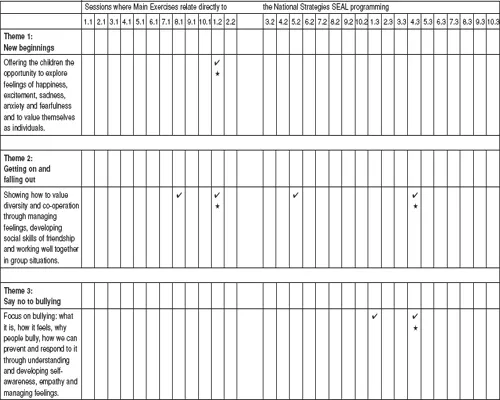
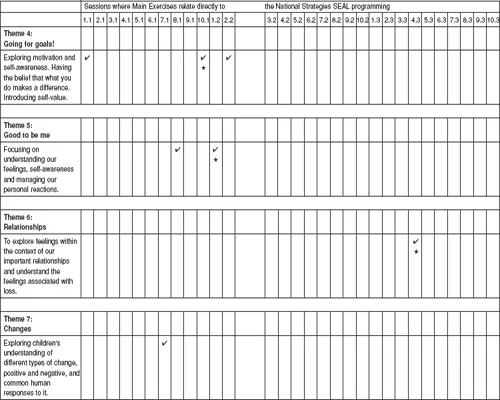
All seven themes within the SEAL programming lend themselves to exploration through drama. With the aim of helping children develop knowledge, understanding and skills in several key social and emotional aspects of learning, drama can be utilised to explore self-awareness, managing feelings, motivation, empathy and social skills.
I have collated a quick-reference guide that indicates which main exercises relate directly to each theme. Using this chart you can incorporate a dramatic, active and challenging supplement to accompany existing resources. I have also indicated which of these exercises can be utilised in a classroom and those that require a larger space.
Social and Emotional Aspects of Learning (SEAL)
* = can be conducted in a classroom
Social and Emotional Aspects of Learning (SEAL) – continued
* = can be conducted in a classroom
![]()
CHAPTER 4
Your drama club:
three terms of 11 session
plans per term
Club term 1
| Club term 1: | Session 1 of 11 |
| Warm Up: Name Game | 5 mins |
Instructions: With the group standing in a circle facing one another, each member takes a turn to introduce themselves with a movement/action to their name, then the rest of the group copy the action exactly. Example: Alison does a star jump and shouts her name at the same time. The group then copies.
(Purpose of game: This game allows the child to express themselves as an individual. It looks at multi-task collaboration; to move; to speak; to think; all at the same time. This game quickly displays those with little confidence and those who will need extra encouragement.)
| Game 1: Paint Pot Game | 10 mins |
Instructions: With the group in a circle the teacher takes the lead and the children follow the mime of: taking a paint pot, brush, stick off the top shelf and putting it on the floor between their feet. Opening the paint pot lid with the stick, stirring the paint – ask the children the colour of their paint. Dipping their brush in the paint they choose a place to paint within the room. Bring them back to the circle, explain they a...