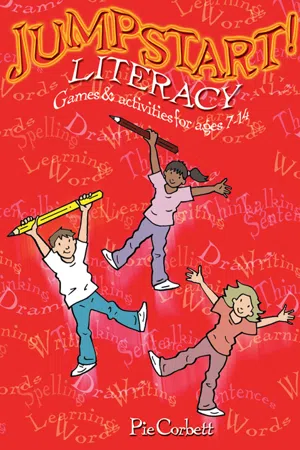
Jumpstart! Literacy
eBook - ePub

Jumpstart! Literacy

Games and Activities for Ages 7-14

  1. 96 pages
  2. English
  3. ePUB (mobile friendly)
  4. Available on iOS & Android
eBook - ePub

Jumpstart! Literacy

Games and Activities for Ages 7-14

About this book

This collection of simple to use, fun, multi-sensory games and creative lesson starters will jumpstart pupils enthusiasm for literacy learning. The `jumpstarts' cover:

  • Warming up the word - spelling and word games
  • Syntactic gymnastics - creating sentences and written style
  • Games to stimulate - talk, drama and writing
  • Quickfire whiteboard starters - to stimulate the imagination.

For use at Key Stages 2 & 3 (ages 7-14).

Frequently asked questions

Yes, you can cancel anytime from the Subscription tab in your account settings on the Perlego website. Your subscription will stay active until the end of your current billing period. Learn how to cancel your subscription.
No, books cannot be downloaded as external files, such as PDFs, for use outside of Perlego. However, you can download books within the Perlego app for offline reading on mobile or tablet. Learn more here.
Perlego offers two plans: Essential and Complete
  • Essential is ideal for learners and professionals who enjoy exploring a wide range of subjects. Access the Essential Library with 800,000+ trusted titles and best-sellers across business, personal growth, and the humanities. Includes unlimited reading time and Standard Read Aloud voice.
  • Complete: Perfect for advanced learners and researchers needing full, unrestricted access. Unlock 1.4M+ books across hundreds of subjects, including academic and specialized titles. The Complete Plan also includes advanced features like Premium Read Aloud and Research Assistant.
Both plans are available with monthly, semester, or annual billing cycles.
We are an online textbook subscription service, where you can get access to an entire online library for less than the price of a single book per month. With over 1 million books across 1000+ topics, we’ve got you covered! Learn more here.
Look out for the read-aloud symbol on your next book to see if you can listen to it. The read-aloud tool reads text aloud for you, highlighting the text as it is being read. You can pause it, speed it up and slow it down. Learn more here.
Yes! You can use the Perlego app on both iOS or Android devices to read anytime, anywhere — even offline. Perfect for commutes or when you’re on the go.
Please note we cannot support devices running on iOS 13 and Android 7 or earlier. Learn more about using the app.
Yes, you can access Jumpstart! Literacy by Pie Corbett in PDF and/or ePUB format, as well as other popular books in Bildung & Bildung Allgemein. We have over one million books available in our catalogue for you to explore.

Information

Publisher
Routledge
Year
2013
eBook ISBN
9781136775536
Edition
1
Topic
Bildung
CHAPTER 1
Jumpstarting spelling
The activities in this chapter focus on improving spelling through a multi-sensory approach. Many children find spelling difficult and this hinders their ability to compose fluently. Spelling needs to be automatic (even if it is not a hundred per cent accurate!). A ten-minute daily session of whole-class spelling games can be a more effective way of helping children remember patterns than relying on a once-a-week spelling bash. Within a ten-minute session you could cover two or three games. Focus on words and patterns that they need, find difficult, or are the ongoing objective from your scheme.
RIGHT FROM WRONG
images
This game is quick and easy. It helps children look carefully at a spelling and try to decide whether or not it is accurate.
  • Write on the whole-class board two or three ways of spelling a word, one of which is correct, e.g.
    wos woz was whas
  • Ask the children to write on their mini- whiteboards the spelling which they think is accurate.
  • Use words that the class often misspell, e.g. because, they, February, answer, ache, tomorrow, beginning, creature, mystery, chocolate, etc.
  • Discuss the different methods that can be used to remember spellings. See what memory-joggers the children already use. How are they going to remember the words you’ve just discussed?
  • Try to ensure that the most common ā€˜tricky’ words are really well known. Examples include:
    about, after, again, all, another, away, because, brother, called, can’t, could/ would/should, don’t, first, friend, girl, half, here, house, how, laugh, little, made, many, more, next, night, now, off, once, our, people, said, saw, school, sister, their, there, they’re, these, they, three, to, too, two, very, water, were, what, when, where, who, will, with, your
Encourage the children to use the tactics explored here when proof-reading their own writing. It can help if they get used to putting a dotted line under any word that they think looks ā€˜incorrect’ as they write. This means that they can keep on writing without losing pace,, and get used to returning to words after composition is complete.
PHOTOGRAPH
images
This game is simple to organise. It is a whole-class version of the famous ā€˜look/say/remember/ cover/think/write/check’ routine. It helps to strengthen children’s visual memory of different spellings.
  • Write on the whole-class board a word that is commonly causing problems for the group, e.g.
    because
  • Ask the children to look at the word and chant the letters, trying to remember what the word LOOKS like and how it is spelled. I often suggest that they ā€˜take a photo’ (i.e. make a visual or mental note). It is worth asking them to look and then close their eyes – can they SEE the word in their mind?
  • Practise this a few times before eventually covering the word completely. Ask the class to write the word on their mini-whiteboards and then to check what they’ve written carefully. Does it look right? Does it read back correctly? If not, change it!
  • You might like to try this game with some of the trickier keywords that children need to be able to spell. Examples include:
    above, across, almost, along, also, always, animals, any, around, asked, baby, balloon, before, below, better, between, birthday, both, brother, bought, brought, can’t, change, children, clothes, coming, didn’t, different, does, don’t, during, earth, every, eyes, father, first, follow, found, friends, garden, goes, great, halves, happy, head, heard, high, I’m, important, inside, jumped, knew, know, lady, leave, light, money, they, said, was, Tuesday, Wednesday, Thursday, Friday, Saturday, February, August, December
Try to encourage the children to use a variety of spelling strategies, e.g. visual memory-joggers, thinking about other words that may be related or similar, and so on.
RHYME IT
images
This game is important because it tunes children into listening carefully to the sounds in a word. Being able to spell by analogy (if I can spell ā€˜sick’ then I can probably spell ā€˜stick’) is a tactic that most of us use – probably without knowing it,
  • Write a word on the whole-class board and ask the class to come up with as many rhyming words as they can in a given time, e.g. 30 seconds. For instance, you might write up
    feet
    and the children will then generate rhyming words, thinking about their spelling as they write them down. Of course, here there is a choice between ā€˜ee’, ā€˜ea’ or ā€˜e consonant e’ (sleet, meat, seat, treat, wheat, heat, complete, etc).
  • Bring the class together and list the words they’ve come up with. (Sadly, on this occasion, there are no rules that help distinguish whether a word is spelt ā€˜eat’, ā€˜eef or ā€˜ete’. You just have to learn each spelling through constantly memorising, using and double- checking them.
  • Try using the following words to generate rhymes:
    train, wheel, bone, light, flies, soap, seed, snail, sign, goat, cream, face, five, bowl, cake, hook, wing, car, sock, back, shout, wood, led, bad, toy, day, gate, see, try, blow, true
  • An extension of this game is to provide a ā€˜rime’ and let the children generate words within a given time, e.g. ake = cake, lake, bake, make, take, mistake, etc. Try using the following ā€˜rimes’:
    ake, ame, ave, ace, ate, ail, ain, ine, ipe, ice, ight, oon, ool, oast, eet
  • Play ā€˜rhyme chain’ – one child says a word and the next has to find a rhyme. Keep going till the rhymes run out.
  • Those who struggle with spelling may need to play ā€˜phoneme fingers’. Like the rhyming activities above, this game helps to strengthen children’s listening skills in an effort to improve spelling. In this game, you say a word, e.g. ā€˜ship’ and the children have to count silently the number of phonemes (individual sounds) and hold u...

Table of contents

  1. Cover
  2. Title Page
  3. Copyright Page
  4. Table of Contents
  5. Acknowledgements
  6. Introduction
  7. 1. Jumpstarting spelling
  8. 2. Jumpstarting words
  9. 3. Jumpstarting sentences
  10. 4. Jumpstarting writing
  11. 5. Jumpstarting speaking, listening and drama
  12. 6. Jumpstarting learning