eBook - ePub
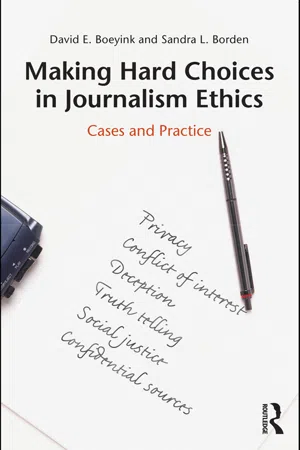
Making Hard Choices in Journalism Ethics
Cases and Practice
- 210 pages
- English
- ePUB (mobile friendly)
- Available on iOS & Android
eBook - ePub
About this book
This book teaches students how to make the difficult ethical decisions that journalists routinely face. By taking a case-based approach, the authors argue that the best way to make an ethical decision is to look closely at a particular situation, rather than looking first to an abstract set of ethical theories or principles. This book goes beyond the traditional approaches of many other journalism textbooks by using cases as the starting point for building ethical practices. Casuistry, the technical name of such a method, develops provisional guidelines from the bottom up by reasoning analogically from an "easy" ethical case (the "paradigm") to "harder" ethical cases. Thoroughly grounded in actual experience, this method admits more nuanced judgments than most theoretical approaches.
Information
CHAPTER 1
HARD CASES IN JOURNALISM ETHICS
Sometimes police encounter real murder mysteries when they are called to a crime scene. They don’t know who commit7ted the crime or why. They may not even fully understand what caused the victim’s death. Without a confession or reliable chronology about what happened, they have no choice but to develop their own “theories” about what took place.
When police face a hard case like this, they rely on their knowledge of forensic science and their experience investigating other crime scenes to know what might be a clue. They also collect and study the evidence systematically. By using an established protocol, they make sure to not miss anything important and to reconstruct their investigation to the satisfaction of other people with an interest in its outcome.
Journalism ethics can seem like a real mystery, too. Sometimes journalists stumble into tough ethical situations that defy simple resolution. They can’t “solve” such hard cases by simply consulting the newsroom’s code of ethics or falling back on general rules like truth telling. Take the case of Patricia Bowman and William Kennedy Smith. Smith, Sen. Ted Kennedy’s nephew, met 29-year-old Bowman in a bar in 1991. After drinks at the Kennedy family mansion, the pair went walking on the mansion’s private beach, where Bowman said Smith raped her. She got a ride with a friend to the local police station immediately afterward and got checked out at a hospital for treatment of injuries and collection of forensic evidence.
Within hours, the news media had converged on Bowman, who lived with her 1-year-old daughter. Subsequent news reports questioned her veracity and suggested that she was promiscuous and unstable. Smith, meanwhile, denied the charges, saying the sex was consensual. Most major news media did not name Bowman before she herself went public after the jury’s verdict, with the exception of NBC News and The New York Times. Bowman specifically requested anonymity until she decided to appear in a post-trial interview with Diane Sawyer on ABC.
For years, The Courier-Journal of Louisville, Kentucky, had a policy of not naming persons who told police they had been raped. But the Bowman/Smith case involved such notoriety and such intensive coverage that the editors were uncomfortable with their policy’s usual balance between privacy and truth telling. Now they had some questions about the wire stories they were receiving from the Associated Press. They wanted to protect Bowman from a kind of second victimization and perhaps make progress in removing the stigma that is attached to all rape victims. Publisher George Gill reflected after the trial:
Iguess philosophically I subscribe to (the) theory … that rape is never going to be manageable, or whatever the word is, as a crime until all the mystery is taken out of it and the guilt is taken out of it and so forth, on the victim’s side. And I think, philosophically, I can buy that. It’s a little difficult, though, coming down and putting your neighbor’s name in the paper without her permission, if she happens to be raped. I mean that’s a tough one–a real tough one.
The editors also thought the case deserved coverage since it involved a prominent member of the Kennedy family. Smith’s name represented an important part of the truth of this story. Yet the intense nature of the national coverage seemed to the editors to be unfair, as it framed Smith as a rapist day after day. Commenting on the case, then Managing Editor Steve Ford commented:
And in the end I think that, with varying degrees of enthusiasm, there was kind of a broad consensus of this different kind of case–that this guy, whether guilty or innocent, you know, was being put on the front page of virtually every paper in the country; he was on all the network news shows, and he was there because of his middle name.
This case did not seem to fit the paper’s long-standing policy of not naming rape victims. Nor was it resolved by an appeal to ethical rules when three of these rules–truth telling, privacy, and fairness–seemed to conflict. What journalists need in such cases is a way of reasoning that helps them to recognize the moral clues at hand and engage in a proper investigation of what’s at stake, morally speaking. Kind of a CSI for journalism ethics.
This textbook will provide you with experience using a case-based method for ethical decision making widely used in the Middle Ages and now enjoying a revival in a number of fields, including journalism. It’s called casuistry. The Bowman/Smith case will provide a touchstone throughout the book as you learn more about the basics of casuistry and how to apply it to “cases of conscience” (Miller 1996: 5) in journalism ethics. But, first, let’s get clear on some basic concepts in the study of ethics.
WHY DO JOURNALISTS NEED TO WORRY ABOUT ETHICS?
Some journalists say that there’s nothing more to journalism ethics than doing journalism well. Certainly, we expect journalists to perform their jobs competently. A reporter should be able to find out information efficiently and know how to verify it so that he or she can vouch for the information’s accuracy and completeness. A good writer should be able to express ideas clearly, describe details vividly and help audiences gain perspective about the world around them. A web designer should be able to arrange text and images in a way that invites audiences to browse, helps them to figure out the most important news on the site, and provides an aesthetically pleasing experience that engages their senses as well as their minds. In short, technical excellence is a part of good work.
However, as moral development experts Mihaly Csikszentmihalyi, William Damon and Howard Gardner (The Good Work Project 2007) point out, competence is just part of the equation. Journalists can be skillful and yet fail to perform good work if they do not also do their jobs with moral excellence.
Moral excellence consists of performing your ethical responsibilities well:

Media ethicist Deni Elliott (1986) suggests that general responsibilities, particular responsibilities and personal responsibilities provide the foundations for moral excellence in journalism. Like the rest of us, journalists have the general responsibilities of telling the truth and minimizing harm. However, these responsibilities take on a specific meaning in journalism. Telling the truth is a strong moral imperative because of journalism’s mission to help citizens participate responsibly in their communities. All of us should be truthful, but we expect journalists to be especially proactive in seeking and disseminating the truth so that we can participate knowledgeably in public life.
Likewise, all of us should avoid harming others whenever possible. But journalists are in a special position to cause harm because of the power they exercise through the reach of modern media. A picture can sway foreign policy; a blog post can incite virulent attacks on an individual. When you act unethically as an individual, you may risk hurting a few people close to you. When journalists act unethically, they may end up injuring millions. For example, a 2005 brief in Newsweek reported erroneously, on the basis of a single anonymous source, that interrogators at Guantanamo Bay had flushed a copy of the Qur’an down the toilet to rattle an Islamic detainee. The accusation appalled Muslims around the world; riots broke out in Pakistan and Afghanistan. Fifteen people died (Thomas 2005).
That’s why the first two principles in the code of ethics for the Society of Professional Journalists (SPJ) are “Seek the Truth and Report it” and “Minimize Harm.” These principles are in constant tension as journalists endeavor to perform good work–in both the technical and the moral sense. It’s precisely because these principles conflict so often that merely appealing to the code is not sufficient for solving the moral mysteries that bedevil even the best journalists.
Elliott notes that journalists also accept certain particular responsibilities by becoming journalists, entering news organizations and joining groups such as the Society of Professional Journalists. By becoming members of the practice and affiliated organizations, journalists agree to the promises that have been made on their behalf by these bodies. If my news organization runs a promo every evening pledging to “be first” with the news, then I have implicitly made this pledge to our audience as well.
One moral hazard is that my organization may make a promise that runs counter to common decency. Will we do anything to be first? Even if it means being insensitive to people in pain or taking advantage of people who are naïve about how the news works? Elliott suggests that general responsibilities have pre...
Table of contents
- CONTENTS
- CHAPTER 1 HARD CASES IN JOURNALISM ETHICS
- CHAPTER 2 THE ROLE OF ETHICAL THEORY
- CHAPTER 3 THE PARADIGM CASE AS ETHICAL STANDARD
- CHAPTER 4 USING CASE COMPARISONS TO MAKE ETHICAL CHOICES
- CHAPTER 5 EVALUATING ETHICAL JUDGMENTS
- CHAPTER 6 CASUISTRY AND NEWSROOM POLICY
- CHAPTER 7 THE JANIE BLACKSBURG CASE: CASUISTRY IN ACTION
- NOTES
- BIBLIOGRAPHY
- INDEX
Trusted by 375,005 students
Access to over 1.5 million titles for a fair monthly price.
Study more efficiently using our study tools.
Frequently asked questions
Yes, you can cancel anytime from the Subscription tab in your account settings on the Perlego website. Your subscription will stay active until the end of your current billing period. Learn how to cancel your subscription
No, books cannot be downloaded as external files, such as PDFs, for use outside of Perlego. However, you can download books within the Perlego app for offline reading on mobile or tablet. Learn how to download books offline
Perlego offers two plans: Essential and Complete
- Essential is ideal for learners and professionals who enjoy exploring a wide range of subjects. Access the Essential Library with 800,000+ trusted titles and best-sellers across business, personal growth, and the humanities. Includes unlimited reading time and Standard Read Aloud voice.
- Complete: Perfect for advanced learners and researchers needing full, unrestricted access. Unlock 1.5M+ books across hundreds of subjects, including academic and specialized titles. The Complete Plan also includes advanced features like Premium Read Aloud and Research Assistant.
We are an online textbook subscription service, where you can get access to an entire online library for less than the price of a single book per month. With over 1.5 million books across 990+ topics, we’ve got you covered! Learn about our mission
Look out for the read-aloud symbol on your next book to see if you can listen to it. The read-aloud tool reads text aloud for you, highlighting the text as it is being read. You can pause it, speed it up and slow it down. Learn more about Read Aloud
Yes! You can use the Perlego app on both iOS and Android devices to read anytime, anywhere — even offline. Perfect for commutes or when you’re on the go.
Please note we cannot support devices running on iOS 13 and Android 7 or earlier. Learn more about using the app
Please note we cannot support devices running on iOS 13 and Android 7 or earlier. Learn more about using the app
Yes, you can access Making Hard Choices in Journalism Ethics by David E. Boeyink,Sandra L. Borden in PDF and/or ePUB format, as well as other popular books in Languages & Linguistics & Journalism. We have over 1.5 million books available in our catalogue for you to explore.