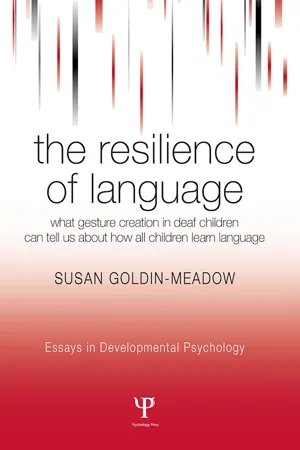
Imagine a child who has never seen or heard any language at all. Would such a child be able to invent a language on her own? Despite what one might guess, the children described in this book make it clear that the answer to this question is 'yes'. The children are congenitally deaf and cannot learn the spoken language that surrounds them. In addition, they have not yet been exposed to sign language, either by their hearing parents or their oral schools. Nevertheless, the children use their hands to communicate - they gesture - and those gestures take on many of the forms and functions of language. The properties of language that we find in the deaf children's gestures are just those properties that do not need to be handed down from generation to generation, but can be reinvented by a child de novo - the resilient properties of language. This book suggests that all children, deaf or hearing, come to language-learning ready to develop precisely these language properties. In this way, studies of gesture creation in deaf children can show us the way that children themselves have a large hand in shaping how language is learned.
eBook - ePub
The Resilience of Language
What Gesture Creation in Deaf Children Can Tell Us About How All Children Learn Language
- 288 pages
- English
- ePUB (mobile friendly)
- Available on iOS & Android
eBook - ePub
The Resilience of Language
What Gesture Creation in Deaf Children Can Tell Us About How All Children Learn Language
About this book
Information
Publisher
Psychology PressYear
2005Print ISBN
9781841694368
9781841690261
Edition
1eBook ISBN
9781135433383
Part
I
The Problem of Language-Learning
1
Chapter
Out of the Mouths of Babes
The fact that children learn language so effortlessly at a time when tying their shoes is a real hurdle makes language-learning appear miraculous. Children are faced with the seemingly difficult task of learning a complex symbolic system, one that varies from culture to culture in seemingly arbitrary ways. We have all had the experience of listening to a foreign language fluently spoken by a native speaker—it feels to us, although not to the speaker, that there are no breaks in the flow. Where are the words? Where do the sentences stop and start? This is the first task that faces young children, discovering the units of the language they are to learn.
In addition, children must learn how the units of their language are combined. When children produce utterances that they have never heard before, and that follow the patterns of the language they are witnessing, we know that they have learned something about the underlying regularities that make English English, Swahili Swahili, or American Sign Language American Sign Language. Children hear particular sentences, yet they acquire rules. Moreover, every child hears a different set of particular sentences, yet they all acquire the same rules and in approximately the same sequence. This is the wonder of language acquisition.
To begin to understand this miraculous process, we will take a brief tour through the steps children follow in acquiring language, beginning with their discovery of the sounds of language.

When we speak, we run words together without reliable pauses between them, which is what gives listeners who don’t know the language the feeling that there are no breaks in the stream. How then do native language-users parse the language they hear into recognizable units? Adult listeners use their knowledge of regularities in the sound structure of the language to predict the boundaries of units like words. Since sound structure differs across language, knowledge of regularities in one language may not be useful in identifying boundaries in another language. Infants thus need to learn the particular features of the sound structure of their native language in order to be able to find words in the stream of talk that is addressed to them. When do they accomplish this feat?
Much to everyone’s surprise, infants know something about the language they are to learn on the day they are born. Newborn babies born to French-speaking mothers listened to tapes of French and Russian speech and sucked on a wired nipple while doing so. The babies sucked more—and, by inference, were more aroused—when they listened to the French tapes than when they listened to the Russian tapes. Babies who had not heard French during their prenatal months showed no such effect (Mehler, Jusczyk, Lambertz, Halsted, Bertoncini, & Amiel-Tison, 1988). What the babies appear to have learned about French during those months in the womb was its prosodic structure (its intonation contours, or “music”); when the speech samples were filtered so that only the prosodic cues remained, the findings were unchanged. Thus, babies are already attuned to the music of their mother’s tongue on day 1.
However, babies do not become sensitive to the particular sounds of their native language until the second half of their first year. Babies start out ready to learn any language—an essential characteristic since, in principle, they could be exposed to any of the world’s languages, present or future. Babies are able to make essentially all the discriminations in sound contrasts that languages across the globe require. But sometime during the latter part of the first year, the ability to discriminate between contrasts not found in the infant’s native language fades. (Adults are only able to hear those contrasts used in their particular language and can no longer hear the rest.) For example, Hindi and Salish have consonant contrasts not found in English. Surprising those who believe that adults always know more than children, infants learning English are able to make these Hindi and Salish discriminations, adult English-speakers are not. However, the infants are only able to do so during their first year—by 12 months the ability fades and they begin to listen like adult English-speakers. Importantly, the ability to discriminate these contrasts does not fade if the infant is exposed to input that makes use of the contrasts—infants learning Hindi or Salish are still able to make the discriminations in their respective languages at 12 months (Werker & Tees, 1984). Babies start to fail to make discriminations among vowels (as opposed to consonants) that are not found in their language even earlier (perhaps as early as 6 months; Kuhl, Williams, Lacerda, Stevens, & Lindblom, 1992).
By 9 months, infants can recognize words in their language independent of prosodic cues. English and Dutch have very similar prosodic characteristics. They differ, however, in phonetic and phonotactic structure (that is, in which sounds are produced in the language and how those sounds combine). For example, the [r] in English words is very different from the [r] found in Dutch words (a phonetic difference). English allows [d] to occur at the end of a syllable while Dutch doesn’t, and Dutch allows [kn] or [zw] to begin syllables while English doesn’t (phonotactic differences). When presented with a spoken list of English and Dutch words, 9-month-old English-learners listen longer to the English than the Dutch words. In contrast, 6-month-old English-learners show no preferences (Jusczyk, 1993). By 9 months, babies have learned enough about the sound structure of their language to prefer their own language to others, even those that have the same “music.”
While learning to listen to sounds, infants are also learning to produce them. Infants do not produce what we might recognize as words until they are approximately 1 year old. However, long before then they use their voices in changing ways. They begin by using their voices to cry reflexively and to make vegetative sounds; they then coo, laugh, and begin to play with sound. Sometime around 6 to 9 months, infants begin to babble (Oller & Lynch, 1992)—they produce true syllables, often in a reduplicated series of the same consonant-vowel combination, for example, [dada] or [mamama]. Later still, infants begin to produce variegated babbling in which the range of consonants and vowels expands and sounds no longer need to be reduplicated (Stark, 1986). The child is now adding prosody to strings of babbles and, as a result, begins to sound like a native speaker (as long as you’re not listening too closely).
Indeed, it is at this point (around 8 months) that native listeners can begin to identify an infant as one who is learning their language. For example, when they heard tapes of 8-month-old babbling, French speakers were able to tell the difference between French babies’ babbling and Arabic or Chinese babies’ babbling (deBoysson-Bardies, Sagart, & Durand, 1984). When the infants’ babbles were closely examined by trained linguists, the French babies were found to display lengthenings and softer modulations than the Arabic and Chinese babies, who exhibited other characteristics that were found in the languages they had been hearing for 8 months (deBoysson-Bardies, 1999). Thus, by the end of the first year, children are beginning to speak, and listen, like native users of their language.
All natural languages, spoken or signed, are structured at many levels. Meaningless units (phonemes) combine to create morphemes, the smallest meaningful units of a language, which in turn combine to form words, phrases, and sentences. Having made significant progress in learning the sound system underlying their language in the first several months of life, children are then free to tackle larger units. Regardless of the language learned, children tend to enter the system of larger units at the level of the word, rather than the morpheme or sentence. Between 10 and 15 months, children produce their first words, typically using each word as an isolated unit. Children then proceed in two directions, learning (1) that the word can be composed of smaller, meaningful parts (morphology), and (2) that the word is a building block for larger, meaningful phrases and sentences (syntax).
What is a word? Consider a child who wants a jar opened and whines while attempting to do the deed herself. This child has conveyed her desires to those around her, but has she produced a word? A word does more than communicate information—it stands for something; it’s a symbol. Moreover, the mapping between a word and what it stands for is arbitrary—“dog” is the term we use in English for furry four-legged canines, but the term is “chien” in French and “perro” in Spanish. There is nothing about the form of each of these three words that makes it a good label for a furry creature— the word works to refer to the creature only because speakers of each language act as though they agree that this is what it stands for.
At the earliest stages of development, children may use a sequence of sounds consistently for a particular meaning, but the sequence bears no resemblance to the sound of any word in their language. These “proto-words” (Bates, 1976) are transitional forms that are often tied to particular contexts. For example, a child uses the sound sequence “brmm-brmm” every time he plays with or sees his toy truck. In fact, a child’s proto-word need not be verbal at all—gesture works quite well. For example, a child smacks her lips every time she feeds her fish, or flaps her arms when she sees a picture of a butterfly (Acredolo & Goodwyn, 1985, 1988; Iverson, Capirci, & Caselli, 1994). Indeed, some children rely heavily on gestural “words” to communicate with others at the early stages.
Sometime around 18 months, children’s vocabularies reach 50 words (Nelson, 1973), and they continue to add an average of nine words a day throughout the preschool years (Carey, 1978). Children’s most common words are names for people and pets (“mama,” “Metro”), objects (“bottle”), and substances (“milk”). These nominal terms are among the earliest terms children learn, along with social words (“want,” “no,” “bye-bye”). Adjectives (“hot”) and verbs (“go,” “up”) are part of a young child’s repertoire, but tend to be rare relative to nouns (Gentner, 1982; Goldin-Meadow, Seligman, & Gelman, 1976; although children learning languages other than English may show the noun bias less than English-learners, e.g., Korean; Gopnik & Choi, 1995; Mandarin; Tardif, 1996).
It is, of course, not trivial for the child to figure out exactly what adults mean when they use a word like “dog” or “run” (let alone abstract terms like “liberty” and “conjecture”). “Dog” could refer to the furry creature in its entirety, its paws, its tail, its fur, and so forth. “Run” could refer to the trajectory of the motion, the manner in which it is carried out, its direction, and so on. An infinite number of hypotheses are logically possible for the meaning of a word in a given adult utterance (Quine, 1960). Yet children are able to zero in on adult meanings of the words they hear. How? It would certainly be easier for children to settle on the meaning of a word if they were constrained to consider only a subset of the possibilities as candidate word meanings—if, for example, they were biased to assume that labels refer to wholes instead of parts (the creature, not the tail) and to classes instead of particular items (all dogs, not one dog). Constraints of this sort have, in fact, been proposed as part of the equipment that children bring to the language-learning situation (Markman, 1991, 1994), although others are equally convinced that inherent constraints are not needed to explain how children learn the meanings of words (Bloom, 2000).
Constraints on what a word means can also come from the discourse context in which the word is used. An adult may, for example, label an object when the child is directing full attention to that object, effectively making a set of meanings particularly salient to the child. More constraining still, the linguistic frame in which a word appears narrows down the meanings that the word can have (Gleitman, 1990). For example, English sentence structure conveys who does what to whom and, in this way, provides clues as to the meaning of the verb in the sentence. A 2-year-old child who hears “the rabbit is gorping the duck,” will look longer at a scene in which the rabbit is acting on the duck than at a scene in which both the rabbit and the duck are circling their arms. The child correctly assumes that “gorp” must refer to an action on an object, in this case, the duck (Naigles, 1990). This is an impressive inference, particularly since the same child when hearing “the rabbit and the duck are gorping” will look longer at the scene in which the rabbit and the duck are each circling their arms. Now the child correctly assumes that “gorp” refers to the arm-circling action. Thus, the clues that children exploit to determine the meaning of a word come not only from how that word is used in relation to the world of objects and actions, but also from how it is used in sentences—children use language itself to bootstrap their way into word meanings (Fisher, Hall, Rakowitz, & Gleitman, 1994; Landau & Gleitman, 1985).
Words in English, and in all languages, can be broken down into parts. For example, the word “dogs” refers to more than one furry creature, but it does so quite systematically—“dog” stands for the animal, while “s” stands for many-ness. We know this because we know that words like “cats,” “shoes,” and “books” all refer to more than one cat, shoe, or book. We have extracted (albeit not consciously) what the words have in common—the “-s” ending in their forms and “plural” in their meanings—to form what is called a morpheme, a consistent pairing between a form and a meaning.
At the earliest stages, children learn morphologically complex words as unanalyzed wholes, “amalgams” (MacWhinney, 1978). For example, “shoes” may not, in the child’s mind, be composed of the stem “shoe” plus the plural “-s,” particularly if the child never produces the form “shoe” and uses “shoes” to refer to footwear in singles and in pairs. At some point, English-learning children discover that “shoes” is composed of parts (“shoe”, “-s”) and that each part has a meaning (footwear, plural). It is often not easy to tell when this analysis has taken place, particularly since it is not likely to have been done consciously.
One key piece of evidence, possible only when the pattern in the language the child is learning is not completely regular, comes from children’s overregularizations—errors in which children make exceptions to the adult pattern (e.g., feet) conform to the regular pattern (e.g., foots). Children who produce the incorrect form “foots” must have extracted the plural morpheme “-s” from a variety of other regular forms in their system, and added it to the noun “foot.” Similarly, children who produce “eated” must have extracted the past tense morpheme “-ed” from verbs like “walked” and “stopped” and added it to the verb “eat” (Marcus, 1995). Creative errors of this sort also indicate that children know the differences between nouns and verbs; children add the “-ed” ending to verbs like “eat” or “walk” but rarely to nouns like “foot” or “shoe.” In addition to waiting for creative errors to occur, experimenters can give older children nonsense words and ask them to generate novel forms for different sentence frames, as Jean Berko (1958) did in her well-known “wug” test. Berko showed children a picture of two unknown creatures and said, “This is a wug. Now there are two of them. There are two _____”. The child who knows about plural endings should supply the word “wugs.”
The “wug” test gives children the sentence frame (“There are two _____”) and a referent (a picture with two items) and asks them to supply the form of the appropriate grammatical morpheme (“-s”). In a clever study, Brown (1957) turned the question around and gave children the form of the grammatical morpheme and asked them to supply the meaning. For example, Brown showed children a picture of hands acting on a confetti-like substance in a pail and told them that this was “sibbing.” They were then asked to identify sibbing in a set of three pictures showing just the acting hands, just the substance, or just the pail. They correctly pointed to the acting hands, indicating that they knew the grammatical morpheme “-ing” attaches to words for actions, not objects. Importantly, when they were told that the original picture contained “some sib,” they pointed to the substance picture, and when they heard it cont...
Table of contents
- Cover
- Half Title
- Title Page
- Copyright Page
- Dedication
- Table of Contents
- Acknowledgments
- Accompanying Website of Video Clips
- Introduction
- Part I: The Problem of Language-Learning
- Part II: Language Development without a Language Model
- Part III: The Conditions that Foster Language and Language-Learning
- References
- Author Index
- Subject Index
Trusted by 375,005 students
Access to over 1.5 million titles for a fair monthly price.
Study more efficiently using our study tools.
Frequently asked questions
Yes, you can cancel anytime from the Subscription tab in your account settings on the Perlego website. Your subscription will stay active until the end of your current billing period. Learn how to cancel your subscription
No, books cannot be downloaded as external files, such as PDFs, for use outside of Perlego. However, you can download books within the Perlego app for offline reading on mobile or tablet. Learn how to download books offline
Perlego offers two plans: Essential and Complete
- Essential is ideal for learners and professionals who enjoy exploring a wide range of subjects. Access the Essential Library with 800,000+ trusted titles and best-sellers across business, personal growth, and the humanities. Includes unlimited reading time and Standard Read Aloud voice.
- Complete: Perfect for advanced learners and researchers needing full, unrestricted access. Unlock 1.5M+ books across hundreds of subjects, including academic and specialized titles. The Complete Plan also includes advanced features like Premium Read Aloud and Research Assistant.
We are an online textbook subscription service, where you can get access to an entire online library for less than the price of a single book per month. With over 1.5 million books across 990+ topics, we’ve got you covered! Learn about our mission
Look out for the read-aloud symbol on your next book to see if you can listen to it. The read-aloud tool reads text aloud for you, highlighting the text as it is being read. You can pause it, speed it up and slow it down. Learn more about Read Aloud
Yes! You can use the Perlego app on both iOS and Android devices to read anytime, anywhere — even offline. Perfect for commutes or when you’re on the go.
Please note we cannot support devices running on iOS 13 and Android 7 or earlier. Learn more about using the app
Please note we cannot support devices running on iOS 13 and Android 7 or earlier. Learn more about using the app
Yes, you can access The Resilience of Language by Susan Goldin-Meadow in PDF and/or ePUB format, as well as other popular books in Languages & Linguistics & Literacy. We have over 1.5 million books available in our catalogue for you to explore.