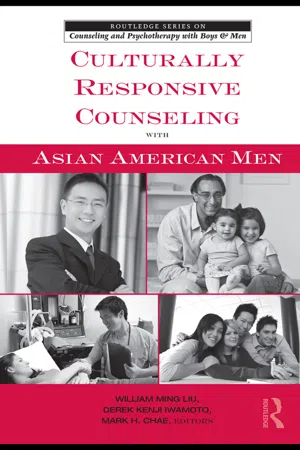
Asian American men represent a complex group with distinct psychological and mental health concerns, yet the current counseling literature is lacking in resources for clinicians working with this population. The purpose of this text is to provide practitioners with a comprehensive overview of the current research and theory related to the important and unique issues that Asian American men experience. It offers clinicians culturally-responsive, practical counseling techniques and strategies to help inform them on how to work effectively with this group. Chapters are written by leading figures in the field and explore such topics as intergenerational conflict, racism, challenges associated with masculinity and fatherhood, sexual orientation identity development, substance abuse, and career counseling. Numerous clinical vignettes and case conceptualizations are included to assist clinicians who work with Asian American men and to demonstrate appropriate treatment responses.
eBook - ePub
Culturally Responsive Counseling with Asian American Men
- 367 pages
- English
- ePUB (mobile friendly)
- Available on iOS & Android
eBook - ePub
Culturally Responsive Counseling with Asian American Men
About this book
Information
CHAPTER 1
Introduction and Overview
WILLIAM MING LIU, DEREK KENJI IWAMOTO, AND MARK H. CHAE
INTRODUCTION
In describing this book to another colleague, I (Liu) noticed that my colleague was not quite sure why a book of this nature was important. Why focus a book about mental health issues on Asian American men? More importantly, I almost thought my colleague was going to ask me, “Do Asian American men have mental health issues?” The reason for such questions, I believe, is due in part to the stereotype of Asian American men as the model minority. An assumption of the model minority is that Asian American men are economically and educationally successful, but this faulty assumption has a severe cost to these men. The economic and educational success essentially relegates Asian American men to unidimensional caricatures—hard workers, smart but asexual or not sexual beings. That is, Asian American men have no time and energy for romantic and sexual relationships when their focus is on becoming the successful and quiet minority (S. L. Wong, 1993).
The other problem for Asian American men is their relative invisibility in the popular media. By “invisible,” we assert that Asian American men represent a disturbing and complex intersection of race and sexuality that the popular media finds difficult to reconcile. For instance, in the late 1990s, two movies that illustrate this notion were released at about the same time. One was The Replacement Killers (RK; 1998) starring Chow Yun-Fat and Mira Sorvino. The other was a James Bond film titled Tomorrow Never Dies (TND; 1998), which starred Pierce Brosnan as James Bond and Michelle Yeoh as a Chinese secret agent.
In RK, Chow Yun-Fat played a killer who was trying to reform himself after an aborted assassination attempt; Mira Sorvino was the White female ally who became a target for Yun-Fat’s affection and admiration. In TND, Brosnan’s James Bond had a “working” relationship with Yeoh’s character as they tracked down the latest evil villain intent on controlling the world. At the end of TND, James Bond kisses Yeoh’s character and the movie concludes with the implication that Bond beds the character. Although no scene depicts this outcome, it is implied because all the Bond movies end that way and it is the natural resolution for Bond’s sexuality based on precedence.
In contrast, in RK, it seems that Yun-Fat and Sorvino’s characters have some affection for each other; however, the movie does not end with a kiss, although that ending would have been very interesting because there is no visual precedent for an Asian American man to kiss a White woman that ends well. In fact, in most other depictions of Asian American men around White women, the men are the sexually deviant aggressors. For example, in D. W. Griffith’s movie, Broken Blossoms, or the alternative title, The Yellow Man and the Girl (1919), Asian men were to be feared and avoided, much like other men of color who were conceived to be sexual deviants.
In RK, the movie ends with Sorvino’s character looking at Yun-Fat’s character, who then simply disappears in a crowd. At the end of RK, the perspective by which we had been watching the movie (through Yun-Fat’s eyes) suddenly shifts to Sorvino, a supporting character. Watching this ending in the theater was interesting because the audience did not react. There were no outcries, sighs, or indignant comments about Yun-Fat’s character simply disappearing. Could one actually believe that at the end of a James Bond movie, 007 looks affectionately at the woman with whom he has been working and trading sexually loaded innuendos and then simply disappears? Note that Bond’s character, rather than Yeoh’s, would fade away—White masculinity would evaporate. Would an audience sit for that sexual resolution?
We suggest that the audience’s acceptance of Yun-Fat’s character in RK is predicated on the sociocultural history and contemporary images of Asian American men. Even though Asian men were the first to migrate to the United States as indentured laborers (S. Chan, 1991), Asian American men are still virtually invisible in most public settings. This is not the same for Asian American women because, in a White-dominant, masculine society, women of color have a certain limited currency. Usually, this currency for Asian American women is circumscribed to be the exotic and sexualized targets of White masculinity. To reinforce this privilege for White men, Asian American men are racialized as effeminate, asexual, unattractive, hypersexual or deviant sexuality, and overly rigid; thus, they are perceived as undesirable romantic partners.
The popular media is rife with various conflicting images of Asian American men, all of which exist on the margins. Defining deviant masculinities, all of which are on the margins, allows White masculinity to be undefined and uncritiqued and thus assumed to be normal (see Liu and Concepcion’s chapter in this book). Asian American men are readily accepted by society as the “asexual nerd.” Consider William Hung, who auditioned for American Idol in 2004 with the song, “She Bangs” by Ricky Martin (a discussion about the irony of Hung’s choosing a song titled “She Bangs” will be saved for another book). Hung, who was a civil engineering student at the time (http://www.williamhung.net/bio.html, May 19, 2009), parlayed this one song into his “15 minutes of fame.”
Hung’s music video of “She Bangs” features him energetically singing the song out of tune with a backdrop of several sexually provocative and scantily clad women dancing in the background. He sings the song in a manner that conveys to the audience that he is completely unaware of these sensual women around him. The women touch and stroke him, but Hung seems oblivious; he does not react and it appears that his goal is to finish his song. Hung is asexual and safe; the women in the video have nothing to fear. We would argue that most viewers likely did not observe or were not offended by the symbolic racially castrating characterization of Hung. Instead, because his asexual persona was consistent with stereotypical conceptions of Asian American men, his performance was accepted and even embraced (Iwamoto & Liu, 2008).
The other readily accepted perception of Asian American men is that of the hypersexual deviant. Consider any movie that may have a scene where the main characters are in a topless bar or strip club. In the background, look for the Asian men in suits with cameras around their necks who are taking pictures of the women. In 1984, John Hughes released the movie Sixteen Candles (a movie that may predate many readers). The movie was a coming-of-age plot for Molly Ringwald’s character. Throughout the movie, Gedde Watanabe’s character, Long Duk Dong, made his entrance known by a loud and audible gong. Watanabe’s character was a Chinese exchange student who was only romantically interested in Ringwald’s character and other White women. The creation of these images of racialized sexual deviance starts early, in teen-oriented movies, and is predicated on sociocultural historical stereotypes, setting the foundation for a future of other similar negative images.
But negative media images do not explain some or most of the problems experienced by Asian American men. Additionally, this discussion heretofore has only partially explained why Asian American men may have been overlooked by mental health professionals. Although counselors and psychologists may view Asian American men as racialized men, it is just as important to understand the specific kind of racialization that Asian American men experience and have to negotiate. Thus, the purpose of this book is to highlight psychological and mental health research that advances our knowledge and understanding of Asian American men.
Because little is known about this population, particularly as it relates to working clinically with this group, this volume addresses the salient psychological and counseling issues that may be relevant for mental health practitioners who work with Asian American men. As such, this volume provides clinical vignettes and case conceptualizations of clinical interventions to assist clinicians who work with this population. Additionally, the volume provides an overview of current empirical and theoretical literature on Asian American men.
OVERVIEW
Asian Americans represent one of the fastest growing populations in America. According to the U.S. Census Bureau (2006), nearly 15 million Asian Americans are living in the United States. In light of the rapid demographic shifts, psychological- and counseling-related research on this population has just started to explore and understand this complex community. For instance, some of the research conducted on Asian Americans has examined the associations between cultural identities such as acculturation and ethnic identity and how these factors relate to psychological functioning (Chae & Foley, in press; S. Sue, 2002). However, despite the numerous psychological studies that have emerged over the past few decades, research devoted to specific clinical issues that affect Asian American men, as well as practical ways in which therapists can clinically work with this population, has been limited.
This limited coverage is problematic for several reasons. Although similarities between Asian American women and men exist, various studies have suggested unique gender differences with regard to substance use (Iwamoto & Liu, 2008; Liu & Iwamoto, 2007), self-esteem (Tsai, Ying, & Lee, 2001), coping with racism (Liang, Alvarez, Juang, & Liang, 2007), and racial identity development (Iwamoto & Liu, in press). In one study, for example, Liu and Iwamoto found that avoidant forms of coping were a predictor of substance use among Asian American college women, but not among their male counterparts. In another investigation, Tsai et al. found that grade point average and fluency in both the Chinese and English languages were associated with self-esteem for Chinese American men, whereas Chinese pride was the only predictor of self-esteem among Chinese American women.
A third study by Liang et al. (2007) also found gender differences in the ways in which men tended to use support-seeking coping strategies when dealing with perceived racism, but the women used active or problem-focused coping strategies. Finally, Iwamoto and Liu (2008) found sex differences in racial identity status between Asian American women and men. The women in this sample scored higher on internalization and lower on resistance subscales. The higher scores on the internalization scale indicated that the women tended to have a more open view about the strengths and limitations of Asian and White Americans. In contrast, Asian American men had higher scores on the resistance subscale, suggesting that they had less positive views of White Americans. The researchers hypothesized that this view may be due to the men’s more negative experiences with White Americans in their lifetime.
These studies highlight important differences between Asian American men and women. Moreover, Asian American men represent a unique and complex group that warrants a broader and more detailed clinical understanding: These men have to negotiate unique challenges related to direct and indirect forms of racism, gender role conflict and masculinity, and intergenerational conflict.
RACIALIZATION
The term “Asian American” will be used to describe this group throughout the various chapters because of the racialization of this group. Although over 30 different ethnic groups fall under the rubric of Asian American, they have, as a whole, been perceived as one group (Liu, 2002). Indeed, Asian Americans tend to be “categorized racially as ‘Asian’ regardless of the various ethnic groups [to which they belong]” (Liu & Iwamoto, 2006, p. 154). For example, if a Vietnamese American or Thai American experiences racism, the racist remarks usually target typical Asian physical features, such as almond-shaped eyes, flat nose, and jet black hair (Liu & Chang, 2006).
As noted earlier, one pervasive form of racialization is the model minority myth and image. The model minority stereotype assumes that all Asians are financially well off, psychologically well adjusted, and highly educated (Liu & Sedlacek, 1999). Within group variations related to acculturation, generational status, gender, or soc...
Table of contents
- The Routledge Series on Counseling and Psychotherapy with Boys and Men
- Contents
- Series Editor Foreword
- Editors
- Contributors
- CHAPTER 1 Introduction and Overview
- CHAPTER 2 The Face of the Asian American Male Client
- CHAPTER 3 A Domain- and Context-Specific View of Acculturation
- CHAPTER 4 Dealing With Gendered Racism and Racial Identity Among Asian American Men
- CHAPTER 5 Intergenerational Masculinity Strain Among Asian American Men
- CHAPTER 6 Asian American Men and Fatherhood
- CHAPTER 7 Redefining Asian American Identity and Masculinity
- CHAPTER 8 Alcohol Abuse and Alcohol-Related Problems Among Asian American Men
- CHAPTER 9 Career Development of Asian American Men
- CHAPTER 10 Domestic Violence and Sexual Aggression
- CHAPTER 11 Sexual Orientation Identity Development and Mental Health Experiences of Gay and Bisexual Asian American Men
- CHAPTER 12 Interracial and Interethnic Relationships
- CHAPTER 13 Using the Internet to Provide Support, Psychoeducation, and Self-Help to Asian American Men
- CHAPTER 14 Counseling Asian American Men Who Demonstrate Suicidal Behavior
- CHAPTER 15 Bridging the International Gap When Counseling Asian and Asian American Men
- CHAPTER 16 On Becoming an Asian American Man
- Index
Trusted by 375,005 students
Access to over 1.5 million titles for a fair monthly price.
Study more efficiently using our study tools.
Frequently asked questions
Yes, you can cancel anytime from the Subscription tab in your account settings on the Perlego website. Your subscription will stay active until the end of your current billing period. Learn how to cancel your subscription
No, books cannot be downloaded as external files, such as PDFs, for use outside of Perlego. However, you can download books within the Perlego app for offline reading on mobile or tablet. Learn how to download books offline
Perlego offers two plans: Essential and Complete
- Essential is ideal for learners and professionals who enjoy exploring a wide range of subjects. Access the Essential Library with 800,000+ trusted titles and best-sellers across business, personal growth, and the humanities. Includes unlimited reading time and Standard Read Aloud voice.
- Complete: Perfect for advanced learners and researchers needing full, unrestricted access. Unlock 1.5M+ books across hundreds of subjects, including academic and specialized titles. The Complete Plan also includes advanced features like Premium Read Aloud and Research Assistant.
We are an online textbook subscription service, where you can get access to an entire online library for less than the price of a single book per month. With over 1.5 million books across 990+ topics, we’ve got you covered! Learn about our mission
Look out for the read-aloud symbol on your next book to see if you can listen to it. The read-aloud tool reads text aloud for you, highlighting the text as it is being read. You can pause it, speed it up and slow it down. Learn more about Read Aloud
Yes! You can use the Perlego app on both iOS and Android devices to read anytime, anywhere — even offline. Perfect for commutes or when you’re on the go.
Please note we cannot support devices running on iOS 13 and Android 7 or earlier. Learn more about using the app
Please note we cannot support devices running on iOS 13 and Android 7 or earlier. Learn more about using the app
Yes, you can access Culturally Responsive Counseling with Asian American Men by William Ming Liu, Derek Kenji Iwamoto, Mark H. Chae, William Ming Liu,Derek Kenji Iwamoto,Mark H. Chae in PDF and/or ePUB format, as well as other popular books in Psychology & Mental Health in Psychology. We have over 1.5 million books available in our catalogue for you to explore.