![]()
1
THE HUMAN-COMPANION ANIMAL BOND
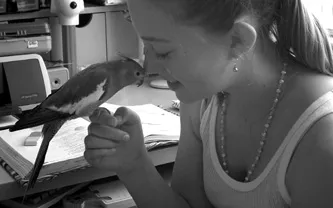
People have the ability to bond with all types of animals and share unique relationships with them. Savannah and Tutti share a loving bond.
A turning point in the way society views pet ownership is occurring. The momentum is swelling and the wave of change is sweeping to the shore. Perhaps it was the unrelenting devastation of Hurricane Katrina, which rocked the Gulf Coast and left thousands of pets and people stranded and eventually perishing. Perhaps it was even earlier than this when another disaster struck the U.S. This time, on 9/11, it was a man-made attack in which pets were abandoned in apartment buildings in New York City. At whatever point in society we can trace the change back to, somewhere along the line the majority of people started to understand and witness the bonds people share with their animals. Pet owners are now being referred to as pet parents or guardians. Journalists acknowledge that the status of the family pet has gone from being a household appendage to a significant family member.
If any good has been derived from such devastation, it is to be found in the endless stories and recounting of tales of just what animals mean to people and how deeply those bonds are felt. People reacted in anger as the media reported the forced abandonment of family pets. Rescue volunteers were not able, not allowed, or perhaps unwilling, to provide for the family pet along with human family members. There was public outrage as people found out that animals were left to fend for themselves, and that many, if not most, died as a result.
People also discussed the very real accounts of how some disaster victims refused to evacuate without their pets, choosing to remain and even die with their pets, rather than abandon them. While some victims did stay, others were forced, perhaps in having to make a difficult choice to evacuate with an aging or ailing parent or child, to leave the family pet behind. The pain and guilt they took with them was yet another affront to what they already had to bear physically, emotionally, psychologically, and spiritually.
It’s during this painful period in U.S. history that people are beginning to view pets as family members worthy of being rescued, cared and provided for, because they are loved.
Out of devastation and loss, lessons are hopefully learned. Veterinary medical organizations, rescue workers, and others are readdressing, developing, and implementing plans to assist pet parents and their pets during a disaster. Some local and state humane and animal rescue organizations are helping to establish emergency policies, protocols, and plans of action to assure the rescue and care of animal family members.
In the eyes of society, the status of pets is forever changed. Ultimately, it is hoped that the loss of a pet will be afforded the same respect as the loss of a human family member and that the validation of, and support for, the loss will be extended to grieving pet parents.
Therapists don’t have to look further than the client sitting before them to discover the significant role companion animals play in people’s lives. All they have to do is ask. According to the American Pet Products Manufacturers Association’s 2005–2006 National Pet Survey, there are 116 million households with pets in the United States. This number has almost doubled since the 1998 survey. The survey included fish, reptiles, birds, cats, dogs, and small animals (guinea pigs, hamsters, mice, rats). It didn’t include those who keep spiders, ducks, horses, and other types of animals as pets, so it’s safe to conclude that the number of pets people have may be significantly higher than the reported 116 million.
Many of the clients therapists see in their practices share a bond with an animal. Anyone who is a pet parent or who works with animals is in a position to form a deep attachment to an animal. This includes veterinarians, zoo keepers, pet store employees, feed store owners, humane society volunteers, groomers, animal trainers, and people who volunteer for animal service organizations. It doesn’t matter what type of pet—bugs to horses and everything in between— deep bonds of attachment can form.
Pets provide people with companionship, protection, entertainment, and stimulus for exercise, social opportunities, and the chance to love and nurture something outside of themselves. When a pet is gone, the guardian often experiences a deep sense of loss and grief. In a recent study on endured stress levels, the death of a pet was the most frequently reported trauma experienced by couples (Lagoni, Butler, & Hetts, 1994, p. 27).
Chances are good that the client who seeks therapeutic services has experienced at least one pet loss in his or her life. Often this is an unresolved loss, as our society is only beginning to recognize the significance of the loss of a pet. Rituals and ceremonies for mourning the passing of a pet are only recently beginning to gain favor in society.
When a client seeks therapy, therapists should include on their initial intake form a question or two about the presence of companion animals in the home. It is important to establish the degree of emotional attachment to the pet(s) of each family member and to determine who takes primary responsibility for the care of the animal(s). An overall assessment of a client’s strengths and weaknesses will be incomplete if the therapist fails to list companion animals as a source of support and pleasure, a focus of concern and stress, or even a cause of guilt, anger, and frustration.
Clients may seek support when they experience the loss of a pet, but it is more likely the pet loss will come up when they are working on other, more socially acceptable stresses (for example, at the time of a divorce, the death of a spouse or friend, or the loss of a job). Many clients have been taught not to display their feelings about the loss of a pet. Some have had the wrong words spoken to them at the wrong time about sharing their feelings of loss for animals. Because of this they often are embarrassed at having deep feelings for an animal; they believe that they are wrong, or different, to feel deep sadness over the loss of a pet and they often go to great lengths to hide those feelings.
A History of Companion Animals
Understanding the bonds between people and their animals will help therapists work with clients who are experiencing a pet loss. The only way a therapist can truly understand the bonds is to ask their clients what the pets mean to them. Once their loss has been validated, it is not uncommon for clients to report that the bond they shared with a companion animal was deeper than any they have shared with another person. This is because companion animals give people something that other people are not always capable of giving: unconditional love.
The relationship between humans and pets dates to the beginnings of civilization. Ancient Egyptians kept cats as pets. There are records of dogs being kept as “house pets” as early as 3000 BC (Mugford, 1977, p. 4). A 14,000-year-old skeleton of a human male was discovered in an ancient near-Eastern burial ground, with its arms wrapped around a dog’s skeleton. Human–companion animal bonding is not a new phenomenon (Arkow, 1987, p. 70).
Recent years have seen a growing interest in and concern for human–companion-animal bonds. We are only beginning to understand the ties that can develop between people and their pets. The significance of a pet’s death can have far-reaching ramifications for the guardian. Because many pets are considered to be members of the family, the death of a pet can alter the entire structure of a family and reshape the guardian’s sense of well-being.
The study of the relationship between humans and animals is not new; but the study of the emotional and psychological bonds humans have with their pets is. One of the first organizations to document the importance of animals to humans was the Latham Foundation, established in 1918 (Levy, 1981). According to Hugh Tebault (1997), its president, the Foundation originated the Delta Group, which was interested in studying the scientific aspects of research in this field. In 1979, the Delta Group became independent, and is now known as the Delta Society. The Delta Society is an international research service and educational center for persons and organizations in the field of human–animal interactions. The Delta Society has uncovered a variety of significant relationships people share with their pets.
Pets provide us with physical, social, and emotional benefits. Most of us are aware of the success of service organizations such as Guide Dogs for the Blind and Canine Companions for Independence (CCI). A vast amount of data has been collected on the difference pets can make in a disabled person’s life. Information also is being collected on the therapeutic benefits that pets bestow on humans. Studies indicate that the presence of a pet in a therapist’s office can encourage a withdrawn child to open up. Other studies show that a patient’s blood pressure can be lowered simply by stroking a cat. No one can dispute the relaxing effects of watching fish in a tank or the positive cardiovascular benefits of walking a dog in the park.
Research also indicates that not all people bond with or even like pets. If a person enjoys having a pet, the human–pet relationship has the potential for positive therapeutic effects on that person’s life. On the other hand, a person who has not liked animals throughout his or her life will not find benefit from keeping an animal as a companion.
Finally, it is important to remember that people form attachments to animals other than cats (the most popular pets) and dogs. In Chapter 12 there is a beautiful story about a woman who loves insects and keeps pet walking sticks. She shares the life-lessons she’s learned from observing and interacting with these amazing creatures. People can also become attached to wild animals. Susan Chernack McElroy includes poignant examples of interacting with nature in her book Animals as Teachers and Healers. Some children and adults will sit for hours in a wooded area to see how many animals will approach them. Many adults like to watch birds or go hiking to experience wildlife.
The Human–Pet Bond
Changes in human mobility and family structure have increased the likelihood that people will form significant attachments to pets. Studies indicate that, in recent years, pets have become even more important to people. The pet industry reports a large increase in pet expenditures in the past decade, an increase that has skyrocketed in the last five years. Researchers attribute this increase to the fact that people are choosing to have fewer children, and consequently often view their pets as their children. In fact, of the people who share their lives with companion animals, 70% consider their pets to be their children (Ciba Seminar, 1996). Another recent study indicated that 99% of cat and dog guardians consider their pets full-fledged family members (Ciba Seminar, 1996).
A pet can represent many things to a pet parent. Some people view their pets as best friends. Others see them as children. Companion animals can be bridges to our past. They can remind us of happier times or of sad events. A companion animal may accompany a person through childhood into adulthood. A pet can be a source of support during a divorce or other loss. In some cases, the presence of a pet in a person’s life can be a lifeline. For many people living with terminal illnesses, pets are not only sources of comfort and support, they are reasons to continue living.
The love and life lessons people experience as pet parents are varied and deep:
- A man living with AIDS said that his three cats kept a vigil by his bedside when he was very sick. When he thought he might die, he was able to reach down and draw strength from his furry friends and feel comforted by their presence.
- A Vietnam veteran whose 17-year-old cat had just been euthanized shared that the cat was the first thing he had learned to love again after returning home from the war.
- A woman who had lost a baby to sudden infant death syndrome (SIDS) acquired a puppy to help her through the loss. When her dog died, she was reminded of the loss of her child as well.
- A woman whose dog died suddenly remarked that his death was more difficult for her to endure than the recent loss of her mother (with whom she’d been close) had been (Petitt, 1994, p. 151).
For a disabled person, a pet not only is a companion but also can be viewed as an extension of the individual. Animals can be trained to be the eyes or ears of a blind or hearing-impaired person. They can provide a disabled person with physical mobility. Animals can be trained to open doors, turn on lights, carry and retrieve items, and even push elevator buttons. They can give the disabled a bridge to the outside world. They can even assist people with emotional and psychological problems by helping them to learn to trust again.
Benefits of Animal Companionship
One emotional or psychological benefit of keeping pets is the very fact that pets are dependent on people. Small animals, such as rabbits, birds, guinea pigs, and rats, require a certain amount of care. Cats reward us with purrs and affectionate rubs. Dogs faithfully greet us at the door. Small tokens of gratitude exhibited by a pet gives one a sense of being needed. Pets also provide us with a focus of attention, something to love and touch. Through care-taking and nurturing of a companion animal, a person’s self-esteem and sense of accomplishment can be enhanced.
Play is another benefit of pet ownership. Pets often evoke play behavior in us, and the act of playing has been recognized as one of the most important aspects of social development. According to Mugford (1977, p. 13), “Play provides essential early stimulation for both human and animal young, serving to reinforce social bonds between parents and infant and exercising motor patterns relevant to later adult behaviors.”
Finally, pets can be social icebreakers. Someone who is shy or has a difficult time communicating with others can reach out to the world via his or her pet. Studies have shown that people will approach others who are with their pets to inquire about the pet or comment on it. This opens up a safe arena for communication (Ross, 1987, p. 13).
Children and Pets
For a child of working parents, one who does not have siblings to play with, pets can encourage the development of the imagination. Children will make up and play games with their pets. A pet can help a child develop his or her motor skills as well. Babies often crawl after a pet or reach out to grab the dog’s tail. Adults as well as children can enjoy interacting with animals.
Dr. Aline Kidd, professor of psychology at Mills College, stressed the benefits of pets for children and their positive effects on the learning process. Young children are not yet aware that they can be hurt or feel pain. The young see other children as objects—like dolls, teddy bears, or plastic toys. Experiencing animals as well as other children helps children learn some of the happier, as well as the more painful, characteristics of life itself. Watching a pet give birth can teach something about the beginning of life. The death of a pet can help teach that life has an end. Both ends of the spectrum, and all the in-between parts, can help a child learn how to cope with his or her own life challenges (Kidd, 1982, p. 8).
A companion animal can provide a child with stability and continuity in the family setting. Especially for those children whose parents have gone through separation or divorce, a pet can remain a dependable family member, someone who silently relates to the child in a constant way in the midst of changes.
According to Levinson (1982), children can develop enhanced self-esteem by seeing themselves in a position of authority when they ...