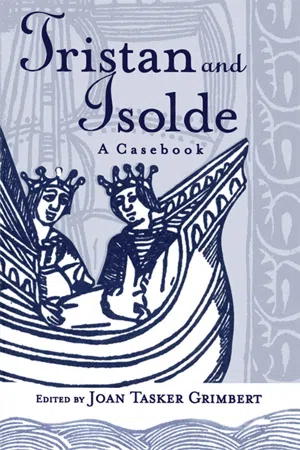
- 638 pages
- English
- ePUB (mobile friendly)
- Available on iOS & Android
eBook - ePub
About this book
A substantial introduction traces the Tristan and Isolde legend from the twelfth century to the present, emphasizing literary versions, but also surveying the legend's sources and its appearance in the visual arts, music and film. The nineteen essays are a mix of new, new English, revised, and 'classic'. It contains an extensive bibliography.
Information
Introduction
Gaston Paris called it the incomparable love epic, and for Jean-Charles Payen it was the most beautiful love story of all time: Tristan and Isolde bound by the singular power of an exclusive passion that forces them to violate the most sacred social and religious ties. As one of the founding myths of Western culture, it has been told and retold from the Middle Ages to the present day. It flourished first in the British Isles, France, and Germany, countries where its appeal has remained most enduring, then quickly spread to Italy, the Iberian Peninsula, Scandinavia, and well beyond, for there are even early versions in Czech and Byelorussian. Transmitted originally, no doubt, in the form of short oral tales, it was cast in verse romances by French and German poets in the late twelfth and early thirteenth centuries. The subversive nature of the passion informing the tale also exercised a powerful attraction on lyric poets and artists, for whom the lovers epitomized ardor, ingenuity, and beauty. Stressing either the celebratory or the cautionary aspect of the legend, they encapsulated it, seeking to portray its essence in one or two emblematic phrases or images. Others expanded it: as Tristan was increasingly drawn into the Arthurian orbit, gaining eventually a seat at the celebrated Round Table, the legend was incorporated into the large prose cycles that recounted, starting in the thirteenth century, the adventures of Arthur's knights. In these romances (mostly French, English, Italian, and Spanish), where the focus was usually on chivalric exploits, the love story was at times eclipsed, although the parallel established with Lancelot and Guenevere gave it new significance. It remained squarely in the forefront of later German and Scandinavian romances, but the subversive impact was blunted by other means.
The legend went into virtual eclipse after the medieval period, only to be resurrected several centuries later when Romantic poets and artists, troubled by the excesses of absolutist regimes and by the social changes wrought by the Industrial Age, embraced the Middle Ages as an idyllic time when people had lived—or so they imagined—happily in harmony with each other, and with nature and the universe. The masterpieces of that “golden age,” preserved in manuscripts or early printed editions but maligned and disdained by Humanist scholars and their Classicist successors, had been gathering dust in libraries and secondhand bookstores. Brought suddenly to light by philologists and other scholars, who published editions, summaries, and modern translations of them, the earliest versions of the Tristan legend became increasingly available to all those for whom the Middle Ages held a special attraction. The patient work of scholars and the impatient aspirations of Romantic and Victorian writers and artists conspired to bring about an important revival of the legend, in England most notably by Arnold, Tennyson, and Swinburne, who profoundly influenced British and American art and literature. Wagner's opera was to have an exceptional impact, disseminating not just in Germany but throughout the Western world a singularly Romantic version of the legend. As if to counteract that effect, the eminent medievalist Joseph Bédier sought to turn attention back to the legend's roots, reconstructing what he believed to be the “original” text and producing for the general public a graceful version in modern French that was widely translated. The extraordinary conjunction of these influences stimulated a new wave of retellings that was to peak in the early decades of this century. Although the legend has continued in the late twentieth century to inspire new and often highly creative retellings, it bears the scars of a difficult passage into an age that is at once more tolerant of adultery and less sanguine about the prospects for undying love. Indeed, it is not uncommon nowadays to see the venerable old story pressed into service to pen its own critique or, more accurately, to condemn the kind of romantic fantasy it has come to represent for those who are unaware of the beauty and complexity of its earliest incarnations.
The foregoing summary, designed to give a broad overview of the legend's prodigious fortunes, purposely blurs the particularities of its evolution in each of the major countries where it first flourished and was rediscovered. Yet one of the most fascinating aspects of the legend is how it took root and thrived in the British Isles, France, Germany, and Norway, then branched out in varied and distinctive ways as it spread throughout Europe, Scandinavia, and, in this century, to the United States. In the more detailed discussion below, we shall see the various metamorphoses it underwent.1
The Origins of the Legend and the Earliest Extant Versions
[Note: Items with asterisks are represented in this volume]
The origins of the legend remain obscure, despite numerous efforts to pinpoint them.2 While the oldest extant versions are fragments dating from the late twelfth century, there are manuscripts preserving traces of earlier states, tales transmitted orally, no doubt, that constitute analogues if not actual sources but that may in fact have been influenced by early French and German versions. These are Celtic, for the most part, but certain motifs were evidently borrowed from Hellenic, Persian, and Arabic sources. The legend's roots have been described variously as lying in Cornwall, northern Britain, and Ireland. The names of the main characters can be traced to sixth- or seventh-century Britain: Tristan has been identified with the Pictish Drust, son of Tallorc, appearing in the Welsh Triads as Drystan, son of Tallwch, whose lover Essylt was married to his uncle March. Key elements of the plot are to be found in Irish works of the ninth and tenth century (The Wooing of Enter and The Pursuit of Diarmaid and Gráinne). Among the possible non-Celtic sources and analogues, the Persian Wîs and Rânîn is cited most frequently.
At the core of the legend as it evolved in the Middle Ages is a passionate love that is both fated and fatal, a mutual ardor so strong and exclusive as to override the most compelling family, social, and religious taboos. The potion/poison that is the source of this passion maintains the lovers in a constant state of unrest and drives them to a premature death. While most scholars agree that these are the key elements of the legend, others claim that the notion of a love potion guaranteeing reciprocity represents a travesty, a willful betrayal by twelfth-century poets who modified the original tale to reflect values associated with a society anxious to reinforce the patriarchal structures embraced by the emerging State and the Church (Rabine*). Indeed, in Celtic analogues, the heroine is a kind of goddess with magical powers: it is she who traditionally chooses a mate and, should the object of her desire prove indifferent to her, casts a spell over him. In the continental romances, this geis, which gives the woman a commanding influence over her heart's desire, has been replaced by the potion, which, on the one hand, renders the woman powerless to oppose her father's resolve to use her marriage for political ends, and, on the other, renders both partners impotent in the face of an inexorable fate that pits their individual desires against those of the community.
The precise sources of the legend and its early history will doubtless always remain an enigma, and while it is clear that there are analogues in the tales of the Celts and of other cultures as well, the story that has fired the imagination of artists of all kinds from the Middle Ages on derives from the versions told by French and German poets beginning in the twelfth century. Nevertheless, the mouvance that characterizes the legend—the uncertain nature of the “original” and the fragmentary state of the earliest written texts—has been an inexhaustible source of creativity through the ages as poets, novelists, playwrights, artists, musicians, choreographers, and filmmakers have attempted either to recapture what they conceive to be the original spirit of the legend or to recast it according to their own particular aspirations and anxieties or to those of their age.
The earliest extant texts recording the legend date from the last half of the twelfth and the beginning of the thirteenth century and represent two separate “traditions” that have long been known respectively as the version commune (common or primitive version) and the version courtoise (courtly version), both of which either descended from a lost “original” romance or archetype (estoire) or were composed from various oral tales that had grown up around a thematic nucleus associated with the legend and were circulating on the Continent at the time.3 It is generally thought that the version commune is most faithful to an earlier state, while the version courtoise incorporates changes that were a product of the court culture flourishing in France and Germany in the late twelfth and early thirteenth centuries. But as we shall see, these labels are somewhat misleading. The major French texts are fragments preserved in Anglo-Norman of two narrative poems composed in octosyllabic couplets in the late twelfth century, one by Béroul, representing the version commune, and the other by Thomas d'Angleterre (version courtoise). Roughly contemporaneous with these is a poem in Middle High German by Eilhart von Oberge, whose plot preserves a slightly different strand of the version commune. Dating from the thirteenth century are two texts whose authors claim to have followed Thomas, a long unfinished poem in Middle High German by Gottfried von Strassburg and a complete translation/adaptation in Old Norse by Friar Robert. Since it is impossible to know what elements of these earliest extant versions were included in the “archetype”—if indeed a single one ever existed—the following rough outline of the legend is intended simply as a frame of reference to facilitate discussion and comparison of the individual versions.
Born to King Rivalin of Lyonesse and Blancheflor, sister of King Mark of Cornwall, Tristan loses his mother at birth, and in most versions his father dies in battle before or just afterward. His education is entrusted to his tutor, Governal, who will become his trusted companion. He shows great promise, not only in all martial skills taught to young nobles, but also in more courtly ones, especially music. He arrives incognito in Cornwall, where his skills in harping and hunting win his uncle's heart. When the Irish champion Morholt (the Irish queen's brother) arrives to demand the annual tribute, Tristan defeats him, inflicting a fatal blow to the head, where a piece of his sword lodges and will later identify him as the slayer. Tristan himself receives a poisonous wound in that combat and eventually, believing he is doomed, has himself set adrift in an open boat along with his harp. He arrives by chance in Ireland, where, disguised as a minstrel named Tantris, he is cured by the Queen and her daughter, Isolde, and then returns to Cornwall, where his uncle's affection for him and the determination to make him his heir cause the jealous barons to urge Mark to marry. Tristan is entrusted with the bridequest, which takes him back to Ireland, where in some versions he goes deliberately in search of Isolde, while in others a storm lands him there after he has set out blindly on a quest Mark hopes is impossible: to find the woman from whose head came the golden strand of hair brought to him by two swallows. In Ireland, Tristan slays the dragon that has been ravaging the land but faints from the poisonous flames emanating from its mouth. When Isolde learns that her father's steward, a known coward, intends to claim the prize (her hand in marriage), she seeks out the real hero, finds Tristan, and nurses him back to health. Although outraged to discover the notch in his sword identifying him as her uncle's murderer, she is persuaded not to kill him in order to avoid being married to the steward. Tristan obtains the king's permission to take her back to Cornwall for Mark, and the two set out with Isolde's servant and confidante, Brangane, to whom the Queen entrusts a love potion for the bridal couple.
On board the ship to Cornwall, Tristan and Isolde drink the potion by mistake and consummate the love that will give them no rest until they die. Isolde persuades Brangane to replace her in her nuptial bed (but later, fearing betrayal, she tries unsuccessfully to have her murdered). In Cornwall, the lovers lead a double life, meeting secretly while trying to thwart attempts by the evil dwarf Frocin and the felonious barons to prove their treachery to Mark, whose affection for the couple makes him reluctant to doubt their professed loyalty. In one famous episode, Frocin persuades Mark to spy on them by hiding in the tree in the orchard where they often meet, but the lovers see his reflection in the water below and engage in an exchange that dispels his doubts, causing him to invite Tristan to sleep again in the royal chamber. One night when Mark is supposedly away, the dwarf sprinkles flour on the floor between the lovers’ beds and, although Tristan avoids it by jumping from his bed to Isolde's, blood from a reopened wound leaves telltale stains on the bedsheets. The lovers are condemned to death, but Tristan escapes by leaping from the window of a cliff-side chapel he entered for last-minute prayer and lands miraculously unhurt on the rocky coast below. Meanwhile, Mark has been persuaded to assure Isolde a shameful death by turning her over to the local leper colony. Tristan rescues her, and they flee to the Morois forest, where they lead an existence whose harshness is mitigated only by their ardent love for each other. At length, Mark learns of their whereabouts and goes there intending to kill them, but after finding them sleeping fully clothed in their hut, with Tristan's sword between them, he again persuades himself of their innocence and retreats, leaving signs to indicate his change of heart. Not long after, the lovers, anxious to reclaim their rightful roles in society, decide to return to court, a desire that in some versions is caused by the abatement of the potion's effects after three or four years. While Mark agrees to take back his wife, he is persuaded to exile Tristan and eventually to make Isolde swear an oath of innocence, an ordeal from which she emerges unscathed.
Tristan's travels lead him at last to Brittany, where he enters the service of Duke Hoël, whose son, Kaherdin, becomes his companion. He eventually marries Hoël's daughter, Isolde of the White Hands, but, realizing on his wedding night that he was temporarily bewitched by her name and beauty, he is unable to consummate the union. He returns periodically to see the Queen in Cornwall, variously disguised as leper, pilgrim, and fool. Back in Brittany while helping Kaherdin engineer a meeting with his lover, he is fatally wounded by a poisoned spear. All remedies failing, he sends for the Queen, instructing the messenger to hoist, on the return trip, a white sail if she is aboard, a black sail if she is not. His wife, apprised at last of his relationship and also of this code, informs Tristan that the white sail she sees on the returning ship is black. Tristan, believing that his lover has ceased to care for him, expires on the spot, as does the Queen when she arrives and finds him dead. Having learned the secret of the potion, a repentant Mark buries them side by side in Tintagel. From their tombs spring two vines that intertwine.
Béroul's poem, composed perhaps as early as 1150, but more likely closer to 1190, is a 4,485-line fragment that takes up the story at the point of the famous tryst under the pine (which establishes the lovers’ unrepentant talent for verbal duplicity and Marc's touching gullibility) and recounts all events up through Yseut's return to court and Tristran's banishment. One of the most famous episodes is both highly comical and deeply disturbing: when Yseut is forced to swear her innocence at a ceremony presided over by King Arthur near the Mal Pas swamp, she arranges to have Tristran, disguised as a leper, carry her across the swamp on his shoulders so that she can swear honestly that she has never had any man between her thighs except her lord Marc ... and the leper. That she is successful here seems to suggest either that God is satisfied with literal truth or that He deems her innocent because she has been driven to this sinful love against her will.
Béroul attributes to the abatement of the potion's effects (limited to three years) the lovers’ decision to leave the forest, but they apparently remain bound by their passion, for they are in the midst of still another secret rendezvous when the fragment breaks off. Comparing Béroul's poem with Thomas's, one is struck by the upbeat tone that stems partly from the lovers’ mischievous delight in their ability to exploit language to achieve their subversive ends and partly from the narrator's overt espousal of their cause, a sympathetic attitude shared by all of Marc's subjects except Frocin and the felonious barons, who claim to have their lord's interests at heart. But the situation is not as clear-cut as it may at first seem. While Tristran's enemies (who, motivated by envy and spite, are clearly evil) manage occasionally to awaken a cruel streak in the King, Marc is actually portrayed with some sympathy, as he wavers between his lo...
Table of contents
- Front Cover
- Half Title
- ARTHURIAN CHARACTERS AND THEMES
- Title Page
- Copyright
- Dedication
- Contents
- Preface
- Introduction
- Acknowledgments
- Select Bibliography
- Tristan and Isolde
- Tristan: The Celtic and Oriental Material Re-examined
- Love and the New Patriarchy: Tristan and Isolde
- How Lovers Lie Together: Infidelity and Fictive Discourse in the Roman de Tristan
- The Representation of the Lovers’ Death: Thomas’ Tristan as Open Text
- The Glass Palace in the Folie d’Oxford
- Tristan the Artist in Gottfried’s Poem
- Gottfried von Strassburg: Tristan and the Arthurian Tradition
- La Parole amoureuse: Amorous Discourse in the Prose Tristan
- Radix Amoris: The Tavola Ritonda and Its Response to Dante’s Paolo and Francesca
- Malory’s “Tale of Sir Tristram”: Source and Setting Reconsidered
- Tristan in Medieval Art
- Swinburne’s Tristram of Lyonesse: Visionary and Courtly Epic
- “That Most Beautiful of Dreams”: Tristram and Isoud in British Art of the Nineteenth and Early Twentieth Centuries
- Wagner’s Tristan und Isolde: Opera as Symphonic Poem
- Wagner and Decadence
- “This too you ought to read”: Bédier’s Roman de Tristan et Iseut
- Tristram the Transcendent
- Cocteau’s Tristan and Iseut: A Case of Overmuch Respect
- Tristan and Isolde in Modern Literature: L’éternel retour
Trusted by 375,005 students
Access to over 1.5 million titles for a fair monthly price.
Study more efficiently using our study tools.
Frequently asked questions
Yes, you can cancel anytime from the Subscription tab in your account settings on the Perlego website. Your subscription will stay active until the end of your current billing period. Learn how to cancel your subscription
No, books cannot be downloaded as external files, such as PDFs, for use outside of Perlego. However, you can download books within the Perlego app for offline reading on mobile or tablet. Learn how to download books offline
Perlego offers two plans: Essential and Complete
- Essential is ideal for learners and professionals who enjoy exploring a wide range of subjects. Access the Essential Library with 800,000+ trusted titles and best-sellers across business, personal growth, and the humanities. Includes unlimited reading time and Standard Read Aloud voice.
- Complete: Perfect for advanced learners and researchers needing full, unrestricted access. Unlock 1.5M+ books across hundreds of subjects, including academic and specialized titles. The Complete Plan also includes advanced features like Premium Read Aloud and Research Assistant.
We are an online textbook subscription service, where you can get access to an entire online library for less than the price of a single book per month. With over 1.5 million books across 990+ topics, we’ve got you covered! Learn about our mission
Look out for the read-aloud symbol on your next book to see if you can listen to it. The read-aloud tool reads text aloud for you, highlighting the text as it is being read. You can pause it, speed it up and slow it down. Learn more about Read Aloud
Yes! You can use the Perlego app on both iOS and Android devices to read anytime, anywhere — even offline. Perfect for commutes or when you’re on the go.
Please note we cannot support devices running on iOS 13 and Android 7 or earlier. Learn more about using the app
Please note we cannot support devices running on iOS 13 and Android 7 or earlier. Learn more about using the app
Yes, you can access Tristan and Isolde by Joan Tasker Grimbert in PDF and/or ePUB format, as well as other popular books in Literature & Literary Criticism. We have over 1.5 million books available in our catalogue for you to explore.