Counseling older adults is not equivalent to counseling the general population, and specialized skills and knowledge, as well as sensitivity to the contexts in which older adults live, are essential in working successfully with this population. This text provides an introduction to gerontological counseling, integrating the basic skills of working with older adults with theories of counseling and aging. Specific counseling issues discussed include mental health counseling, career counseling, rehabilitation counseling, and family counseling. Along with these, important contextual factors such as race/culture, social class, social justice, spirituality, Alzheimer's and other dementias, and family issues are considered in light of the latest research. Each chapter contains case studies, discussion questions, a glossary, and suggestions for further reading to reinforce the material presented.
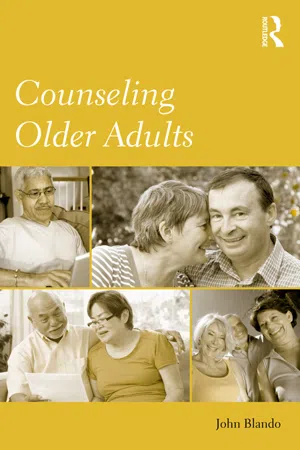
- 442 pages
- English
- ePUB (mobile friendly)
- Available on iOS & Android
eBook - ePub
Counseling Older Adults
About this book
Information
CHAPTER 1
Theories of Aging and Later Life Development
A person is not a problem to be solved, but a mystery in which to dwell.
—Daniel P. Sulmasy (2002, after Marcel, 1949)
Old age, especially when it has enjoyed honors, has an influence worth all the pleasures of youth put together.
—Marcus Tullius Cicero (106–43 BCE)
CHAPTER OVERVIEW
In this chapter, you will learn some basic information about the major theories of aging and later life development. You will learn about implicit theories of aging. You also will learn two perspectives on aging from two very different cultures—a classical point of view from the ancient city-state of Athens and a Hindu outlook from India. Finally, you will learn a number of modern and contemporary theories of aging, including those of Carl Jung, Erik Erikson, Paul Baltes, Johannes Schroots, and others.
The first time I, as a clinician-in-training, sat down with an older adult client—an 80-year-old who was recovering from a stroke—I thought to myself, “What do I really know about growing old?” I was lucky enough to have spent cherished time with my grandparents and to have taken wonderful courses in aging and psychology, but I did not have an experiential understanding of aging. The longer I thought about this, the more I realized that what I did have was a personal theory of aging. I did not label it as a theory per se; rather, I thought of it as a set of beliefs. As I reflected on my theory, I came to understand that my personality; the culture in which I live; my age; my education; my experiences in childhood, adolescence, and adulthood; and a number of other factors influenced my theory.
I came to believe that each of us has a personal theory of aging and later life development. I have one, you have one, and older clients have one. We may not have articulated our theories, but we have them. Like those that influence my theory, many factors influence your theory and older clients’ theories: personality, culture, gender, age, cohort, lived experience, and so forth. These factors affect beliefs about development over the life span and into old age. Furthermore, as we change over time, so do our theories of aging and later life development.
You might be thinking, “What relevance does a theory of aging have in my day-to-day life or that of older clients?” I argue that theories of aging do matter. What you believe about aging influences how you perceive and interact with older clients. Furthermore, older clients’ beliefs about aging influence how they perceive themselves and how they interact with others. Whether one is counselor or client, one’s theory of aging influences one’s perceptions and how one lives one’s day-to-day life.
Aging, as an area of study, is unique in that there is no single overarching theory. In other words, there is no unified theory of life span development and aging. There are many different theories—some of them biomedical, others sociological, psychological, philosophical, economic, or spiritual. In this chapter, we will look at two philosophical-spiritual perspectives, as well as major psychosocial theories. We will explore how they are similar to and how they differ from one another, focusing particularly on those factors most relevant to counseling.
Older people have sets of beliefs about how personal attributes change over the life course, and they use these beliefs to construct stories of what they were like when they were younger (McFarland, Ross, & Giltrow, 1992). These sets of beliefs are implicit theories of aging. That is, each of us has a set of beliefs, even if we do not explicitly articulate it to others or even to ourselves.
Attributes found in these implicit theories take one of three forms: attributes that are perceived as increasing with age (e.g., understanding, affection, life satisfaction, pride, or physical discomfort), attributes that are perceived as decreasing with age (e.g., activity level, ruggedness, or the ability to remember names or phone numbers), or attributes that are perceived as neither increasing nor decreasing with age (e.g., involvement in politics, mood swings, or the importance of being attractive) (McFarland et al., 1992). An older adult may believe that athletic ability decreases with age, happiness decreases with age, and assertiveness increases with age. This is one implicit theory of aging. Another older adult may believe that memory decreases with age but that wisdom increases with age and that common sense stays the same. This is another implicit theory of aging. An individual’s set of beliefs compose, then, his or her implicit theory of aging.
Older adults’ remembrance of attributes that they believe increase with age are biased, in that they recall themselves as possessing less of a particular attribute when younger than is actually possessed by younger adults. Likewise, older adults’ remembrance of attributes that they believe decrease with age are biased in that they recall themselves as possessing more of a particular attribute when younger than is actually possessed by younger adults (McFarland et al., 1992). This suggests either that older adults have implicit theories of aging that are biased—in that the theories demand more change in attributes than what is actually experienced—or that the theories are not biased but older adults’ current assessments of changes in the attribute are (McFarland et al., 1992). What is clear is that older adults’ memories are influenced by their intrinsic theories of aging, namely, in the changes experienced as one gets older, whether the changes are positive or negative, and independent of how self-serving is the memory (McFarland et al., 1992).
Aging is “the transformation of the human organism after the age of physical maturity … so that the probability of survival constantly decreases and there are regular transformations in appearance, behavior, experience, and social roles” (Birren, 1988, p. 159). This means that upon birth, and for a period of years, we develop toward sexual maturity, reaching an age at which we are most successful at sexual reproduction. After this age begins a period in which we, at an increasing rate, are more likely to die and a period in which changes continue to occur in how we look, how we act, what we experience, and the roles we are given or that we take in our families and culture. One thing is as certain as our birth: If we are so lucky, we shall mature, grow into old age, and die.
What follows is a broad overview of theories of aging and later life development. We will start with two diverse theoretical foundations: that of the city-state of ancient Athens expressed in Plato’s perspective on aging and that of India expressed in the Hindu life stage concept of ashrama. We then will explore modern theories of aging, including Carl Jung’s perspective, Havinghurst’s activity theory, Erikson’s eight stages of psychosocial development, Cumming and Henry’s disengagement theory, and Neugarten’s perspective on personality and successful aging. Finally, we will address some of the major contemporary theories, including Baltes and associates’ theory of selective optimization with compensation, Salthouse’s resource-reduction theory, Costa and McCrae’s personality trait model, Levinson’s personality development theory, Tornstam’s gerotranscendence theory, Schroots’s gerodynamics theory, Atchely’s continuity theory, and Rowe and Kahn’s theory of successful aging. Though not without their critics, these theories will help you broaden and deepen your understanding of later life and aging.
As we address the theories, consider the degree to which each of them has relevance to clients or is helpful in conceptualizing clients’ challenges or in developing therapeutic interventions. Ask yourself, “Are Plato’s theory or Hindu ashrama theory relevant to my clients? Are either of these theories helpful to them in conceptualizing their challenges or in developing more adaptive responses? Does gerotranscendence theory have relevance to me? Is it helpful to me in conceptualizing my clients’ challenges or in developing therapeutic interventions?”
ANCIENT FOUNDATIONS
We will begin by discussing as examples of the diversity of theories of life span development and aging a theory based on an ancient Western tradition—a classical Athenian perspective on aging presented by Plato—and a theory based on an Eastern tradition—a theory of life span development that evolved in India’s Hindu tradition. These two perspectives are offered as example theories of aging. You will find other early theories in the writings of the ancient Romans, Chinese, Persians, and other civilizations.
Plato’s Theory of Aging
Plato explicated a theory of aging in at least three of his major works—Republic, Apology, and Crito—and in doing so anticipated three major issues in theories of aging: dialectic between theories, the life review, and the nature of wisdom (McKee & Barber, 2001) (see Table 1.1).
TABLE 1.1 Plato’s Theory of Aging
| Issue | Description |
Dialectic between theories | The dynamic tension between old age as a time of activity-continuity and old age as a time of disengagement-gerotranscendence |
Life review | Retrospective evaluation of life prompted by temporal movement toward death |
Nature of wisdom | Cognitive, affective, and volitional dimensions of an older person that are useful in responding to life’s problems |
Note: McKee, P., & Barber, C. E., “Plato’s Theory of Aging,” Journal of Aging and Identity, 6(2), 93–104, 2001.
Dialectic Between Theories. A theory of aging can be conceptualized as being either an activity-continuity theory or a disengagement-gerotranscendence theory (McKee & Barber, 2001). An activity-continuity theory of aging is one that proposes that in late life, adults continue to seek out those activities, relationships, and values that were of importance to them in midlife (McKee & Barber, 2001). Any theory with this viewpoint fundamentally proposes that we think, feel, and do in late life that which we think, feel, and do in midlife unless something (such as illness) interferes with it. It is a belief in continuity in adulthood. A disengagement-gerotranscendence theory of aging is one that proposes that in late life adults develop a perspective different from what they had in midlife. Furthermore, this different perspective is marked by a lesser interest in the beliefs, feelings, and activities common in midlife and a greater interest in looking inward and considering one’s relationship to the transcendent (McKee & Barber, 2001). Both of these theoretical orientations are present in Plato’s writings.
In the Republic, Plato describes an interaction in which Socrates asks an old man, Cephalus, the secret of happiness in late life. Cephalus states that happiness in late life is found in qualities that allow one to detach from the values of youth and midlife (especially those of material gain) and “to transcend the many painful aspects of age,” especially those of physical decline (McKee & Barber, 2001, p. 94). Furthermore, Plato reflects on several concepts found in disengagement-gerotranscendence theory (discussed below): a movement from materialism to transcendentalism (in the allegory of the cave, represented by the desire to escape from darkness into the light), “identification with prior generations” (in stories of Socrates’ respect for the customs and laws of civil society), “responsibility for future generations” (in the allegory of the cave, the wise one’s return to the cave as mentor), and a decreased fear of death (in stories of Socrates’ gracious acceptance of the inevitability of death) (McKee & Barber, 2001, p. 97). Through these stories, Plato appears to be at the disengagement-gerotranscendence end of the spectrum.
Yet Plato does not stop there. He considers whether older adults who want to disengage have a responsibility not to do so and to remain actively engaged (McKee & Barber, 2001). In the allegory of the cave, Plato comes to the conclusion that older adults have a moral obligation to return to the cave where others remain, to stay engaged, and to share the pains and joys of the younger generations (McKee & Barber, 2001). Plato, in his telling of the story of Socrates’ trial, suggests that continuity of thoughts, feelings, and behaviors is present in late life, even in the face of severe circumstances, including the prospect of death (McKee & Barber, 2001). These stories reflect an activity-continuity perspective. What are we to conclude? For Plato, aging may be a time of activity-continuity or of disengagement-gerotranscendence or both. This suggests the possibility that, in terms of theories of aging, what is needed today is an integration of theories from each end of the spectrum (McKee & Barber, 2001).1
Life Review. Robert Butler (1963, cited in McKee & Barber, 2001) developed the concept of life review2 to describe why older adults reminisce. He posited that elders review their lives in order to evaluate the decisions they made and the relationships they had over their life course (McKee & Barber, 2001). Butler suggested that older adults reminisce more because they are closer to death, that in reminiscing they may change their judgments, and that life review varies from one person to another and varies over time even within the same person (McKee & Barber, 2001). Plato tells many stories that revolve around life review. In one story, Cephalus not only recounts his past actions and considerations but also analyzes them, eschewing a romanticized nostalgia of the past and emphasizing a “retrospective evaluation” prompted by his realization of the “reality of death” (McKee & Barber, 2001, p. 99). In another story, Socrates, during his trial, tells the jury about his life, detailing its major events and insights—insights that are accessible only to the old (McKee & Barber, 2001). To Plato, life review was a common phenomenon of late life and even more so a process that produced “knowledge and understanding” (McKee & Barber, 2001, p. 100).
Nature of Wisdom. Plato explored the nature of wisdom, a central consideration in many theories of aging (McKee & Barber, 2001). Plato portrayed Socrates as the “wise elder” (McKee & Barber, 2001, p. 100). He believed that wisdom comprised “cognitive, affective, and volitional” (i.e., thinking, feeling, and free choice) dimensions (McKee & Barber, 2001, p. 100). In the Apology, Socrates describes wisdom in its affective element and also its cognitive element. In the Republic, the...
Table of contents
- Cover
- Half Title
- Title Page
- Copyright Page
- Dedication
- Table of Contents
- Preface
- Acknowledgments
- About the Author
- Chapter 1 Theories of Aging and Later Life Development
- Chapter 2 Attending and Listening Skills in Work With Older Adults
- Chapter 3 Stages of Counseling Older Adults
- Chapter 4 Psychodynamic and Existential Foundations in Counseling Older Adults
- Chapter 5 Transference and Other Counseling Processes With Older Adults
- Chapter 6 Approaches to Counseling Older Adults
- Chapter 7 The Culture and Context of Old Age
- Chapter 8 Spirituality and Counseling Older Adults
- Chapter 9 Multicultural Gerontological Counseling
- Chapter 10 School, College, and Career Counseling and Older Adults: Grandparenting, Reentry Students, and Retirement
- Chapter 11 Health and Rehabilitation Counseling With Older Adults
- Chapter 12 Alzheimer’s Disease and Other Dementias
- Chapter 13 Family Issues in Counseling Older Adults
- Chapter 14 Psychological Issues in Community and Mental Health Counseling
- Chapter 15 Future Trends in Aging and Counseling
- References
- Index
Trusted by 375,005 students
Access to over 1.5 million titles for a fair monthly price.
Study more efficiently using our study tools.
Frequently asked questions
Yes, you can cancel anytime from the Subscription tab in your account settings on the Perlego website. Your subscription will stay active until the end of your current billing period. Learn how to cancel your subscription
No, books cannot be downloaded as external files, such as PDFs, for use outside of Perlego. However, you can download books within the Perlego app for offline reading on mobile or tablet. Learn how to download books offline
Perlego offers two plans: Essential and Complete
- Essential is ideal for learners and professionals who enjoy exploring a wide range of subjects. Access the Essential Library with 800,000+ trusted titles and best-sellers across business, personal growth, and the humanities. Includes unlimited reading time and Standard Read Aloud voice.
- Complete: Perfect for advanced learners and researchers needing full, unrestricted access. Unlock 1.5M+ books across hundreds of subjects, including academic and specialized titles. The Complete Plan also includes advanced features like Premium Read Aloud and Research Assistant.
We are an online textbook subscription service, where you can get access to an entire online library for less than the price of a single book per month. With over 1.5 million books across 990+ topics, we’ve got you covered! Learn about our mission
Look out for the read-aloud symbol on your next book to see if you can listen to it. The read-aloud tool reads text aloud for you, highlighting the text as it is being read. You can pause it, speed it up and slow it down. Learn more about Read Aloud
Yes! You can use the Perlego app on both iOS and Android devices to read anytime, anywhere — even offline. Perfect for commutes or when you’re on the go.
Please note we cannot support devices running on iOS 13 and Android 7 or earlier. Learn more about using the app
Please note we cannot support devices running on iOS 13 and Android 7 or earlier. Learn more about using the app
Yes, you can access Counseling Older Adults by John Blando in PDF and/or ePUB format, as well as other popular books in Psychology & Developmental Psychology. We have over 1.5 million books available in our catalogue for you to explore.