Overcoming Problematic Alcohol and Drug Use is a workbook for use with clients in treatment, informed by the most current research and literature in the substance abuse field. Offering a field-tested alternative to the disease model of addiction, the book introduces a six-session curriculum for treating persons with substance abuse issues and can be used as a self-help resource, or as a practice guide for human service professionals. Drawing on years of research on cognitive-behavioral therapy, the stages of change model, motivational interviewing, and solution-focused therapy, the author has put together a comprehensive and effective guide to change.
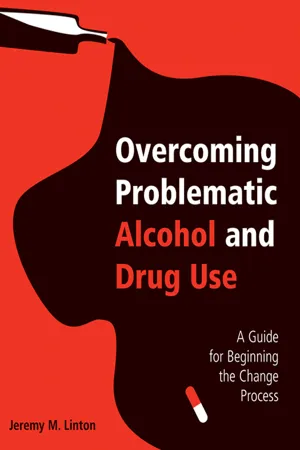
eBook - ePub
Overcoming Problematic Alcohol and Drug Use
A Guide for Beginning the Change Process
- 136 pages
- English
- ePUB (mobile friendly)
- Available on iOS & Android
eBook - ePub
Overcoming Problematic Alcohol and Drug Use
A Guide for Beginning the Change Process
About this book
Information
1
Determining your Goals and Getting Started
Welcome to this book! This opening chapter is designed to help you take some first steps toward change. There are several questions for thought and activities to complete as you work through this chapter. By the end of this chapter you should:
- Have a good idea about the purpose of this book.
- Have some goals for change.
- Understand why you want to change.
- Understand the pros and cons for change.
- Be ready to put your full energy into completing the rest of this book.
Good luck!
Purpose of this Book
If you have picked up this book, then you are interested in doing something about the problem of alcohol and drugs. You may be a person trying to cope with an alcohol and other drug abuse (AOD) problem and have selected this book to help you change your patterns of AOD use. Or, you may be a counselor looking for new ways to address substance abuse issues with your clients. Finally, you may be a counselor-in-training learning about alcohol and drug abuse for the first time. This book is appropriate for all such readers. A little bit later in this chapter, I will offer some suggestions for how each type of reader can effectively use the content of this book.
The first question to think about is, Why read this book instead of some other book on alcohol and drug abuse? Simply put, this book summarizes much of what we know about change, and it guides you through the process of putting theories of change into action. Presented in the chapters that follow are key concepts about change developed by leading researchers in the substance abuse treatment field. This means that you can benefit from years of research conducted all over the world.
This book is comprised of nine chapters covering different aspects of recovery from AOD abuse problems. The chapters should be used in order, and concepts in later chapters build off those presented in earlier chapters. As you work through this book you will notice several special features included in each chapter. Classic research on learning tells us that people learn new information best when they engage the material on four different levels (Kolb, 1981). These levels include: (a) hearing or reading new information, (b) understanding why the material is relevant to the learner’s personal life, (c) practicing new skills related to the information, and (d) reflecting on each of the proceeding tasks. Each chapter of this book is designed to provide the reader with opportunities to experience the material on all of these levels.
Each chapter of this book begins by providing the reader with relevant information on the chapter topic. Following this, throughout each chapter, several features are included to promote the reader’s active engagement with the material. These include examples to promote a concrete understanding of the topic, questions for thought to encourage reflection on what is learned, and chapter assignments to encourage practice of new skills. In order to get the full benefit from this book it will be very important for you to actively take part in each of these activities.
Opening Questions
Now it’s time to get to work! Let’s start with an easy question: Why have you picked up this book? Probably, the answer to this question is that, for whatever reason, you desire to make some sort of change. If this is true for you, the questions become: What is it about your life that you want to be different? and Why do you want to change? Either you have decided on your own that you want to make changes to your alcohol and drug use patterns or someone else has decided for you that you need to do so. Maybe you have examined your life and decided that your current pattern of alcohol and drug use no longer works for you. Perhaps a loved one has told you to seek some kind of help for your alcohol or drug use in the form of an ultimatum; either get help or our relationship is over. Possibly, your employer has urged you to take a look at your alcohol and drug use. Or, maybe you are just curious about your drug and alcohol use and have decided to investigate whether you have a problem. Whatever your motivation, I offer my congratulations! You have picked up this book and have at least committed to exploring the possibility of change. Now, let’s move on and think about the questions that I asked above.
What type of user are You?
An important task in thinking about changing your AOD use patterns is to figure out what type of AOD user you are. Different people use alcohol and drugs at different rates and experience different consequences of their use. The nature of your relationship with AOD and the types of consequences you have experienced because of your use will have a direct impact on the plans you make throughout the rest of this book.
To help you better understand the type of AOD user you are, we can turn to the scientific research in the field. Miller and Munoz (2005), two well-respected researchers in the area of AOD treatment, identified four different patterns of alcohol use: overdrinking, dumb drinking, harmful drinking, and dependent drinking. Because this book is about overcoming both alcohol and drug use, Miller and Munoz’s categories have been slightly modified to include the use of other drugs in addition to alcohol. Each is described below.
Overusing
Overusing involves taking more alcohol or drugs than is considered physically safe. At certain levels, for example, alcohol has no harmful physical effects on the body. For men, this safe level of drinking is two drinks per day and for women it is one drink per day. However, when you drink more than this, you put yourself at a higher risk for harmful physical consequences such as liver and digestive problems, respiratory distress, and high blood pressure. With other drugs, however, there is no safe level of use. Smoking marijuana, for instance, even occasionally, is harmful to your lungs. Likewise, taking oxycodone without a prescription and supervision from a physician is equally as dangerous.
It is important to note that overusers may not experience any harmful effects of their AOD use. They may avoid legal difficulties, family conflict, problems at work, and any other related stressors. Similarly, they may not even experience any harmful physical effects of their AOD use. However, the danger lies in the fact that the overuser is placing him- or herself at a higher risk for harmful consequences and therefore needs to take a look at his or her patterns of use.
Dumb Using
In the next category, dumb using, the user takes AOD in situations where it is dangerous or unadvisable to do so. Miller and Munoz (2005) offer drinking alcohol before driving as the classic example of dumb using. Even at very low levels, alcohol can impair the user’s ability to safely operate an automobile. Simply put, drinking before driving, even if only done one time, is dumb.
For the most part, use of drugs other than alcohol can almost always be categorized as dumb use. Even if users are merely experimenting for the first time with a drug, they are placing themselves at a high risk for negative consequences. People’s bodies react differently to different drugs, and what may be safe for one user can be deadly for another. Taking a drug without knowing how it will affect you is like playing Russian roulette, and to do so is not smart. A famous example of this came in 1986 with the death of college basketball great Bias. Less than 48 hours after being selected in the 1986 NBA draft, Len Bias died of a cardiac arrhythmia induced by cocaine use. It is unclear if Bias was a regular cocaine user. However, because he had a preexisting heart condition, this a tragedy that could have occurred even if Bias had only used cocaine on this one occasion.
Experimental or occasional use of marijuana and other drugs thought by some (erroneously!) to be relatively harmless can also be categorized as dumb use. With the advent of more potent strains of marijuana, the trading business for this drug has become more and more intense. In an effort to keep up with more powerful strains of the drug, some manufacturers and dealers have elected to cut their marijuana with other drugs (e.g., PCP, LSD, or cocaine) or harmful chemicals. In effect, this has led to a “buyer beware” situation for marijuana users; you never really know what you are going to get when you purchase the drug. As a result, the marijuana user may be ingesting several toxins, in addition to those present in the marijuana, which could lead to many harmful consequences.
Harmful Using
The third category of use described by Miller and Munoz (2005) is harmful using. In this category, AOD users are experiencing actual harm or problems from their use, not just placing themselves at a higher risk as in the previous two categories. The hallmark of harmful using is that the users’ problems are a direct result of their AOD use. Problems created by AOD use in this category may include conflict in relationships, missing work, legal troubles, or AOD-related health problems. For whatever reason, however, the user keeps taking AOD in the face of these consequences.
Dependent Using
Finally, there is dependent using. Miller and Munoz (2005) describe this category of use as being characterized by either physical dependence or psychological dependence on AOD. ...
Table of contents
- Cover
- Half Title
- Title Page
- Copyright
- Dedication
- Preface
- About the Author
- Contents
- 1. Determining Your Goals and Getting Started
- 2. The Change Process
- 3. Cognitive-Behavioral Model of Addiction
- 4. Errors in Thinking
- 5. Path to Recovery
- 6. Preventing Relapse
- 7. Managing Emotions
- 8. Living with Integrity
- 9. Summing Up and Moving Forward
- References
- Index
Trusted by 375,005 students
Access to over 1.5 million titles for a fair monthly price.
Study more efficiently using our study tools.
Frequently asked questions
Yes, you can cancel anytime from the Subscription tab in your account settings on the Perlego website. Your subscription will stay active until the end of your current billing period. Learn how to cancel your subscription
No, books cannot be downloaded as external files, such as PDFs, for use outside of Perlego. However, you can download books within the Perlego app for offline reading on mobile or tablet. Learn how to download books offline
Perlego offers two plans: Essential and Complete
- Essential is ideal for learners and professionals who enjoy exploring a wide range of subjects. Access the Essential Library with 800,000+ trusted titles and best-sellers across business, personal growth, and the humanities. Includes unlimited reading time and Standard Read Aloud voice.
- Complete: Perfect for advanced learners and researchers needing full, unrestricted access. Unlock 1.5M+ books across hundreds of subjects, including academic and specialized titles. The Complete Plan also includes advanced features like Premium Read Aloud and Research Assistant.
We are an online textbook subscription service, where you can get access to an entire online library for less than the price of a single book per month. With over 1.5 million books across 990+ topics, we’ve got you covered! Learn about our mission
Look out for the read-aloud symbol on your next book to see if you can listen to it. The read-aloud tool reads text aloud for you, highlighting the text as it is being read. You can pause it, speed it up and slow it down. Learn more about Read Aloud
Yes! You can use the Perlego app on both iOS and Android devices to read anytime, anywhere — even offline. Perfect for commutes or when you’re on the go.
Please note we cannot support devices running on iOS 13 and Android 7 or earlier. Learn more about using the app
Please note we cannot support devices running on iOS 13 and Android 7 or earlier. Learn more about using the app
Yes, you can access Overcoming Problematic Alcohol and Drug Use by Jeremy M. Linton in PDF and/or ePUB format, as well as other popular books in Psychology & Addiction in Psychology. We have over 1.5 million books available in our catalogue for you to explore.