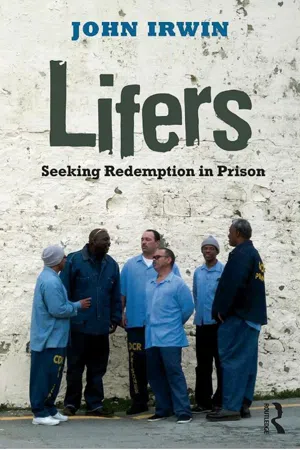
John Irwin writes about prisons from an unusual academic perspective. Before receiving a Ph.D. in sociology, he served five years in a California state penitentiary for armed robbery. This is his sixth book on imprisonment – an ethnography of prisoners who have served more than twenty years in a California correctional institution. The purpose of the book is to take issue with the conventional wisdom on homicide, society's purposes of imprisonment, and offenders' reformability. Through the lifers' stories, he reveals what happens to prisoners serving very long sentences in correctional facilities and what this should tell us about effective sentencing policy.
- 152 pages
- English
- ePUB (mobile friendly)
- Available on iOS & Android
eBook - ePub
About this book
Information
1
INTRODUCTION
While I was studying Solano State Prison (2000 to 2004), I drew together a group of convict “experts” to supply me with information about prisoner behavior patterns and prisoner social organization and to critique drafts of the chapters I wrote.1 It turned out that all my experts were “lifers,” most of them in prison for homicide.2 They had all served in excess of 20 years. Through my extended association with them, I was convinced that they were intelligent, sincere, and decent human beings. In addition, I became aware of their circumstances, particularly the difficulty they were having in obtaining a parole. I knew from my former experiences with the California prison system that before 1975, persons convicted of first degree homicide served an average of 12 to 13 years. What these shorter sentences for the most serious crimes reflect is that society in the decades before 1980 demanded less punishment for crimes and believed that offenders were redeemable.
It became clear to me that in this punitive era in penology most people—particularly government functionaries, prison employees, and parole board members—view lifers as repudiated pariah and are extremely reluctant to allow their release on parole. This is reflected in the public announcement California Governor Gray Davis made soon after taking office in 1999 that the only way a person convicted of homicide was going to get out of prison during his tenure was with a toe tag and in a bag—in other words, dead. Even most prison reformers ignore lifers and focus their efforts on petty drug offences or non-violent, unserious felonies. Over 1,000 persons convicted of first or second degree murder come to prison each year and there are over 10,000 who, according to the law and administrative regulations, are eligible for release. Only 230 have been released on parole in the last 10 years.3
The truth is that whoever they were and whatever crime they committed, the vast majority of lifers become completely different people after serving years in prison. Two things unavoidably happen to them. First, they are removed from the social contexts that in many complicated ways influenced their orientation, values, and viewpoints and contributed to their crimes. Second, they mature. Beyond these two inevitable changes, most of them consciously undertake a transformation of their thinking, orientation, and personality. This leads to their actively taking advantage of every resource available to prepare themselves for a different life when they are released. Not only do they prepare themselves through education and vocational training, they actively and collectively seek atonement and, perhaps, even redemption through a multitude of programs, most of which they, the prisoners themselves, organized and maintain.
Because of the changes they experience, most California lifers are transformed into persons who pose a minimal threat to public safety.4 In fact, they become conscientious and decent individuals who can, given the chance, make valuable contributions to society. However, because of the seriousness of the crimes (usually homicides) they committed 25 or more years earlier, they continue to be viewed and processed as dangerous criminals.
This practice of holding lifers 10 to 15 years beyond the time prescribed by the law and formally established administrative policy is unjust and, apparently, as California and Federal Courts have recently been ruling, illegal.5 Also, it is financially disastrous. The California prison system is experiencing extreme overcrowding and fiscal
problems. It has the largest population in the country. Though it built 22 new prisons in the 1980s and 1990s, each now holding 6,000 prisoners, it is at 170 percent capacity. Three Federal Judges are currently holding hearings on a lawsuit regarding this overcrowding. Also, its medical delivery system is being monitored by the Federal Court, which has ruled that it is in violation of U.S. Constitutional cruel and unusual treatment standards.
Aging lifers become more and more expensive to take care of in prison. Kara Dansky, the executive director of the Stanford Criminal Justice Center, has calculated the added cost of aging prisoners, as this article explains:
Without a considerable boost in funding, the prospect of prisons accommodating older prisoners properly will remain bleak. Part of the problem is that caring for these aging and elderly inmates is incredibly expensive, says Kara Dansky, a lawyer and the executive director of the Stanford Criminal Justice Center. She estimates California spends about $43,000 annually to incarcerate an inmate. But national studies show that older inmates—who are more likely to have medical conditions like diabetes or heart disease—cost at least an additional $25,000.
Some of those added costs are for medical services, while others are for equipment. An August 2007 report commissioned by the medical receiver of the state prison system said the state needs 3,224 medical beds now (it has approximately 800) and will need 5,292 by 2017 if the older-inmate population continues to grow at the current pace. The legislative analyst’s office estimates that construction of proposed new medical facilities could cost the state as much as $3 billion.6
In effect, the “tough on crime,” movement has California government officials backed into a corner. The movement has resulted in massive prison overcrowding and an array of attendant problems, one of which is the growing population of lifers who become the most costly prisoners. However, these officials—the governor, legislators, Supreme Court justices, and parole board members—are either committed to being tough on crime or are fearful of being seen as soft on crime and are, therefore, unwilling to take steps to solve these problems. Solving them would require, above all, shortening prison sentences and this they are unwilling to do.
MY STUDY
In 2006 I began associating with and interviewing lifers housed at San Quentin. I eventually completed long interviews of 17 lifers. I did not select these persons according to a systematic sampling procedure. I merely interviewed persons whom I got to know and who were willing to be interviewed. Since I wanted to focus on people who had served long sentences, I only interviewed persons who had served at least 20 years. In addition, I circulated in the prison, got to know dozens of lifers, and attended many meetings of the various programs in which they were involved.
My own biography equips me to understand and evaluate their criminal past, prison experiences, and conversion. I am intimately familiar with all these aspects of their lives. I can sincerely state, there but by the twists of fate go I. At the age of 16, I started stealing car parts, then cars, in order to build my own “roadster.”7 I progressed to safe burglary and then armed robbery with considerable drug use thrown in. In this journey to prison, I acquired a complete criminal identity. I was sent to prison for armed robbery with a sentence of 5 to life and served 5 years. On the last robbery my crime partner and I committed, a “shootout” ensued. The owner of the business we were robbing came through a side door firing a .45 at my partner. While dashing out of the building, my partner returned a pistol round in the general direction of the owner. The owner proceeded to fire at us while we rapidly departed in a stolen car. Luck was on our side and nobody was killed. If someone had been, we would have been guilty of “felony murder,” a capital offense.
In prison I prepared myself for a different career. Upon release, I went to college, eventually receiving a PhD in sociology. The subject of my dissertation was the career of the felon and it took me back to the prison to study convicts. The dissertation was published in a widely read book—The Felon. I then began my career as a college professor and continued studying incarceration.8 In addition to conducting studies of prisoners, I pursued prison reform and prisoner rehabilitation. For 50 years, my close contact with prisoners and ex-prisoners has been
broad and constant. I fully understand and appreciate their transformation in prison.
The primary data of my study are long interviews of the 17 lifers I selected for the study. As indicated above, these lifers had all served more than 20 years for first degree, or second degree homicide, attempted homicide, or conspiracy to commit homicide. They had served years beyond the minimum recommended by sentencing law and prison administrative policy. My examination of their prison careers led to my conclusions on the transformation they experience while serving their long sentences. In an attempt to reveal to readers essential information about the lifers’ early lives and the nature of their transformations, I have included lengthy quotes from the interviews, which were recorded and transcribed. It is my intention that, through the lifers’ disclosures, the reader will form an understanding of these men and their transformation.
My primary purpose in writing this book is to demonstrate that most lifers are not fundamentally evil people and that over time they become trustworthy and conscientious individuals who pose no threat to public safety. In fact, most of them desire to engage in social services upon their release. I also argue that holding lifers for years beyond their prescribed sentences has severe negative consequences, the most obvious being the enormous added expense of their incarceration. But also, it is cruel and unjust to punish people more than is required to fulfill society’s desire for retribution for their crimes. Through a lengthy series of changes in sentencing laws and administrative rules, the California Legislature and the Department of Corrections established the appropriate punishment for various forms of homicide. The final product came after the “tough on crime” movement swept the nation and is, therefore, relatively punitive.
In addition to retribution, the official purposes of imprisonment include general deterrence, incapacitation, and rehabilitation. How much punishment is required to deter other citizens from breaking the law is difficult to determine and remains controversia...
Table of contents
- Lifers
- CRIMINOLOGY AND JUSTICE STUDIES SERIES
- CONTENTS
- SERIES FOREWORD
- PREFACE
- ACKNOWLEDGMENTS
- 1 INTRODUCTION
- 2 THE LIFERS
- 3 THEIR CRIMES
- 4 AWAKENING
- 5 ATONEMENT
- 6 CALIFORNIA LIFERS’ LEGAL PREDICAMENT
- 7 EPILOGUE
- INDEX
Trusted by 375,005 students
Access to over 1.5 million titles for a fair monthly price.
Study more efficiently using our study tools.
Frequently asked questions
Yes, you can cancel anytime from the Subscription tab in your account settings on the Perlego website. Your subscription will stay active until the end of your current billing period. Learn how to cancel your subscription
No, books cannot be downloaded as external files, such as PDFs, for use outside of Perlego. However, you can download books within the Perlego app for offline reading on mobile or tablet. Learn how to download books offline
Perlego offers two plans: Essential and Complete
- Essential is ideal for learners and professionals who enjoy exploring a wide range of subjects. Access the Essential Library with 800,000+ trusted titles and best-sellers across business, personal growth, and the humanities. Includes unlimited reading time and Standard Read Aloud voice.
- Complete: Perfect for advanced learners and researchers needing full, unrestricted access. Unlock 1.5M+ books across hundreds of subjects, including academic and specialized titles. The Complete Plan also includes advanced features like Premium Read Aloud and Research Assistant.
We are an online textbook subscription service, where you can get access to an entire online library for less than the price of a single book per month. With over 1.5 million books across 990+ topics, we’ve got you covered! Learn about our mission
Look out for the read-aloud symbol on your next book to see if you can listen to it. The read-aloud tool reads text aloud for you, highlighting the text as it is being read. You can pause it, speed it up and slow it down. Learn more about Read Aloud
Yes! You can use the Perlego app on both iOS and Android devices to read anytime, anywhere — even offline. Perfect for commutes or when you’re on the go.
Please note we cannot support devices running on iOS 13 and Android 7 or earlier. Learn more about using the app
Please note we cannot support devices running on iOS 13 and Android 7 or earlier. Learn more about using the app
Yes, you can access Lifers by John Irwin in PDF and/or ePUB format, as well as other popular books in Social Sciences & Criminology. We have over 1.5 million books available in our catalogue for you to explore.