![]()
Part 1
The Nature, Scope, and Function of Corrections
Justice in a democracy demands fair treatment of all citizens, neither ignoring victims nor degrading prisoners.1
American Correctional Association
CORRECTIONS IS BOTH FASCINATING AND FRUSTRATING. Changing the direction of an offender’s life can be a fulfilling challenge. Helping a juvenile get back on the right track, linking an ex-offender with community resources, getting an alcoholic into treatment, or simply making time in a facility more tolerable for an inmate can all be very personally rewarding experiences. Corrections offers unlimited opportunities for such meaningful contributions—for work that has a purpose and makes a difference.
At the same time, when corrections is ineffective, it can be a frustrating experience. When the same offenders keep reappearing, when budgets are overwhelmed, when no one agrees about what corrections should be doing, when the public is unconcerned and unsupportive, much of the fascination is diminished. Facing such obstacles can create confusion and conflict. It can also provide the potential for change—if obstacles are seen as opportunities.
Certainly, there is considerable opportunity for change in corrections. But before exploring where corrections might be tomorrow, it is essential to determine where this field is today and how it got there. Only with an understanding of the past and the present can we begin to shape the future. Thus Part 1 of this book focuses on an overview of the nature, scope, and function of corrections.
The framework is set in Chapter 1 with a description of what is included in this vast collection of facilities, programs, and services collectively called “corrections.” With a better understanding of the correctional conglomerate, Chapter 1 then addresses the public’s role in shaping correctional practices. Through conflicting models of policy-making, we realize how correctional practices have changed over time as social opinion has fluctuated.
With this foundation, Chapter 2 explores the impact of sentencing policies on corrections. As sentencing practices have shifted from indeterminate to determinate, we see how the nature of structured sentencing guidelines, truth in sentencing, and similar approaches fulfill crime-related public policies and generate correctional caseloads as well as institutional populations. Since it is society’s response to crime that is of greatest concern to corrections, Chapter 2 concludes with a review of the various perspectives that have guided public opinion—from retribution, deterrence, and incapacitation to rehabilitation and reintegration.
Chapter 3 then takes a step back in time to see how corrections evolved over the years. Although we would find it difficult to imagine living in a society without prisons or jails, these have been relatively recent “inventions.” The harshness of past punishment practices is described in vivid detail—in contrast to the more humanitarian forces that eventually resulted in the evolution of correctional institutions, the reform movement, and the rehabilitative era. Historical developments conclude with a consideration of how the past has shaped the present, along with a challenge for the future—accommodating demands for punishment without abandoning directions toward positive change. In corrections, it is easy to resign oneself to the frustrations. The challenge is to rekindle the fascinations.
![]()
Chapter 1
The Correctional Conglomerate
Corrections remains a world almost unknown to law-abiding citizens, and even those within it often know only their own particular corner.1
President’s Commission on Law Enforcement and Administration of Justice
Chapter Overview
Learning Goals
Do you know:
- why corrections can be considered a “conglomerate”?
- the levels of government at which corrections functions?
- the differences between prisons and jails, as well as probation and parole?
- the percentage of inmates under correctional supervision who are confined in custodial institutions, as compared with those under community supervision?
- the definition of “corrections”?
Much of the confusion surrounding corrections and what it should be accomplishing is related to the wide variety of institutions, programs, and services provided within what is broadly viewed as “corrections.” This chapter therefore begins by considering just what is included within this vast correctional conglomerate. But even understanding its nature reveals only part of its complexity, for corrections does not operate in isolation. As a component of the criminal justice system, corrections interacts with—and is affected by—both law enforcement and the courts. The criminal justice system, in turn, reflects social policy—as anchored in the executive, legislative, and judicial functions of government.
Policy, in turn, is influenced by the values, opinions, and interests of society. As a public service ultimately responsive to the community, corrections is also subject to various political and social pressures. At times, these have created conflicting expectations, and when society demands public policies that emphasize goals ranging from retribution and punishment to treatment and rehabilitation, it is sometimes difficult to determine exactly what corrections is supposed to be accomplishing. The question therefore becomes not just what corrections is but, more importantly, what it is expected to do. As a member of society, you have not only a personal stake in the answers, but also a role in shaping them.
The Correctional Conglomerate
In private enterprise, a massive business corporation with far-reaching markets, numerous customers, and a vast array of products and services would be called a conglomerate. Similarly, a government service composed of as many employees, clients, and diverse activities as corrections can also be considered a conglomerate. The difference between a business conglomerate and corrections is that you have a personal stake in the “profits” or “losses” of corrections—it is your tax dollars that support it, citizens in your community who are its “customers,” and your safety that is involved in its success or failure. Moreover, it is through your elected and appointed government officials that the policies, procedures, and future directions of corrections are established. It is therefore in your interest to take a closer look at the correctional conglomerate.
conglomerate: a complex organization composed of numerous diverse functions.
As with any conglomerate, operating the correctional system requires massive fiscal and human resources.
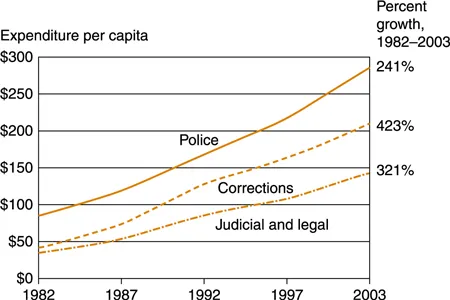
- What does all of that cost? Well over $60 billion annually,2 which is on a par with the national budget of Austria, Taiwan, or Poland.3 As indicated in Exhibit 1.1, corrections has been receiving a steadily increasing share of total criminal justice resources. In fact, its rate of growth from 1982 to 2003 (423 percent) outpaced both police and the courts. As a result, the correctional conglomerate has been consuming an increasing share of tax dollars—far outpacing the growth of other public services in many states. Second only to Medicaid, corrections has become the fastest-growing general fund expenditure in the U.S.4 Between 1987 and 2007, for example, total state expenditures on corrections more than doubled.5 In fact, one state recently made deep cuts in the budget for such essential services as mental health and education, while at the same time funding an extra $6 million for its prisons.6 Experts have been expressing concern that this spending pattern may continue until it hits “critical mass”—the point at which there may be few resources available for anything else.7
Exhibit 1.1 Per capita expenditures and growth of the justice system, 1982–2003.
Source: Kristen A. Hughes, “Justice Expenditure and Employment in the United States, 2003,” Bureau of Justice Statistics: Bulletin (Washington, DC: U.S. Department of Justice, April, 2006), p. 2.
- How many people does all of that money employ? The nearly 750,000 correctional employees throughout the U.S.8 would populate a large city with people in positions ranging from correctional officers to administrators, social workers, psychologists, psychiatrists, doctors, nurses, lawyers, teachers, counselors, office staff, and maintenance personnel. In fact, just about every professional and support occupation you can name is probably employed somewhere in the correctional conglomerate.
- Where do all of these employees work? In the federal government (5 percent), the 50 states (62 percent), and the thousands of municipalities and counties (33 percent) throughout the United States.9
- How many clients does this conglomerate serve? Picture the combined populations of Baltimore, Dallas, and San Diego. On any given day, an estimated 7.3 million adults are under some form of correctional supervision,10 which is actually larger than the population of 45 countries.11 Statistically, of every 31 adults you encounter, one is currently a correctional client. Of course, you would need to visit a prison or jail to encounter many of them. But do not mistakenly assume that the majority are confined to secure institutions. Most are not.
client: someone under the care, custody, or control of a correctional agency.
Custodial Institutions
Corrections is easily stereotyped by its most visible physical structures—custodial institutions. For adults, these are prisons and jails. For juveniles, they are training schools, detention centers, and boot camps. In fact, what do you picture when you hear the word “corrections”? Often, our first thought is of a forbidding-looking gray fortress surrounded by thick concrete walls with rifles protruding from guard towers, where expressionless inmates move in dull routines under the constant supervision of uniformed officers. That is generally the image of corrections portrayed in movies and on television.
prisons: state or federal correctional institutions that confine those serving sentences of longer than one year.
jails: local correctional institutions that primarily confine those awaiting trial or serving sentences of less than one year.
But, of all adult inmates housed in correctional institutions throughout the U.S., only about one-third are serving time in such maximum-security prisons.12 Far more inmates are confined to medium-security institutions—where wire fencing replaces concrete walls, armed towers are nonexistent, and inmate supervision is less intense. The lowest-risk offenders, who can be trusted with more freedom, are serving their sentences or preparing for parole in minimum-security facilities such as halfway houses, which bear no more resemblance to a prison than a dormitory or an apartment building.
In addition to being distinguished by their level of security, correctional facilities function within all three levels of government: local, state, and federal. The private sector also provides correctional services and now operates a sizeable number of custodial institutions. But corrections is primarily a function of state government. States are responsible for the operation of prisons, where inmates ser...