Art and other expressive therapies are increasingly used in grief counseling, not only among children and adolescents, but throughout the developmental spectrum. Creative activities are commonly used in group and individual psychotherapy programs, but it is only relatively recently that these expressive modalities have been employed within the context of clinical grief work in structured settings. These forms of nonverbal communication are often more natural ways to express thoughts and feelings that are difficult to discuss, particularly when it comes to issues surrounding grief and loss. Packed with pictures and instructional detail, this book includes an eight-session curriculum for use with grief support groups as well as alternative modalities of grief art therapy.
Section III Alternative Art Forms, Programs, and Stories of Art and Healing
14 CHAPTER Deborah Koff-Chapin, Carol McIntyre, and Judith Koeleman The Painters
What I recall clearly about the first true painting I ever did was the feeling that night that something real was happening.
—Natalie Goldberg, Living Color
Touch Drawing in Grief Work: Drawing Out Your Soul Deborah Koff-Chapin
I discovered Touch Drawing in revelatory play in 1974. A friend asked me to help clean up in the art school print shop. In the moment before wiping, I playfully moved my fingertips on a paper towel that had been placed over an inked glass plate. As I lifted the paper towel off the inked surface, I saw the traces of my touch imprinted on the underside of the towel. A rush of creative energy flooded my system. I realized that this simple, direct process had the potential to become a new and powerful form of creative expression. I felt called to share this dynamic process with the world.
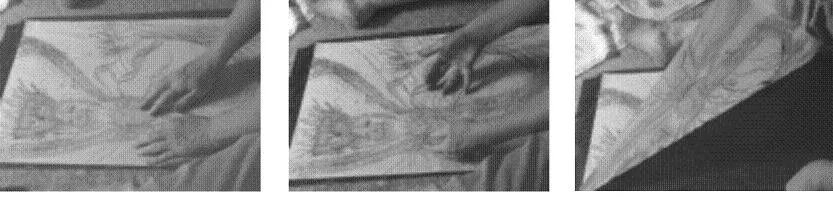
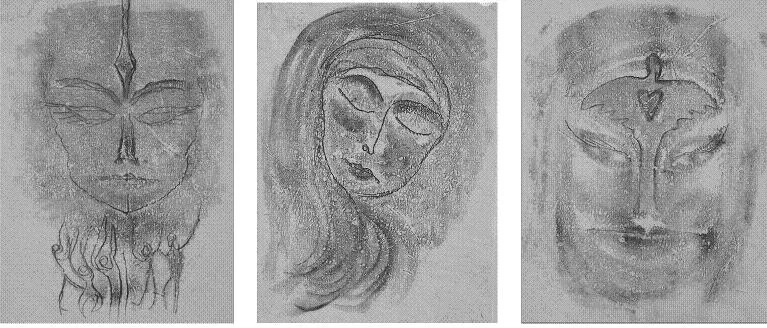
FIGURES 14.1–14.3 Creative expression. (Photos courtesy of Deborah Koff-Chapin.)
As I have introduced Touch Drawing over the years, this calling has been affirmed time and time again. When offered basic instructions and a safe, supportive environment, people take to Touch Drawing like fish to water. Effortlessly, their hands dance upon the surface of the paper, translating their feelings into form and image. As I gaze across a roomful of people doing Touch Drawing, I feel like I am witnessing a sacred act: people gazing deeply into the inner mirror of their souls.
In a medium as immediate and direct as Touch Drawing, new channels of expression are opened, enabling feelings to flow forth uncensored. The act of creating with these feelings provides more than a purely cathartic release. It unleashes vibrant healing forces that guide the psyche toward coherence. Whatever darkness or pain may surface is fuel for the creative fire. Each successive drawing reveals another layer of awareness. With these imprints of the soul now on paper, nonverbal messages from the psyche are available for reflection by the conscious mind. Touch Drawing is a practice of creative, psychological, and spiritual integration.
These qualities make Touch Drawing a natural for grief work. I would like to share a few stories to give a sense of the power of this process. Tinky Timmons of Charlotte, NC shares her personal story as well as her experience doing Touch Drawing with others:
When Deborah introduced me to Touch Drawing, I was going through an extremely difficult time in my life. My husband was leaving me for a younger woman, my best friend had passed away from cancer, and I was starting the process of healing from 17 years of child abuse. It was all I could do to breathe. My first experience of Touch Drawing was a huge turning point in my journey to healing from so much grief.
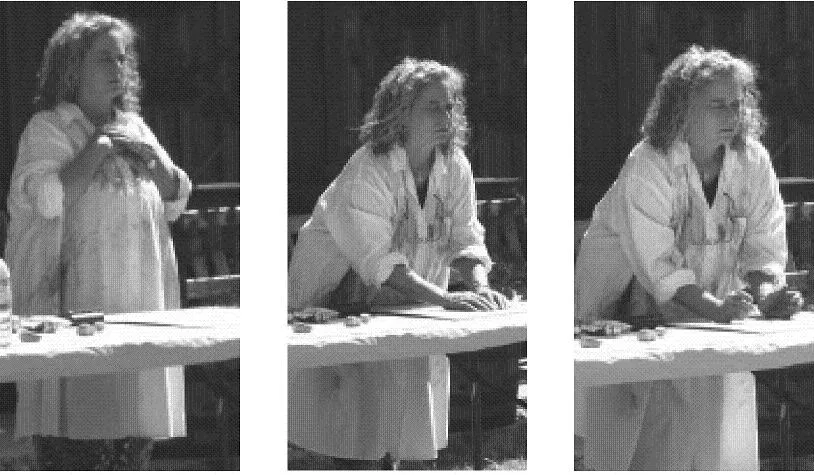
FIGURES 14.4–14.6 Images of a woman Touch Drawing. (Photos courtesy of Deborah Koff-Chapin.)
Grief is so overwhelming and is a hard emotion to explain even to oneself. The reasons for grieving are as diverse as each individual and the response to grief is multifaceted. Therefore, it is hard to find anything that works for all types of people. Touch Drawing seems to work for everyone — no matter what level of grief they may be in, what age they are, or what artistic abilities they may have. I have used Touch Drawing with cancer patients who have never even thought of drawing or painting, but just need to release something that is so devastating. When they are in the process of Touch Drawing, they are in a space of no pain, no grief, no suffering. They are watching their feelings appear out of the paper, and by gazing at the paper they seem to feel more at peace.
I have used Touch Drawing with abused children, and even though they don’t know the depth of what they are doing, the process often brings tears they didn’t know they had. That has been the case for myself as well. I have seen things coming out of my paper that amaze me and somehow show me how I am feeling even if I am not aware of the feeling at the time I am drawing. Often, I see a freedom and lightness there. I see an innocence of what my hands have done and realize that innocence came from a place deep within and it heals me in a way that no spoken word can.
I have cried while Touch Drawing, I have laughed while Touch Drawing, but most of all, I have healed while Touch Drawing. It is a powerful tool that one can use to heal from grief. It has facilitated my healing process and helped to bring me to a place of true inner peace!
Valerie McCarney is a Hospice volunteer and an Expressive Art Therapist in Saratoga Springs, NY. She had been using Touch Drawing with several of her other clients when she was asked to do a workshop for Hospice. She shares what happened:
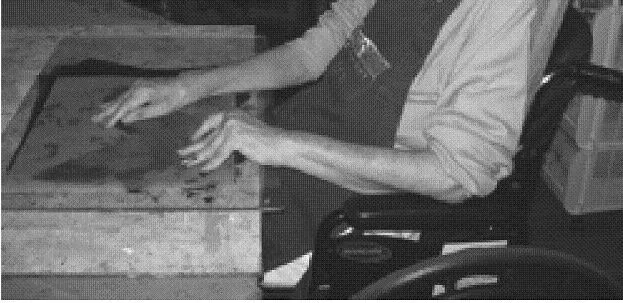
There were several people in the nursing home living with advanced ALS and multiple sclerosis. They had all lived there for a couple of years and had become very close. Then within six weeks, three of them died. This was very scary and sad for the remaining patients. The staff was worried because, although the patients were all upset, they were not expressing their grief. Instead, they were in a deep trauma state. (Figure 14.7)
FIGURE 14.7 Woman in a wheelchair touch driving. (Photo courtesy of Valerie McCarney.)
Because of my background, Hospice asked me if I would be willing to do an art session with them. Since many can barely move, I felt that Touch Drawing would work the best. We had volunteers helping, lifting their arms, and putting their hands on the papers. But once there, they could move their fingers around on the paper. I played different kinds of music and we talked about their feelings. Once the process began the energy in the room just shifted. Some of the people started to cry and express emotions that they had been holding in. To see people who were mostly paralyzed creating beautiful pieces of artwork was just wonderful. There was a man with advanced ALS and everything he drew looked like a spinal cord. I was told later he had been a chiropractor.
After we worked for about 45 minutes, I brought out a “word bowl” and the patients, with the help of the volunteers, chose words that expressed their feelings. We used glue sticks to put the words on their artwork. I took home the artwork and put it on foam board and brought it back to the nursing home for them to hang. They were all so proud. When the grief feelings came up again for them the social workers would take them down to the paintings to process, using the art and the words expressed as catalysts. It was truly healing for all of us involved. I find that for myself, having lost my mother last year and my father being in the dying process right now, Touch Drawing has been a way for me to be with all the feelings of grief and anticipatory grief. It is very healing and therapeutic.
Touch Drawing is serving Tinky and Valerie both in their work with others and in their own grief process. Without self-conscious effort, feelings of grief seem to naturally find their way to the surface to be reflected upon and transformed. Janyt Piercy shares how this occurred for a participant in a workshop she was facilitating:
One of my participants ended up doing some unexpected grief work. This woman was well into drawing and was doing faces. All of a sudden she came to me with a Touch Drawing she had just created. The woman was sobbing and showed me the drawing, explaining that the face was her dead mother’s face. I held a space for her to talk and to cry as she needed to. This was a huge breakthrough for her. She was so moved by the experience that she went on to use Touch Drawing as a valuable tool in her grief process. She had felt her mother’s presence manifest in the Touch Drawing session in the appearance of the face. (Figures 14.8 through 14.10)
FIGURES 14.8–14.10 Touch Drawings of womens’ faces. (Photos courtesy of Deborah Koff-Chapin.)
Kathleen Horne (MA, REAT) describes a similar experience of drawing her mother’s face, eight months after her death. She also did some reflective writing after the experience, demonstrating the power of verbal expression that has been catalyzed by the nonverbal experience of Touch Drawing:
I could feel, as my Touch Drawing process deepened, the hovering around of grief. Suddenly, as I put my hands on the paper and began to draw, it was as though I was stroking her face as she lay in the hospital bed. The tears unleashed and I continued to draw — drawing after drawing, crying, and in awe as the series unfolded — taking me to a new place in my grieving process. My head was disengaged and my hands brought forth the wisdom. When I was done, I was done. Then this writing came:
Grief appears, with an urgent intensity. Soft, and insistent. Grief of the mother. Grief of the daughter. Both aware that the loving angel of death is announcing its arrival. A space of timeless time, a space between worlds. I sit, you lie, in waiting. Touch: the only means of communication. The deep lines of life vanish from your countenance in preparation for leaving. Ultimate perfection. The cycle of return. The time draws near. As you are saying goodbye to the Dance of Life We gather around you, speaking in tears and moans, laughter and silence. The last Breath comes. I let you go. I have no choice. I bow down before the eternal flame of Wisdom. Your body is offered forth Cradled, and at rest at last. Love Holds.
Christina Wilson (MA, CEAT) uses Touch Drawing in the bereavement program she created for Hospice of the North Coast in Carlsbad, CA. Here she describes the format of her work with groups:
The session begins with the participants voluntarily disclosing to the group what they are struggling with in their grief (such as sorrow, anger, physical symptoms or illness, fear, anxiety). If a person wants to do this privately they can do so in their journal. Each participant lights a candle and sets an intention for their healing. The candle is moved to a safe table away from the drawing materials. The atmosphere in the room is quiet and subdued. I keep the lights low; bright enough to see everything, but not bright. I play very soft, meditative music such as the kind used for yoga. (Figure 14.11)
Then we begin Touch Drawing — at first with eyes closed, then open. Participants are encouraged to begin another drawing as soon as one is finished. We continue this for about 45 minutes or more. Then, we set aside our drawing materials, clean our hands, and begin to journal about our Touch Drawing experience. Usually there are one or two images that are deeply meaningful to the participants, so I ask each participant to choose a drawing and dialogue with it in their journal. Since we use the Creative Journal method (originated by Lucia Capacchione, Ph.D., ATR, REAT) the image speaks with the nondominant hand in the first person. The participant can then have a conversation with the image(s). Using Touch Drawing in this way has been very helpful for the bereaved in the groups. One participant who had lost her young daughter became more deeply in touch with her anger and rage through the Touch Drawing images that emerged. She then went on to integrate the images into other modalities of expressive arts.
To close the session, participants voluntarily share about their process and any ...
Table of contents
Cover Page
Half Title page
Series page
Title Page
Copyright Page
Dedication
Contents
About the Author/Editor
Contributors
Series Editor's Foreword
Acknowledgments
Section I The Use of Expressive Arts in a Grief Support Group
Section II The Grief Support Group Curriculum: Eight Sessions
Section III Alternative Art Forms, Programs, and Stories of Art and Healing
References
Index
Trusted by 375,005 students
Access to over 1.5 million titles for a fair monthly price.
Study more efficiently using our study tools.
Frequently asked questions
Yes, you can cancel anytime from the Subscription tab in your account settings on the Perlego website. Your subscription will stay active until the end of your current billing period. Learn how to cancel your subscription
No, books cannot be downloaded as external files, such as PDFs, for use outside of Perlego. However, you can download books within the Perlego app for offline reading on mobile or tablet. Learn how to download books offline
Perlego offers two plans: Essential and Complete
Essential is ideal for learners and professionals who enjoy exploring a wide range of subjects. Access the Essential Library with 800,000+ trusted titles and best-sellers across business, personal growth, and the humanities. Includes unlimited reading time and Standard Read Aloud voice.
Complete: Perfect for advanced learners and researchers needing full, unrestricted access. Unlock 1.5M+ books across hundreds of subjects, including academic and specialized titles. The Complete Plan also includes advanced features like Premium Read Aloud and Research Assistant.
Both plans are available with monthly, semester, or annual billing cycles.
We are an online textbook subscription service, where you can get access to an entire online library for less than the price of a single book per month. With over 1.5 million books across 990+ topics, we’ve got you covered! Learn about our mission
Look out for the read-aloud symbol on your next book to see if you can listen to it. The read-aloud tool reads text aloud for you, highlighting the text as it is being read. You can pause it, speed it up and slow it down. Learn more about Read Aloud
Yes! You can use the Perlego app on both iOS and Android devices to read anytime, anywhere — even offline. Perfect for commutes or when you’re on the go. Please note we cannot support devices running on iOS 13 and Android 7 or earlier. Learn more about using the app
Yes, you can access The Art of Grief by J. Earl Rogers in PDF and/or ePUB format, as well as other popular books in Psychology & Mental Health in Psychology. We have over 1.5 million books available in our catalogue for you to explore.