This celebrated and seminal text examines the industrial revolution, from its genesis in pre-industrial Britain, through its development and into maturity. A chapter-by-chapter analysis explores topics such as economic growth, agriculture, trade finance, labour and transport.
First published in 1969, The First Industrial Nation is widely recognised as a classic text for students of the industrial revolution.
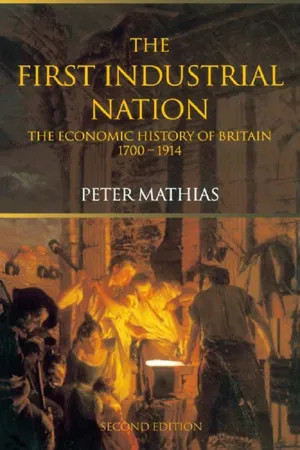
- 528 pages
- English
- ePUB (mobile friendly)
- Available on iOS & Android
eBook - ePub
About this book
1
Prologue: the industrial revolution – identity and beginning
The term industrial revolution, which is now used so widely in all manner of publications, needs defining. More particularly, the problem is to limit its definition. Emphatically, the expression should not be used just to denote industrial or mechanical innovation, an advance in a technique of production or the mechanization of a process in a single industry, or even the conversion of a single industry onto a mass-production basis with large plants driven by more than human power. If the concept is to mean only this, then the search for its origin would be lost in the remote past. Did it begin with the gig-mill, or the blast-furnace in the fifteenth and sixteenth centuries, the fulling-mill in the thirteenth century or the water-and wind-mill in more remote classical and medieval times? Professor Nef has claimed an industrial revolution in the years 1540–1640. Professor Carus Wilson has attached the term to the fulling-mill. Professor Gordon Childe once spoke of ‘the industrial revolution of the late Bronze Age’. A typical industrial transformation occurred to urban brewing in London during the seventeenth century, when the structure of the industry was translated from being a handicraft affair where individual families and publicans brewed their own beer to where commercial brewers, producing possibly 10,000 barrels a year in specialized places of manufacture, supplied dependent publicans whose economic function had been reduced to simple retailing. Yet other industries retained their medieval form of production and structure of organization until the later nineteenth century — such as flour-milling, glove-making, shoe-making. The ready-made suit industry was a development of the twentieth century. The present decade is seeing much traditional food-processing leaving the family kitchen and entering the factory and shop. Where can the line be drawn? Clearly, to define the industrial revolution in this way is to universalize the term, to rob it of all limitations as to time and space. A similar semantic problem bedevils the concept of the Renaissance. Innovations in techniques of production, in technical change, although differing as to the pace and scale of change, form a continuum in history.
To be given identity, the concept implies the onset of a fundamental change in the structure of an economy; a fundamental redeployment of resources away from agriculture, becoming self-evident over time. This does not necessarily mean that investment in agriculture, output in agriculture or the labour force in agriculture go down. Indeed all these things may need to increase in absolute terms. But growth in production, investment and the labour force grows more rapidly in other sectors of the economy, which therefore becomes more differentiated. The British economy in 1850 had become structurally more different compared with 1750 than 1750 was with 1650 or compared with structural changes coming in any previous century. One can only see how important this trend is by trying to relate each main sector of the economy, and their relative rates of change, to the whole.
The concept involves also the assumption that industrial production begins to expand at a higher and sustained rate — speaking of output as a whole. The popular phrase is that coined by Professor W. W. Rostow, ‘the take-off into self-sustained growth’ — in other words the onset of industrialization. Essentially this presumes the idea of measuring the rate of growth of the whole economy (the gross national product or the national income, as the total value of goods and services produced in the economy) or industrial output as a whole. One speaks of a rate of growth of production. This has to be so conceptually, even though evidence may be desperately short for certain sectors of the economy, to work out national income and industrial growth rates statistically until after 1800. But if gross national product is to increase by up to 2 per cent per annum in the last twenty years of the eighteenth century or between 2 and 3 per cent per annum for periods of the nineteenth century — and this is broadly what self-sustained growth meant in Britain — it will have been increasing much faster than in any pre-industrialized economy. And such a rate of growth would involve changes, sooner or later, in every aspect of a country’s history and its institutions. Economic ‘growth’ in this sense of differentiation — structural change, ‘deepening’ of investment, technical change involving a change in ‘production functions’ — has to be distinguished from economic ‘expansion’ — extending a traditional pattern of economic activity without such qualitative changes. With economic expansion, in this sense, no change would come to output per head, or to national wealth and income per head Indeed, with diminishing returns probable in traditional agriculture and the resource base of industrial production, using a broadly static technology, continued expansion would lead to a diminution in output per head — a decline in economic growth in terms of national income relative to population.
When one asks these questions about the beginning of rapid, cumulative, structural change, with the onset of rates of growth of up to 2 per cent per annum, with all the implications this involved, the industrial revolution can be located in time and place. Britain saw the gestation of such a process between the 1740s and the 1780s. Here came a break with a tradition of economic life, and a pace of change, which had lasted for centuries and which, in certain essential characteristics, had been universal across all countries of the globe up to that time. The actual term industrial revolution was coined in the early nineteenth century in France, in conscious parallel to the French Revolution, but it had also been expressed in other words by contemporaries in Britain like Robert Owen. In 1837 a French economist, Blanqui, explicitly claimed that since the late eighteenth century (he mentioned Watt and Arkwright by name) deep-seated economic changes of this nature were affecting Britain, as fundamental in their effects on the national life, although operating in a less dramatic way, as the political upheavals which had changed the traditional face of France in 1789. The metaphor ‘revolution’ has one disadvantage: the assumption of very rapid change in a short space of time. In Britain the pace of change has been proved slower than in many subsequent case-histories (such as those of Germany and the United States in the later nineteenth century or many others of the world’s richest countries in the twentieth century, particularly Japan), and slower also than literary metaphors like ‘revolution’ or ‘take-off’ suggest, whenever people have tried to measure that rate of change statistically and to pin-point the take-off point. The metaphor is overdramatic and implies over-precision in dating. However, judged against the long perspectives of recorded history, the late eighteenth century did see pivotal changes of this nature and the development of new trends which may be claimed in retrospect to have changed the entire nature of the economy and to have established the watershed between an essentially medieval and an essentially modernized context in the economic sense. There is a simple way of demonstrating the truth of this assertion. If the long-term trends in the rate of growth of the economy in the two centuries after 1780 are projected backwards before 1780, the economy would have virtually ceased to exist.
Britain’s was the first industrialization of any national economy in the world. Even more remarkable, it occurred spontaneously, not being the result of conscious government policy sponsoring industrial progress. Although inevitably the results of state policy were significant in legal processes, taxation policies, tariffs, shipping regulations and the like, it derived virtually no momentum directly from public taxation, or public promotion, or state-guaranteed loans to raise capital for productive investment. Nor was there imported capital on any scale. Considerable Dutch investment in British government funds during the earlier part of the eighteenth century (which would be releasing indigenous capital for other things) was being repatriated after 1780, exactly when the need for capital investment in Britain was rising. It is worth stressing from the outset that the state had its back turned to the economy, as far as directly promoting industrial growth or new industrial skills on any scale were concerned. All later industrializations have been much more involved with public initiative and imported capital, while in the eighteenth century, on the other side of the Channel, much greater efforts were being made to promote new industrial skills by state decree and favour. Even in the United States in the early nineteenth century some of the capital raised for canals was obtained from the sale of states’ bonds in London, with interest being guaranteed from local tax revenues, if need be; and American railways often prospered, like many of their colleges, on land grants from state governments. In the twentieth century most governments whose countries are not already industrialized have decided that an industrial revolution is something no country can afford to be without, and have set about creating one by state decree. Britain saw an industrial revolution by consent. It owed nothing to planners and nothing to policemen — a phenomenon, as Professor Chambers claimed, which grows the more remarkable as it recedes in time.
In many senses, all nations concerned with economic growth in the twentieth century are treading the path Britain first set foot on in the eighteenth. Even though many of the solutions available today are very different, as are so many aspects of the contexts in which they are placed, the essential problems are basically the same, even though differing in scale.
The elemental truth must be stressed that the characteristic of any country before its industrial revolution and modernization is poverty. Life on the margin of subsistence is an inevitable condition for the masses of any nation. Doubtless there will be a ruling class, based on the eco nomic surplus produced from the land or trade and office, often living in extreme luxury. There may well be magnificent cultural monuments and very wealthy religious institutions to which the record of all great civilizations bears witness. But with low productivity, low output per head, in traditional agriculture, any economy which has agriculture as the main constituent of its national income and its working force does not produce much of a surplus above the immediate requirements of consumption from its economic system as a whole. Most of what is produced beyond these elemental consumption needs flows into various forms of conspicuous expenditure and construction rather than into productive investment. The population as a whole, whether of medieval or seventeenth-century Europe, or nineteenth-century Africa, lives close to the tyranny of nature under the threat of harvest failure or disease, which can bring the death rate up to seventy to one hundred per thousand in a ‘dismal peak’ and average it between thirty and forty per thousand. Increasing numbers in these circumstances, if there is a shortage of fertile land cultivatable by traditional methods, without changes in the economic system will eventually bring checks: diminishing returns in traditional agriculture and a higher incidence of emigration, famine or disease. Even if population establishes an equilibrium with resources through various types of social control, influencing the number of marriages and the number of children per marriage, thus avoiding crises of Malthusian checks in their direct form, that equilibrium will be at a very low level of real income. The graphs which show good purchasing power of wages in some periods tend to reflect conditions in the aftermath of plague and endemic disease. If one looks to late fourteenth-and fifteenth-century England as the ‘golden age of labour’ as Thorold Rogers did, it is really the equivalent of advocating the solution of India’s difficulties now by famine and disease — of counting it a success to raise per capita national income by lessening the number of people rather than by expanding the economy.
These problems of poverty, of the threat of mass starvation, have been unknown in Britain since the industrial revolution, and it is well to emphasize such a generalization in advance of more detailed discussion about movements in the standard of living during the first century of industrialization after 1750. Gregory King’s evidence of mass poverty reveals a situation which cannot be solved by the redistribution of income, only by enlarging the flow of resources being produced by the economy. And to increase the national income as a whole, and productivity per head, means changing the nature of the economic system. This is why the industrial revolution, the start of this rapid transformation in Britain, becomes the fundamental watershed in the economic development of this country when seen in the time-scale of centuries. The last paragraph of Professor Ashton’s book on the industrial revolution, one of the most influential paragraphs in the writing of economic history in recent generations, deserves quoting here in full.
The central problem of the age was how to feed and clothe and employ generations of children outnumbering by far those of any earlier time. Ireland was faced by the same problem. Failing to solve it, she lost in the ‘forties about a fifth of her people by emigration or starvation or disease. If England had remained a nation of cultivators and craftsmen she could hardly have escaped the same fate, and, at best, the weight of a growing population must have pressed down the spring of her spirit. She was delivered, not by her rulers, but by those who, seeking no doubt their own narrow ends, had the wit and resource to devise new methods of production and new methods of administering industry. There are today on the plains of India and China men and women, plague-ridden and hungry, living lives little better, to outward appearance, than those of the cattle that toil with them by day and share their places of sleep by night. Such Asiatic standards, and such unmechanized horrors, are the lot of those who increase their numbers without passing through an industrial revolution.1
To pose the question of what needs to happen before self-sustained economic growth can develop is to search for a Holy Grail of explanation for the secrets of economic growth being hunted so assiduously by poor countries in our own day. No single equation or single mode of combinations of factors can provide the answer. There is no general theory of economic growth to which all case-histories conform. Modes of interaction between factors, the relative importance of individual factors, have changed dramatically according to their context in time or place. Nor are all the variables economic: increasingly social, political, cultural and institutional relationships are seen to have been of significance in influencing the process of economic change. The notion of a fixed set of `pre-conditions’ is also difficult to equate with the complexity of historical reality — even though it can be argued that, by one means or another, capital needs to be accumulated, technical change developed, labour flows made responsive, transport improved, agricultural growth and/or productivity enhanced. But such a statement of the issues is not to specify any single set of mechanisms by which constraints against change were relaxed.
A very deep-seated instinct exists to look for a pervasive single-cause explanation for historical phenomena (preferably one which no one else has yet thought of) in terms of which to seek to explain everything. In most cases, this easy assumption is surely misguided in principle and impossible to employ operationally, at least when one is dealing with such a deep-seated and widespread historical phenomenon like the industrial revolution or the Renaissance. To search for a single-cause explanation for the industrial revolution is to pose a false analogy with a simple equation governing chemical change. It is less tidy, less satisfying, less simple, but nevertheless more accurate to suppose that there was no one secret key which undid the lock, no single operative variable, no one prime relationship which had to be positive and in terms of which all other aspects of change may be regarded as dependent variables.
To create some confusion, which is always a stimulus to thought, it is worth challenging each...
Table of contents
- Cover Page
- Half Title page
- Title Page
- Copyright Page
- Dedication
- Contents
- List of figures
- List of tables
- Introduction
- Preface to the first edition
- Preface to the second edition
- Acknowledgements
- 1 Prologue: the industrial revolution – identity and beginning
- Part I the industrial economy is born: 1700 to the early nineteenth century
- Part II the evolving industrial economy: to 1914
- Appendix
- Index
Trusted by 375,005 students
Access to over 1.5 million titles for a fair monthly price.
Study more efficiently using our study tools.
Frequently asked questions
Yes, you can cancel anytime from the Subscription tab in your account settings on the Perlego website. Your subscription will stay active until the end of your current billing period. Learn how to cancel your subscription
No, books cannot be downloaded as external files, such as PDFs, for use outside of Perlego. However, you can download books within the Perlego app for offline reading on mobile or tablet. Learn how to download books offline
Perlego offers two plans: Essential and Complete
- Essential is ideal for learners and professionals who enjoy exploring a wide range of subjects. Access the Essential Library with 800,000+ trusted titles and best-sellers across business, personal growth, and the humanities. Includes unlimited reading time and Standard Read Aloud voice.
- Complete: Perfect for advanced learners and researchers needing full, unrestricted access. Unlock 1.5M+ books across hundreds of subjects, including academic and specialized titles. The Complete Plan also includes advanced features like Premium Read Aloud and Research Assistant.
We are an online textbook subscription service, where you can get access to an entire online library for less than the price of a single book per month. With over 1.5 million books across 990+ topics, we’ve got you covered! Learn about our mission
Look out for the read-aloud symbol on your next book to see if you can listen to it. The read-aloud tool reads text aloud for you, highlighting the text as it is being read. You can pause it, speed it up and slow it down. Learn more about Read Aloud
Yes! You can use the Perlego app on both iOS and Android devices to read anytime, anywhere — even offline. Perfect for commutes or when you’re on the go.
Please note we cannot support devices running on iOS 13 and Android 7 or earlier. Learn more about using the app
Please note we cannot support devices running on iOS 13 and Android 7 or earlier. Learn more about using the app
Yes, you can access The First Industrial Nation by Peter Mathias in PDF and/or ePUB format, as well as other popular books in Economics & Economic History. We have over 1.5 million books available in our catalogue for you to explore.