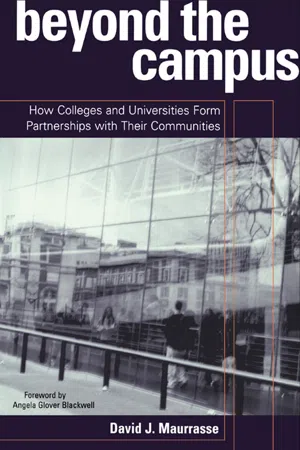
The role of the university and its relationship to the community has long been a highly debated topic among educators, administrators, and local business leaders. David J. Maurrasse offers a passionate appeal for community partnerships. Going further than a simple explanation of the problems at hand, Beyond the Campus offers a road map for both universities and local institutions to work together for the good of their communities.
eBook - ePub
Beyond the Campus
How Colleges and Universities Form Partnerships with their Communities
- 224 pages
- English
- ePUB (mobile friendly)
- Available on iOS & Android
eBook - ePub
Beyond the Campus
How Colleges and Universities Form Partnerships with their Communities
About this book
Information
Chapter 1
The Mission of Higher Education
What is the purpose of higher education? What goals should colleges and universities attempt to pursue? What obligations do colleges and universities have to society? Academic missions are not static; they can shift with societal needs and historical contexts. Core academic missions of institutions of higher education have changed over time from serving an elite, to teaching the liberal arts, to producing scientific research, to teaching vocation, to providing service. Most of today’s colleges and universities adopt comprehensive missions spanning an array of elements, but often including some combination of teaching and research, liberal arts and sciences. Service often has been a third element alongside teaching and research, but its security can be tenuous depending on the institution.
Historically, changes in the broader environment spawned appropriate amendments in the missions of colleges and universities.1 This has been true for most major institutions and industries. The rate at which institutions can adapt to societal change rests on multiple factors. Given the many different types of institutions of higher education, adaptation to the burgeoning expectation that colleges and universities will be involved in community partnerships will vary significantly.
As much as higher education appears to be moving toward involvement in local communities, the institutions also are becoming increasingly corporate in nature. The outsourcing2 of labor is a good example. While corporations meet some particular societal demands, they primarily are driven by the bottom line—profits. Institutions of higher education ideally are driven by the fulfillment of a social mission. Developing minds, leaders—social uplift is the charge of higher education. These concepts, according to many involved in higher education/community partnerships, can be extended into community development—the development of people inside and outside of the institution. Higher education, the community partnerships movement suggests, must as a part of its mission take ownership of its broader environment; the institution must see itself as a citizen with a responsibility to its neighbors.
Scholars have increasingly been analyzing the inherent responsibilities of citizenship. Groups interests, some argue, are not naturally distinct from self interests.3 The communitarian movement, popularized by Amitai Etzioni, for example, promotes individual responsibility to fellow citizens, rooted in collective interests.4 These concepts can be extended to institutional citizenry; the high education/community partnership movement is rooted in such ideas.
While postsecondary education was once the bastion of the elite, higher education has become increasingly accessible to the masses.5 The United Nations Educational, Scientific and Cultural Organization’s (UNESCO) 1998 World Conference on Higher Education highlighted the global “massification” of higher education, in which institutions once accessible to less than one percent of the population in some countries are now flanked by other colleges and universities that have expanded the field of citizens with postsecondary degrees. Today, the perception of the stuffy ivory tower institution teeming with sweatered prep-school offspring of the captains of industry is no longer an accurate reflection of the state of higher education. Most institutions of higher education now have diverse student bodies, including many working-class people with a host of real-world life challenges.6 Working-class people of color in student bodies and even faculty and administration can influence the priorities of higher education, including the degree of participation in surrounding communities.
The relationship between higher education and community varies by institution, and the mission of higher education varies by the type of university or college. However, while few in number, major research universities dominate societal conceptions of the role of higher education. A comparative analysis of different types of institutions of higher education highlights some of the critical distinctions in the contextual circumstances of many colleges and universities. Nevertheless, the influence of major research universities may in fact dwarf that of other institutions of higher education. Robert Rosenzweig said of the approximately one hundred such institutions:
Although that may seem small in number—indeed, is a small number, in comparison with the total of thirty-five hundred post secondary institutions—it is a group whose influence and importance far exceed its percentage of the total. Not only do these universities conduct most of the nation’s basic research; they also educate the vast majority of future college teachers and research scientists of all types as well as leaders of the learned professions. They are the most visible of all educational institutions, and, for better or for worse, they are the models that many others in this country and abroad strive to emulate. What happens in them and to them matters.7
As one begins to imagine policy changes specifically designed to enhance the civic engagement of institutions of higher education, major research universities would have to play a critical role in order to shape the entire academy’s approach to local communities. However, major research universities, with their rise to prominence during the twentieth century, have not been in the forefront of constructing models of community partnerships. Many residents of communities in close proximity to these universities would argue that their powerful neighbors have done more harm than good.
For any college or university the broader idea of taking on greater social responsibility boils down to fulfilling that mission without infringing upon the rights or interests of others. Institutions of higher education are in the precarious position of satisfying multiple interests in the fulfillment of a mission. The core academic mission holds one set of priorities; economic aspects of the mission drive another set of priorities. The two are intertwined, but not always in sync. Further engagement in communities only expands the number of constituents with a stake in the institution. To take account of perspectives of faculty, administrators, students, trustees, staff, and donors, not to mention government, the private sector, and local communities is daunting. It’s an imposing management challenge. Nevertheless, each of those constituency groups holds a stake in the institution. Understanding their priorities only improves how the institution interacts with them. Openness to their questions, concerns, and interests only strengthens the institution.
During the twentieth century, for example, student protest was one of the more salient examples of an interest group bringing to the table strong disagreements with the priorities of central administrations. Despite administrators’ resistance to such protest, the missions and operations of higher education certainly have been enhanced by student demands. Student protest has made universities more diverse, more sensitive in their investments, broader in their curriculum, and increasingly more responsible to their surrounding communities. Student movements continue to hold academia accountable and drive the enhancement of various aspects of higher education. Stronger relationships with community will pave avenues for local input. If higher education/community partnerships continue to grow at a similar rate, colleges and universities will be forced to take account of community voices in more significant ways. This effectively would strengthen the service aspect of the higher educational mission and enhance the institutional civic responsibility of colleges and universities.
Evolution of the Role of Higher Education
It is difficult to discuss historical debates on the role of higher education without addressing nineteenth-century British scholar and preacher John Henry Newman’s seminal work, The Idea of a University, originally published in 1873. Newman defines a university as “a place for teaching universal knowledge in order to mandate the presence of theology as a science of sciences.”8 According to Newman, a university education is not professional or vocational, rather it expands one’s outlook and capacity for social and civic interaction.
And this is the reason why it is more correct to speak of a university as a place of education, than of instruction, though, when knowledge is concerned, instruction would at first sight have seemed the more appropriate word. We are instructed, for instance, in manual exercises, in the fine and useful arts, in trades, and in ways of business; for these are methods which have little or no effect on the mind itself…. When we speak of the communication of knowledge as being education, we thereby really imply that that knowledge is a state or condition of mind; and since cultivation of mind is surely worth seeking for its own sake…” (85)
A university produces, according to Newman, a “gentleman,” who is polished and worldly, yet not above laypersons. Influenced by the Catholic church, Newman stressed that students should pursue excellence yet remain loyal to higher religious pursuits of contributing to society. These ideas, although rooted specifically within Catholic ideology, stress a higher educational mission that promotes contribution to society. The training of contributors to society, Newman argued, was a function of building their intellects. “If then a practical end must be assigned to a University course, I say it is that of training good members of society. Its art is the art of social life, and its end is fitness for the world. It neither confines its views of particular professions on the one hand, nor creates heroes or inspires genius on the other. Works indeed of genius fall under no art; heroic minds come under no rule” (125). Referring to the characteristics of a universally educated person, Newman maintains, “He is at home in any society, he has common ground with every class; he knows when to speak and when to be silent; he is able to converse, he is able to listen; he can ask a question pertinently, and gain a lesson seasonably” (126).
The holistic nature of universities does indeed have utility as Newman argues; however, it does not seem certain that great contributions to society naturally flow from a well-rounded “universal” education. Current community partnerships are rooted in the idea of societal contribution, but they demonstrate a conscious commitment to extending higher educational resources outside of the institution. A college or university has to demonstrate the will to take responsibility for the external environment.
While Newman and others laid the foundation for liberal arts, scientific research would eventually coexist with and in some cases dominate the higher educational landscape. George Washington was among the first to call for some federal role in advancing scientific research. In 1796, he called for a Board of Agriculture, which would encourage experimentation.9 Such thinking ultimately led to sweeping legislation like the Morrill Act of 1862, and the Hatch Act of 1887, which established experiment stations at the land grant universities created through the Morrill Act. Eventually, scientific research became incorporated into several institutions of higher education, leading to gradations among research universities. Major research universities, often known as “research 1” institutions, have come to control a significant percentage of the resources designated for higher education.
In the United States, the dominance of major research universities is heavily supported by powerful external interests. “For government, business, and the major foundation, the best criterion for research investment is the proven performance of blue chip institutions.”10 It was not until after World War II that a large cluster of American research universities rose to positions of global preeminence, as the federal government began to rely heavily on these institutions for scientific expertise. This allowed new research universities to significantly enhance their international profiles.11 The war highlighted the role of science and technology in modern military strategies, leading Vannevar Bush, director of the wartime Office of Scientific Research and Development, to advocate for harnessing the existing resources of universities for scientific ends. This direction only facilitated the application of scientific research to other areas.12 Research universities fulfilled demand stemming not only from government, but from foreign students.
Prior to the war, $31 million was available for scientific research. “A quarter of a century later, that figure had multiplied twenty-five times in constant dollars. Virtually all of the increase was the consequence of the federal government that stressed the importance of research as a central university function, a sharp departure from earlier years” (Rosenzweig, 1998, p. 2). While the research mission thrives in the most prominent universities and is often aspired to by the vast field of other institutions of higher education, the top-secret, militarily-driven research came under heavy criticism by some internal university constituents, especially students. The anti-Vietnam War movement played a critical role in limiting secret research on campuses nationwide (4). Prior to that era, research and development expenditures more than tripled between 1957 and 1968.
Academic research personnel in public universities grew from 13,000 to 23,000 and in private universities from 12,000 to 23,000. The federal share of research funds grew from 53 percent to 75 percent in public universities and from 66 percent to 82 percent in private universities. Total higher educational enrollment grew from three million to more than seven million. Enrollment in public doctoral universities grew from 800,000 to 1.9 million. Private doctoral university enrollment went from 440,000 to 650,000. The number of doctorates awarded in science and engineering grew from 5,800 to 14,300. (5–6)
Politicians’ dissatisfaction with “violent disruptions” on campuses during the late 1960s and early 1970s led to lower federal appropriations to universities and more stringent conditions of financial support. Moreover, a general public suspicion of science emerged (9–10). Ironically, liberal arts remained a centerpiece of undergraduate education in the United States throughout the rise of scientific research. But as we head into the twenty-first century, scientific research still drives the majority of funding into universities.
Today, Newman’s “idea of a university” survives, but universities have taken advantage of their scientific capacities. The fulfillment of government demands for research and the promotion of knowledge for its own sake coexist. But, what does this mean for community partnerships? How much of the research produced in higher education ever reaches communities?
I would argue that making a societal contribution has to be a more active process, in which communities present their priorities to the academy, and research is conducted accordingly.13 While on the surface this may fly in the face of academic freedom, it would not be very much different than accepting government support for research. Government may be the messenger of societal needs, but do policy makers really know better than residents at the neighborhood level? In fact, many public officials often rely on academics to articulate societal needs. If academics do not have a direct pipeline to the voices of communities, then how can they really know the issues? Community partnerships have the potential to create a smarter higher educational system—one that is truly in tune with the critical issues facing the cities, the farms, and all in between. The academic mission can be more than fulfilled through higher education/community partnerships.
Higher Education and Meeting Societal Needs
Throughout the colonization of America, new immigrants attempted to cultivate the country’s vast natural resources, from oil to forests to land suitable for growing numerous food crops. Particularly as colonizers began to move westward, improved agriculture became an increasing priority. With societal demand moving in this direction during the late eighteenth century, higher education eventually followed suit. The concept of “land grant” was based on the need to provide practical education, which would enhance the skills and capacity of farmers.14 This thinking initially facilitated the establishment of elementary schools on land provided by the federal government—an extension of the Northwest Ordinances of 1785 and 1787, which “laid the foundation for a national system of free education”—and ultimately expanded the availability of higher education as well to a broader cross-section of the population, particularly working farmers (7). Scientific education had, by this time, increased in its significance within higher education, particularly because the public began to see the potential practical uses of science in solving the challenges of daily life.
The United States Agricultural Society was established in 1852 in response to the demand for experiments, essays, and reports on improvements in farming practices (6). With its headquarters in Washington, it boasted a membership of three hundred societies in thirty-one states and five territories. This coalition pushed for congressional support for higher educational programming in agriculture and the mechanical arts. Prior to the passing of the legendary Morrill Act of 1862, which effectively established the higher educational land grant system, the University of Michigan in 1837 and the University of Wisconsin in 1848 were established based on an 1836 authorization of two “townships.” These were the first colleges of agriculture—direct responses to the conditions of the time. Higher education was compelled to adapt to demand, spawning universities with the mission of enhancing the agricultural economy. Prior to the establishment of these new institutions, higher education was not suited to take on these challenges. Someone had to take action to support the interests of farmers.
It was Jonathon Baldwin Turner of Illinois who spearheaded the push for federal land grants to establish colleges of agriculture and the mechanical arts (8).
Turner’s plan was influenced and guided by Jeffersonian ideals. He sought to develop young people’s reasoning faculties, enlarge their minds, and cultivate their morals so that commerce, agriculture, and manufacturing could prosper to the benefit of every American. Education was truly in the public interest. The plan included three basic goals: (1) to establish colleges that would be open at minimum cost, to laborers in agricultur...
Table of contents
- Cover Page
- Title Page
- Copyright Page
- Foreword
- Acknowledgments
- Introduction
- Chapter 1 The Mission of Higher Education
- Chapter 2 Have Ivory Tower, Will Trave
- Chapter 3 Living Up to a People’s University
- Chapter 4 Community in the Roots
- Chapter 5 Just Getting By
- Chapter 6 Comparisons and Conclusions
- Appendix
- Notes
- Selected Bibliography
Trusted by 375,005 students
Access to over 1.5 million titles for a fair monthly price.
Study more efficiently using our study tools.
Frequently asked questions
Yes, you can cancel anytime from the Subscription tab in your account settings on the Perlego website. Your subscription will stay active until the end of your current billing period. Learn how to cancel your subscription
No, books cannot be downloaded as external files, such as PDFs, for use outside of Perlego. However, you can download books within the Perlego app for offline reading on mobile or tablet. Learn how to download books offline
Perlego offers two plans: Essential and Complete
- Essential is ideal for learners and professionals who enjoy exploring a wide range of subjects. Access the Essential Library with 800,000+ trusted titles and best-sellers across business, personal growth, and the humanities. Includes unlimited reading time and Standard Read Aloud voice.
- Complete: Perfect for advanced learners and researchers needing full, unrestricted access. Unlock 1.5M+ books across hundreds of subjects, including academic and specialized titles. The Complete Plan also includes advanced features like Premium Read Aloud and Research Assistant.
We are an online textbook subscription service, where you can get access to an entire online library for less than the price of a single book per month. With over 1.5 million books across 990+ topics, we’ve got you covered! Learn about our mission
Look out for the read-aloud symbol on your next book to see if you can listen to it. The read-aloud tool reads text aloud for you, highlighting the text as it is being read. You can pause it, speed it up and slow it down. Learn more about Read Aloud
Yes! You can use the Perlego app on both iOS and Android devices to read anytime, anywhere — even offline. Perfect for commutes or when you’re on the go.
Please note we cannot support devices running on iOS 13 and Android 7 or earlier. Learn more about using the app
Please note we cannot support devices running on iOS 13 and Android 7 or earlier. Learn more about using the app
Yes, you can access Beyond the Campus by David J. Maurrasse in PDF and/or ePUB format, as well as other popular books in Education & Education General. We have over 1.5 million books available in our catalogue for you to explore.