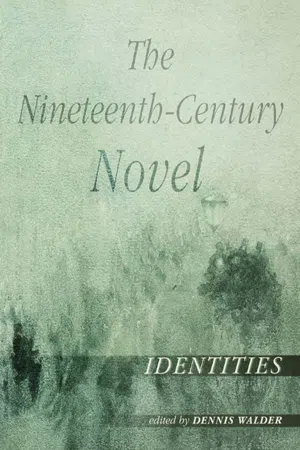
The Nineteenth-Century Novel: Identities provides an ideal starting point for understanding gender in the novels of this period. It explores the place of fiction in constructing gender identity within society at large, considering Madame Bovary, Portrait of a Lady and The Woman in White. The book continues with a consideration of the novel at the fin de siecle, examining Dracula, The Awakening and Heart of Darkness.
These fascinating essays illuminate the ways in which the conventions of realism were disrupted as much by anxieties surrounding colonialism, decadence, degeneration and the 'New Woman' as by those new ideas about human psychology which heralded the advent of psychoanalysis.
The concepts which are crucial to the understanding of the literature and society of the nineteenth century are brilliantly explained and discussed in this essential volume.
- 320 pages
- English
- ePUB (mobile friendly)
- Available on iOS & Android
eBook - ePub
The Nineteenth-Century Novel: Identities
About this book
Information
PART 1
Introduction to part 1
DOI: 10.4324/9780203820414-2
In the first part of this volume, we focus upon three contrasting mid- to late nineteenth-century novels: Gustave Flaubert’s Madame Bovary (1856–7), Wilkie Collins’s The Woman in White (1859–60) and Henry James’s The Portrait of a Lady (1880–1). As their titles suggest, these novels all feature women as central characters; in terms of origin, theme and technique, however, they are quite different. Madame Bovary, one of the great nineteenth-century novels of adultery, is also a scrupulous examination of the detailed texture of northern French provincial life and its constraints. Thick with realist detail, the novel none the less played a key role in promoting a recognizably modern form of impersonal narration, and in raising the status of the genre to the highest level. The Woman in White, on the other hand, was the first, and also arguably the greatest, of popular English ‘sensation novels’: it is a masterfully constructed tale in which mysterious midnight encounters, intrigue and crime all feature, and suspense is more important than everyday reality. The Portrait of a Lady deals with the disillusionment of a young American woman in Europe, while harking back to the conventions of English domestic fiction, where the search for a suitable husband is the main aim of the plot. In this novel, James develops a narrative method of undercurrent and implication that invites readers into profound reflection upon the complexity of one woman’s situation.
Despite these obvious differences, all three novels, in one form or another, may be said to raise the issue of female identity. Most novels have to do with the nature of the self in relation to others; but taking into account the question of how the central female character is, so to speak, ‘constructed’ sheds fresh light on both the art of the novelist in the nineteenth century, and on the ways in which novels connect with prevailing beliefs, manners and social structures. The specific instability of female identity revealed by our readings of these novels leads to further questions about the coherence of the self in the novels discussed in part 2 of this volume – Bram Stoker’s Dracula (1897), Kate Chopin’s The Awakening (1899) and Joseph Conrad’s Heart of Darkness (1899) – all of which probe the new ways in which fiction represented a growing sense of the difficulty, if not the impossibility, of imagining a unified and coherent subject.
Our approach involves looking at these novels from a perspective that draws on recent thinking (including, most notably, feminist theory) about the relation of the novel to its psychological, social and ideological underpinnings. The increasing self-awareness of fiction from roughly the middle of the nineteenth century onwards seems to have coincided with an increased interest among certain writers in experimentation, as they engaged with contemporary realities in a more inward, or indirect, way. The growing understanding that social and historical realities cannot be written from an objective standpoint, but that writing necessarily reflects the position of the writer, led to a conception of fictional truths as a function of the ‘point of view’ of the imagining consciousness. This is most obvious, perhaps, in the theorization of his practice by James, who can be seen as the founder of modern novel-criticism in English. It was the French novelists of the nineteenth century Honoré de Balzac, Gustave Flaubert and Émile Zola who developed the most sophisticated theory of the novel, especially in terms of the debates about realism. But it was James’s prefaces and reviews (many of which invoked these novelists) that had the greatest impact upon Anglo-American novel-criticism. It was not until the 1920s and 1930s that the writings of novelists such as Virginia Woolf (in the Common Reader volumes of the 1920s and 1930s and in A Room of One’s Own, 1929), E. M. Forster (in Aspects of the Novel, 1927) and D.H. Lawrence (in Phoenix, 1936) created a broader and more diversified criticism.
The continuing influence of James’s views was evident in the work of F. R. Leavis, who adopted the Jamesian criterion of ‘felt life’ (James, [1880–1] 1995; preface; p.7) as a watchword, while developing a highly selective canon of novels and novelists as the ‘central’ or ‘great’ tradition. In The Great Tradition ([1948] 1962), Leavis insisted that the great English novelists were Jane Austen, George Eliot, Henry James and Joseph Conrad, on the grounds that their work made the most profound contribution to our awareness of the ‘possibilities of life’. Leavis went on to find the high moral seriousness he attributed to these novelists in the work of D.H. Lawrence, but it was not until 1970 that (in part under the influence of his wife, Q.D. Leavis) he included the work of Charles Dickens in similar terms. Opposition to what was identified as the ‘Leavis position’, and in particular to his anti-theoretical, highly judgmental and exclusive approach, has grown apace; it has been attacked or, increasingly, ignored, by both structuralists and post-structuralists, on the one hand, and Marxist and feminist critics, on the other. One of the dangers of this development has been to encourage the idea that nothing important was said before the 1960s or 1970s, when the new wave of literary theory arose – or, indeed, before the 1980s or 1990s, when further exciting (and often bewildering) new approaches captured the attention of academics and students, if not writers and reviewers. These approaches – new historicism, cultural materialism, post-colonialism and lesbian/gay criticism (or Queer Theory) – represent new attempts to politicize critical endeavour, broadening yet further the reach of reading and understanding to incorporate texts and groups previously marginalized or underrated. This new inclusiveness has informed the chapters that follow.
The method we have adopted might best be described as ‘eclectic-historicist’, with the most obvious influence being that of feminist thinking about the novel. From the well-known opening of Jane Austen’s Northanger Abbey (1818), in which the novel’s heroine is characterized in terms wittily contrasting her with the conventional romance figure, very many nineteenth-century novels concerned themselves with the construction of the female psyche, and the nature of readerly or generic expectations towards women. Nor was this concern only the preserve of female writers like Austen, Charlotte Brontë or George Eliot. The three novels we look at in detail in part 1 were all written by men, and it is likely that there was an element of self-identification with the central female figures in them_ as Flaubert allegedly announced, ‘Madame Bovary, c’est moi.’
Why should it have been so important to these male writers to try to inhabit women? Was there something about the predicament of women at the time that made this seem a worthwhile ambition? Or was it that they felt the pressure of demand from a female readership to explore the choices confronting women? Or were there darker motives for this perhaps surprising choice of perspective? Hovering behind these heroines’ struggles for fulfilment are death, madness and despair. Could no better end be imagined, in terms of the realities of the time?
Scholarship and criticism generated by the feminist movement has increased our awareness of these questions, and provided some of the means to answer them. To talk of ‘the feminist movement’ can be misleading, however, since there were, and are, so many strands of political, social and cultural – not to mention literary – criticism that might fall under that heading. For a start, it is important not to forget that some of the most powerful and influential voices challenging prevailing assumptions about the position of women emerged long before what we nowadays think of as the women’s movement. These voices go back well beyond the ‘second’ wave of feminism, from the 1960s onwards, or beyond the suffragettes of the early twentieth century. Books such as Mary Wollstonecraft’s A Vindication of the Rights of Woman (1792), the American Margaret Fuller’s Woman in the Nineteenth Century (1845), John Stuart Mill’s The Subjection of Woman (1869), Friedrich Engels’s The Origin of the Family (1884), Eleanor Marx’s The Woman Question (1886) and Olive Schreiner’s Women and Labour (1911) all offered classic critiques of women’s subordination in Western societies. In the 1920s the impact of new thinking about the position of women upon attitudes towards writers and writing was strikingly apparent in the work of Rebecca West and, most famously, Virginia Woolf. In her influential book A Room of One’s Own , Woolf argued that economic and cultural factors, rather than innate disposition, prevented women from achieving the classic status of male writers. This conviction was shared by Simone De Beauvoir, whose monumental work Le Deuxième Sexe (1949; ‘The Second Sex’) explored the role of women in literature by scrutinizing their place in anthropology, biology, philosophy and religion. Her conclusion was that women have been defined in relation to men, who are seen as the ‘Absolute’, while women are always the ‘Other’.
The social construction of women became a central tenet for the spate of writings which emerged in the late 1960s, arguing that women had been oppressed and exploited by the ‘patriarchal order’ of society, which defined them as ‘Other’. Many writers, while urging the need to look at the historical and socioeconomic status of women, focused particularly upon literary sources (many, such as Germaine Greer and Elaine Showalter, were in any case trained literary critics). Looking back now, there seem to have been two main stages in the development of twentieth-century feminist criticism_ the first was concerned with the critique of anti-woman, or misogynist, stereotyping in literature, examining the ways in which, for example, sexually assertive women were typically represented as angry harridans, while heroines had to be legless and tearful, rather than whole human beings; the second stage was concerned with the recovery of ‘lost’ writers and their works – such as Kate Chopin’s The Awakening, long ignored and out of print. De Beauvoir had addressed herself to the way in which women had been represented by male writers such as Stendhal and Lawrence, although more recent French feminist criticism, such as that of Luce Irigaray and Julia Kristeva, has become obsessively interested in the psychoanalytic dimension, reading texts as tangles of repressed desire. English feminist criticism, while strongly influenced by developments in France, has had a more Marxist, or at least a more materialist, take on the oppression of women, and how this might be encountered in literary and other texts – examining the social (and particularly class) aspect of literary production, as well as the psychological. Terry Lovell’s 1987 book. Consuming Fiction , for example, rewrote the standard account of ‘the rise of the novel’ (the title of Ian Watt’s influential study of 1957) in both gender and class terms. The common objection was that far too often in this kind of criticism ‘Marxism spoke and feminism listened’ – as Ruth Robbins puts it in a helpful account. Literary Feminisms (2000, p.38). Hence, according to many American feminists, not only was it vital to restore the issue of gender (affecting men as well as women) to a central position, but questions of aesthetics, too. which might also be sidelined by an over-emphasis upon social formations. And, as African American critics such as bell hooks argued, race was all too easily overlooked as well.
Clearly, feminist criticism may involve many different and sometimes antagonistic viewpoints. An interest in the nineteenth-century novel has been one thing in common, doubtless because of its focus on intimate and domestic life, romance, courtship and marriage – not to mention the subversive impact of adultery and other forms of transgression, highlighted by books such as Sandra M. Gilbert and Susan Gubar’s The Madwoman in the Attic (1979), Nina Auerbach’s Woman and the Demon: The Life of a Victorian Myth (1982) and Lyn Pykett’s The Improper Feminine: The Women’s Sensation Novel and the New Woman Writing (1992). The novels discussed in the first part of this volume place women in a central position; in part 2, only one of the three novels discussed, that by Kate Chopin, treats women characters as central. Yet a striking continuity can be perceived through all six novels: a preoccupation with the struggle to understand human desire, through sexuality, ownership and, on the largest scale, empire.
The manipulation of different generic forms within the novelistic narrative is one aspect of this struggle (using fantasy or dream to subvert the realist surface of the text, for example); another is the changing context of attitudes, beliefs and law. Around the middle of the nineteenth century, the ideology of ‘separate spheres’, according to which men were economically active, striving and competitive, and women passive, domestic and nurturing, still seemed dominant in England, France and America: whereas by about 1900, strict gender divisions had cracked and broken in many places. Of course, fissures can be found wherever you look, in novels as in other areas of discourse: in Jane Eyre (1847) or in Dombey and Son (1846–8), for instance, class, gender and racial assumptions are at times extremely shaky. But there is strong evidence of (middle-class) women becoming more assertive and independent by the 1880s and 1890s (when their legal position had also improved), while some scientific as well as literary discourses were proposing more malleable conceptions of identity than had previously prevailed. If, as we suggest in what follows, writers from James to Conrad were registering deep anxiety about the roles of women and men in society, this was in part because changing conceptions of gender were encouraging the development of new ways of thinking about the self in society.
The role of literary texts in such developments is not easy to discern. The novels we have chosen to study encourage us to think about, and question, the relationship between ourselves and fiction, and between fiction and reality. In the first place, though, they seduce us into reading them, into an intimacy with their worlds. One of the most distinctive features of what the Russian critic M.M. Bakhtin refers to as the ‘novelistic zone’ is the closeness between text and reader. As he says, ‘in place of our tedious lives’ many novels offer us ‘a surrogate, true, but it is the surrogate of a fascinating and brilliant life. We can experience these adventures, identify with these heroes; such novels almost become a substitute for our own lives’ (1982, p.32). Yet this special experience, absent from the reading of more distanced genres such as drama or poetry, brings a special danger: ‘we might substitute for our own life an obsessive reading of novels, or dreams based on novelistic models’ – in short, ‘Bovaryism becomes possible’ (ibid.).
‘Bovaryism’ is, of course, the ultimately fatal disease that overtakes the heroine of Madame Bovary: she identifies closely with the characters and settings of what she obsessively reads and enjoys, but also tries to bring her own life into line with her novelistic models. It is not just that as a fifteen-year-old in a convent Emma Bovary makes a ‘cult’ of Mary Stuart, and has ‘an enthusiastic veneration for illustrious or ill-fated women’ (Flau...
Table of contents
- Cover Page
- Title Page
- Copyright Page
- Table of Contents
- General introduction
- Part 1
- Part 2
- Index
Trusted by 375,005 students
Access to over 1.5 million titles for a fair monthly price.
Study more efficiently using our study tools.
Frequently asked questions
Yes, you can cancel anytime from the Subscription tab in your account settings on the Perlego website. Your subscription will stay active until the end of your current billing period. Learn how to cancel your subscription
No, books cannot be downloaded as external files, such as PDFs, for use outside of Perlego. However, you can download books within the Perlego app for offline reading on mobile or tablet. Learn how to download books offline
Perlego offers two plans: Essential and Complete
- Essential is ideal for learners and professionals who enjoy exploring a wide range of subjects. Access the Essential Library with 800,000+ trusted titles and best-sellers across business, personal growth, and the humanities. Includes unlimited reading time and Standard Read Aloud voice.
- Complete: Perfect for advanced learners and researchers needing full, unrestricted access. Unlock 1.5M+ books across hundreds of subjects, including academic and specialized titles. The Complete Plan also includes advanced features like Premium Read Aloud and Research Assistant.
We are an online textbook subscription service, where you can get access to an entire online library for less than the price of a single book per month. With over 1.5 million books across 990+ topics, we’ve got you covered! Learn about our mission
Look out for the read-aloud symbol on your next book to see if you can listen to it. The read-aloud tool reads text aloud for you, highlighting the text as it is being read. You can pause it, speed it up and slow it down. Learn more about Read Aloud
Yes! You can use the Perlego app on both iOS and Android devices to read anytime, anywhere — even offline. Perfect for commutes or when you’re on the go.
Please note we cannot support devices running on iOS 13 and Android 7 or earlier. Learn more about using the app
Please note we cannot support devices running on iOS 13 and Android 7 or earlier. Learn more about using the app
Yes, you can access The Nineteenth-Century Novel: Identities by Dennis Walder in PDF and/or ePUB format, as well as other popular books in Literature & Literary Criticism. We have over 1.5 million books available in our catalogue for you to explore.