- 288 pages
- English
- ePUB (mobile friendly)
- Available on iOS & Android
eBook - ePub
About this book
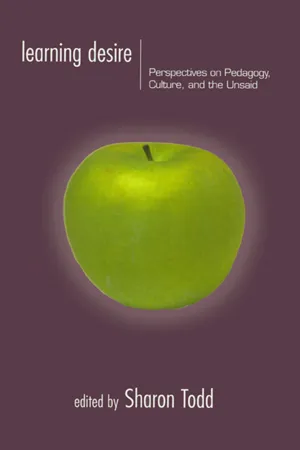
What role can desire play in pedagogical interaction? In Learning Desire , contributors from the fields of education, cultural studies, psychoanalysis and literary theory explore the many ways desire intersects with knowledge, recognition, fantasy, and embodiment, and what this can mean for transformative pedagogical practice. While acknowledging the productive and destructive force desire can have on the learning experience, the authors offer engaging, innovative modes of thinking about teaching and thinking about desire as an education tool. This volume, rooted in theory, is one also geared towards practice; in taking a fresh look at the limits and possibilities of a transformative pedagogy, it will also give teachers and students new languages for articulating their experiences in the classroom and beyond.
Information
Part 1
Desire and Knowledge
1
Psychoanalysis and Education
Teaching Terminable and Interminable
In memory of Jacques Lacan
Meno: Can you tell me, Socrates, if virtue can be taught? Or is it not teachable but the result of practice, or is it neither of these, but men possess it by nature?
Socrates: … You must think me happy indeed if you think I know whether virtue can be taught… I am so far from knowing whether virtue can be taught or not that I do not even have any knowledge of what virtue itself is.
Meno: Yes, Socrates, but how do you mean that we do not learn, but that what we call learning is recollection? Can you teach me how this is so?
Socrates: … Meno, you are a rascal. Here you are asking me to give you my “teaching,” I who claim that there is no such thing as teaching, only recollection.
—Plato, Meno1
The Measure of a Task
Socrates, that extraordinary teacher who taught humanity what pedagogy is, and whose name personifies the birth of pedagogics as a science, inaugurates his teaching practice, paradoxically enough, by asserting not just his own ignorance, but the radical impossibility of teaching.
Another extraordinarily effective pedagogue, another one of humanity’s great teachers, Freud, repeats, in his own way, the same conviction that teaching is a fundamentally impossible profession. “None of the applications of psychoanalysis,” he writes, “has excited so much interest and aroused so many hopes … as its use in the theory and practice of education …”:
My personal share in this application of psychoanalysis has been very slight. At an early stage I had accepted the bon mot which lays it down that there are three impossible professions—educating, healing, and governing—and I was already fully occupied with the second of them.2
In a later text—indeed the very last one that he wrote—Freud recapitulates this paradoxical conviction which time and experience seem to have only reinforced, confirmed:
It almost looks as if analysis were the third of those ‘impossible’ professions in which one can be sure beforehand of achieving unsatisfying results. The other two, which have been known much longer, are education and government. (Standard, XXIII, 248)
If teaching is impossible—as Freud and Socrates both point out—what are we teachers doing? How should we understand—and carry out—our task? And why is it precisely two of the most effective teachers ever to appear in the intellectual history of mankind, who regard the task of teaching as impossible? Indeed, is not their radical enunciation of the impossibility of teaching itself actively engaged in teaching, itself part of the lesson they bequeath us? And if so, what can be learnt from the fact that it is impossible to teach? What can the impossibility of teaching teach us?
As much as Socrates, Freud has instituted, among other things, a revolutionary pedagogy. It is my contention—which I will here attempt to elucidate and demonstrate—that it is precisely in giving us unprecedented insight into the impossibility of teaching, that psychoanalysis has opened up unprecedented teaching possibilities, renewing both the questions and the practice of education.
This pedagogical renewal was not, however, systematically thought out by Freud himself, or systematically articulated by any of his followers; nor have its thrust and scope been to date fully assimilated or fully grasped, let alone utilized, exploited in the classroom. The only truly different pedagogy to have practically emerged from what might be called the psychoanalytic lesson is the thoroughly original teaching-style of Jacques Lacan, Freud’s French disciple and interpreter. If Lacan is, as I would argue, Freud’s best student—that is, the most radical effect of the insights of Freud’s teaching—perhaps his teaching practice might give us a clue to the newness of the psychoanalytic lesson about lessons, and help us thus define both the actual and, more importantly, the potential contribution of psychoanalysis to pedagogy.
What is a Critique of Pedagogy?
Lacan’s relationship with pedagogy has, however, been itself—like that of Freud—mostly oversimplified, misunderstood, reduced. The reason for the usual misinterpretations of both Lacan’s and Freud’s pedagogical contribution lies in a misunderstanding of the critical position taken by psychoanalysis with respect to traditional methods and assumptions of education. Lacan’s well-known critique of what he has pejoratively termed “academic discourse” (le discours universitaire) situates “the radical vice” in “the transmission of knowledge.” “A Master of Arts,” writes Lacan ironically, “as well as other titles, protect the secret of a substantialized knowledge.”3 Lacan thus blames “the narrow-minded horizon of pedagogues” for having “reduced” the “strong notion” of “teaching”4 to a “functional apprenticeship” (E 445).
Whereas Lacan’s pedagogical critique is focused on grown-up training—on academic education and the ways it handles and structures knowledge, Freud’s pedagogical critique is mainly concerned with children’s education and the ways it handles and structures repression. “Let us make ourselves clear,” writes Freud, “as to what the first task of education is”:
The child must learn to control his instincts. It is impossible to give him liberty to carry out all his impulses without restriction… Accordingly, education must inhibit, forbid and suppress5 and this is abundantly seen in all periods of history. But we have learnt from analysis that precisely this suppression of instincts involves the risk of neurotic illness…. Thus education has to find its way between the Scylla of non-interference and the Charybdis of frustration…. An optimum must be discovered which will enable education to achieve the most and damage the least…. A moment’s reflection tells us that hitherto education has fulfilled its task very badly and has done children great damage. (Standard, XXII, 149)
Thus, in its most massive statements and in its polemical pronouncements, psychoanalysis, in Freud as well as Lacan—although with different emphases—is first and foremost a critique of pedagogy. The legacy of this critique has been, however, misconstrued and greatly oversimplified, in that the critical stance has been understood—in both Lacan’s and Freud’s case—as a desire to escape the pedagogical imperative: a desire—whether possible or impossible—to do away with pedagogy altogether. “Psychoanalysis,” writes Anna Freud, “whenever it has come into contact with pedagogy, has always expressed the wish to limit education. Psychoanalysis has brought before us the quite definite danger arising from education.”6
The illocutionary force of the psychoanalytical (pedagogical) critique of pedagogy has thus been reduced, either to a simple negativity, or to a simple positivity, of that critique. Those who, in an oversimplification of the Freudian lesson, equate the psychoanalytic critical stance with a simple positivity, give consequently positive advice to educators, in an attempt to conceive of more liberal methods for raising children—methods allowing “to each stage in the child’s life the right proportion of instinct-gratification and instinct-restriction.”7 Those who, on the other hand, in an oversimplification of the Lacanian lesson, equate the psychoanalytical critical stance with a simple negativity, see in psychoanalysis “literally an inverse pedagogy”: “the analytic process is in effect a kind of reverse pedagogy, which aims at undoing what has been established by education.”8 In the title of a recent book on the relationship of Freud to pedagogy, Freud is thus defined as “The Anti-Pedagogue.”9 This one-sidedly negative interpretation of the relation of psychoanalysis to pedagogy fails to see that every true pedagogue is in effect an anti-pedagogue, not just because every pedagogy has historically emerged as a critique of pedagogy (Socrates: “There’s a chance, Meno, that we, you as well as me … have been inadequately educated, you by Gorgias, I by Prodicus”10), but because, in one way or another, every pedagogy stems from its confrontation with the impossibility of teaching (Socrates: “You see, Meno, that I am not teaching … anything, but all I do is question .. .”11). The reductive conception of “Freud: The Anti-Pedagogue” thus fails to see that there is no such thing as an anti-pedagogue: an anti-pedagogue is the pedagogue par excellence. Such a conception overlooks, indeed, and fails to reckon with, Freud’s own stupendous pedagogical performance, and its relevance to his declarations about pedagogy.
The trouble, both with the positivistic and with the negativistic misinterpretations of the psychoanalytical critique of pedagogy, is that they refer exclusively to Lacan’s or Freud’s explicit statements about pedagogy, and thus fail to see the illocutionary force, the didactic function of the utterance as opposed to the mere content of the statement. They fail to see, in other words, the pedagogical situation—the pedagogical dynamic in which statements function not as simple truths but as performative speech-acts. Invariably, all existing psychoanalytically-inspired theories of pedagogy fail to address the question of the pedagogical speech-act of Freud himself, or of Lacan himself: what can be learnt about pedagogy not just from their theories (which only fragmentarily and indirectly deal with the issue of education) but from their way of teaching it, from their own practice as teachers, from their own pedagogical performance.
Lacan refers explicitly to what he calls the psychoanalyst’s “mission of teaching” (E 241, N 34 TM12), and speaks of his own teaching—the bimonthly seminar he gave for forty years—as a vocation, “a function … to which I have truly devoted my entire life” (S-XI, 7, N l).13 Unlike Lacan, Freud addresses the issue of teaching more indirecdy, rather by refusing to associate his person with it:
But there is one topic which I cannot pass over so easily—not, hecause, became I understand particularly much about it or have contributed very much to it. Quite the contrary: I have scarcely concerned myself with it at all. I must mention it because it is so exceedingly important, so rich in hopes for the future, perhaps the most important of all the activities of analysis. What I am thinking of is the application of psychoanalysis to education. (Standard, XXII, 146)
This statement thus promotes pedagogy to the rank of “perhaps the most important of the all the activities of analysis” only on the basis of Freud’s denial of his own personal involvement with it. However, this very statement, this very denial is itself engaged in a dramatic pedagogical performance; it itself is part of an imaginary “lecture,” significantly written in the form of an academic public address and of a dialogue with students—a pedagogic dialogue imaginarily conducted by a Freud who, in reality terminally ill and having undergone an operation for mouth-cancer, is no longer capable of speech:
My Introductory Lectures on Psychoanalysis were delivered … in a lecture room of the Vienna Psychiatric Clinic before an audience gathered from all the Faculties of the University….
These new lectures, unlike the former ones, have never been delivered. My age had in the meantime absolved me from the obligation of giving expression to my membership in the University (which was in any case a peripheral one) by delivering lectures; and a surgical operation had made speaking in public impossible for me. If, therefore, I once more take my place in the lecture room during the remarks that follow, it is only by an artifice of the imagination; it may help me not to forget to bear the reader in mind as I enter more deeply into my subject…. Like their predecessors, [these lectures] are addressed to the multitude of educated people to whom we may perhaps attribute a benevolent, even though cautious, interest in the characteristics and discoveries of the young science. This time once again it has been my chief aim to make no sacrifice to an appearance of being simple, complete or rounđed-off, not to disguise problems and not to deny the existence of gaps and uncertainties. (Standard, XXII, 5–6)
No other such coincidence of fiction and reality, biography and theory, could better dramatize Freud’s absolutely fundamental pedagogic gesture. What better image could there be for the pedagogue in spite of himself, the pedagogue in spite of everything—the dying teacher whose imminent death, like that of Socrates, only confirms that he is a born teacher—than this pathetic figure, this living allegory of the speechless speaker, of the teacher’s teaching out of—through—the vety...
Table of contents
- Cover
- Half Title
- Title Page
- Copyright Page
- Dedication
- Table of Contents
- Acknowledgments
- Introduction: Desiring Desire in Rethinking Pedagogy
- Part 1: Desire and Knowledge
- Part 2: Desire and Recognition
- Part 3: Desire and Voice
- Part 4: Desire and Re-Signification
- Part 5: Desire and Bodies
- Contributors
- Index
Trusted by 375,005 students
Access to over 1.5 million titles for a fair monthly price.
Study more efficiently using our study tools.
Frequently asked questions
Yes, you can cancel anytime from the Subscription tab in your account settings on the Perlego website. Your subscription will stay active until the end of your current billing period. Learn how to cancel your subscription
No, books cannot be downloaded as external files, such as PDFs, for use outside of Perlego. However, you can download books within the Perlego app for offline reading on mobile or tablet. Learn how to download books offline
Perlego offers two plans: Essential and Complete
- Essential is ideal for learners and professionals who enjoy exploring a wide range of subjects. Access the Essential Library with 800,000+ trusted titles and best-sellers across business, personal growth, and the humanities. Includes unlimited reading time and Standard Read Aloud voice.
- Complete: Perfect for advanced learners and researchers needing full, unrestricted access. Unlock 1.5M+ books across hundreds of subjects, including academic and specialized titles. The Complete Plan also includes advanced features like Premium Read Aloud and Research Assistant.
We are an online textbook subscription service, where you can get access to an entire online library for less than the price of a single book per month. With over 1.5 million books across 990+ topics, we’ve got you covered! Learn about our mission
Look out for the read-aloud symbol on your next book to see if you can listen to it. The read-aloud tool reads text aloud for you, highlighting the text as it is being read. You can pause it, speed it up and slow it down. Learn more about Read Aloud
Yes! You can use the Perlego app on both iOS and Android devices to read anytime, anywhere — even offline. Perfect for commutes or when you’re on the go.
Please note we cannot support devices running on iOS 13 and Android 7 or earlier. Learn more about using the app
Please note we cannot support devices running on iOS 13 and Android 7 or earlier. Learn more about using the app
Yes, you can access Learning Desire by Sharon Todd in PDF and/or ePUB format, as well as other popular books in Education & Education General. We have over 1.5 million books available in our catalogue for you to explore.