eBook - ePub
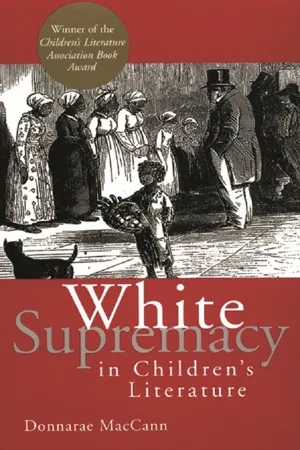
White Supremacy in Children's Literature
Characterizations of African Americans, 1830-1900
- 274 pages
- English
- ePUB (mobile friendly)
- Available on iOS & Android
eBook - ePub
White Supremacy in Children's Literature
Characterizations of African Americans, 1830-1900
About this book
This penetrating study of the white supremacy myth in books for the young adds an important dimension to American intellectual history. The study pinpoints an intersecting adult and child culture: it demonstrates that many children's stories had political, literary, and social contexts that paralleled the way adult books, schools, churches, and government institutions similarly maligned black identity, culture, and intelligence. The book reveals how links between the socialization of children and conservative trends in the 19th century foretold 20th century disregard for social justice in American social policy. The author demonstrates that cultural pluralism, an ongoing corrective to white supremacist fabrications, is informed by the insights and historical assessments offered in this study.
Information
Part One
The Antebellum Years
While the poor black is treated so contemptuously in, what are called, the free states…it is not to be wondered that the cause of negro-emancipation moves so slowly.
—James G.Birney, White abolitionist, 1835
The abolitionists were torn between a genuine concern for the welfare and uplift of the Negro and a paternalism which was too often merely the patronizing of a superior class.
—William H.Pease and Jane H.Pease, Historians 1965
The central icon of abolitionism, the figure of a black kneeling, hands folded and eyes cast upward, carried a clear message. It made emancipation conditional—on condition of conversion, on condition of docility and meekness, on condition of being on ones knees.
—Jan Nederveen Pieterse, Cultural historian 1992
Chapter One
Ambivalent Abolitionism
A Sampling of Narratives
Racialized relations do not follow an inevitable course in any historical period. There are always choices, alternatives, issues that can be resolved in a variety of ways. During a period of active abolitionist agitation, from about 1830 until the conclusion of the Civil War, the movement was splintered because its adherents were making different choices.
The conviction that so-called Caucasians constituted a superior group did not originate in the 1830s, but it was increasingly systematized to counter the growing attacks of abolitionists. As the antislavery forces expanded and spread their message, slavery advocates were forced into a more defensive posture and became more vocal on behalf of their cause. Ironically, abolitionists seldom opposed the idea of white superiority, even when presenting strong challenges to the proslavery forces in the South. An examination of antebellum children’s books provides clues as to how the radical abolitionists differed from the conservatives and why neither faction succeeded in sowing the seeds of a continuing egalitarian movement. Neither the Christian “brotherhood” argument against slavery nor the democratic “principles” argument could mitigate ongoing oppression unless these arguments encompassed an antiprejudice theme. That theme did not materialize in many abolitionist narratives.
A disjuncture between theory and practice in the antebellum period had a certain ludicrous slant. Both proslavery and antislavery forces found it convenient to invoke biblical teachings and American constitutional principles in support of their causes. By neatly canceling each other out, it became possible for the Northern antislavery argument to take the lead only when a range of sectional conflicts were added to the debate about emancipation. These sectional differences were enough to lead to war, but this is not to say that there were great differences between the Northern and Southern view of Blacks. Slaves and free Blacks were typically perceived as having a lower place than “Caucasians” on a supposed “chain of being.” Children’s books indicated that even White abolitionists subscribed to such a theory, or were, at best, ambivalent. (It should be noted that the historiography of abolitionism concentrates on White abolitionist activity. Free Blacks were important to this movement and opposed the bigotry of the [White] abolitionists, the group described below.)
The Reformist Group
Stories that represent the most hopeful and radical end of the abolitionist spectrum did explicitly address race prejudice as well as slavery. They were reformist tracts by such well known political commentators as Lydia Maria Child, Eliza Lee Follen, and Samuel Goodrich. Others such as Julia Colman and Matilda G.Thompson were not public figures but were among the committed antislavery operatives, people who created for even the youngest citizens images of slavery’s invidiousness (e.g., Colman and Thompson were contributors to The Child’s Anti-Slavery Book). Even though these writers were in the vanguard of progressive thought, the mainstream’s ethnocentric currents sometimes washed over them. They did not always resist that tide.
Lydia Maria Child’s antislavery agitation ranged from vehement exhortations, to antiprejudice parables, to incidental remarks tacked on to narratives. “Jumbo and Zairee” falls into the first category. It appeared in Child’s children’s magazine, Juvenile Miscellany, in 1831 and is based on a true-life account that was originally published in a Colonization Society publication.1 It features “two pretty negro children” whose father is an African prince, the rescuer of a shipwrecked Englishman. After enjoying the prince’s elaborate hospitality, the Englishman, Mr. Harris, returns to his home in England, but fails to tell Jumbo and Zairee that he is leaving. As they search for him by the seaside, they are captured by slavers and end up on a plantation in the United States.
The Middle Passage, the Africans’ journey across the Atlantic, is the occasion for the author’s first direct statement to the reader about the evils of the slave system. She speaks of the ship captain’s regret when his captives die, but he is only aggrieved about the profit loss. Child continues:
You will ask me if this man was an American? One of our own countrymen, who make it their boast that men are born free and equal? I am sorry to say that he was an American. Let us hope there are but few such.2
When Child first describes the plantation experiences of the two children, she gives the slavers the benefit of the doubt. She explains that slaves on the plantation were not abused, and she adds the footnote: “We believe this is generally the case with the slaves at the south; but the principle is wrong, even if there are nine hundred and ninety-nine good masters out of a thousand.”3 However, Child’s narrative is full of instances of abuse. When Zairee breaks an earthen pitcher and is about to receive twenty lashes, Jumbo intervenes on her behalf, but this results in seventy-five lashes for him and forty-five for his sister. At this point the author comments: “Even a Christian would have found it very hard to forgive such injuries….”4 These injustices are compounded when Jumbo is sold because of his impudence, and Zairee, too full of grief to eat her meals, is given the choice of eating or being whipped. Here Child vents her indignation before concluding the story optimistically. She writes:
This was in the United States of America, which boasts of being the only true republic in the world! the asylum of the distressed! the only land of perfect freedom and equality! Shame on my country—everlasting shame. History blushes as she writes the pages of American slavery, and Europe points her finger at it in derision.5
The narrative winds down with a series of coincidences. Jumbo is assigned to a different plantation, and it proves to be the home of his father (who has since been enslaved). Mr. Harris has immigrated to America and owns the neighboring plantation. These three are reunited and Mr. Harris arranges to buy Zairee at an inflated price. Apparently it is only his encounter with the very same African who saved his life that causes Mr. Harris a pang of conscience. At any rate, he suddenly frees all his slaves except two who refuse this change of fortune (they are old men, we are told, and too attached to Mr. Harris to part with him). Mr. Harris buys a ship for the freed Blacks and they return to Africa.
Even though Child emphasizes that the principle underlying slavery is wrong, she depicts Mr. Harris, the slave owner, as a paragon of virtue. The contradiction may not be inadvertent, since for many abolitionists it was a tactical maneuver to treat slave owners as suffering from a momentary moral lapse. In any case, Child’s intermittent antislavery speeches are among the most direct and potent that children’s books and magazines of the antebellum period offer.
While slavery is the chief target of “Jumbo and Zairee,” Child suggests indirectly her opposition to race prejudice when she alludes to the American creed. As she states, those who uphold that creed “boast” of their convictions vis-à-vis the “perfect freedom and equality” of all peoples. In another short story, Child concentrates her attention upon prejudice, upon attitudes lacking the benefit of knowledge or reason.
In “The Little White Lamb and the Little Black Lamb,” Child addresses the bigoted prejudgments of individuals rather than the slave system. This tale features a Black nurse, Nancy, who cares for a European American child, Mary Lee, but this story is unlike the plantation “Mammy” stories that were published in some quantity following the Civil War. In the stereotypic “Mammy” story, the Black surrogate mother is often depicted as someone with great disdain toward Black children. But Nancy is presented as a loving parent of Thomas, her own child. The author puts these words in Mary Lee’s mouth: “I am my mother’s little white lamb, and Thomas is Nancy’s black lamb; and God loves us both.”6 Then she editorializes about God’s love of children and God’s love of lambs, irrespective of color, and the withdrawal of that love when children are naughty. “Mary” continues as the narrator:
I suppose lambs are always good. But little children are naughty sometimes. Henry Pratt struck good little Thomas, and called him a nigger; and that made me cry. My little white lamb loves the black lamb; but Henry Pratt struck good little Thomas, and called him names. That was very naughty.7
A third type of story makes fewer references to race conflict, but does not miss its opportunity to suggest an egalitarian outlook. “Lariboo” has two primary thematic strands: first, the tragedy of intertribal warfare in Africa and its accompanying slave trade; and second, the possibility of a mystical, supportive relationship between a human and a wild animal. A young woman, “Lariboo,” experiences grief over her child’s death while on a forced march to a slave market, but her own life is sustained by a panther that befriends her after she is abandoned for dead. Early in the tale the author describes Lariboo’s tribe. The reader is encouraged to think construc-tively about cultural differences, to adopt the relativism of a latter day anthropologist (even though Child unfortunately repeats the fallacy that an African nation is invariably “merry”).
The Tibboos are a good-natured merry race, extravagantly fond of singing and dancing. Lariboo was reckoned quite a belle among them. I don’t suppose you would have thought her very good-looking, if you had seen the oil streaming over her face, coral passed through her nose, and broad brass rings on her arms and ancles [sic]. But she thought herself dressed very handsomely; and I do not know why it is considered more barbarous to bore the nose for ornaments, than to pierce holes through the ears, as our ladies do. As for the dark tint of her complexion, it would be considered beautiful by us, as it was by the Tibboo beaux, if we had been accustomed from infancy to see all our friends of that color. The Africans, who never see white men, or see them only as enemies, who come to carry them into slavery, consider the European complexion ghastly and disagreeable. When they describe the spirit of wickedness, usually called the Devil, they always paint him as a white man.8
In the end Lariboo comments on the flawed human race in a general sense. She has been reunited with her husband, and has moved with her tribe to a safer region (this group is not so happy-go-lucky as to remain in the locale that is vulnerable to slave hunters). However, the most poignant lines in the concluding scenes are about the heroic, sacrificial pa...
Table of contents
- Cover Page
- Half Title page
- Title Page
- Copyright Page
- Dedication
- Contents
- Preface
- A Note on Usage
- Introduction
- The Antebellum Years
- Ambivalent Abolitionism A Sampling of Narratives
- Sociopolitical and Artistic Dimensions of Abolitionist Tales Chapter Two
- Personal and Institutional Dimensions
- The Postbellum Years
- Children's Fiction A Sampling
- The Social/Political Context
- Literary Lives
- Postwar Institutions
- Literary Methods and Conventions
- Conclusion The “Lost Cause” Wins
- Bibliography
- Index
Trusted by 375,005 students
Access to over 1.5 million titles for a fair monthly price.
Study more efficiently using our study tools.
Frequently asked questions
Yes, you can cancel anytime from the Subscription tab in your account settings on the Perlego website. Your subscription will stay active until the end of your current billing period. Learn how to cancel your subscription
No, books cannot be downloaded as external files, such as PDFs, for use outside of Perlego. However, you can download books within the Perlego app for offline reading on mobile or tablet. Learn how to download books offline
Perlego offers two plans: Essential and Complete
- Essential is ideal for learners and professionals who enjoy exploring a wide range of subjects. Access the Essential Library with 800,000+ trusted titles and best-sellers across business, personal growth, and the humanities. Includes unlimited reading time and Standard Read Aloud voice.
- Complete: Perfect for advanced learners and researchers needing full, unrestricted access. Unlock 1.5M+ books across hundreds of subjects, including academic and specialized titles. The Complete Plan also includes advanced features like Premium Read Aloud and Research Assistant.
We are an online textbook subscription service, where you can get access to an entire online library for less than the price of a single book per month. With over 1.5 million books across 990+ topics, we’ve got you covered! Learn about our mission
Look out for the read-aloud symbol on your next book to see if you can listen to it. The read-aloud tool reads text aloud for you, highlighting the text as it is being read. You can pause it, speed it up and slow it down. Learn more about Read Aloud
Yes! You can use the Perlego app on both iOS and Android devices to read anytime, anywhere — even offline. Perfect for commutes or when you’re on the go.
Please note we cannot support devices running on iOS 13 and Android 7 or earlier. Learn more about using the app
Please note we cannot support devices running on iOS 13 and Android 7 or earlier. Learn more about using the app
Yes, you can access White Supremacy in Children's Literature by Donnarae MacCann in PDF and/or ePUB format, as well as other popular books in Literature & Literary Criticism. We have over 1.5 million books available in our catalogue for you to explore.