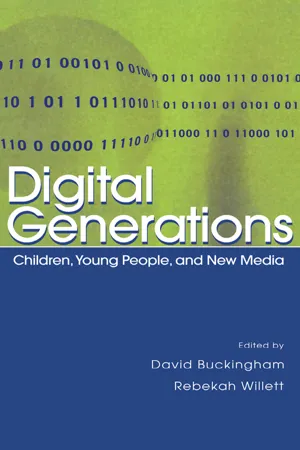
Computer games, the Internet, and other new communications media are often seen to pose threats and dangers to young people, but they also provide new opportunities for creativity and self-determination. As we start to look beyond the immediate hopes and fears that new technologies often provoke, there is a growing need for in-depth empirical research. Digital Generations presents a range of exciting and challenging new work on children, young people, and new digital media. The book is organized around four key themes: Play and Gaming, The Internet, Identities and Communities Online, and Learning and Education. The book brings together researchers from a range of academic disciplines – including media and cultural studies, anthropology, sociology, psychology and education – and will be of interest to a wide readership of researchers, students, practitioners in digital media, and educators.
eBook - ePub
Digital Generations
Children, Young People, and the New Media
- 352 pages
- English
- ePUB (mobile friendly)
- Available on iOS & Android
eBook - ePub
Digital Generations
Children, Young People, and the New Media
About this book
Information
Chapter 1
Is There a Digital Generation?
University of London
The title of this book reflects a kind of generational rhetoric that often characterizes discussions of the use and impact of so-called new media. Young people are frequently described as a digital generation—a generation defined in and through its experience of digital computer technology. This rhetoric can be found in popular commentary in fields as diverse as commerce, government, education, and youth activism. Thus, the electronics company Panasonic is currently advertising its new e.wear MP3 players as providing “digital music for a digital generation”; the U.S. Department of Commerce speaks about “preparing the digital generation for the age of innovation” (Mehlman, 2003); the educationalist Papert (1996) writes of the “digital generation gap” between parents and children; and the journalist Lasica (2002) seeks to defend young people from what he sees as “Hollywood’s war against the digital generation.” Elsewhere, we encounter “the Nintendo generation” (Green & Bigum, 1993), “the Playstation generation” (Blair, 2004), and the “net generation” (Tapscott, 1998), as well as related constructions such as “cyberkids” (Holloway & Valentine, 2003), “bionic children” (“Bionic Kids,” 2003), and even “cyborg babies” (Davis-Floyd & Dumit, 1998). Meanwhile in Japan, there has been considerable discussion of the “thumb generation”—young people who have apparently developed a new dexterity in their thumbs as a result of their use of game consoles and mobile phones (Brooke, 2002).
Of course the notion of a “generation gap” has been around for decades, if not centuries. It typically emerges as a consequence of adults’ fears about the escalating pace of social change and their anxieties about a loss of continuity with the past. The idea of a digital generation merely connects these fears and anxieties to technology: It suggests that something has fundamentally and irrevocably changed, and that this change is somehow produced by technology. In this opening chapter, I suggest that we should approach these issues with a degree of skepticism. Rather than falling back on easy rhetoric, there are several fundamental questions we need to address. Is there indeed a digital generation—or even digital generations, in the plural? If there is, how do we define it, does it matter, and in what ways?
THE SOCIAL HISTORY OF GENERATIONS
In their book Generations, Culture, and Society, Edmunds and Turner (2002) provide the basis for a sociological and historical theory of generations. They define a generation as “an age cohort that comes to have social significance by virtue of constituting itself as a cultural identity” (p. 7). As this implies, generations are defined both historically and culturally. Most simply, a generation is a cohort of individuals born within a particular time frame, although, as Edmunds and Turner suggest, a generation may also be defined by its relationship to a particular traumatic event, such as a world war, the Great Depression, or the rise of fascism. (It may be that the attack on the U.S. World Trade Center in 2001, and the ensuing reconfiguration of world politics, will come to be seen as a similarly defining moment.) However, this process of definition is also a cultural issue; it is a matter of how the potential members of a generation constitute themselves as having a shared identity. It is possible, following this argument, that some generations may be more self-conscious or self-reflexive than others, and hence come to claim greater social significance: The “1960s generation” (at least in Western countries) might be seen in this way. More subjectively, this argument also implies that individuals’ generational identifications are malleable and fluid, and so we may identify with a generation of which we are not strictly members in terms of biological age.
This theory of the construction of generations raises broader questions about structure and agency that are central to social theory. Mannheim (1952/1979), for example, argues that the definition of generations is partly a matter of the particular life chances that are available to people by virtue of when they happened to be born; but it is also a question of how people respond to those life chances, how they interpret their given historical circumstances, and the shared meanings they attribute to their position. Mannheim argues that different units within a given generation are likely to define their situation—and hence to behave as members of a generation (to “act their age,” perhaps)—in different ways. Interestingly, he also notes that, as the pace of social change accelerates, the boundaries between generations are likely to become blurred. Similarly, Bourdieu (1993) argues that generations are socially and culturally defined and produced. Different generations will have different tastes, orientations, beliefs, and dispositions (or habitus). Although these are partly a result of the historical and economic circumstances in which people were born, they also emerge through struggles between generations over cultural and economic resources. As this implies, generations are naturally occurring phenomena, which emerge simply as a result of the passing of time. But generations also produce themselves, as their members (and, presumably, nonmembers too) define the meanings of generational membership.
These ideas find many echoes in recent work on the sociology of childhood and youth. Alanen (2001) uses the notion of generationing to describe the ways in which children and adults assert and jointly construct their differences on grounds of age. Defining who is an adult and who is a child (or a young person) occurs partly through a continual othering—and indeed policing—of those who are older or younger. This kind of social constructionist view is often criticized for failing to pay enough attention to biological or developmental differences, but it does reflect the ways in which the generational order is constantly being renegotiated. Likewise, in youth research, researchers are now inclined to conceive of socialization not merely as something that adults do to young people, but as a process in which young people are also active participants. The notion of self-socialization, which has become prominent in youth studies in Germany (e.g., Fromme et al., 1999), implies that socialization is something that young people work to achieve for themselves, among the peer group. Meanwhile others have discussed the notion of reverse socialization (Hoikkala, 2004)—the possibility that young people may socialize their parents to adapt to social change, not least around technology. Both these ideas reflect a broader rejection of the notion that the social or generational order is something fixed and is simply imposed on passive individuals. In both cases also, the media and consumer culture have been seen to play a central role in this defining and redefining of generational differences and identities (e.g., see Arnett, 1995; Johansson, 2004).
Nevertheless, just as in discussions of gender, the study of generational differences inevitably runs the risk of essentializing those differences. It is worth recalling here Mannheim’s notion of generational units and his argument that a generation is not necessarily uniform, but that members attribute meaning to generational experiences in quite different ways. It is also difficult to know where the distinctions between generations are to be drawn. For example, if we explore the construction of a popular category such as Generation X, there is considerable disagreement about its historical parameters, let alone whether the term actually means anything to the people who are allegedly members of this generation (Ulrich & Harris, 2003). Which experiences, dispositions, or characteristics do we take to be representative of a generation? Who are the spokespersons of their generation, and how is their authority established? How do we actually identify the boundaries—or even the shared consciousness—of a generation?
These kinds of questions are often at the heart of academic controversies about the nature of social change. For example, there has been considerable debate within sociology between Ronald Inglehardt and others about the notion of a postmaterialist generation (Brechin & Kempton, 1994; Inglehardt, 1990; Reimer, 1989). Essentially, Inglehardt argues that there has been a generational shift from materialist to postmaterialist values in the postwar period; yet his analysis raises difficult theoretical and methodological questions about how we measure and identify values, and about the relationship between the values that people might proclaim or sign up to in a questionnaire and their actual behavior. Both within the academy and popular debate, therefore, the concept of generation is complex and contested, and how we define, characterize, and study generations is highly problematic.
ACCOUNTING FOR MEDIA AND TECHNOLOGY
This issue becomes even more complicated when we take account of the potential role of media and technology in the construction and self-construction of generations. Within media and cultural studies, age has (somewhat belatedly) come to join class, ethnicity, and gender as a key dimension of social identity. In attempting to escape the limitations of normative psychological accounts, there has been a growing emphasis on how the media—and the ways in which the media are used—participate in defining the meanings of age differences (Buckingham, 2000; Jenkins, 1998). As I noted, sociologists like Edmunds and Turner (2002) sometimes point to the role of traumatic defining events—such as wars—in defining generations. It is possible, at least in principle, that radical shifts in technology or media might also play a role in this respect. The Australian cultural theorist Wark (1993), for example, argues that: “Generations are not defined by war or depression any more. They are defined by media culture” (p. 75).
What is the evidence for such a claim? On one level, we might draw attention to the role of taste cultures among children and young people that serve precisely to exclude adults, and thereby to assert their own generational distinctiveness. This is most apparent in the case of specialized areas of popular music and fashion (Bennett, 1999), but it also occurs around more mainstream media such as TV (Davies et al., 2000). We might also point to the phenomenon of retro culture—the periodic revivals of particular musical or fashion styles, or enthusiasms for cult TV shows of earlier decades, which often combine nostalgia and irony. As these examples imply, media can be used self-reflexively, as signifiers of generational affiliation.
Of course the media industries are also busily defining and reconfiguring generational categories for the purposes of maximizing profit. Thus, it is possible to trace the historical emergence of age-based categories within marketing discourse and practice. The category of the teenager is often seen as a phenomenon of the postwar consumer boom, which came to prominence in market research during the 1950s (Abrams, 1959). Cook’s (2004) history of the children’s clothing industry in the United States identifies the gradual emergence of age-based distinctions, and the construction of new age-defined categories such as the toddler during the 1930s. In more recent years, we have seen the construction of the tween consumer (Willett, 2005), as well as a proliferation of new age-based marketing categories such as kidults, middle youth, adultescents, and so on. As in the case of Generation X, it is possible to show that, even if these categories were not invented by marketers, they are very quickly taken up by them as a means of describing and hoping to control what they perceive as a volatile and unpredictable market.
Beyond this, it could be argued that youth has become a symbolic value that can be marketed to a wide range of audiences—to children aspiring to escape from the constraints of childhood (as in the marketing of girls’ fashion products and makeup), and to adults aspiring to recover lost values of youthful energy and rebellion (as in the marketing of much contemporary rock music). In the increasingly competitive environment of contemporary media, such distinctions have a growing commercial significance. The term youth in particular invokes a set of symbolic meanings that can refer to fantasy identities as much as to material possibilities. How old you are—or how old you imagine yourself to be—is increasingly defined by what you consume, by your relationship to specific brands and commodities; and youth culture, it would seem, is no longer just for young people.
Social theorists have suggested that, in recent decades, chronological age has become decoupled from people’s actual life situations, and that the normative biography—or the steady progress of the life course—has become decentered (Ziehe, 2005). Even so, children and young people are not passive victims of this process: They are actively involved in sustaining the distinctions and boundaries between the generations even as they may aspire to challenge them. In exploring the changing meanings of such age-based, generational categories, therefore, we need to understand how they are actually used by young people—and indeed, whether they recognize them at all—as well as how they work to regulate and define the meanings of age differences. We need to recall that such categories are not merely discursive, imaginary fictions: They also have real material consequences.
Despite these qualifications (and others to be considered in due course), Wark’s assertion that generations are “defined by media culture” does raise some interesting empirical questions. Do young people who are growing up with digital media in fact have a different orientation to the world, a different set of dispositions or characteristics—or in Bourdieu’s terms, a different habitus? It should be possible to ask this question without assuming a simple before-and-after sequence—not least because the dissemination of technology is bound to be gradual and incremental. It should be possible to address it without necessarily assuming a form of technological determinism—and to take account of the fact that technology may reinforce changes that would be happening in any case. It should be possible to answer it without having to reduce everything to age—to acknowledge that there may indeed be differences (e.g., to do with gender, culture, and social class) within a given generation. At least in principle, therefore, it should be possible to posit the existence of a digital generation without recourse to teleology, determinism, or essentialism.
THE GENERATIONAL HYPOTHESIS
Tapscott’s (1998) book, Growing Up Digital: The Rise of the Net Generation, is one of the best-known and most ambitious arguments in favor of the idea of the digital generation. Tapscott’s account is based on two sets of binary oppositions—between technologies (TV vs. the internet) and between generations (the Baby Boomers vs. the net generation). He draws clear lines between the generations, based primarily on birth-rate statistics: The Boomers were born between 1946 and 1964, followed by the Bust (1965–1976) and the Boom Echo (1977–1997). According to Tapscott, the Boomers are the “TV generation,” who are defined by their relationship with that medium, just as the children of the Boom Echo are the net generation.
Tapscott’s oppositions between these technologies are stark and absolute. Television is a passive medium, whereas the Net is active; TV “dumbs down” its users, whereas the Net raises their intelligence; TV broadcasts a singular view of the world, whereas the Net is democratic and interactive; TV isolates, whereas the Net builds communities; and so on. Just as TV is the antithesis of the Net, so the TV generation is the antithesis of the net generation. Like the technology they now control, the values of the TV generation are increasingly conservative, hierarchical, inflexible, and centralized. By contrast, the N-Geners are “hungry for expression, discovery and their own self-development”: They are savvy, self-reliant, analytical, articulate, creative, inquisitive, accepting of diversity, and socially conscious. These generational differences are seen to be produced by technology, rather than being a result of other social, historical, or cultural forces. Unlike their parents, who are portrayed as incompetent technophobes, children are seen to possess an intuitive, spontaneous relationship with digital technology. “For many kids,” Tapscott (1998) argued, “using the new technology is as natural as breathing” (p. 40). Technology is the means of their empowerment, and it will ...
Table of contents
- Cover Page
- Half Title page
- Title Page
- Copyright Page
- Contents
- Preface
- List of Contributors
- 1 Is There a Digital Generation?
- I Play and Gaming
- II The Internet
- III Identities and Online Communities
- IV Learning and Education
- Author Index
- Subject Index
Trusted by 375,005 students
Access to over 1.5 million titles for a fair monthly price.
Study more efficiently using our study tools.
Frequently asked questions
Yes, you can cancel anytime from the Subscription tab in your account settings on the Perlego website. Your subscription will stay active until the end of your current billing period. Learn how to cancel your subscription
No, books cannot be downloaded as external files, such as PDFs, for use outside of Perlego. However, you can download books within the Perlego app for offline reading on mobile or tablet. Learn how to download books offline
Perlego offers two plans: Essential and Complete
- Essential is ideal for learners and professionals who enjoy exploring a wide range of subjects. Access the Essential Library with 800,000+ trusted titles and best-sellers across business, personal growth, and the humanities. Includes unlimited reading time and Standard Read Aloud voice.
- Complete: Perfect for advanced learners and researchers needing full, unrestricted access. Unlock 1.5M+ books across hundreds of subjects, including academic and specialized titles. The Complete Plan also includes advanced features like Premium Read Aloud and Research Assistant.
We are an online textbook subscription service, where you can get access to an entire online library for less than the price of a single book per month. With over 1.5 million books across 990+ topics, we’ve got you covered! Learn about our mission
Look out for the read-aloud symbol on your next book to see if you can listen to it. The read-aloud tool reads text aloud for you, highlighting the text as it is being read. You can pause it, speed it up and slow it down. Learn more about Read Aloud
Yes! You can use the Perlego app on both iOS and Android devices to read anytime, anywhere — even offline. Perfect for commutes or when you’re on the go.
Please note we cannot support devices running on iOS 13 and Android 7 or earlier. Learn more about using the app
Please note we cannot support devices running on iOS 13 and Android 7 or earlier. Learn more about using the app
Yes, you can access Digital Generations by David Buckingham, Rebekah Willett, David Buckingham,Rebekah Willett in PDF and/or ePUB format, as well as other popular books in Ciencias sociales & Psicología del desarrollo. We have over 1.5 million books available in our catalogue for you to explore.