Music in Television is a collection of essays examining television's production of meaning through music in terms of historical contexts, institutional frameworks, broadcast practices, technologies, and aesthetics. It presents the reader with overviews of major genres and issues, as well as specific case studies of important television programs and events. With contributions from a wide range of scholars, the essays range from historical-analytical surveys of TV sound and genre designations to studies of the music in individual programs, including South Park and Dr. Who.
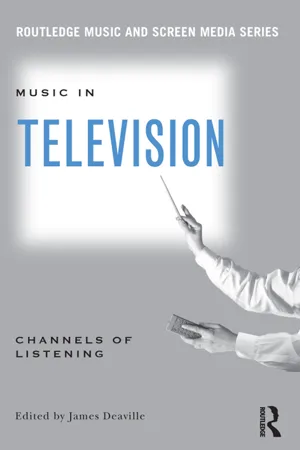
- 244 pages
- English
- ePUB (mobile friendly)
- Available on iOS & Android
eBook - ePub
About this book
Information
Part I
Practices and Theories of
Television Music
Chapter 1
1. A Discipline Emerges
Reading Writing about Listening
to Television
Television music has had difficulty establishing itself as a serious area for academic study. The early academic literature about film music fostered the erection of a canonic divide from television music, in order to obtain and maintain its own scholarly respectability.1 Thus, film-music scholarship had little positive to say with regard to television music: Roy Prendergast, often recognized as one of the first American scholars to write seriously about music for cinema, dismisses music in television for a variety of reasons, including its brevity, commercialization, and production values.2 This elitist attitude is shared by a number of specialists in film music, who either write disparagingly about television music, or overlook it in discussions that could benefit from consideration of the small screen. As recently as 2002, professor of film and video Michael Chanan (Roehampton University) could dismiss television music with the observation that “television contributes to … aural pollution by reducing every kind of music to the same level of a passing moment in the televisual flow.”3 Ron Rodman argues in contrast that
television is a transmitter of values and cultural beliefs … [that] communicates effectively because we, the viewers, are able to “read out” and decode these messages through an understanding of the language of television. Music, as one component of television, communicates both as a language in and of itself and in terms of the multiple roles it plays in TV programs and commercials.4
Nevertheless, as long as a hierarchical epistemological divide persists between film studies and television studies in general, scholars of television music will find little support from that quarter.5 And the inability or reluctance of television scholars to discuss the musical components of their subject further marginalizes those who cultivate the field.6 Even the work of a leading television studies specialist such as Horace Newcomb has tended to minimize the importance of music: in his voluminous Encyclopedia of Television, Newcomb and his editorial board opted to publish an article “Music on Television” rather than “Music in Television.”7 As a result, the entry’s authors almost exclusively report on the history of diegetic music (performances on variety shows, MTV, etc.), rather than considering music in its “intradiegetic” (the underscore of television programming) and “extradiegetic” (music used by the network or station) functions that Rodman has identified.8
Studying Music in Television: Issues
and Opportunities
From the very beginnings of network television in the late 1940s, music has played a significant role in the presentation of the medium and the shaping of its domestic consumption. The plenitude of music on the small screen comprises both an opportunity and a liability, the former because of the quantity and diversity of potential research topics, the latter because of the increased difficulty in sorting out music that has served as a significant or at least notable bearer of cultural, social, and/or political meanings. Moreover, given the “ephemerality” of the medium of television—as opposed to film—it is often impossible to gain access to the programs under consideration, let alone reconstruct the sonorous frame in which the music for those shows was situated.9 In comparison with film music, television music adds this complexity of the normative extradiegetic realm—that of music associated with the network or station—to the study of music in screen media, as it does issues arising from the context of television’s “planned flow,” as famously formulated by Raymond Williams.10 And we cannot ignore the aesthetic concerns expressed by critics of the medium and its music: Frith’s dictum that “music on television is less often heard for its own sake than as a device to get our visual attention” certainly characterizes the televisual experience of music,11 even though he fails to differentiate that from the function of music in film.
Keeping these considerations in the back of our minds, the opportunities and insights afforded by the serious study of music in television should rival in significance and quantity those for film music. The ubiquity argument raised by Tagg (“a lot of people hear a lot of it”) is compelling,12 as is his “awareness campaign” aimed at exposing the potential dangers from the persuasive televisual mix of narrative text, image, and sound.13 Negus and Street articulate one aspect of the value of looking more closely at television music when they observe that “television is a significant mediator of knowledge, understanding and experience of music.”14 However, inverting their formulation to “music is a significant mediator of the knowledge, understanding, and experience of television” significantly opens the discussion to embrace the cultural, social, and political work accomplished by music on television.
The Background
Television was one of the most anticipated technological developments of modern times—considerations of transmitting visual communication can be traced back to Samuel Morse’s 1844 unveiling of the telegraph—and yet its technical realization had to wait until the mid-1920s and its practical fulfillment until the late 1940s.15 Nevertheless, speculation about its future uses, opportunities, and limitations abounded, especially during the 1920s, even as inventors and the music industry were putting their minds to the task. Music figured prominently in one of the most celebrated prognostications about television, by columnist Charles H. Sewall in 1900:
The child born to-day in New York City, when in middle age he shall visit China, may see reproduced on a screen, with all its movement and color, light and shade, a procession at that moment passing along his own Broadway. A telephone line will bring to his ear music and the tramp of marching men […] Sight and sound will have unlimited reach through terrestrial space.16
Here the congruence of moving image, music, and sound, globally broadcast as the event—a military parade?—occurs, is prophetically envisioned. That music played a role in early writings such as Sewall’s may not strike us as unusual, since it was to become a regular feature of the cinematic experience. However, authors who speculated about music in television conceived a different role for it than the non-diegetic soundtrack that has become customary in programming: visionary pioneers such as David Sarnoff and Orrin E. Dunlap Jr. believed that television would serve as the medium for the transmission of opera, dance, and other musical genres and artistic forms that required hearing and seeing. Dunlap’s The Outlook for Television from 1932 quotes Rosa Ponselle as an authority about the new technology: “I believe we are rapidly approaching the day when radio and the opera will be entirely reconciled by the addition of television to sound programs.”17 An anonymous article in Popular Science Monthly of 1927 likewise argued for the value of enjoying opera in the home, made possible through the new Baird television process.18 The slow development of the technology meant that it was not until 1936 that the dream of opera on television was realized, when, on November 13, scenes from Albert Coates’s opera Mr. Pickwick were broadcast from the BBC studios.19
The outbreak of World War II halted the further development of television technology temporarily: not only was the number of stations severely limited, but the production of television sets ceased between 1942 and 1945.20 This large-scale termination of activity had some effect upon musicians, although because television was still in an incipient phase, the impact was significantly less than when cinema musicians lost their jobs in the late 1920s and early 1930s. As a result of this torpor, a temporary interregnum in the production of writing about television music set in.
Despite a reawakened interest in the broadcasting of performances as expressed in the literature about music on television during the later 1940s, President of the American Federation of Musicians James Petrillo’s 1945 ban on the participation of federation members in television performances effectively banished music from the small screen for three more years.21 The anticipation of television’s role in broadcasting musical events was so high not only in literature of the time but also in the incipient industry that within two days of Petrillo’s withdrawal of objections, March 18, 1948, two networks vied to present the first televised concert: on March 20, CBS broadcast Eugene Ormandy and the Philadelphia Orchestra at 5:00 p.m. for its New York and Philadelphia affiliates, while NBC featured Arturo Toscanini and the NBC Symphony Orchestra at 6:30 p.m. to viewers in New York, Philadelphia, Washington, and Boston. These performances attracted a host of reviews and commentaries, including a column by Harold Taubman in the New York Times, which both closely evaluated the performance of the television technology, especially the use of the cameras, and noted future benefits of broadcasting concerts.22
The expectations for television’s potential for the diegetic presentation of music continued to rise into the 1950s, given the advent of television opera in 1951 with the premiere of Gian Carlo Menotti’s Amahl and the Night Visitors and an International Conference on Opera in Radio, TV and Film in 1956.23 This phenomenon—presenting classical music on television as a means to educate and enculturate the public—evoked a sizable body of literature that pondered, pontificated, and prognosticated the value and future of televising “good” music, primarily opera. For example, in 1957, Lionel Salter (Head of Music for BBC Television, 1956–1963) contributed to the Musical Times a strong, well-supported apology for music on television in the UK, in which he argued for the large size of the potential audience and the benefits of seeing (and not just hearing) opera, while discussing some of the technical problems in producing musical performances for television.24
At the same time, television regularly began to feature “intradiegetic” and “extradiegetic” music (program underscoring and network/station music), both as carry-overs from radio productions of the same programming (e.g., The Lone Ranger or Dragnet) and as newly composed (libraries of) music to accompany programs or to assist the televisual flow.25 However, the aforementioned writers about television music (Graf, Helm, Salter) and their ass...
Table of contents
- Cover
- Title
- Copyright
- Contents
- Series Foreword
- Foreword by Claudia Gorbman
- Acknowledgments
- Introduction: The “Problem” of Music in Television
- PART I. Practices and Theories of Television Music
- PART 2. Case Studies in Television Music
- 7. From Punk to the Musical: South Park, Music, and the Cartoon Format
- 8. It’s What’s Happening, Baby! Television Music and the Politics of the War on Poverty
- 9. Channeling Glenn Gould: Masculinities in Television and New Hollywood
- 10. “The Rock Man’s Burden”: Consuming Canada at Live 8
- Appendix. Generation X, South Park, and Television Music CompositionAn Interview with Adam Berry Conducted by Sean Nye
- Notes on Contributors
- Index
Trusted by 375,005 students
Access to over 1.5 million titles for a fair monthly price.
Study more efficiently using our study tools.
Frequently asked questions
Yes, you can cancel anytime from the Subscription tab in your account settings on the Perlego website. Your subscription will stay active until the end of your current billing period. Learn how to cancel your subscription
No, books cannot be downloaded as external files, such as PDFs, for use outside of Perlego. However, you can download books within the Perlego app for offline reading on mobile or tablet. Learn how to download books offline
We are an online textbook subscription service, where you can get access to an entire online library for less than the price of a single book per month. With over 1.5 million books across 990+ topics, we’ve got you covered! Learn about our mission
Look out for the read-aloud symbol on your next book to see if you can listen to it. The read-aloud tool reads text aloud for you, highlighting the text as it is being read. You can pause it, speed it up and slow it down. Learn more about Read Aloud
Yes! You can use the Perlego app on both iOS and Android devices to read anytime, anywhere — even offline. Perfect for commutes or when you’re on the go.
Please note we cannot support devices running on iOS 13 and Android 7 or earlier. Learn more about using the app
Please note we cannot support devices running on iOS 13 and Android 7 or earlier. Learn more about using the app
Yes, you can access Music in Television by James Deaville in PDF and/or ePUB format, as well as other popular books in Media & Performing Arts & Music. We have over 1.5 million books available in our catalogue for you to explore.