ONE
COMPLEXES
The destiny of every human being is dictated by what goes on inside his skull when he is confronted with what goes on outside his skull.
Eric Berne (1910–1970), psychiatrist and creator of Transactional Analysis1
In this chapter we are going to start looking at the very basic processes that take place inside our skulls when we are faced with what is going on outside them.2
Look at the word on the following line, neatly typed on the page, outside your skull:
Ear.
. . .
. . .
What happened inside your skull, when you read these letters?
You probably had a picture or an impression of an ear in your mind’s eye.
Perhaps it was your ear? Perhaps it was your partner’s ear?
Or perhaps it was just a general impression of an ear.
Maybe with an earring attached?
If I ask you to imagine a ‘stick of chalk’, what comes to mind?
A new stick? Or is it half worn down?
Is it white or coloured?
What other thoughts come up? A teacher? A blackboard?
Now, ‘Russia’.
Cossacks?
Snow?
Vodka?
Notice I give you one thought, it activates others.
This means that in our heads thoughts are stuck to each other in Complexes.
In fact there is no such thing as a loose thought; they are all attached to other thoughts as Complexes.
Let’s take a closer look at what’s happening:
Orange.
. . .
. . .
What came in then?
Did you see the fruit? A fruit bowl?
Could you imagine the texture? The smell? The taste?
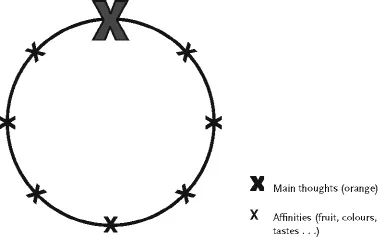
Whatever came up for you was part of your Complex with ‘orange’, where orange was the main thought and all the associated thoughts are affinities.
AFFINITIES:
- Pictures and impressions that evolve as a result of thinking in active Imagination the entity under consideration
- Every activated thought in a Complex other than the main one
You will notice throughout this book that every term we use has to be defined so that all parties can be confident that we know what the other means and there’s no confusion.
Each definition also has to be workable. There is no point in having definitions that don’t help us to do our job. These terms are our tools and for them to be effective, they need to be fit for Purpose.
So then what is a Complex?
Freud’s use of the term was defined as ‘any cluster of impulses, emotions, thoughts etc.’3 This works nicely.
Let’s make it even clearer and shape the ‘cluster’ into a circle, so that we now have a circle of thoughts.
And then let’s drop in the ‘orange’ example and see how that looks – see Figure 1.1.
Figure 1.1 A circle of thoughts
As a circle of thoughts, rather than a cluster, it is much easier to see how like a tambourine, when one side (main thought) is shaken, the rest of the jingles (incidentally these are called ‘zils’, the attached affinities) also sound.
We can now refine Freud’s definition:
COMPLEX: A circle of thoughts where when one is activated, then so are the others to different degrees
Imagine one morning I am buying a croissant on the way to work. Croissant is part of my ‘breakfast’ Complex, which is part of my ‘meals’ Complex, which is part of my ‘food’ Complex, which is part of my ‘nutrition’ Complex, which is part of my ‘health’ Complex, which is part of my ‘well-being’ Complex, and so on. Notice every Complex is part of a slightly bigger Complex which is part of a slightly bigger Complex, and so on, until we arrive at a super Complex of Complexes, where all the Complexes get united and which we will call, for the purpose of this topic, consciousness.
So why is it important for an actor to understand Complexes and how they work?
You may now start to see:
CHARACTER: A collection of thoughts (experiences), and results of their interactions
- some of the processes in the formation of their own (character’s) consciousness
- creating a character is in a way creating Complexes
- whatever the character says or does is a result of their Complexes being activated
- Complexes can tell us many things about the character’s past.
Have a think about it.
Then let’s see how one of our earliest Complexes got formed.
Formation of Complexes
When I was born I did what all babies do when they are babies, I got used to thoughts about the face, shape, smell, smile and feel of what would eventually be labelled ‘Mummy’. These simple thoughts form the Complex, ‘Mummy’. I start calling my Mummy ‘Mummy’ before I can write.
Not surprisingly the first time I see the letter M, it means nothing to me until my mother starts making the sound ‘mmm’, ‘mmm’. Then she writes, a, and makes the sound ‘aah’, ‘aah’. Next she puts the two sounds together to make ‘Maah’. After a few afternoons of my mum drawing pictures and making funny sounds, I notice that each time I see the picture, Ma, I hear the sound ‘Maah’ and when I hear the sound ‘Maah’ I see the picture, Ma. I have now formed my simplest picture-sound Complex. From now on everything I know about my mum comes and sticks to the label ‘Ma’.
Soon I realized that my friend’s mothers look like my mother and when there is more than one mother, or my Aunt Betty and her friend Norah come to the house, together they are ‘Women’. So now my Complex gets larger with my ‘Ma’ now being part of the Complex ‘Women’ and vice versa.
As you may be starting to notice, creating Complexes is learning. The more we learn, the more thoughts are attached to these Complexes and these Complexes themselves become a part of other Complexes. With the formation of these and many other Complexes comes the formation of (one aspect of) my consciousness.
This book is all about creating the Complexes you need to be a good actor and to dismantle the Complexes you may have which will hinder you becoming a good actor. The key to this, as with all learning, is Frequent Repetitive Thinking. I will be coming back to this many times throughout this book. For now simply consider again the ‘Ma’ Complex. This is probably one of the strongest Complexes most people have because it is has been thought the most frequently and repetitively. Compare this to a weak Complex. This is a Complex which can be interrupted at any time. After your first driving lesson your Complex was still weak. Instead of automatically knowing what to do next, your ‘driving a car’ Complex may have been interrupted by pushing down the wrong pedal or knocking the windscreen wipers on by mistake.
My purpose with this book is for you to gain strong acting Complexes. That is why many topics will be touched on a number of times, in various ways, to recap or to take you to the next step, in order for your acting Complexes to get larger and stronger with every chapter, if not every page.
Well-known Complexes
Complexes that are part of our everyday language include ‘inferiority’ Complex or ‘superiority’ Complex and Freud’s ‘Oedipus’ Complex. How do these work?
In the case of ‘inferiority Complex’, this means that every time I think about people (or a certain type of people), I automatically think that I am inferior to them. Likewise with a ‘superiority Complex’, whenever I think of other people (or some of them), I automatically think I am superior. When I say ‘automatically’, I mean that my thoughts in response to these other people is not consciously controllable – the attached thoughts are immediately thought by themselves. The whole tambourine is sounding – all the zils are jingling, to various degrees.
In this same way, the Oedipus Complex of a man wanting to kill his father and belong with his mother refers to a consciously uncontrollable Complex.
Another well-known Complex was documented by Ivan Pavlov in the 1890s while he was studying dogs’ digestive mechanisms. Pavlov would ring a bell just before feeding a pair of dogs. Then one day Pavlov just rang the bell and observed: the dogs started to salivate and look for food. The dogs had formed a Complex between the bell ringing and being fed.
Even more interesting are the results of physiologist Benjamin Libet’s recordings of electrical brain activity. He demonstrated that when humans did simple things like moving their hand, a massive surge in brain activity took place before the person had consciously decided to do it. Suggesting that brain activity, that isn’t part of our conscious thinking, is involved in our decision making; that subconscious activity precedes and determines conscious decisions; that our choices are indeed unconsciously controlled.
How Complexes work and affect our lives is a fascinating insight into why people live the way they do. The next exercise will help you understand the implications of Complexes in our lives and why it is important for the actor to recognize this.
Jesus and Judas
Let us look at how we would approach a simple story where we would like to create the character of Judas, to see how and why Complexes need to be understood. This is one possible interpretation of the story. Your interpretation of the facts may be different and would produce a different story. The difference between each and every person’s consciousnesses ensures that a conveyor-belt-like production of interpretations and therefore characters can never happen.
What facts can we start with?
- Judas betrayed Jesus to Pontius Pilate
- Jesus was arrested
- Judas was given thirty pieces of silver
- Jesus was crucified
- Judas hanged himself
First, it has to be pointed out that Judas was not given thirty pieces of silver to then betray Jesus. It was not given to him as an incentive. Instead the money was given to him afterwards, more like a reward. Then why did he do it, if not for an incentive?
Whatever Judas’ reason, it must have been part of a very strong Complex, because he was unable to interrupt it. It was so strong that he was unable to stop and see what the repercussions of his actions would be. If he had been able to do this he would have thought, ‘What’s the point in betraying Jesus if I am going to kill myself afterwards’.
But he did kill himself. So a Complex had been triggered that he could not consciously control.
Let’s see if we can use what we know and can find out about Judas to find out what this ‘invisible’ Complex could have been.
There is evidence that Judas was of small stature and also that he was the treasurer of the disciples.
What does being a treasurer mean?
It means that he was better than anybody else at counting and looking after money. We also know that he was a tax collector before joining the disciples.
So what can we derive from what we know?
How does this lead us to the final betrayal of Jesus and Judas then hanging himself?
If Judas was of small stature, it is very likely that he was a small boy compared to his peers. Being small and possibly considered inferior could mean that he was picked on, in other words bullied. And people who are bullied aren’t just bullied once; it is usually a regular occurren...