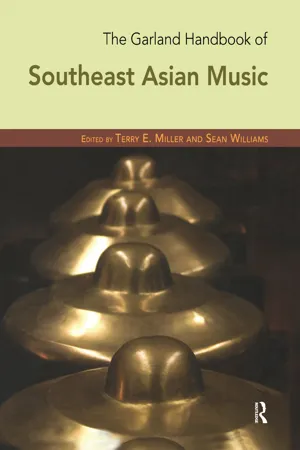
The Garland Handbook of Southeast Asian Music is comprised of essays from The Garland Encyclopedia of World Music: Volume 4, Southeast Asia (1998). Largely revised and updated, the essays offer detailed, regional studies of the different musical cultures of Southeast Asia and examine the ways in which music helps to define the identity of this particular area.
Part one provides an in-depth introduction to the area of Southeast Asia and explores a series of issues and processes, such as colonialism, mass media, spirituality, and war. The articles in this section are important in gaining historical, political, and social perspective. Part two focuses on mainland Southeast Asia, with essays representing Cambodia, Thailand, Laos, Burma, Peninsular Malaysia, Vietnam, Singapore, and the minority peoples of mainland Southeast Asia. Part three focuses on island Southeast Asia, dividing the area into three sections: Indonesia, the Philippines, and Borneo. In addition to offering a detailed study of the music of each area, it also offers recent perspectives on the gamelan and theater traditions of Indonesia. Questions for Critical Thinking at the end of each major section guide and focus attention on what issues – musical and cultural – arise when one studies the music of Southeast Asia – issues that might not occur in the study of other musics of the world. An accompanying compact disc offers musical examples from Southeast Asia.
Most major Southeast Asian musics bear strong similarities to one another, crossing boundaries of culture, language, and land. But although bronze gongs, xylophones, and bamboo flutes link the musics of the region, there is nevertheless a remarkable diversity of peoples and music styles. For centuries, the unique sounds and organizational systems of these musics have attracted outsiders—including dozens of scholars and the Western composers Debussy, Britten, and Reich.
Southeast Asian Musics: An Overview
Terry E. Miller and Sean Williams
Regional Issues
Two Approaches to Listening
REGIONAL ISSUES
The subcontinent of Southeast Asia is too large to be treated holistically; therefore, it is divided here into two parts: mainland and islands. Within each division, the most obvious subdivision is the nation-state. Mainland Southeast Asia consists of seven nations (Burma, Cambodia, Laos, Malaysia, Singapore, Thailand, and Vietnam); island Southeast Asia consists of three (Brunei, Indonesia, and the Philippines). Malaysia, extending into both divisions, is treated here as part of the mainland. Papua (formerly known as Irian Jaya), the Indonesian province that occupies the western section of the island of New Guinea, is covered in the Oceania volume. And finally the large island of Borneo is divided into provinces of Indonesia and (East) Malaysia, though its inhabitants share many important cultural traits.
The national boundaries that demarcate Southeast Asia into its countries are recent and largely colonial inventions. Laos, a landlocked country, sandwiched among Vietnam, Cambodia, Thailand, Burma, and China, is a cobbled-together remnant of the spoils of war. The Republic of Indonesia came into being when a group of islanders attained self-rule over the Netherlands East Indies. The Philippines was once a group of islands united in the name of a Spanish king’s son, Felipe. Few of these countries developed an indigenous national consciousness before their national creation. Indeed, even within areas that have used the same linguistic and political systems for centuries, we have no reason to assume any kind of social, political, or musical unity.
Lowland and Upland Peoples
Except for Singapore, all Southeast Asian nations have both lowland plains, usually drained by a major river, and upland areas, which may be either vast plateaus or rugged mountain ranges. Nearly every country or region discussed in this volume is tied in some way to the ocean, and some areas (especially the island regions) are frequently rattled by earthquakes and volcanic eruptions. The way the land shapes and is shaped by its inhabitants has an impact on differences in musical production. Most nonmainstream minorities live in upland areas, and most of the dominant population lives in lowlands. Since most minorities differ in language and lifestyle from the dominant people, their musics are usually so different as to bear no comparison to those of the dominant people. Thus, it makes sense to treat minority musics separately.
Regionalism
Each country of Southeast Asia displays diversity of culture and population. Each has more than one cultural region, even within the majority population. These are never completely discrete but may exhibit individuality in language (dialect or accent), central literary works, clothing, architecture, cuisine, musical instruments, and musical styles. In some countries (such as Thailand), a regional culture has been adopted as the national culture. Whether the other regional cultures are viewed as challenges to the dominant culture or as complements to it depends on the time and place.
Regionalism is most likely to be tolerated, even celebrated, in countries that have achieved stability based on the “national” culture—true of both Thailand and Indonesia. Where such a consensus has not been reached, or where the lack of mass communications allows the maintenance of regional distinctiveness, all regions may be near-equals, or even rivals; in the latter case, regionalism works against nationhood and may consequently be suppressed. Regionalism is mainly an issue within the dominant culture, leaving minority groups largely on the outside.
Urban and Rural
Asian cities reflect least the distinctiveness of “traditional” and especially regional culture. Many of the first centers of population in Southeast Asia were Hindu-Buddhist courts and commercial cities. The courts functioned as places to house the person in power with accompanying family, personnel, and regalia; the entire city would be laid out according to its relationship to the center. Many of these cities were inland. Commercial cities drew most of their population from those interested in profiting from trade; these cities tended to be located either at the crossroads of major inland trade routes or in ports. Commercial cities are laid out according to needs of access in relation to the market. Once Islam had become established in Southeast Asia, a kind of Muslim city developed, particularly in Malaysia and Indonesia; it included a large mosque located at the center of the city. Last, colonial administrative cities were created by various colonial empires, either on the foundations of other types of cities, or out of areas that appeared convenient for administration and commerce. Each Southeast Asian city reflects the kind of urban planning and centrally located architecture (mosque, grand temple, government buildings, etc.) that characterize its origins; all, however, include some of the most unfortunate aspects of twentieth-century architecture as well. Cities are the most modern places in a country, and the main cities are the most internationalized. The most modern cities of Southeast Asia are Singapore, Jakarta, Kuala Lumpur, Bangkok, Manila, and Hồ Chí Minh City (Saigon); the least modern include Rangoon (Yangon), Vientiane, and Phnom Penh. The largest cities often attract the regional poor, seeking opportunities. Money earned from urban wages is frequently channeled back to villages, and most urbanites maintain close ties to family and friends in villages. Cities, then, tend to develop pan-urban cultures, though pockets of regional populations sometimes maintain aspects of their culture. Urban populations have the greatest choices of musical styles, especially from the media, and are most thoroughly exposed to mass culture.
Figure 2.1 Hội An, Vietnam, one of the country’s first ports of entry, preserves architecture reflecting the coming of the Chinese, Japanese, Europeans, and other foreigners. Photo by Terry E. Miller, 1993.
It is largely true that if you do not live in a city, you live in a village. Depending on the country’s level of poverty or prosperity, village life may be slow to change (as in Borneo, Burma, certain areas of Indonesia, Laos, Cambodia, and Vietnam) or much affected by modernization (as in the Philippines, Malaysia, and Thailand). Some villagers with homes that once stood on the outskirts of Southeast Asia’s cities now find themselves surrounded by factories, airports, bus terminals, and housing developments. Dispersed throughout many of the largest cities are village enclaves, complete with chickens, wells, tiny plots of cultivated land, and rural people.
The poverty of village life tends to preserve its traditionalism. At least in earlier times, village cultural life centered on cycles related to agriculture, religion, and the calendar. Songs and rituals are, or were, associated with various stages of agriculture (especially the growing of rice) and seasonal rituals and festivities. In general, musical activities ceased during the rainy season, which in Theravada Buddhist countries (Burma, Cambodia, Laos, Thailand) coincides with the Buddhist period of withdrawal, when rice requires little attention, allowing males to be ordained and to withdraw into a temple to earn spiritual merit.
CDTRACK1
Because this music originated in villages, where people must work year-round to maintain house, family, and food supply, it tends to be simpler than that found in cities, particularly in the mainland regions. Few music specialists support themselves through performance, and anyone with a modicum of talent may sing and play music. Musical instruments tend to be user friendly and simple, made from locally available materials (though exceptions occur).
The theme of courtship permeates village musics throughout Southeast Asia. Courtship was formerly ritualized and in places remains so. Males and females alternated in performing various forms of repartee, creating veritable gender wars, based on wit and double entendre. The texts of repartee transmitted rural wisdoms, reminding listeners of their history, literature, role models, religion, and sometimes even “the facts of life.” In its fundamental forms, ritualized courtship could be spoken (as with Lao phanya), but most forms involve some kind of heightened speech or song, with or without an instrument. In some places, certain performers grew so highly skilled that they became professional or semiprofessional entertainers, and the original function of courtship metamorphosed into a paid exhibition of talent.
Figure 2.2 In Yogyakarta, Java, small villages coexist with modern urban accouterments within the boundaries of the city. Photo by Sean Williams, 1989.
Classical, Folk, Popular
A tripartite division of music into classical, folk, and popular has limited validity in Southeast Asia. Each term creates dilemmas. Classical has connotations of sophistication, high value, being representative of the best of a culture, and expressive of political and economic power, what Milton Singer has called the Great Tradition of a culture. In Burma, Cambodia, and Thailand, scholars agree on what genres fit the classical category; for Laos, Malaysia, the Philippines, Singapore, and Vietnam, they do not. Substituting court for classical, as some writers do with Cambodian, Javanese, and Thai musics, is not necessarily better, for the music described as court was never restricted to a court and survives today—at least in Thailand and Cambodia—entirely outside the context of a court, even in villages.
Regardless of the term, “classical” musics have several traits in common. Musical instruments play a prominent role. Some are complex and highly decorated, and performance on them requires advanced technical skills. The repertory is usually extensive, requiring the undivided attention of musicians who must memorize complex works, practice long hours, and play for a variety of occasions, some ceremonial, some ritualistic, some for entertainment. These musics often require enough surplus wealth to allow the musicians to give their full attention to the art of music and to be relieved of any necessity of growing their food, providing their shelter, and securing their safety. Consequently, musics called classical are often associated with an aristocracy, or at least a wealthy elite. There is also a consensus among the wealthy elite that these musics best represent the culture of the nation to the outside world, whether the citizenry commonly listens to them or not.
Such definitions create few problems in categorizing some Burmese, Thai, Cambodian, and Indonesian musics as “classical,” but elsewhere the issue becomes thorny. Though Laos has a “classical” music similar to that of Thailand, it is less extensive and sophisticated. Laos arguably has a classical music, but the tradition was damaged when the Pathet Lao (a Communist party) banned such “aristocratic decadence” in 1975, and the country’s poverty and lack of an aristocracy prevent this kind of music from flowering beyond a minimal level. Vietnam’s imperial court is long gone, and though its music survived until the 1970s, it was never widely known or played. Today, it has been revived, but more as a symbol of the city of
than as a symbol of the country. Malaysia, formerly a collection of sultanates, had royal music and entertainment, but these barely survive in isolated pockets. The term Malaysian classical music, like Vietnamese classical music, has no clear meaning. The Philippines has been so deeply Christianized th...
Table of contents
Cover
Half Title
Title Page
Copyright Page
Table of Contents
List of Audio Examples
List of Contributors
Preface
Guide to Pronunciation
Part I Issues and Processes in Southeast Asian Musics
Questions for Critical Thinking: Issues and Processes in Southeast Asian Musics
Part II Mainland Southeast Asia
Questions for Critical Thinking: Mainland Southeast Asia
Part III Island Southeast Asia
Glossary
A Guide to Publications
A Guide to Recordings of Southeast Asian Music
Notes on the Audio Examples
Index
Trusted by 375,005 students
Access to over 1.5 million titles for a fair monthly price.
Study more efficiently using our study tools.
Frequently asked questions
Yes, you can cancel anytime from the Subscription tab in your account settings on the Perlego website. Your subscription will stay active until the end of your current billing period. Learn how to cancel your subscription
No, books cannot be downloaded as external files, such as PDFs, for use outside of Perlego. However, you can download books within the Perlego app for offline reading on mobile or tablet. Learn how to download books offline
Perlego offers two plans: Essential and Complete
Essential is ideal for learners and professionals who enjoy exploring a wide range of subjects. Access the Essential Library with 800,000+ trusted titles and best-sellers across business, personal growth, and the humanities. Includes unlimited reading time and Standard Read Aloud voice.
Complete: Perfect for advanced learners and researchers needing full, unrestricted access. Unlock 1.5M+ books across hundreds of subjects, including academic and specialized titles. The Complete Plan also includes advanced features like Premium Read Aloud and Research Assistant.
Both plans are available with monthly, semester, or annual billing cycles.
We are an online textbook subscription service, where you can get access to an entire online library for less than the price of a single book per month. With over 1.5 million books across 990+ topics, we’ve got you covered! Learn about our mission
Look out for the read-aloud symbol on your next book to see if you can listen to it. The read-aloud tool reads text aloud for you, highlighting the text as it is being read. You can pause it, speed it up and slow it down. Learn more about Read Aloud
Yes! You can use the Perlego app on both iOS and Android devices to read anytime, anywhere — even offline. Perfect for commutes or when you’re on the go. Please note we cannot support devices running on iOS 13 and Android 7 or earlier. Learn more about using the app
Yes, you can access The Garland Handbook of Southeast Asian Music by Terry Miller, Terry Miller,Sean Williams, Terry Miller, Sean Williams in PDF and/or ePUB format, as well as other popular books in Media & Performing Arts & Ethnomusicology. We have over 1.5 million books available in our catalogue for you to explore.