Argumentation theory is a distinctly multidisciplinary field of inquiry. It draws its data, assumptions, and methods from disciplines as disparate as formal logic and discourse analysis, linguistics and forensic science, philosophy and psychology, political science and education, sociology and law, and rhetoric and artificial intelligence. This presents the growing group of interested scholars and students with a problem of access, since it is even for those active in the field not common to have acquired a familiarity with relevant aspects of each discipline that enters into this multidisciplinary matrix. This book offers its readers a unique comprehensive survey of the various theoretical contributions which have been made to the study of argumentation. It discusses the historical works that provide the background to the field and all major approaches and trends in contemporary research.
Argument has been the subject of systematic inquiry for twenty-five hundred years. It has been graced with theories, such as formal logic or the legal theory of evidence, that have acquired a more or less settled provenance with regard to specific issues. But there has been nothing to date that qualifies as a unified general theory of argumentation, in all its richness and complexity. This being so, the argumentation theorist must have access to materials and methods that lie beyond his or her "home" subject. It is precisely on this account that this volume is offered to all the constituent research communities and their students. Apart from the historical sections, each chapter provides an economical introduction to the problems and methods that characterize a given part of the contemporary research program. Because the chapters are self-contained, they can be consulted in the order of a reader's interests or research requirements. But there is value in reading the work in its entirety. Jointly authored by the very people whose research has done much to define the current state of argumentation theory and to point the way toward more general and unified future treatments, this book is an impressively authoritative contribution to the field.
eBook - ePub
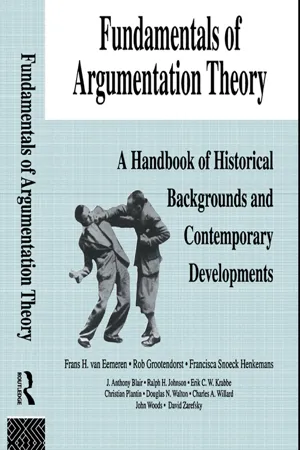
Fundamentals of Argumentation Theory
A Handbook of Historical Backgrounds and Contemporary Developments
- 440 pages
- English
- ePUB (mobile friendly)
- Available on iOS & Android
eBook - ePub
Fundamentals of Argumentation Theory
A Handbook of Historical Backgrounds and Contemporary Developments
About this book
Information
CHAPTER
1
INTRODUCTION
1.1 ARGUMENTATION
Argumentation (or argument) is familiar to all of us. The following three quotations are examples of argumentation:
(a) Mother to daughter: Forget about vacationing all by yourself. No way! When your sister was fourteen, we didn’t let her go either.
(b) Tom: Of course I’m in favor of heavier punishment for drug addicts.
Jim: Why?
Tom: Well, otherwise the problem will get worse and worse.
Jim: How do you mean?
Tom: You know, soon enough the rumor spreads that not much is going to happen, even if you get caught, so they’ll all have a go at it.
(c) Letter to the Editor: Sir, When consideration is being given to a third television channel could not a way be found round the “advertising break” problem by devoting the new channel entirely to advertising? In that way the present commercial channel could be left free from programme breaks (natural or otherwise), thus satisfying those of us who object to these interruptions while those millions who are alleged to prefer “the adverts” will also be made more happy in their viewing.
Yours faithfully,
E.H. Dare
Nobody will have much trouble in identifying such examples as specimens of argumentation as argumentation is present in virtually all our verbal communication. Both oral and written argumentation are indeed integral parts of our daily routines. We all regularly engage in argumentative practices, when we advance arguments in defense of certain assertions or actions and when we react to arguments put forward by others.
Argumentation is a verbal activity, which is normally conducted in an ordinary language (such as English). A speaker or writer, engaged in argumentation, uses certain words and sentences to state, question, or deny something, to respond to statements, questions or denials, and so on.1 Just as other verbal activities, argumentation may well be accompanied by the use of nonverbal means of communication, such as facial expression and gestures, but not to the extent that the verbal expressions are completely replaced by the nonverbal ones. Without the use of language, there can be no argumentation.
Argumentation is a social activity, which in principle is directed at other people.2 Of course, the social nature of argumentation is most clearly evident in a discourse between two or more interlocutors. All the same, even when people are conferring with themselves, contemplating the pros and cons of their own ideas, their conduct is basically social. For as soon as they start weighing up the various considerations, this amounts to an anticipation of an interlocutor’s possible reactions, even if these reactions are only their own. Thus, when people put forward their arguments, they attempt to meet the outspoken or tacit reactions of others.
Argumentation is an activity of reason, which indicates that the arguer has given some thought to the subject. Putting forward an argument means that the arguer attempts to show that a rational account can be given of his or her position on the matter. This is not to say that emotions cannot play a part in adopting a position, but that these internal motives, which have been assimilated in the discourse, are not directly relevant as such. When people put forward their arguments in argumentation they place their considerations within the realm of reason.
In the discourse, argumentation always relates to a particular opinion, or standpoint, about a specific subject.3 The need for argumentation arises when opinions concerning this subject differ or are supposed to differ. By itself, holding an opinion is not enough to initiate argumentation. Arguing makes sense only if there is a listener or reader who entertains doubt about an opinion or has a diverging opinion. Argumentation starts from the presumption, rightly or wrongly, that the standpoint of the arguer is not immediately accepted, but is controversial.
A difference of opinion may be completely overt and explicit—it being clear to all that the interlocutor does not share the arguer’s standpoint—but in practice the controversy will often remain covert and implicit. The standpoint itself may also remain obscure. It can vary in firmness, nature, and scope. A standpoint that is presented as absolute (“It is certain that litmus reacts to acid by changing color”) is firmer than a more restrained standpoint (“It is likely that not all top sportsmen take stimulants”). A standpoint pertaining to a factual judgment, a claim that a certain state of affairs obtains (“No such journal exists”), is different in nature from a standpoint referring to a value judgment (“This journal is not very good”). And a standpoint referring to all members of a certain class (“All writers are intelligent”) has a wider scope than a standpoint referring to only one member (“Jane Austen is an intelligent writer”).
Standpoints, hence differences of opinion, can be about all kinds of subjects, from economics, psychology, and politics to sex, entertainment, and the weather. They can be expressed by affirmative or negative “objective” statements, but also by personal judgments, and even by questions and imperatives. Standpoints of any type might give rise to argumentation. A few examples may illustrate the diversity:
(1) Litmus reacts to acid by changing color.
(2) Amsterdam is the capital of the Netherlands.
(3) If you ask me, not all top sportsmen take stimulants.
(4) In my opinion Satie’s “Prélude de la porte héroïque du ciel” is superb.
(5) I think one should help one’s fellow men in times of need.
(6) Wouldn’t it be nicer if people in academic circles were a little more tolerant?
As shown by the examples, a standpoint may be marked as such by the use of phrases like “in my opinion,” “I think,” and “if you ask me.” In ordinary discourse, however, such indicators are frequently absent. Thus, it is perfectly usual to present a standpoint by a statement consisting simply of the utterance of an unmarked (impersonal) indicative sentence, or even by a question. For an utterance to count as the expression of a standpoint, it is crucial that the person involved may be considered to have taken position for or against a certain proposition about the subject of discourse. Standpoints can only play their part in argumentative discourse if the people who advance them are committed to the stands they have taken and can be called upon to defend them.
Argumentation is intended to justify one’s standpoint, or to refute someone else’s.4 In an argumentative justification of a standpoint one is attempting to defend the standpoint by showing that it conveys an acceptable proposition; in an argumentative refutation one is to attack the standpoint by showing that the proposition is unacceptable whereas the opposite, or contradictory, proposition is acceptable.5 Justifying or refuting a standpoint by way of argumentation, as in advancing standpoints, proceeds by putting forward propositions. In the case of argumentation, however, the constellation of propositions has, due to its justificatory or refutatory force, a special communicative function.
In an attempt to justify a standpoint, the constellation of propositions consists of one or more pro-arguments (“reasons for”); in an attempt to refute a standpoint, it consists of one or more contra-arguments (“reasons against”). In practice, arguers often restrict themselves to putting forward either pro-argumentation or contra-argumentation. In principle, however, these two activities are interdependent: pro-arguments often presuppose certain contra-arguments, and vice versa. They are, in fact, complementary tools for testing the acceptability of a standpoint.
Argumentation is aimed at increasing (or decreasing) the acceptability of a controversial standpoint for the listener or reader. The constellation of propositions put forward by the arguer is calculated to achieve that purpose by convincing or persuading the audience. It depends not only on the intrinsic qualities of the arguments whether or not the approbation of the audience will be gained, but also on the audience’s qualities in evaluating them. The more sophisticated the audience, the better it can fulfil a critical function in testing the strength of the argumentation for (or against) the standpoint.
In advancing argumentation, arguers submit their arguments to the scrutiny of the audience. In principle, the very act of arguing involves an appeal, for better or worse, to the audience’s reasonableness. In a reasonable evaluation, the audience must determine the extent to which the argumentation renders the standpoint acceptable. The appeal to reasonableness would be pointless if the audience were not presumed to evaluate the argumentation as a rational judge.6 In order to comply with this requirement the audience should evaluate the argumentation on the basis of sound standards.
In practice, arguers addressing an audience with a view to justifying or refuting a standpoint will generally presume that there are certain standards available for judging the quality of argumentation. They will also presume that these standards will be applied by the audience in evaluating the argumentation. Otherwise their argumentation would be futile. Of course, the standards arguers have in mind are not necessarily those of a rational judge, and arguers can be wrong in thinking that the audience shares their standards.
Having thus unraveled the main aspects of the meaning of the word argumentation, we can now clarify the argumentation theorists’ object of study by providing a general definition. This definition is descriptive in the sense that it is closely connected to the way in which the word argumentation is used in ordinary language. This means, for one thing, that its “process-product ambiguity” is retained. Argumentation refers not only to the process of arguing (“I’m almost through with my argumentation”), but also to the product resulting from it (“The argumentation as it stands is not convincing”).
The definition is also stipulative in the sense that it introduces a terminological convention. The meaning given by this convention to the term argumentation is more precise than that which is normally assigned to it by ordinary language users. It is not only more explicit, but also more comprehensive. The reason for this being that in this way one obtains a clear common denominator of the subject matter under invest...
Table of contents
- Cover Page
- Half Title page
- Title Page
- Copyright Page
- Contents
- Preface
- Dedication
- 1 Introduction
- Part I Historical Backgrounds
- Part II Contemporary Developments
- Classified Bibliography
- References
- Author Index
- Subject index
Trusted by 375,005 students
Access to over 1.5 million titles for a fair monthly price.
Study more efficiently using our study tools.
Frequently asked questions
Yes, you can cancel anytime from the Subscription tab in your account settings on the Perlego website. Your subscription will stay active until the end of your current billing period. Learn how to cancel your subscription
No, books cannot be downloaded as external files, such as PDFs, for use outside of Perlego. However, you can download books within the Perlego app for offline reading on mobile or tablet. Learn how to download books offline
Perlego offers two plans: Essential and Complete
- Essential is ideal for learners and professionals who enjoy exploring a wide range of subjects. Access the Essential Library with 800,000+ trusted titles and best-sellers across business, personal growth, and the humanities. Includes unlimited reading time and Standard Read Aloud voice.
- Complete: Perfect for advanced learners and researchers needing full, unrestricted access. Unlock 1.5M+ books across hundreds of subjects, including academic and specialized titles. The Complete Plan also includes advanced features like Premium Read Aloud and Research Assistant.
We are an online textbook subscription service, where you can get access to an entire online library for less than the price of a single book per month. With over 1.5 million books across 990+ topics, we’ve got you covered! Learn about our mission
Look out for the read-aloud symbol on your next book to see if you can listen to it. The read-aloud tool reads text aloud for you, highlighting the text as it is being read. You can pause it, speed it up and slow it down. Learn more about Read Aloud
Yes! You can use the Perlego app on both iOS and Android devices to read anytime, anywhere — even offline. Perfect for commutes or when you’re on the go.
Please note we cannot support devices running on iOS 13 and Android 7 or earlier. Learn more about using the app
Please note we cannot support devices running on iOS 13 and Android 7 or earlier. Learn more about using the app
Yes, you can access Fundamentals of Argumentation Theory by Frans H. van Eemeren,Rob Grootendorst,Ralph H. Johnson,Christian Plantin,Charles A. Willard in PDF and/or ePUB format, as well as other popular books in Philosophy & Communication Studies. We have over 1.5 million books available in our catalogue for you to explore.