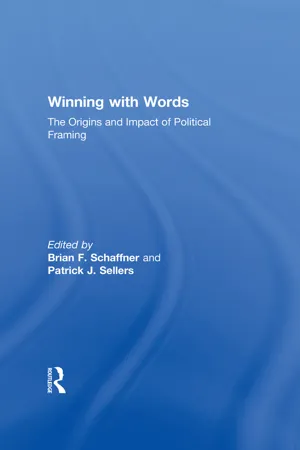
Today's politicians and political groups devote great attention and care to how their messages are conveyed. From policy debates in Congress to advertising on the campaign trail, they carefully choose which issues to emphasize and how to discuss them in the hope of affecting the opinions and evaluations of their target audience. This groundbreaking text brings together prominent scholars from political science, communication, and psychology in a tightly focused analysis of both the origins and the real-world impact of framing. Across the chapters, the authors discuss a broad range of contemporary issues, from taxes and health care to abortion, the death penalty, and the teaching of evolution. The chapters also illustrate the wide-ranging relevance of framing for many different contexts in American politics, including public opinion, the news media, election campaigns, parties, interest groups, Congress, the presidency, and the judiciary.
eBook - ePub
Winning with Words
The Origins and Impact of Political Framing
- 204 pages
- English
- ePUB (mobile friendly)
- Available on iOS & Android
eBook - ePub
About this book
Information
1 Introduction
Brian F. Schaffner and Patrick J. Sellers
On his fourth day in office, President Barack Obama delivered his first radio address to the nation. His remarks focused on the American Recovery and Reinvestment Act, legislation that Obama hoped Congress would pass quickly in order to stem the economic downturn. Despite the fact that the news media and many politicians commonly referred to the legislation as a “stimulus package,” Obama did not use the word stimulus once in his 806-word address. Democratic pollsters had indicated that the public was more willing to support an economic recovery package than an economic stimulus. Their research also indicated that the public was more supportive of the legislation when told about how the money would be spent than about the total amount of spending (Brown 2009). Not surprisingly, Obama’s speech framed the legislation in a favorable way by focusing almost entirely on the programs that the spending would support, without ever mentioning the total size of the bill.
This story illustrates how today’s politicians devote great attention and care to framing their messages to the public and each other. From policy debates in Washington to advertising on the campaign trail, our political leaders carefully choose which issues to emphasize, and how to discuss those issues. These crafted messages can significantly affect the opinions and evaluations of target audiences (Iyengar 1991; Nelson et al. 1997; Jacobs and Shapiro 2000; Entman 2004; Druckman 2001). Yet, important questions remain about politicians’ attempts to win political battles with carefully worded messages. Exactly what strategies guide politicians’ creation of frames? Do these strategies differ across issues and contexts? What makes a message more persuasive in the real world? Are some voters more susceptible to persuasion than others? Does this impact extend beyond the public’s short-term attitudes?
These questions are fundamental for American politics. Public discussions about policy issues inherently involve framing, as politicians intentionally and necessarily emphasize certain aspects of those issues and deemphasize others. If politicians can effectively use framing to shape public opinion, it becomes unclear whether that opinion even exists absent framing. In such a scenario, voters may possess weak or even non-existent attitudes about policy issues and their elected leaders (Asher 2007). Politicians could conceivably define and manipulate public opinion and the political process to further their own interests (Lippman 1922; Bartels 2003). This worrisome possibility makes it important to understand politicians’ framing strategies and the limits to their effectiveness, that is, the conditions under which the public holds opinions in resistance to framing.
In this volume, prominent scholars from political science, communication, and psychology come together to explore the dynamics of framing. Across the chapters, the authors discuss political messages about a range of contemporary issues, from taxes to abortion and the death penalty. The chapters also illustrate the wide-ranging relevance of framing for many different contexts in American politics, including the news media, election campaigns, interest groups, Congress, and public opinion. To explore framing across these contexts, the authors employ diverse methodologies, from surveys and laboratory experimentation to elite interviews and content and archival analysis. When combined, the diverse issues, contexts, and methods go beyond the existing studies of framing and paint a broad picture of many ways in which framing influences American politics. Such a unique picture can help students of contemporary politics better understand how competing politicians carefully choose their words in order to win.
This introductory chapter places the chapters in the broader context of the expansive literature concerning framing. We discuss two dimensions of this literature and explain how subsequent chapters in this volume fit into these dimensions. We conclude the chapter by emphasizing the importance of considering both framing successes and failures.
Framing Debates
The term “framing” is one of the most widely used concepts in political science, communication studies, psychology, and sociology.1 Two dimensions of the literature figure prominently in this volume. The first dimension concerns competing conceptions of framing. The broadest conception, what we might call “emphasis framing,” describes a process in which competing frames emphasize different messages and arguments in a policy debate (Nelson et al. 1997; Druckman 2001). Communication scholar Robert Entman uses these types of frames to explain how political and media elites interact to shape US foreign policy and public opinion (Entman 2004). In a similar manner, cognitive linguist George Lakoff describes how Democrats and Republicans employ very different arguments and evidence in contemporary policy debates (Lakoff 2004). Republicans often use a “strict father” model to frame issues, with emphasis on protecting the family in a dangerous, difficult world and teaching children right from wrong. In contrast, the “nurturant parent” model, employed by Democrats, emphasizes making the world a better place in order to nurture the needs of children and others. On the issue of poverty, for example, the models lead Republicans to emphasize self-reliance and personal responsibility, and the Democrats to focus on society’s responsibility to help those in need.
Many of this book’s chapters also employ similar types of “emphasis framing.” The Nelson et al. chapter, for example, examines the policy debate over the teaching of intelligent design. In this debate, supporters of intelligent design framed the scientific process as based on a “marketplace of ideas.” Their opponents, in contrast, labeled intelligent design as a “Trojan Horse” designed to force religious beliefs on school children. Other chapters focus on emphasis framing as well. Gerrity describes how interest groups attempted to emphasize different aspects of the partial-birth abortion issue; Druckman demonstrates how focusing on different arguments for or against a casino influenced support for the proposal; and Baumgartner et al. argue that a new emphasis on the “innocence frame” led to a significant decline in the application of the death penalty.
An alternative conception of framing focuses less broadly on competing arguments, and more narrowly on the ways in which a single argument is presented. Early and prominent examples of this “equivalence framing” (Druckman 2001) emerged from the work of Tversky and Kahneman (1974), who demonstrated how presenting the same policy proposal as a gain or loss shaped individuals’ evaluations of that proposal. In this volume, the chapter by Schaffner and Atkinson uncovers a similar effect: the authors illustrate how the competing labels of “death tax” and “estate tax” shape citizens’ perceptions and evaluations of inheritance tax reform. In this book’s conclusion, Iyengar argues for a focus on this type of equivalence framing, suggesting that it is more precisely defined and offers greater potential for distinguishing among competing influences on public opinion.
These competing conceptions of framing matter because they suggest different ways that political elites may influence citizens’ perceptions and evaluations. This influence forms the basis of a second dimension of framing that emerges from this volume: the distinction between the origin and impact of frames.
Origins
Political elites may create frames for different reasons and in different contexts. Legislative leaders may use arguments or amendments to frame a policy debate and therefore shape legislators’ votes on a policy proposal (Riker 1986). Policy making more broadly has grown increasingly reliant on public communication in recent decades (Kernell 1997; Jacobs and Shapiro 2000; Sellers 2010), encouraging political elites to promote favorable frames to the news media and the public, again in hopes of shaping opinions and policy outcomes.2
The chapters in the first half of this volume help unpack the decision making process behind elites’ choice of frames for political communication. Nelson and his co-authors examine how elites use values as tools of persuasion in political debates. “Value recruitment” describes how communicators adopt social and political values to make persuasive policy arguments and influence public opinion. The recurring debate over the teaching of evolution in public schools provides a vivid and instructive case study of value recruitment in action, as captured through in-depth interviews and content analysis of news coverage about the debate.
In the next chapter, Harris traces the recent history of how congressional parties have framed policy debates in the US House of Representatives. Drawing extensively from House leadership archives (from Speakers Tip O’Neill to Newt Gingrich), Harris demonstrates how congressional leaders consciously use framing strategies to create party messages. These strategies have evolved across congresses, parties, and leaders. In Chapter 4, Gerrity explores how interest groups have developed frames on the issue of abortion. Building on in-depth analysis of interest groups’ public documents and interviews with the group leaders, Gerrity outlines how the groups’ goals varied in the abortion debate and how the groups created different frames to realize their particular goals.
The chapter by Ansley and Sellers shifts the focus to recent election campaigns and a new way to create frames. These authors argue that candidates can more effectively frame electoral and policy choices by changing from the traditional top-down management structure to a more decentralized organization. This alternative approach empowers volunteers to contribute to the campaign’s message and help promote that message in new and different ways. Those volunteers and the public subsequently find that message more persuasive and credible. Ansley and Sellers support these arguments with extensive content analysis of campaign websites, advertisements, and news coverage of the 2006 Senate elections.
Impact
After creating frames in these various ways, the political elites expect these frames to shape the perceptions and evaluations of target audiences. The second half of this volume examines this impact, that is, how frames influence individual citizens, overall public opinion, and ultimately policy making. The context and substantive content of this impact vary widely across the chapters. In Chapter 6 Druckman asks how competition among frames affects elites’ efforts to shape public opinion. He first defines the range of competitive contexts that might surround a policy debate, which political scientists have largely ignored. He then explains how audiences, messages, and competitive environments interact to shape the impact of framing.
As noted above, Schaffner and Atkinson in Chapter 7 focus on a specific issue common to real-world policy debates: reforming the federal inheritance tax. Conservatives and Republicans labor mightily to frame this debate over the “death tax.” Schaffner and Atkinson illustrate how the parties’ actual frames in this debate shaped not only citizens’ preferred positions but also their knowledge of the tax and how widely it applied.
Wagner’s chapter considers how framing may have a more lasting impact on the public’s attitudes. He captures how US presidents talked about two issues, taxes and abortion, over a 25-year period (1975–2000). Wagner then shows how the presidents’ varying frames on these issues helped shape the public’s party identification over the same period.
In the final empirical chapter, Baumgartner et al. illustrate how framing may go beyond public opinion to influence policy making directly. In the decades-long debate over the death penalty, the authors document how the rise of the powerful new “innocence” frame ended the long-term expansion of the death penalty in the United States. Since the rise of the “innocence” frame, the number of death sentences has actually decreased by over half.
The News Media
When discussing the origins and impact of framing, it is important to note the news media’s role in mediating the relationship between political elites and the public. Journalists may attempt to provide coverage that mirrors actual events, including politicians’ frames (Gans 2004; Graber 2006). But, the public may not receive competing arguments from all sides, particularly if the news media merely “index” the degree of disagreement on an issue among political elites (Bennett 1990). In addition, market pressures may push the news media toward presenting their coverage in certain ways. For example, competitive concern over ratings often pushes television outlets to personalize their coverage of public policy debates, using more episodic than thematic framing (Iyengar 1991).
While not a central focus of this volume, the news media’s mediating role emerges in several chapters. Political elites often construct frames in anticipation of how the news media will cover them. The Harris chapter explains how this anticipation shaped the public relations decisions of congressional leaders. The Gerrity chapter does the same for interest groups involved in the partial-birth abortion debate. Baumgartner et al. track coverage of the death penalty in the New York Times since 1960 and find that, as the Times paid more attention to the “innocence frame,” their coverage came to present an increasingly negative view of the death penalty.
Framing Failures
If political elites can create frames that effectively shape public opinion, the normative implications are indeed worrisome, as outlined at the start of this chapter. The elites could conceivably shape public opinion to further their own interests. But, this volume’s chapters and authors offer a hopeful response to this concern: framing does not always work.
In the first half of this volume, the authors document how political elites in different debates and contexts considered a wide range of frames. The elites did not actually use all these frames, and not all of the frames used actually proved effective. For example, Gerrity d...
Table of contents
- Cover
- Title
- Copyright
- Contents
- List of Figures
- List of Tables
- Preface
- Acknowledgments
- 1 Introduction
- PART I Origins
- PART II Impact
- Notes on Contributors
- Index
Trusted by 375,005 students
Access to over 1.5 million titles for a fair monthly price.
Study more efficiently using our study tools.
Frequently asked questions
Yes, you can cancel anytime from the Subscription tab in your account settings on the Perlego website. Your subscription will stay active until the end of your current billing period. Learn how to cancel your subscription
No, books cannot be downloaded as external files, such as PDFs, for use outside of Perlego. However, you can download books within the Perlego app for offline reading on mobile or tablet. Learn how to download books offline
Perlego offers two plans: Essential and Complete
- Essential is ideal for learners and professionals who enjoy exploring a wide range of subjects. Access the Essential Library with 800,000+ trusted titles and best-sellers across business, personal growth, and the humanities. Includes unlimited reading time and Standard Read Aloud voice.
- Complete: Perfect for advanced learners and researchers needing full, unrestricted access. Unlock 1.5M+ books across hundreds of subjects, including academic and specialized titles. The Complete Plan also includes advanced features like Premium Read Aloud and Research Assistant.
We are an online textbook subscription service, where you can get access to an entire online library for less than the price of a single book per month. With over 1.5 million books across 990+ topics, we’ve got you covered! Learn about our mission
Look out for the read-aloud symbol on your next book to see if you can listen to it. The read-aloud tool reads text aloud for you, highlighting the text as it is being read. You can pause it, speed it up and slow it down. Learn more about Read Aloud
Yes! You can use the Perlego app on both iOS and Android devices to read anytime, anywhere — even offline. Perfect for commutes or when you’re on the go.
Please note we cannot support devices running on iOS 13 and Android 7 or earlier. Learn more about using the app
Please note we cannot support devices running on iOS 13 and Android 7 or earlier. Learn more about using the app
Yes, you can access Winning with Words by Brian F. Schaffner,Patrick J. Sellers in PDF and/or ePUB format, as well as other popular books in Politics & International Relations & Political Campaigns & Elections. We have over 1.5 million books available in our catalogue for you to explore.