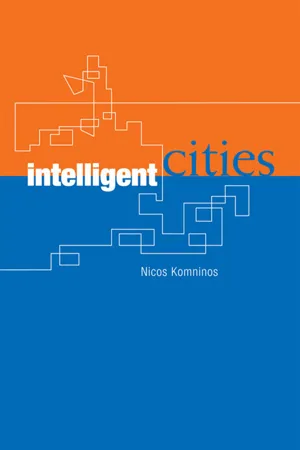
At the turn of the century some cities and regions in Europe, Japan and the USA, displayed an exceptional capacity to incubate and develop new knowledge and innovations. The favourable environment for research, technology and innovation created in these areas was not immediately obvious, yet it was of great significance for a development based on knowledge, learning, and innovation. Intelligent Cities focuses on these environments of innovation, and the major models (technopoles, innovating regions, intelligent cities) for creating an environment-supporting technology, innovation, learning, and knowledge-based development.
The introduction and the first chapter deal with innovation as an environmental condition, and with the geography and typology of islands of innovation. The next three parts focus on the theoretical paradigms and the planning models of the 'industrial district', the innovating region', and the 'intelligent city', which offer three alternative ways to create an environment of innovation.
- 320 pages
- English
- ePUB (mobile friendly)
- Available on iOS & Android
eBook - ePub
About this book
Information
1Innovation is an Island
Over the past twenty years industrial countries have put considerable effort into research and technological development in order to meet the challenges of globalization. Since the Western world has chosen technological innovation as the basic competitive advantage in the global economy, it has led to extensive mobilization of scientific and technological knowledge in the search for solutions to problems of production and development. However, despite the pre-eminent position of technological innovation in the contemporary world, our knowledge of its processes and mechanisms is largely axiomatic and empirical. It is based, on the one hand, on the concept of innovation as the commercial and productive exploitation of science and technology, and on the other, on best practice and examples of organizations that have developed successful technological innovations.
In this chapter we argue that technological innovation is an environmental condition. Innovation flows from an environment rich in factors and mechanisms facilitating the conversion of scientific knowledge into products and services. Such a favourable environment for technological innovation has been created in a whole series of areas, including industrial districts, technopoles, innovative regions, and intelligent cities, in which conditions of collaboration and collective ingenuity reinforce the capabilities of established organizations and enterprises. The environment of innovation is characterized by specific functions, among which research and development, technology transfer, networking, and technological cooperation dominate.
Innovation and the R&D Lab
The term ‘innovation’, notes the Green Paper on Innovation, is somewhat equivocal, for it designates both a process and its result. It signifies the transformation of scientific and technological knowledge into products and services, and in this sense the term describes a process (European Commission 1996a). However, when the word innovation designates a new product, then the emphasis is on the result of the process. This double meaning is a source of misunderstandings, the most common of which is confusion between the factors that promote innovation, such as research and development (R&D), technology purchase, international technological cooperation, funding, and their result, that is, a new product, a new method, a new service.
In some surveys, for instance, the enterprises that buy or sell technology are considered innovative, a definition that creates confusion between a cause (purchase of technology) and its result (the renewal of products and processes, being innovative).1The same perplexity is found in assessments of the regional technology gap, measuring the intensity of efforts devoted to R&D and technology, although these efforts do not necessarily mean that a region or organization spending more on research is by definition more innovative. This indeed is the criticism of the linear model of innovation. It is not sufficient to increase the intensity of R&D in order to trigger the process and increase the potential for innovation. Many experiences from regional innovation strategies show that a critical parameter in the innovation process is not the size of the regional research budget, but the institutional and social web permitting the transformation of scientific knowledge into new products and processes.
It is important to remember at this point that technological innovation is the transformation within an organization (enterprise, service organization, research laboratory) of:

The renewal of products and production processes can be radical or incremental. It is radical when it has to do with the development of a new technology or the initial commercial exploitation of a new product, and it is incremental when it concerns the adoption of a technology that is considered ‘good practice’ and that is already being implemented in more advanced segments within a productive sector or region. In the first instance we have a generic innovation, whereas the second is innovation on the level of the specific organization. This distinction opens the door of innovation to all those organizations that improve their production up to the level of the best practice. Innovation does not concern only the best enterprises and organizations that carry out original research and develop original products, but includes technology transfer and dissemination, in addition to the development of new products and technologies.
With the globalization of economies and competition, innovation has become the most important factor in development, employment, and prosperity. Innovation in methods and processes permits increased productivity, energy saving, ergonomic optimization, better efficiency and reliability in production. Innovation in products and services permits differentiation from competing products, opens new markets, and improves the competitiveness of the company. Innovation in organizations permits the better use of human resources, flexibility, and it is usually a precondition for the successful implementation of new products and processes. Despite this logical systematization, innovation is difficult to measure. If, for example, one organization develops one new product a year and another develops three in that year, does that mean the second is more innovative than the first? Probably not. Innovation is not only about the number of new products. We have to measure the effort made to develop them and the results in terms of growth and employment. This goes back to expenditure on R&D, to the precondition rather than the result of the innovation. But as mentioned, expenditure on R&D does not always lead to a successful innovation. Without a global theory of the innovation process, this vicious circle among causes and results just goes on repeating itself.
The R&D Lab
In the rapid change and innovation of products, production technologies, and management methods, a number of factors come into play. Critical among them is research and development, and the use of scientific and technical knowledge for commercial purposes. Research capacity, however, is not sufficient for innovation. The latter also requires appropriate managerial support, funding, market promotion, and the collaboration with technology providers, suppliers, and other producers.
Until the 1980s, the process of innovation had been mainly conceived within the framework of the research laboratory of a large company (Alison 1969). Let us assume, for example, writes Donald Schon, that a researcher or engineer working in a lab discovers a new quality in some material or describes a new mechanical set-up (Schon 1969).
It is obvious that the example describes in simplified form, the innovation process in the large (usually multinational) mass production companies that flourished in the second half of the twentieth century. It outlines the several stages in the innovation process: its origin in the R&D division, the securing of a budget from the administration, the support from the marketing division, the manufacture of prototypes and the pilot production and quality test run (Table 1.1). At each step, the innovation plan risks being dropped if cost, market, and technical problems appear to be insuperable.
Innovation, however, is not a linear process that ...
Table of contents
- Cover
- Half Title
- Full Title
- Copyright
- Dedication
- Contents
- Acknowledgements
- INTRODUCTION Origins, Structure and Contents
- CHAPTER 1 Innovation is an Island
- PART I Technopoles and Science Parks: Innovation as Spatial Proximity
- PART II Innovating Regions: Innovation as an Institution
- PART III Intelligent Cities: Islands of Innovation meet the Digital World
- Notes
- References
- Index
Trusted by 375,005 students
Access to over 1.5 million titles for a fair monthly price.
Study more efficiently using our study tools.
Frequently asked questions
Yes, you can cancel anytime from the Subscription tab in your account settings on the Perlego website. Your subscription will stay active until the end of your current billing period. Learn how to cancel your subscription
No, books cannot be downloaded as external files, such as PDFs, for use outside of Perlego. However, you can download books within the Perlego app for offline reading on mobile or tablet. Learn how to download books offline
Perlego offers two plans: Essential and Complete
- Essential is ideal for learners and professionals who enjoy exploring a wide range of subjects. Access the Essential Library with 800,000+ trusted titles and best-sellers across business, personal growth, and the humanities. Includes unlimited reading time and Standard Read Aloud voice.
- Complete: Perfect for advanced learners and researchers needing full, unrestricted access. Unlock 1.5M+ books across hundreds of subjects, including academic and specialized titles. The Complete Plan also includes advanced features like Premium Read Aloud and Research Assistant.
We are an online textbook subscription service, where you can get access to an entire online library for less than the price of a single book per month. With over 1.5 million books across 990+ topics, we’ve got you covered! Learn about our mission
Look out for the read-aloud symbol on your next book to see if you can listen to it. The read-aloud tool reads text aloud for you, highlighting the text as it is being read. You can pause it, speed it up and slow it down. Learn more about Read Aloud
Yes! You can use the Perlego app on both iOS and Android devices to read anytime, anywhere — even offline. Perfect for commutes or when you’re on the go.
Please note we cannot support devices running on iOS 13 and Android 7 or earlier. Learn more about using the app
Please note we cannot support devices running on iOS 13 and Android 7 or earlier. Learn more about using the app
Yes, you can access Intelligent Cities by Nicos Komninos in PDF and/or ePUB format, as well as other popular books in Architecture & Architecture General. We have over 1.5 million books available in our catalogue for you to explore.