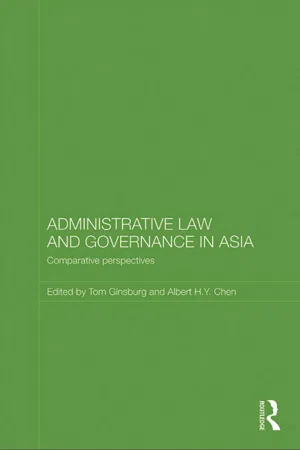
This book examines administrative law in Asia, exploring the profound changes in the legal regimes of many Asian states that have taken place in recent years. Political democratization in some countries, economic change more broadly and the forces of globalization have put pressure on the developmental state model, wherein bureaucrats governed in a kind of managed capitalism and public-private partnerships were central. In their stead, a more market-oriented regulatory state model seems to be emerging in many jurisdictions, with emphases on transparency, publicity, and constrained discretion. This book analyses the causes and consequences of this shift from a socio-legal perspective, showing clearly how decisions about the scope of administrative law and judicial review have an important effect on the shape and style of government regulation. Taking a comparative approach, individual chapters trace the key developments in the legal regimes of major states across Asia, including China, Japan, Korea, Malaysia, Taiwan, Hong Kong, Indonesia, Singapore, the Philippines, Thailand and Vietnam. They demonstrate that, in many cases, Asian states have shifted away from traditional systems in which judges were limited in terms of their influence over social and economic policy, towards regulatory models of the state involving a greater role for judges and law-like processes. The book also considers whether judiciaries are capable of performing the tasks they are being given, and assesses the profound consequences the judicialization of governance is starting to have on state policy-making in Asia.
eBook - ePub
Administrative Law and Governance in Asia
Comparative Perspectives
- 400 pages
- English
- ePUB (mobile friendly)
- Available on iOS & Android
eBook - ePub
Administrative Law and Governance in Asia
Comparative Perspectives
1
The judicialization of administrative governance
Causes, consequences and limits
In recent years, there has been increasing attention to the phenomenon of judicialization, the expansion of the range of activities over which judges exercise significant authority. Judges around the world now routinely make important policy decisions that only a few years ago would have been seen as properly the purview of bureaucrats, politicians, and private actors.1 Beyond the direct involvement of judges in decision-making, judicialization can also refer to the expanding use of trial-like procedures for making governmental decisions and the extension of law-like processes into new social spheres.
Whereas recent studies have examined judicialization in a variety of regional contexts,2 the overwhelming emphasis is on judicialization in Europe and the United States.3 But of course there is far more to the world than the North Atlantic. One of the motivations for this volume is to ask whether and to what extent judicialization has occurred in East and Southeast Asia. It analyzes this issue in a particularly crucial context: the sphere of administrative law and regulation. Though much more attention in the nascent judicialization literature is devoted to constitutional issues,4 most citizens are far more likely to encounter the state in the routine matters that are the stuff of administrative law rather than in the rarified sphere of constitutional law.
Administrative law is a mode of “regulating regulation,”5 a particular way of ensuring that government observes certain rules in its interaction with society. I characterize administrative law as operating at two levels: retail and wholesale. The retail level concerns administrative interaction with private parties, what is called administrative justice in the UK. The wholesale level, which is less uniformly conceived as part of the domain of judicial control, concerns the formation of sub-legislative rules. Despite continuing doctrinal divergences and quite different institutional structures, there has been substantial convergence in the core elements of administrative law systems, with a right to present one’s case before agencies, to receive reasons for adverse decisions, and the right to challenge administrative decisions before third party decision-makers. Particularly when judges have the power to review decisions of regulators, administrative law provides a crucial locus of state–society interaction, a channel for determining how and if participation can occur and rights can be protected. Judicial review of administrative action and enforcement of constitutional guarantees of fair procedures have been important constraints on regulatory decision-making.
East and Southeast Asia provides an important regional context for examining administrative law and regulation. For many years, the dominant trope in discussions of the Asian state was the developmental state,6 an image of state-led economic growth in which bureaucratic supermen used vast grants of discretion to pick economic winners and losers. A large debate concerns the extent to which this imagery matched reality, but the very existence of the debate suggests that there was the appearance of substantial state discretion, in contrast with conventional economic theory. However, in the mid-1990s, as a result of several forces, this image began to lose power and East Asian states began to transform toward a more liberal regulatory model. This model included privatization, establishment of administrative procedures acts and the emergence of greater constitutional constraint on regulatory actors.
This shift has significant consequences for law and courts. Although law was not a major concern for first-generation analysts of the Asian state, the developmental state model contained an implicit model of law in general and administrative law in particular. Administrative law in the region tended to be formalistic and to govern a relatively small range of transactions. A paradigmatic practice, known in Japan as “administrative guidance” and by other euphemisms elsewhere, consisted of government suggesting a course of action by private parties that would be followed even if government lacked the formal legal power to force the course of action it was suggesting. Contrary to some imagery, such behavior is hardly the exclusive competence of Asian bureaucrats, but is found in virtually every regulatory system to one degree or another. Nevertheless, the notion that Asian bureaucracies during the high-growth period exercised a lot of discretion remains powerful. The statutory frameworks governing bureaucratic action were not extensive. The powerful Northeast Asian economies of Japan, Korea and Taiwan did not even pass their first general administrative procedures acts until the 1990s.
Beyond this, judicial authorities would tolerate fairly vague legislative pronouncements that empowered bureaucratic authorities. Particularly when compared with vigorous systems of administrative review by courts that operated under the American, French and German constitutional traditions, Asian courts seemed to be reticent to become involved in regulatory governance. Administrative courts did exist in some countries but the combination of judicial deference and powerful bureaucracies meant that their scope was not extensive at all.
This structural feature had consequences for firm strategy. With relatively underdeveloped formal legal guarantees, firms had to invest in specific relationships with regulatory authorities. Firms were dependent on state authorities for information, access to markets, and even capital during the high-growth period. Their investment in such relationships meant there was a corresponding disincentive to push for change. There was thus no winning domestic coalition supporting more transparent and open styles of regulation. So long as bureaucratic–business relationships were stable, the legal equilibrium was sustainable as well.
A number of factors, explored in great detail in the case studies in this volume, combined to put pressure on this situation. This chapter first describes the concept of judicialization, with special attention to the context of administrative governance. It next describes the various theories of why the shift is occurring, focusing on three categories of explanation: politics, economics and general features of the global environment. The chapter then considers some of the consequences of the shift and speculates briefly on the limits of judicialization. The discussion is generic in the sense that it does not purport to explain any single country experience, but rather to provide some considerations that may operate to a greater or lesser extent in various contexts.
The concept of judicialization of governance
The judicialization of politics is now an established concept, with an expanding literature tracing the myriad spheres in which courts are now making and influencing policy decisions that previously had not been within their purview.7 By judicialization of governance, we have in mind a broad conception of the expansion of judicial involvement in the formation and regulation of public policy. Expanded judicial power may come at the expense of bureaucratic power, as in the establishment of vigorous systems of judicial review of administrative action and judicially policed processes of sub-legislative rule formation. It may come at the expense of politicians, so that political decision-making is shaped and constrained by higher order principles articulated by judges. And it may come at the expense of private actors, who find their own freedom to create and organize rules is constrained by judicially created or enforced public policies.
Judicialization involves more than simply the direct articulation and application of rules by judges; it also involves decisions by other political actors made in the shadow of judicial processes. An agency that refrains from certain conduct, or provides extensive legal justification for actions that it does take, or introduces trial-like processes to defend itself from claims of arbitrariness, may be acting to avoid being brought before courts. In this sense the sphere of judicialized governance is broader than it might initially appear and it may also be difficult to trace its precise boundaries.
A related concept is that of juridification: the spread of legal discourse and procedures into social and political spheres where it was previously excluded or was minimal.8 Hirschl notes that this has long been a concern of social theory, as rationalized processes. A particularly interesting contribution is exemplified by Morgan9 who identifies the spread of cost–benefit analysis in the economic sphere as a kind of quasi-judicialization, in which technocratic discourse is employed to evaluate individual cases against “higher” criteria of rationality. We focus instead on judicialization, not because juridification is unimportant, but because judicialization is one window on the broader and more amorphous process of juridification.
The most elaborate elucidation of the judicialization concept is by Stone Sweet, who roots the concept of judicialization in dyadic social relationships and a shift to third parties.10 Dyadic social relations are sustained by reciprocity. Reciprocity can be stable for a very long time, but sometimes it can break down, as parties disagree over rights and obligations. Once conflict occurs, one party might be able to force its view on the other, but if not, the dyad is likely to turn to a third party to help resolve the dispute.11 When a third party enters the picture to resolve disputes and help the dyad partners coordinate their expectations, governance begins.
The triadic structure of dispute resolution involves, inherently, the articulation of rules and the generation of a normative structure that helps guide future behavior. This also engenders a discourse about the application of rules that itself becomes embedded into the reasoning and strategic calculus of the governed. Future dyadic interaction occurs in light of this normative structure, and a feedback cycle develops whereby new conflicts that emerge are again sent to the triadic dispute resolver, with the questions becoming ever more refined over time. This is the process of judicialization.
In the Asian context, one can view relational, reciprocity-based networks of exchange as being essentially dyadic in character. Firms contract with each other, and enforce the contracts through reciprocity-based sanctions. Firms also interact with government in essentially dyadic ways, with each firm seeking to establish relationships and norms of cooperation with government ac...
Table of contents
- Routledge law in Asia
- Contents
- Contributors
- Preface
- 1 The judicialization of administrative governance
- Part I General perspectives
- Part II Northeast Asia and Greater China
- Part III Southeast Asia
- Index
Trusted by 375,005 students
Access to over 1.5 million titles for a fair monthly price.
Study more efficiently using our study tools.
Frequently asked questions
Yes, you can cancel anytime from the Subscription tab in your account settings on the Perlego website. Your subscription will stay active until the end of your current billing period. Learn how to cancel your subscription
No, books cannot be downloaded as external files, such as PDFs, for use outside of Perlego. However, you can download books within the Perlego app for offline reading on mobile or tablet. Learn how to download books offline
Perlego offers two plans: Essential and Complete
- Essential is ideal for learners and professionals who enjoy exploring a wide range of subjects. Access the Essential Library with 800,000+ trusted titles and best-sellers across business, personal growth, and the humanities. Includes unlimited reading time and Standard Read Aloud voice.
- Complete: Perfect for advanced learners and researchers needing full, unrestricted access. Unlock 1.5M+ books across hundreds of subjects, including academic and specialized titles. The Complete Plan also includes advanced features like Premium Read Aloud and Research Assistant.
We are an online textbook subscription service, where you can get access to an entire online library for less than the price of a single book per month. With over 1.5 million books across 990+ topics, we’ve got you covered! Learn about our mission
Look out for the read-aloud symbol on your next book to see if you can listen to it. The read-aloud tool reads text aloud for you, highlighting the text as it is being read. You can pause it, speed it up and slow it down. Learn more about Read Aloud
Yes! You can use the Perlego app on both iOS and Android devices to read anytime, anywhere — even offline. Perfect for commutes or when you’re on the go.
Please note we cannot support devices running on iOS 13 and Android 7 or earlier. Learn more about using the app
Please note we cannot support devices running on iOS 13 and Android 7 or earlier. Learn more about using the app
Yes, you can access Administrative Law and Governance in Asia by Tom Ginsburg, Albert H.Y. Chen, Tom Ginsburg,Albert H.Y. Chen in PDF and/or ePUB format, as well as other popular books in Law & Administrative Law. We have over 1.5 million books available in our catalogue for you to explore.