Medieval German Literature provides a comprehensive survey of this Germanic body of work from the eighth century through the early fifteenth century. The authors treat the large body of late-medieval lyric poetry in detail for the first time.
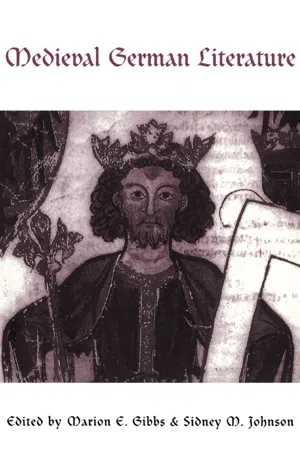
- 458 pages
- English
- ePUB (mobile friendly)
- Available on iOS & Android
eBook - ePub
About this book
Information
Middle High German Literature under the Hohenstaufens 1170–1273
HISTORICAL BACKGROUND
German literature of the High Middle Ages, the remarkable flowering described as classical MHG literature, the mittelhochdeutsche Blütezeit, is inextricable from the name of Hohenstaufen, the reigning house that gained dominance in Europe during the latter half of the twelfth century. It had first achieved significance in 1079, when Agnes, daughter of the Emperor Henry IV, had married Frederick of Staufen who was then created Duke of Swabia. It was his father, Frederick of Büren, who in about 1077 had built the castle now known as Hohenstaufen, not far from Stuttgart, one of the first of the many castles throughout Swabia which became the strongholds of the dynasty and important administrative centers.
On the death of Henry V in 1125 the Salian inheritance passed to the Hohenstaufens, who did not, however, as yet assume the imperial crown, even though Henry himself had designated his nephew, Frederick II of Swabia his successor. Breaking the tradition of hereditary succession to the German crown, the princes elected Lothar of Supplinburg, Duke of Saxony. The inevitable conflict with the Hohenstaufens lasted for the larger part of Lothar’s reign, and the episode represented a significant assertion of the power of the princes.
When Lothar died in 1138, there was another setback to the hereditary principle, when Lothar’s nominee, his son-in-law Henry the Proud, Duke of Bavaria and Saxony, was rejected in favor of the long-term anti-king, the Hohenstaufen Conrad III, formerly Duke of Franconia. Henry the Proud, whose only son was Henry, known as the Lion, died in suspicious circumstances in 1139.
Conrad III died in 1152, on his return from the Second Crusade. The son whom he had originally nominated to succeed him had died two years earlier, and his only other son was still a child. Recognizing the urgent need for a strong opposition to the Saxons under Henry the Lion, who had long attempted to lay claim also to Bavaria, Conrad had taken the step of naming as his successor not that second son of his, but his nephew, Frederick of Hohenstaufen, Duke of Swabia, a man of thirty at the time.
This was a popular nomination: Frederick, often called Frederick Barbarossa, was already known as a statesman and a warrior who had participated in the crusade. Most important, he stood in exactly the same relationship to the Welf and Hohenstaufen dynasties—his mother was the sister of Henry the Proud and his father brother to Emperor Conrad—and looked as though he might unite the divided Germany. It all seemed auspicious, and perhaps if he had devoted himself to the state of affairs in Germany instead of becoming embroiled in turbulent relations with Italy and bitter confrontations with successive popes, the course of the Hohenstaufen dynasty would have been very different, and, with it, the course of European history.
For the time being, however, the stability of the Hohenstaufen dynasty was assured, and, thus also, the power of the German Empire, the Holy Roman Empire as it was to be called in time to come. This was the environment which nurtured the literature which dominates medieval Germany, the staufische Klassik, which reached its peak in the very early years of the thirteenth century, coinciding with the peak of chivalry and the dominance of the knightly class. The poets of that age often, though not in all cases, came from that class, and their works were certainly intended for a knightly audience. The decline of that class and its increasing substitution by the middle classes coincide likewise with the decline of courtly literature, and this at a time when Hohenstaufen power was gradually but irrevocably waning.
The Hohenstaufens under Frederick I may have appeared invincible, but their position was often held on a thread, and the almost constant opposition of Church and State gave rise to a volatile situation. It is also important to bear in mind that events in the far reaches of the Empire had resonances in that part which concerns us for the study of medieval German literature.
Crucial was the position of Sicily, the future of which was significantly affected by the marriage in 1186 of Frederick’s son Henry to Constance, daughter of King Roger of Sicily of the Hauteville dynasty. The basis of the union was blatantly political: to preserve the succession in the event of the death of the reigning king, William IV, who had no heir. Potentially, also, the marriage would mean the union of the enormously wealthy kingdom of Sicily with the Empire, and the consequent diminution of papal power.
Henry was to concern himself with Italy, while Frederick returned to Germany, under threat of excommunication by Pope Urban III for arranging the marriage without papal approval. As things turned out, this excommunication did not take effect, because matters of even greater significance intervened: the surrender of Jerusalem to Saladin, the death of Urban III and, in 1190, the death by drowning of Frederick himself as he led his forces into the Third Crusade. The fact that the Empire passed without challenge to his son Henry VI is testimony to the achievements of Frederick Barbarossa, but his son was a ruler of quite a different caliber, lacking the charisma of his father.
Henry and Constance were crowned in Rome in 1191, Henry having laid claim to Sicily, too, on the death of William of Sicily, in 1189, but the union of this kingdom with the Empire depended on the continuation of the Hohenstaufen dynasty, something which could be threatened by the princes if the occasion arose, and certainly by a powerful pope. Henry VI did try to establish the principle of the hereditary empire, but he failed, although he succeeded in having his young son elected as king in 1196, shortly before his own death in 1197, an event which plunged Germany into a state of anarchy during the ensuing fifteen years of conflict between the Hohenstaufens and the Welfs.
Ironically enough, these were years which saw the upsurge of courtly literature in Germany, and it was precisely in Thuringia, which was severely affected, that a rich literary center flourished at the court of Count Hermann I. This flowering is an unambiguous testimony to the power and wealth of the noble lords, and their new role as patrons of the arts, not to mention the less tangible but frequently observed coincidence of significant periods of artistic creativity with times of social unrest. The picture of courtly society, idealized in the concept of the court of King Arthur, may well have been an attempt to block out the negative features of reality, yet the most effective narrative poets of the day, astute observers as they were, did not provide an unreservedly positive view. It is possible to discern a certain criticism in Hartmann’s Iwein, for example, or to see Gottfried’s Tristan as an attack on society. In the outspoken comments of Walther von der Vogelweide, moreover, we gain a powerful insight into the prevailing malaise as well as some of the most specific references to political events.
The child Frederick was three years old when his father died, and his mother, the Empress Constance, died in 1198. Although there was plenty of support for him as the appointed heir, there was a need to avert a state of chaos developing in the period before he attained his majority. Therefore, his uncle, Philip of Swabia, agreed, after some initial reluctance, to be crowned, with the support of the majority of the great lords and bishops. Once more, however, the death of the pope precipitated a crisis: on the accession of Innocent III, who saw the potential threat of an Empire which was composed of Germany, central Italy and Sicily, there was a plausible rival candidate in the form of Otto of Brunswick, son of Frederick Barbarossa’s old enemy Henry the Lion of Saxony. He, too, was crowned, and Germany was thrown into a civil war, with the Welfs supported by Richard the Lionheart and the pope on the one side, and the Hohenstaufen cause supported by Philip Augustus of France on the other.
This double election was thus not merely a German issue but much wider in its implications and capable of resolution only on a broader, European scale. The German Empire no longer held the dominant position it had held during the earlier Middle Ages, but was dependent on decisions taken and moves made elsewhere in Europe. Moreover, the situation did not by any means remain constant. Richard the Lionheart died in 1199, and the subsequent shift in loyalty of some of Otto’s most significant supporters was followed by a period during which the pope also relented and transferred his favor to Philip. The murder of Philip himself in 1208, assassinated by a personal enemy, changed the whole course of events.
Otto was crowned emperor in 1209, and in 1211 he marched his armies into southern Italy, to the consternation of the pope, for whom a union of Sicily and the Empire under Otto was just as threatening as the same union under the Hohenstaufens. With no other choice open to him, the pope turned to Frederick, who had meanwhile attained his majority and been elected king in 1211 and crowned in Mainz in 1212.
In 1214, at the battle of Bouvines, Otto’s army was defeated by the cavalry of Philip Augustus of France who, in an act of blatant symbolism, transferred the imperial banner, the golden eagle left battered on the battlefield, to Frederick. Frederick was crowned emperor at Aachen in 1215, and Innocent III declared himself in favor of him at the great Lateran council of that same year. Shortly after his coronation, Frederick made a public declaration of his intent, underlining it by having the body of Charlemagne displayed in its magnificent shrine in Aachen and then personally hammering the first nails into the sarcophagus. This was the successor to Charlemagne, who aimed at nothing short of world dominion and whose first step was to announce a crusade: a clash with Innocent III was inevitable.
Frederick II had spent his entire life in his mother’s kingdom of Sicily, and he was a complete stranger to the country of his father, its customs, even its language. By the time of his election as emperor, however, he had powerful allies among the German princes, whose authority had increased during the years of conflict between Otto and Philip. With no hereditary succession established, the princes had enjoyed considerable independence, to the extent that the great families possessed power and sometimes popularity which rivalled that of the emperor. Since an election was necessary before the title of Emperor could pass from father to son, it meant that even the ploy of having the heir elected at a very early age was dependent on the goodwill and the support of the princes. Thus the monarchy in Germany was weakened at a time when the reverse was happening in England and France.
The intelligent and highly cultivated Frederick, who is numbered among the foremost literary patrons of the age, felt infinitely more at home in Sicily than in Germany. For the time being, however, expediency dictated that he remain in Germany, although as it turned out he spent only nine of the thirty-eight years of his reign there. He had promised Innocent III that he would transfer the kingdom of Sicily to his infant son Henry, but the death of the pope released him, in his own mind, from this undertaking, and he committed himself instead to the task of having Henry elected King of the Romans, thus establishing the succession and enabling himself to return to Sicily.
In 1220 Frederick achieved his ambition of being crowned emperor in Rome. He also renewed his crusading oath which had earlier been ignored by Innocent III. In 1218 Pope Honorius had been obliged to call on him to participate in a crusade which lacked united leadership, and by 1220 this need was all the more urgent. Following his coronation, however, Frederick was more concerned with his kingdom of Sicily and neglected his obligation to the disastrous crusade. He was permitted by Honorius to postpone his departure, promising in 1225 to set out in 1227. With this end in mind, he married Isabella of Jerusalem, his wife Constance, mother of Henry VI, having died in 1222. Isabella, sometimes called Yolande, was fourteen and the daughter of the King of Jerusalem, who held the title, however, from his deceased wife. It seemed desirable that a husband of Frederick’s stature should present himself, to defend her inheritance, and to assume, as he did with alacrity, the title of King of Jerusalem.
Although he did commence the postponed crusade in August 1227, he almost immediately became very ill, stricken with the same affliction, which may have been typhoid or cholera, which claimed many of his men, including his close friend and deputy, Ludwig IV von Thüringen, son of Hermann I, who had been one of the great patrons of German literature until his death in 1217. Although there is no reason to suppose that Frederick’s illness was other than genuine, it gave the new pope, Gregory IX, an excuse to excommunicate him on the grounds that he had broken his oath.
When he was fully recovered, he prepared to depart again in June 1228, against the expressed command of the pope. Frederick saw it as imperative to succeed in a crusade if he were to put pressure on the papacy and secure his rule in the Empire and in Sicily. As King of Jerusalem he was expected to destroy Islam, and this was his route to universal authority. By 1229 he had recovered the most important areas conquered by Saladin, and he had himself crowned in the Church of the Holy Sepulcher in Jerusalem, asserting that his authority came from God.
The return of Jerusalem was achieved by negotiation with al-Kamil, and this conquest by diplomacy was suspect to both Muslims and Christians. The pope, for his part, seized the opportunity of the absence of the impenitent and excommunicated crusader to engage in war against Sicily, left now undefended and, as he saw it, wrongfully held by Frederick.
His claim to the title of King of Jerusalem was contested when, soon after the birth of his son Conrad, his wife Isabella died. Amid accusations—unproven and actually against all sense in the circumstances—that he had been responsible for her death, it was maintained that the rightful heir to his mother’s title was the child. Conrad IV did indeed bear the title King of Jerusalem in the future, though Frederick continued to lay claim to it for the time being. Having placed Germany in the decidedly unstable care of his son Henry, Frederick returned from the Holy Land to Italy. He did not return to Germany until 1235, when the rebellion of his son Henry forced him to take action.
Henry had been crowned king at Aachen in 1222 and placed by his father under the guardianship of Ludwig von Wittelsbach, Duke of Bavaria and Count Palatine of the Rhine. Some mystery surrounds the murder of Ludwig in 1231, and it may indeed have been a consequence of his undue influence on his ward, which seemed to have led to an alienation of the latter from his father and Frederick’s suspicion that his son was too close to the pope for his liking. The action which Frederick took was extreme, but, in the opinion of some, justified by his desire to preserve his Empire. Henry was arrested and imprisoned in various places, until his suicide in 1242, committed, it is believed, because he feared that his father had worse in store for him, but Frederick apparently lamented his son’s death deeply.
Assessments of the reign of Frederick II differ, depending on the perspective from which it is viewed. A fascinating and complex figure, he achieved much, but not for Germany, although we cannot overlook his impact as a patron of literature. His obsession with his mother’s kingdom led to his virtual neglect of the larger part of his Empire. Yet for some spectators, the glory of the Hohenstaufen house attaches to him, despite the fact that he presided over its decline. He failed to exploit the great potential of the German nation, and he allowed internal strife, not least within his own family and among his own supporters, to dissipate the inherent energy of the vast regions under his crown.
The death of Frederick II in 1250 marked an important turning-point, signalling the end of the dominance of the German Empire and heralding an era when one can more accurately speak of its individual components. Of course this was not an abrupt change, and much of the 13th century is characterized by uncertainty and crisis.
It is probably true to say that the social changes of the period determined the literary environment and accounted for some of the literary developments. Crucially it was a courtly culture deriving from France but developing native German features which promoted the environment in which the remarkable literature of the “classical” MHG period flourished. The literary centers were the great courts of Europe, the imperial court itself but increasingly the smaller courts of powerful and discriminating princes, for whom the patronage of literature could reflect on their own prestige and ensure them lasting fame. Some of these patrons were surely motivated by altruism and even considerable aesthetic judgment in their nurturing of literature at courts which, with the focus on lavish feasts and celebrations, provided the ideal venue for the encouragement of artistic talent. Indeed, some of the patrons were also not undistinguished performers themselves, particularly in the field of the love lyric, and well-equipped to influence the manner and the standard of the presentations they were supporting. In some cases it was the noble ladies who exerted an influence, since the knights very often left the task of learning to read to their women-folk. Although ...
Table of contents
- Cover Page
- Title Page
- Copyright Page
- Preface
- Abbreviations Used in Bibliographies in Text
- Introduction
- Old High German Literature 750–1050
- Early Middle High German Literature 1050–1170
- Middle High German Literature under the Hohenstaufens 1170–1273
- The Medieval German Lyric
- Post-“Classical” Literature
- Literature of the Late Middle Ages: Innovations and Continuing Trends
Trusted by 375,005 students
Access to over 1.5 million titles for a fair monthly price.
Study more efficiently using our study tools.
Frequently asked questions
Yes, you can cancel anytime from the Subscription tab in your account settings on the Perlego website. Your subscription will stay active until the end of your current billing period. Learn how to cancel your subscription
No, books cannot be downloaded as external files, such as PDFs, for use outside of Perlego. However, you can download books within the Perlego app for offline reading on mobile or tablet. Learn how to download books offline
Perlego offers two plans: Essential and Complete
- Essential is ideal for learners and professionals who enjoy exploring a wide range of subjects. Access the Essential Library with 800,000+ trusted titles and best-sellers across business, personal growth, and the humanities. Includes unlimited reading time and Standard Read Aloud voice.
- Complete: Perfect for advanced learners and researchers needing full, unrestricted access. Unlock 1.5M+ books across hundreds of subjects, including academic and specialized titles. The Complete Plan also includes advanced features like Premium Read Aloud and Research Assistant.
We are an online textbook subscription service, where you can get access to an entire online library for less than the price of a single book per month. With over 1.5 million books across 990+ topics, we’ve got you covered! Learn about our mission
Look out for the read-aloud symbol on your next book to see if you can listen to it. The read-aloud tool reads text aloud for you, highlighting the text as it is being read. You can pause it, speed it up and slow it down. Learn more about Read Aloud
Yes! You can use the Perlego app on both iOS and Android devices to read anytime, anywhere — even offline. Perfect for commutes or when you’re on the go.
Please note we cannot support devices running on iOS 13 and Android 7 or earlier. Learn more about using the app
Please note we cannot support devices running on iOS 13 and Android 7 or earlier. Learn more about using the app
Yes, you can access Medieval German Literature by Marion Gibbs,Sidney M. Johnson in PDF and/or ePUB format, as well as other popular books in Literature & Literary Criticism. We have over 1.5 million books available in our catalogue for you to explore.