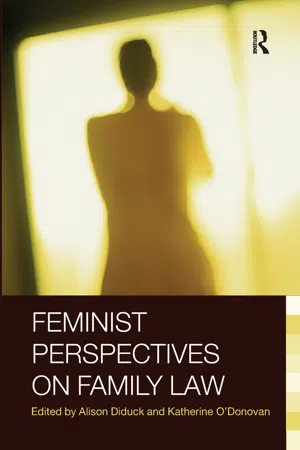
Examining specific areas of family law from a feminist perspective, this book assesses the impact that feminism has had upon family law. It is deliberately broad in scope, as it takes the view that family law cannot be defined in a traditional way. In addition to issues of long-standing concern for feminists, it explores issues of current legal and political preoccupation such as civil partnerships, home-sharing, reproductive technologies and new initiatives in regulating family practices through criminal law, including domestic violence and youth justice.
- 284 pages
- English
- ePUB (mobile friendly)
- Available on iOS & Android
eBook - ePub
Feminist Perspectives on Family Law
Chapter 1
Feminism and Families: Plus Ça Change?
Introduction
While feminist perspectives on all areas of life and law are crucial to achieve a just, nuanced and comprehensive understanding of them, some might think that the family and family law are the first, or at least most obvious, places to start. After all, feminism is concerned to ask questions about the lives of women, and the lives of women have traditionally centred upon their families. In fact, feminist perspectives have been offered upon family relations since a recognised feminist movement began centuries ago. From these, its ‘first waves’, the feminist movement was concerned, among other things, to secure not only women’s political equality with men, but also women’s (special) rights to custody of their children; the second wave’s campaigns in the mid-twentieth century to promote women’s financial self-sufficiency and independence from men also aimed to reveal an ideology of the family that inhibited that goal. Family relations and family law have thus always been as important to women, and therefore to feminism, as have claims to civil, political or legal rights. And importantly, in always asking the ‘woman question’ and thus rendering both visible and valuable the concerns of women in law, feminist legal theory has also been able to link family law and family relations to women’s abilities to make those claims.
Of course, family relations and family law have always been important to men and children also and to their political status, economic activity and claims to citizenship and rights, and it is a feminist perspective that has made this link explicit. The importance of feminist perspectives on family law, therefore, is to bring to light the ways in which the legal regulation of private, family relations are also about the regulation of social and political relations; they are about the nature and value of dependence and independence, about the balance of social and economic power and about the part that law plays in this regulation. A feminist perspective emphasises the personal as political, and, born as it was of feminist activism, feminist theory is also about the possibility of the transformation or reconstruction of both.
The contributions to this collection about family law are thus feminist in orientation or character not because they necessarily agree about the advantages or disadvantages of, or the causes of or solutions to, gendered living, but because they explore the ways in which law is implicated in that living. And they adopt a range of feminist methodologies to do so. Method, as Maleiha Malik1 points out, is critical. Feminist methods are about critique: they aim to disrupt; to question; to render problematic the ‘objective’, the ‘neutral’ and the ‘normal’. Feminist perspectives challenge not only law’s claims to objectivity and liberalism’s foundational claims of autonomy2 and equality,3 but also legal and social norms4 and the forms of reasoning that sustain them.5 Like other feminist work, there is a breadth to the writings here. Some of the chapters draw on traditional legal sources such as cases and statutes; others look to government position papers and parliamentary discussion; yet others are based on interview material and the internet. Contributors adopt conceptual feminist methods,6 hermeneutic methods,7 queer theory,8 discourse analysis,9 empirical analysis,10 critique,11 futurology12 and social policy analysis.13 Sometimes they discover that law is amenable to feminist disruption and critique, but often they uncover its resistance and the difficulties that resistance creates in the day-to-day family lives – the family practices14 – of individual men, women and children.15
The perspectives offered in this book can also be called feminist because they address one or more of the themes that many scholars of family law have identified as currently important in transforming the lived reality or material effects of gendered family living.16 The changing landscapes of family, of feminism and of law mean that the concerns of the twenty-first century are different from those of other times, as are the conceptual and practical tools with which we can engage with them. In the 1970s, campaigns for ‘wages for housework’, questions like ‘why be a wife?’, or references to ‘the rapist who pays the rent’ generated a long moment of challenge to gendered conceptions of family, self and society. Although this challenge was initially directed at perceived male dominance and at the silence and invisibility of women, both sexes came under scrutiny, which led to analyses of dominant and accepted norms in family and personal life.
Different concerns dominated the 1980s. A form of ‘pro-family’ feminism came to celebrate gender differentiation, including women’s roles as mothers. Elements of this pro-familialism remain today, with the expression by some women of a ‘you can’t have it all’ philosophy once they become mothers. Indeed, there is something almost unfashionable for many young women today about the claims their mothers made, and it is feminism that is often blamed for creating unreal expectations for women who try to live their family lives differently, perhaps by ‘having it all’ and combining paid work with family work.17
In contemporary times, questions of labour and political economy and ‘who does care and caring?’ remain as material as they were twenty or even forty years ago, but feminist theory has also raised new questions. Focus is now also on the ways in which both concepts and material realities are constructed or given meaning, so that previously taken-for-granted concepts like autonomy, rationality, justice, or sex/gender can themselves be unsettled.
Feminist engagements with law and policy have also undergone a form of self-reflection or self-interrogation. While nineteenth- and early twentieth-century feminists relied firmly on the authority of law to effect social and political change, formal law’s centrality in maintaining the gender order seems no longer to be so clear.18 To modern feminists, law is still important, but even it must be redefined, and it must be analysed in terms of the part it plays in conjunction with other regimes or ‘discourses’ to regulate our familial and gendered lives.
As a result of the work of feminists in all of these times we have been able to bring to light not only inequalities at the material and symbolic levels of the private, but also their spillover effects into politics, paid work and public life in general; the terms of the debates in politics, in fiscal and social policy and in the labour movement have shifted accordingly. We can now ask, for example, if it is the structure of the labour market or, as Ann Mumford19 suggests, the tax and benefit system, rather than the individual choices of women, which means they ‘can’t have it all’, and we can also ask how we contribute in our day-to-day performance of gender to its material effects.20 This shift, we argue, this legitimation of previously unvoiced and unvoiceable concerns and observations, can be counted as another of feminism’s success stories in the family law field.21
We have also become able to redraw the boundaries around ways of thinking about ourselves and the ways we live. Contributors here, for example, illustrate the importance of entirely new ways of thinking about intimate and affective connections in their proposal for a new paradigm from which questions can be posed about relationships of care and support.22 Even apart from the question of why the dyadic relationship is privileged over others, Anne Bottomley and Simone Wong23 and Carl Stychin24 ask: ‘When does a couple become a shared household and when does a shared household become a couple?’ For our purposes, we could also ask ‘when do they each become a “family?” ’ and, for this question, we could also draw upon Caroline Jones’s25 and Emily Jackson’s26 challenging of the ‘naturalness’ of parenthood. In the twenty-first century, the meaning, value and politics of terms such as ‘couple’, ‘parent’ and ‘family’ lend themselves to feminist scrutiny and challenge.
The terms of the legal ...
Table of contents
- List of Contributors
- Acknowledgments
- Contents
- Table of Cases
- Chapter 1 Feminism and Families: Plus Ça Change?
- Chapter 2 Family Friendly? Rights, Responsibilities and Relationship Recognition
- Chapter 3 Shared Households: A New Paradigm for Thinking about the Reform of Domestic Property Relations
- Chapter 4 What Is a Parent?
- Chapter 5 Parents in Law: Subjective Impacts and Status Implications around the Use of Licensed Donor Insemination
- Chapter 6 After Birth: Decisions about Becoming a Mother
- Chapter 7 The Ethic of Justice Strikes Back: Changing Narratives of Fatherhood
- Chapter 8 Domestic Violence, Men’s Groups and the Equivalence Argument
- Chapter 9 Feminist Perspectives on Youth Justice
- Chapter 10 Working towards Credit for Parenting: A Consideration of Tax Credits as a Feminist Enterprise
- Chapter 11 ‘The Branch on Which We Sit’: Multiculturalism, Minority Women and Family Law
- Chapter 12 Feminist Legal Studies and the Subject(s) of Men: Questions of Text, Terrain and Context in the Politics of Family Law and Gender
- Index
Trusted by 375,005 students
Access to over 1.5 million titles for a fair monthly price.
Study more efficiently using our study tools.
Frequently asked questions
Yes, you can cancel anytime from the Subscription tab in your account settings on the Perlego website. Your subscription will stay active until the end of your current billing period. Learn how to cancel your subscription
No, books cannot be downloaded as external files, such as PDFs, for use outside of Perlego. However, you can download books within the Perlego app for offline reading on mobile or tablet. Learn how to download books offline
We are an online textbook subscription service, where you can get access to an entire online library for less than the price of a single book per month. With over 1.5 million books across 990+ topics, we’ve got you covered! Learn about our mission
Look out for the read-aloud symbol on your next book to see if you can listen to it. The read-aloud tool reads text aloud for you, highlighting the text as it is being read. You can pause it, speed it up and slow it down. Learn more about Read Aloud
Yes! You can use the Perlego app on both iOS and Android devices to read anytime, anywhere — even offline. Perfect for commutes or when you’re on the go.
Please note we cannot support devices running on iOS 13 and Android 7 or earlier. Learn more about using the app
Please note we cannot support devices running on iOS 13 and Android 7 or earlier. Learn more about using the app
Yes, you can access Feminist Perspectives on Family Law by Alison Diduck,Katherine O'Donovan in PDF and/or ePUB format, as well as other popular books in Law & Civil Law. We have over 1.5 million books available in our catalogue for you to explore.