Based on a study examining the meaning of the term "media literacy" in children, this volume concentrates on audiovisual narratives of television and film and their effects. It closely examines children's concepts of real and unreal and how they learn to make distinctions between the two. It also explores the idea that children are protected from the harmful effects of violence on television by the knowledge that what they see is not real.
This volume is unique in its use of children's own words to explore their awareness of the submerged conventions of television genres, of their functions and effects, of their relationship to the real world, and of how this awareness varies with age and other factors. Based on detailed questionnaire data and conversations with 6 to 11-year-old children, carried out with the support of a fellowship at the Annenberg School for Communication, University of Pennsylvania, the book eloquently demonstrates how children use their knowledge of real life, of literature, and of art, in intelligently evaluating the relationship between television's formats, and the real world in which they live.
eBook - ePub
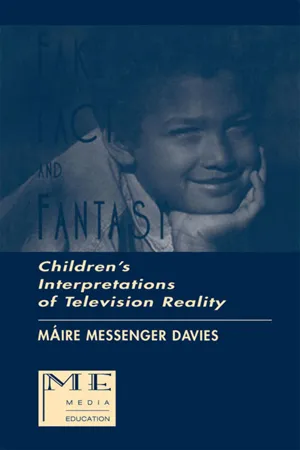
Fake, Fact, and Fantasy
Children's Interpretations of Television Reality
- 256 pages
- English
- ePUB (mobile friendly)
- Available on iOS & Android
eBook - ePub
About this book
Information
1
The Mediated World: The Uses of Media Literacy
“Is that a real train?”
(Small boy, aged about three, to his mother, as they stood on a suburban station platform, watching the London train approach.)
What idea of a train was in this little boy’s mind when he asked this question? The question implied that the little boy had some conception of “unreal” trains against which he was comparing this one. Would this conception of real/unreal be based on experience of pictures? Or stories? Or fantasy play? Or television, or film, or toys, all of which, as an urban child in the 1990s, he would have had experience of? Perhaps this little boy was comparing the oncoming train to a toy train; or he might have been thinking of a televised train like Thomas the Tank Engine. Both have elements of reality and unreality; for instance, you can play with one, but not with the other. On the other hand, Thomas the Tank Engine, although it only appears in the flat, pictorial world of television, moves by itself and has properly scaled human figures walking round it. The train in the distance obviously raised some of these questions in this toddler’s mind.
VISUAL LITERACY
Perhaps the oncoming London train presented a perceptual problem of perspective to the little boy. Perhaps, in the distance, it looked as small as a toy, or as flat as a picture to him. It did not to me, but then, I do not consciously notice things like perspective any more. I long ago internalized the habit of using depth and distance cues to assess the size and proximity of objects, probably when I was a baby. Recognizing the artificial techniques of representing distance in a picture is different, though. I distinctly remember the first time I noticed the artistic technique of perspective. I was six years old and there was a poster on the wall of my school classroom with a representation of a path converging to a point on the horizon. I realized that if I wanted to make my drawings of paths look “real,” I had to draw converging lines, like an upturned V, instead of parallel ones. I was very proud of my discovery and all my own drawings from then on had upturned-V paths in them. Later I realized that a lot of other people had already made this discovery, and even later, to my surprise, I found out that artistic perspective was not just something to be stumbled upon; it was also the product of an early form of artistic technology; artists like Leonardo had used special gadgets to view distant scenes and to mathematically represent the relationship between objects in space on the canvas.
This raises the question of whether we understand the artistic techniques by which real-life distance and dimensions are artificially represented through inborn instinct, or whether this knowledge has to be acquired through cultural experience and education. As in my case, it is probably a little of both. But artistic perspective does seem to be unique to certain kinds of culture and not to others, as Paul Messaris’ 1994 book, Visual Literacy, discussed. Messaris did not believe that this is because different cultures have fundamentally different ways of seeing things. He argued that the perceptual processes we use in working out the shape, nearness, and relationship of objects in the real world are the same abilities that we use in interpreting pictures. Hence, he proposed, even people unfamiliar with perspective ought to be able to make sense of it, just as people who have grown up in totally flat landscapes can still work out what a mountain or a tall building is.
This raises the further question of whether people have to be taught to be visually literate. Despite the fact that we use our eyes quite efficiently to interpret visual information every moment of our waking lives, the term visual literacy implies that there are some visual techniques we cannot master without help.
The use of the term literacy when applied to print is comparatively uncontentious. Reading and writing are rare skills, which most of us cannot acquire on our own. To acquire them, we need access to written materials, and we have to be taught how to make sense of these materials. The printed word, as Messaris pointed out, has only an arbitrary relationship to meaning. Hence it is difficult for an untaught person to work out the relationship between the abstract markings on a page and spoken language (which, of course, is arbitrary too, in that there is no intrinsic relationship between sound and sense). The comparative rarity and specialization of print literacy has made it culturally valuable; literacy means power. Spoken language, on the other hand, can be mastered by anybody by the time they are four or so, no matter how low-class or uncivilized they are. This very much reduces the cultural value of oral traditions; if any ignorant peasant can do it, it cannot be very special, can it? And visual literacy? Or media literacy? What is special about them? Why, and how, should we have to be taught to make sense of pictures or, even more vaguely, of media? Media could mean anything from huge broadcasting institutions and the way they are run and financed, to the use of your fingers to write messages in the sand. How does anyone become media-literate? Do we pick up our knowledge of modern audiovisual media automatically from exposure to them, or does acquiring this knowledge require rare and special skills, like reading print, which we have to be taught?
NATURE AND NURTURE
The nature/nurture argument, of which the debate about whether children have to be taught to ‘read’ television is a recent offshoot, has long-standing political implications; human abilities that seem to be natural are often undervalued, whereas skills that are laboriously acquired by small groups of people, end up labeled as “elite,” and can earn great rewards. Clearly, any type of information that can attach the title “literacy” to itself, can make claims for being special—for being included in the school curriculum, for instance, and acquiring budgets and personnel. The politics of the argument can obscure the commonsense fact that, for young children, it is an irrelevant argument. All human skills require both natural ability and environmental encouragement in the form of budgets and personnel, and this is particularly evident in the skills of symbolic representation, of which spoken language is an excellent example.
The little boy on the station, in common with 3-year-olds all over the world, was able to speak in sentences. Reaching this stage of linguistic development around the third year of life seems to be universal, which suggests that it is biologically programmed (Lenneberg, 1967). However, the little boy’s language was English, his accent was pure Cockney, and his knowledge of real trains probably came from travel, all of which could only be the result of local and specific cultural experiences. Furthermore, his question was addressed to his mother in the confident knowledge that she would hear, understand, and answer; without her, or somebody like her, he could not have reached such a sophisticated stage of linguistic development so young.
Children are born with an innate human capacity to learn. They also need to learn to understand the world in which they live, including the way that it is represented in different symbolic forms. These vary, depending on when and where we live, and each generation of children has to come to terms with these variations. Some of the skills of making sense of symbolic representation can be picked up by children, so long as they have access to such representations. (My “discovery” of perspective is an example.) But literacy in its widest sense requires learned and taught skills. Literacy, in the sense in which it is increasingly used today, is about enabling the developing child to understand and use the many abstract systems underpinning the various representations of the real world with which he or she is surrounded: the printed word; logic; mathematics; scientific models; musical harmony; computer languages; visual displays; artistic structures of various kinds, including the ‘realistic’ audiovisual narratives of television and film.
All these structures have some relationship with the real world. The connection may be arbitrary, as in the case of written language, where we have to be taught to understand the link between the mysterious grouping of letters in the word C-A-T, as it appears in a young child’s picture book, and the furry animal which says “miaow.” Or the relationship may be more directly representational and iconic, as in the case of the photograph of the cat on the facing page in the book. A baby can identify the picture, but not the word, which suggests that visual literacy comes a lot more easily and naturally than does print literacy. However, even in photographs and realistic paintings, the relationship between a real-world object and its representation is never direct. As the grammatical transformations of speech—negations, tenses, emphases—signal different versions of meaning, so objects, people, and experiences in the real world also go through a series of transformations in the process of being translated into an artistic or media representation. It is these transformations, and children’s awareness of them, that are discussed in this book.
The book is concerned particularly with the audiovisual narratives of television and film. It is a fundamental premise of the book—borne out by the research described in it—that the “realism” of film and television genres is only apparent. The naturalistic qualities of soap opera, situation comedy, and children’s drama, as well as the “real” people and events in non-fiction programs such as TV news, are the product of a great deal of human artifice, and they operate according to rules and conventions quite as complex as the five-act structure of Jacobean drama or the sculptured representations of history in the friezes on the Parthenon. Unlike these examples, which thanks to the passing of time, we can all recognize as Art, or Culture, to be analyzed and appreciated, the daily conventions of television programs are so familiar, domesticated, and naturalized as to appear more like life than like art. Even adult critics talk about television fiction as if it were really happening; the cartoon characters, the Simpsons, for example, are often described as a dysfunctional family. Nevertheless, even the youngest viewers have some sense of the artifice of television, and older children have much more interesting ideas about the medium than are generally discussed. It was to explore children’s awareness of the submerged conventions of television genres, of their functions and perceived effects, of their relationship to the real world, and of how this awareness varies with age and other factors, that the study described in this book was carried out.
THE REAL WORLD
For the modern child, brought up from babyhood with apparently realistic representations of recognizable people talking to her from a box in the corner, a knowledge of the rules of different representational systems, whether picked up or taught in media education classes, is only half the story. To be truly literate, the modern child also needs to have a body of knowledge about the real world, against which the various symbolic representations of it can be measured. The relationship between the real and the represented (or mediated) is probably the central intellectual question for a late 20th century child, as my 3-year-old friend on the station correctly realized. Any assessment of children’s media literacy has to be concerned with their understandings of the relationship between the real and the representational.
MASS PRODUCED CULTURE: A CAUSE FOR PESSIMISM?
The cultural products of the Western world in the last half of this century, and the myriad ways in which the reality of the world is represented or mediated are greater and more accessible for young children now than they have ever been. From the time-honored picture book, now using high-definition photographs, through television, computer games, and virtual reality, visual and audiovisual representations of the world have become more and more sophisticated, more and more like the real thing, and more and more pervasive. Furthermore, as children in industrialized societies lose their freedom to walk the streets and fields, these mediated forms are an increasingly important source of information for them about the outside world.
There are those who view these developments with pessimism. Cultural commentators such as George Gerbner and Neil Postman lament the fact that young human beings no longer receive their cultural products from their own communities, but from mass-produced entertainment, provided for them by huge commercial organizations whose primary concern is profit. There is something sad to those of us who grew up in the (just) pre-TV age, about the thought that children prefer to sing commercial jingles, or the songs from a Disney movie, rather than old nursery rhymes (many of which were adult products, often referring to topics not at all suitable for children—Georgie Porgie for instance.) Stories about children not being allowed to walk to school by themselves, or having to be taught playground games by grown-ups are certainly depressing. There is much adult concern, too, about the realistic violence that children are able to see on television and video. Some people are concerned about this because they believe that children do not know the difference between reality and fantasy on TV, and, therefore, are more likely to be harmed by it. Others argue that children do know the difference between TV fantasy and reality, or can be taught about it, and, hence, can be protected against harmful effects. The idea that knowing that something is unreal protects us from harmful effects needs to be critically examined, and this is one of the lines of inquiry described in this book.
I tend to line up with the cultural optimists on these questions, not because I approve of exposing children (even those who know the difference between reality and fantasy) to exotic and realistic media representations of torture: I do not. My optimism comes from my respect for the developing human organism and its huge capacity for adaptive learning. Evolution has programmed human children to be flexible, adaptable, and competent learners, so that they can accommodate themselves to whatever conditions of society in which they happen to find themselves. Such conditions are very various, and they have never been perfect. But given a very few essential requirements—food, shelter, love—and reasonably stable social arrangements in which adults can provide these things, human children will usually grow up into competent adults. Human children as a breed are not pessimistic at all. They want and need to learn, and the world is an interesting place to them because of the opportunities for learning it presents. We adults may be nervous about computers. Six-year-olds are not.
THE CHALLENGE OF MODERN MEDIA
How do children adapt to, and learn from, modern media? What do mediated representations such as television and film mean to them? Children need to work out the relationship between the real world of their own experience and the mediated world they see on TV, in films, in pictures, and increasingly nowadays, on computer screens, and we need to know what strategies they use to do this. It is particularly important for them to have ways of deciding what to believe of what they see and hear. Modern media offer a bewildering variety of cues about what is reliable information and what is not. For instance, TV news presenters routinely address the camera, whereas actors in a drama almost never do; facing the camera is, thus, a reality (or, to use a linguistics term that recurs in this book, a modality) cue about whether a program is fact or fiction.
Many researchers and teachers are interested in how and when young children learn these cues. Do they learn them by themselves? Or are they duped by the clever techniques of directors and editors into believing things that are not true, or that are not good for them? Does this matter? After all, most traditional culture and art forms—paintings, sculptures, plays, operas, novels, poetry—which we adults tend to think of as good, are designed to deceive us, too. Of course, there are other pleasures and truths that we can gain in the process of yielding to these deceptions, of willingly suspending our disbelief, as the poet Samuel Taylor Coleridge put it. But deceiving children is somehow seen as especially wrong, in a way that is less often applied to adult media and culture; the young, as critics since Plato have been reminding us, are supposed to be told the truth. But is reality the same as truth, and is being seen as real the only criterion for judging something’s value? What do children themselves think?
The research described in this book addresses some of these questions by asking children themselves about their reality, or modality, judgments about different kinds of television and exploring their reasons for these judgments. Despite the increasing proliferation of new media like computers and interactive technology, which raise interesting new questions about literacy, I concentrate on television for two reasons: First, it is still the most pervasive and popular form of entertainment and leisure-time activity in the industrialized world, for both children and adults. Second, and more importantly from the perspective of an interest in literacy, television, particularly the kinds of popular drama enjoyed by children, has deep roots in literature. The link between literacy and literature is not only etymological but cultural. The definition of television adopted in this study is not that of a “one-eyed monster” or a “plug-in drug”—to quote some of the wilder adult fantasies about it—but of a body of literature to which children are regularly exposed.
The study is an attempt to explore more deeply some of children’s ideas about the medium of television and how it works: its messages; its artifice; its techniques; its aims; its effects; its usefulness to themselves and to other children. These are children’s views. They are different from adults’ views. I hope that they help to develop some fuller answers to the question posed at the beginning of this chapter. When a child asks whether something is real or not, the first question an adult needs to ask is, What do you mean by real?
Table of contents
- Cover
- Title page
- Copyright
- Contents
- Dedication
- Preface
- 1 The Mediated World: The Uses of Media Literacy
- 2 The Real World—and the Real Child
- 3 Reality Perception on TV
- 4 Formal Features, Literature, Art, and Education
- 5 The Sample and the Study
- 6 The Interview Methodology: Recognizing the Not Real
- 7 “A Show for Little Kids”: Sesame Street
- 8 “Everyone is Talking About Ross Perot”: Real News for Kids
- 9 “A Comedy Fiction Type of Thing”: The Cosby Show
- 10 “It’s Supposed to Be a Fairytale”: The Sand Fairy
- 11 Modality: Conversations About the Relationship of Art to Life
- 12 “Charming Our Leisure”: Why Media Matter
- References
- Appendix A: Questionnaire for First and Second Graders
- Appendix B: Questionnaire for Third, Fourth, and Fifth Graders
- Appendix C: Sample Interview Transcript, First Grade Boy
- Appendix D: Sample Interview Transcript, First Grade Girl
- Appendix E: Sample Interview Transcript, Third Grade Boy
- Appendix F: Sample Interview Transcript, Fourth Grade Girl
- Appendix G: Sample Interview Transcript, Fifth Grade Boy
- Appendix H: Interview Schedule
- Notes
- Author Index
- Subject Index
Trusted by 375,005 students
Access to over 1.5 million titles for a fair monthly price.
Study more efficiently using our study tools.
Frequently asked questions
Yes, you can cancel anytime from the Subscription tab in your account settings on the Perlego website. Your subscription will stay active until the end of your current billing period. Learn how to cancel your subscription
No, books cannot be downloaded as external files, such as PDFs, for use outside of Perlego. However, you can download books within the Perlego app for offline reading on mobile or tablet. Learn how to download books offline
Perlego offers two plans: Essential and Complete
- Essential is ideal for learners and professionals who enjoy exploring a wide range of subjects. Access the Essential Library with 800,000+ trusted titles and best-sellers across business, personal growth, and the humanities. Includes unlimited reading time and Standard Read Aloud voice.
- Complete: Perfect for advanced learners and researchers needing full, unrestricted access. Unlock 1.5M+ books across hundreds of subjects, including academic and specialized titles. The Complete Plan also includes advanced features like Premium Read Aloud and Research Assistant.
We are an online textbook subscription service, where you can get access to an entire online library for less than the price of a single book per month. With over 1.5 million books across 990+ topics, we’ve got you covered! Learn about our mission
Look out for the read-aloud symbol on your next book to see if you can listen to it. The read-aloud tool reads text aloud for you, highlighting the text as it is being read. You can pause it, speed it up and slow it down. Learn more about Read Aloud
Yes! You can use the Perlego app on both iOS and Android devices to read anytime, anywhere — even offline. Perfect for commutes or when you’re on the go.
Please note we cannot support devices running on iOS 13 and Android 7 or earlier. Learn more about using the app
Please note we cannot support devices running on iOS 13 and Android 7 or earlier. Learn more about using the app
Yes, you can access Fake, Fact, and Fantasy by Maire Messenger Davies in PDF and/or ePUB format, as well as other popular books in Social Sciences & Developmental Psychology. We have over 1.5 million books available in our catalogue for you to explore.