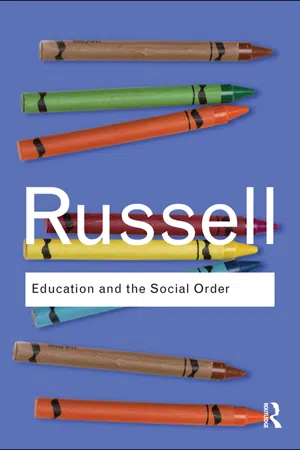
Bertrand Russell was renowned for his provocative views on education. Considered an educational innovator, Russell attempted to create the perfect learning institution. Despite the failure of this practical vision, it did not stop him from continuing to strive towards inventing and arguing for a system of education free from repression. In Education and the Social Order, Russell dissects the motives behind educational theory and practice, and in doing so lays out original and controversial arguments for the reformation of the education of the individual.
- 186 pages
- English
- ePUB (mobile friendly)
- Available on iOS & Android
eBook - ePub
Education and the Social Order
About this book
Information
1
THE INDIVIDUAL VERSUS THE CITIZEN
That education is desirable is the opinion of all modern civilised States, but is, nevertheless, a proposition which has at all times been disputed by some men whose judgement commands respect. Those who oppose education do so on the ground that it cannot achieve its professed objects. Before we can adequately examine their opinion, we must, therefore, decide what it is that we should wish education to accomplish if possible: on this question there are as many divergent views as there are conceptions of human welfare. But there is one great temperamental cleavage which goes deeper than any of the other controversies, and that is the cleavage between those who consider education primarily in relation to the individual psyche, and those who consider it in relation to the community.
Assuming (as will be argued in the next chapter) that education should do something to afford a training and not merely to prevent impediments to growth, the question arises whether education should train good individuals or good citizens. It may be said, and it would be said by any person of Hegelian tendencies, that there can be no antithesis between the good citizen and the good individual. The good individual is he who ministers to the good of the whole, and the good of the whole is a pattern made up of the goods of individuals. As an ultimate metaphysical truth I am not prepared either to combat or to support this thesis, but in practical daily life the education which results from regarding a child as an individual is very different from that which results from regarding him as a future citizen. The cultivation of the individual mind is not, on the face of it, the same thing as the production of a useful citizen. Goethe, for example, was a less useful citizen than James Watt, but as an individual must be reckoned superior. There is such a thing as the good of the individual as distinct from a little fraction of the good of the community. Different people have different conceptions of what constitutes the good of the individual, and I have no wish to argue with those who take a view different from my own. But whatever view may be taken, it is difficult to deny that the cultivation of the individual and the training of the citizen are different things.
What constitutes the good of the individual? I will try to give my own answer without in any way suggesting that others should agree with me.
First and foremost, the individual, like Leibniz’s monads, should mirror the world. Why? I cannot say why, except that knowledge and comprehensiveness appear to me glorious attributes, in virtue of which I prefer Newton to an oyster. The man who holds concentrated and sparkling within his own mind, as within a camera obscura, the depths of space, the evolution of the sun and planets, the geological ages of the earth, and the brief history of humanity, appears to me to be doing what is distinctively human and what adds most to the diversified spectacle of nature. I would not abate this view even if it should prove, as much of modern physics seems to suggest, that the depths of space and the ‘dark backward and abysm of time’ were only coefficients in the mathematician’s equations. For in that case man becomes even more remarkable as the inventor of the starry heavens and the ages of cosmic antiquity: what he loses in knowledge he gains in imagination.
But while the cognitive part of man is the basis of his excellence, it is far from being the whole of it. It is not enough to mirror the world. It should be mirrored with emotion: a specific emotion appropriate to the object, and a general joy in the mere act of knowing. But knowing and feeling together are still not enough for the complete human being. In this world of flux men bear their part as causes of change, and in the consciousness of themselves as causes they exercise will and become aware of power. Knowledge, emotion, and power, all these should be widened to the utmost in seeking the perfection of the human being. Power, Wisdom, and Love, according to traditional theology, are the respective attributes of the Three Persons of the Trinity, and in this respect at any rate man made God in his own image.
In this we are thinking of man as an individual. We are considering him as he has been considered by Buddhists, Stoics, Christian saints, and all mystics. The elements of knowledge and emotion in the perfect individual as we have been portraying him are not essentially social. It is only through the will and through the exercise of power that the individual whom we have been imagining becomes an effective member of the community. And even so the only place which the will, as such, can give to a man is that of dictator. The will of the individual considered in isolation is the god-like will which says ‘let such things be’. The attitude of the citizen is a very different one. He is aware that his will is not the only one in the world, and he is concerned, in one way or another, to bring harmony out of the conflicting wills that exist within his community. The individual as such is self-subsistent, while the citizen is essentially circumscribed by his neighbours. With the exception of Robinson Crusoe we are of course all in fact citizens, and education must take account of this fact. But it may be held that we shall ultimately be better citizens if we are first aware of all our potentialities as individuals before we descend to the compromises and practical acquiescences of the political life. The fundamental characteristic of the citizen is that he co-operates, in intention if not in fact. Now the man who wishes to co-operate, unless he is one of exceptional powers, will look about for some ready-made purpose with which to co-operate. Only a man of very exceptional greatness can conceive in solitude a purpose in which it would be well for men to co-operate, and having conceived it can persuade men to follow him. There have been such men. Pythagoras thought it well to study geometry, for which every schoolboy to this day has reason to curse him. But this solitary and creative form of citizenship is rare, and is not likely to be produced by an education designed for the training of citizens. Citizens as conceived by governments are persons who admire the status quo and are prepared to exert themselves for its preservation. Oddly enough, while all governments aim at producing men of this type to the exclusion of all other types, their heroes in the past are of exactly the sort that they aim at preventing in the present. Americans admire George Washing-ton and Jefferson, but imprison those who share their political opinions. The English admire Boadicea, whom they would treat exactly as the Romans did if she were to appear in modern India. All the Western nations admire Christ, who would certainly be suspect to Scotland Yard if He lived now, and would be refused American citizenship on account of His unwillingness to bear arms. This illustrates the ways in which citizenship as an ideal is inadequate, for as an ideal it involves an absence of creativeness, and a willingness to acquiesce in the powers that be, whether oligarchic or democratic, which is contrary to what is characteristic of the greatest men, and tends, if over-emphasised, to prevent ordinary men from attaining the greatness of which they are capable.
I do not mean to be understood as an advocate of rebellion. Rebellion in itself is no better than acquiescence in itself, since it is equally determined by relation to what is outside ourselves rather than by a purely personal judgement of value. Whether rebellion is to be praised or deprecated depends upon that against which a person rebels, but there should be the possibility of rebellion on occasion, and not only a blind acquiescence produced by a rigid education in conformity. And what is perhaps more important than either rebellion or acquiescence, there should be the capacity to strike out a wholly new line, as was done by Pythagoras when he invented the study of geometry.
The issue between citizenship and individuality is important in education, in politics, in ethics, and in metaphysics. In education it has a comparatively simple practical aspect, which can be to some degree considered apart from the theoretical issue. The education of the young of a whole community is an expensive business, which, in the main, is bound to fall to the lot of the State. The only other organisation sufficiently interested in form-ing the minds of the young to have any really important share in education is the Church. The purpose of the State is, of course, to train citizens. For certain historical reasons, this purpose is as yet considerably mitigated by tradition. In the Middle Ages education meant the education of the priest. From the Renaissance until recent times it meant the education of a gentleman. Under the influence of snobbish democracy, it has come to mean an education which makes a man seem like a gentleman. Many things of little utility to the citizen as such are taught in schools, with a view to making the scholars genteel. Other elements in education remain from the ecclesiastical tradition of the Middle Ages, of which the purpose was to enable a man to apprehend the ways of God. Gentility and godliness are attributes of the individual rather than of the citizen. The Christian religion as a whole is a religion of the individual, owing to the fact that it arose among men destitute of political power. It is concerned primarily with the relation of the soul to God; and while it considers the relation of a man to his neighbour, it considers it as resulting from the man’s own emotions, not from laws and social institutions.
The political element in Christianity, as it exists at the present day, came in with Constantine. Before his day it was the Christian’s duty to disobey the State, while since his day it has, as a rule and in the main, been the Christian’s duty to obey the State. The anarchic origin of Christianity has, however, left a leaven which has led, throughout its history, to revivals of the primitive attitude of disobedience. The Cathari, the Albigenses, the Spiritual Franciscans, all in their various ways rejected authority in favour of the inner light. Protestantism began in a revolt against authority, and has never found any logical justification for such exercise of theological jurisdiction as it has been inclined to claim after it had acquired control of the government. Consequently, Protestantism has been driven by an inner logic to the acceptance of religious toleration, a view which Catholicism has never adopted in theory, and has only accepted in practice for reasons of temporary convenience. In this, Catholicism represents the tradition of the Roman Emperor, while Protestantism has reverted to the individualism of the Apostles and the Early Fathers.
Religions may be divided into those that are political and those that concern the individual soul. Confucianism is a political religion: Confucius, as he wandered from court to court, became concerned essentially with the problem of government, and with the instilling of such virtues as to make good government easy. Buddhism, on the contrary, in spite of the fact that in its early days it was the religion of princes, is essentially nonpolitical. I do not mean that it has always remained so. In Tibet it is as political as the papacy, and in Japan I have met high Buddhist dignitaries who reminded me of English archdeacons. Nevertheless, the Buddhist, in his more religious moments, considers himself essentially as a solitary being. Islam, on the contrary, was from its very beginning a political religion. Mahomet made himself a ruler of men, and the caliphs who succeeded him remained so until the conclusion of the Great War. It is typical of the difference between Islam and Christianity that the caliph combined within himself both temporal and spiritual authority, which to a Mahometan are not distinct; whereas Christianity, by its non-political character, was led to create two rival politicians, namely, the Pope and the Emperor, of whom the former based his claims to temporal power upon the unimportance of secular rule. Communism, as it has developed in Russia, is a political religion analogous to Islam. It is, however, unavoidably influenced by Byzantine tradition; and there is a possibility that the Communist party may take the place of the Church, leaving the secular government to that degree of independence of ecclesiastical authority which it possessed before the Revolution. In this, as in other matters, Russia is divided between an Eastern and a Western mentality. In so far as Russia is Asiatic, the Communist party takes the place of the caliphate; while in so far as Russia is European, the Communist party takes the place of the Church.
The purpose of this bird’s eye view of the history of religions has been to suggest that the elements in current education which are concerned with individual culture are, in the main, products of tradition, and are likely to be more and more replaced by education in citizenship. Education in citizenship, if it is wise, can retain what was best in individual culture. But if it is in any way shortsighted, it will stunt the individual in order to make him a convenient tool of government. It is therefore important to realise the dangers inherent in the ideals of citizenship when narrowly conceived. Those who institute State systems of education will cause men to deteriorate, even as citizens, if they take a narrow view of what constitutes a good citizen. Only men of wide individual culture are capable of appreciating that individual culture has to contribute to citizenship. Unfortunately, in the present day, such men tend to be replaced more and more by men of executive ability, or by mere politicians who must be rewarded for their services.
An education of which the purpose is to make good citizens has two very different forms, according as it is directed to the support or to the overthrow of the existing system. It might be supposed, in view of the importance of the State in education, that education would be almost always directed to the support of the status quo. This, however, is not the case. Except in Russia, the influence of religion and of the middle class is sufficiently strong to cause a very large part of education to remain reactionary wherever Socialists have acquired power. On the other hand, before the French Revolution, and again before the Russian Revolution, education, while not widespread, was in the main anti-governmental. In the more backward parts of the United States at the present day there is a similar tendency. State Universities tend to teach, more or less unintentionally, doctrines which are repugnant to the ignorant farmers who pay the taxes on which the Universities live. The farmers, not unnaturally, think that those who pay the piper should call the tune, but when they cannot understand the piper, or know what tune he is playing, they find this a little difficult. But in spite of these exceptions, education in the modern world tends to be a reactionary force, supporting the government when it is conservative, and opposing it when it is progressive. Unfortunately, also, the elements of good citizenship which are emphasised in schools and Universities are the worst elements and not the best. What is emphasised most of all is patriotism in a somewhat militant form: that is to say a narrow devotion to the persons living in a certain area, as opposed to those living elsewhere, and willingness to further the interests of the persons in the chosen area by the use of military force. With regard to internal affairs, citizenship, as generally taught, perpetuates traditional injustices. The great majority of well-to-do young men, for example, felt patriotic during the General Strike when they acted as blacklegs. Hardly any of them had been so educated as to be able to conceive the case in favour of the strikers. Wherever an injustice exists, it is possible to invoke the ideal of legality and constitutionality in its support. Educators in every country except Russia tend to be constitutionally timid, and, either by their income or by their snobbery, to be adherents of the rich. On both grounds their teaching tends to over-emphasise the importance of the law and the constitution, although these give the past a paralysing hold over the present. By reaction against this over-emphasis, those who desire any radical improvement in the world are compelled to be revolutionary, and the revolu-tionary’s conception of duty to the community is liable to be just as narrow, and in the long run just as dangerous, as that of the advocate of law and order.
There are, however, certain respects in which the advocate of change is likely to give better education than the advocate of the status quo. Animal habit is sufficient by itself to make a man like the old ways, just as it makes a horse like to turn down a road which it usually turns down. None of the higher mental processes are required for conservatism. The advocate of change, on the contrary, must have a certain degree of imagination in order to be able to conceive of anything different from what exists. He must also have some power of judging the present from the standpoint of values, and, since he cannot well be unaware that the status quo has its advocates, he must realise that there are at least two views, which are possible for a sane human being. Moreover, he is not obliged to close his sympathies against the victims of existing cruelties, or to invent elaborate reasons to prove that easily preventable sufferings ought not to be prevented. Both intelligence and sympathy, therefore, tend to be less repressed by an education hostile to the status quo than by one which is friendly to it.
To this, however, there are certain limitations. Hostility to the status quo may be derived from either of two sources: it may spring from sympathy with the unfortunate or from hatred of the fortunate. If it springs from the latter, it involves just as much limitation of sympathy as is involved in conservatism. Many revolutionaries in their day-dreams are not so much concerned with the happiness that is to come to the common people as with the vengeance that they will be able to wreak upon the insolent holders of power from whom they are suffering in the present. On the intellectual side, again, there is a tendency for advocates of change to organise themselves into groups, welded together by a narrow orthodoxy, hating heresy, and viewing it as moral treachery in favour of prosperous sinners. Orthodoxy is the grave of intelligence, no matter what orthodoxy it may be. And in this respect the orthodoxy of the radical is no better than that of the reactionary.
One of the most important ways in which individual culture conflicts with the education of the citizen, narrowly conceived, is in respect of the scientific attitude towards doubtful questions. Science has developed a certain technique, which is essentially a technique of discovery, that is to say, of change. The scientific frame of mind is, broadly speaking, that which facilitates discovery, not that which causes a man to have an unwavering belief in the present tenets of science. A well-educated citizen is likely to be incapable of discovery, since he will respect his elders and betters, reverence the great men of the past generation, and look with horror upon all subversive doctrines. The modern State, which is built upon science, is therefore in a difficulty. Some States prefer unorthodox people who invent new explosives, others prefer that their young men should be orthodox, and should carry on the great traditions of the past. The Byzantines, when they could have purchased the help of the West by a few theological concessions, chose instead to preserve their orthodoxy, and suffered defeat at the hands of the Turk. Similarly, the British Admiralty, when faced with the terrible alternative of either listening to subversive young men or becoming obsolete through admiration of Nelson, prefers the latter alternative, whatever sufferings may be entailed by its reverence for the great traditions of our ancestors. So at least it is said by those who should know.
It is one of the contradictions of our time that science, which is the source of power, and more particularly of governmental power, depends for its advancement upon an essentially anarchic state of mind in the investigator. The scientific state of mind is neither sceptical nor dogmatic. The sceptic holds that the truth is undiscoverable, while the dogmatist holds that it is already discovered. The man of science holds that the truth is discoverable though not discovered, at any rate in the matters which he is investigating. But even to say that the truth is discoverable is to say rather more than the genuine man of science believes, since he does not conceive his discoveries as final and absolute, but as approximations subject to future correction. Absence of finality is of the essence of the scientific spirit. The beliefs of the man of science are therefore tentative and undogmatic. But in so far as they result from his own researches, they are personal, not social. They depend, that is to say, upon what he himself has ascertained by observation and inference, not upon what society considers it prudent for the good citizen to believe. This conflict between the scientific spirit and the governmental use of science is likely ultimately to bring scientific progress to a standstill, since scientific technique will be increasingly used to instil orthodoxy and credulity. If this is not to happen, it will be necessary that boys showing a certain degree of aptitude for science shall be exempted from the usual training in citizenship, and given a licence to think. Persons reaching a certain level in examinations will be allowed to place after their names the letters L.T., meaning ‘Licensed to Think’. Such persons shall thereafter never be disqualified from any post on the ground that they think their superiors fools.
Speaking more seriously, the whole conception of truth is one which is difficult to reconcile with the usual ideals of citizenship. It may, of course, be said, as is said by pragmatists, that the conception of truth in its traditional form has no validity, and that the truth is only what it is convenient to believe. If this be the case, truth can be determined by Act of Parliament. Leigh Hunt found it to be inconvenient to believe that the Prince Regent was fat, since this opinion caused him to be incarcerated. It follows that the Prince Regent was thin. It is difficult in such a case as this to accept the pragmatist’s philosophy. One can hardly resist the conviction that there is something objectively and absolutely true about the proposition that the Prince Regent was fat. I can, of course, imagine a large number of arguments designed to escape from this conclusion. The word ‘fat’ is a relative term. I remember that when the late Master of Christ’s, by no means a small man, found himself at dinner between two of the most eminent writers of our time, he remarked that he was having the unusual experience of feeling thin. Compared to some prize pigs the Prince Regent may have been thin. Therefore, in order to make Leigh Hunt’s statement accurate, it would be necessary to say that the Prince Regent belonged to the fattest one per cent of adult males, or some such statement as that. It would be possible to say: ‘the ratio of the Prince Regent’s weight to His Highness’s height exceeds that of all but one per cent of His Majesty’s adult male subjects.’ This statement might, of course, be on the margin of doubt, but if so it could be made quite certainly correct by substituting two per cent for one per cent. It cannot be seriously maintained that such a proposition is true because it is convenient to believe it, or becomes false through the fact that it is criminal to utter it. I have chosen an instance from a time more than a hundred years since, and one which no longer arouses political passion. But analogous matters of fact are at the present day of interest to governments, and there are still many propositions which no person of scientific mind can deny, but which no person who wishes to keep out of jail will utter. All the governments of the world adopt elaborate methods of concealing truths which they consider undesirable, and inflict various forms of penalty upon those who spread knowledge which is thought bad for the population. This applies especially to knowledge of the kind which is considered sedi-tious, and the kind which is considered obscene. I shall not give instances, since, if I did, I should myself fall under the ban of the law.
For the reasons which we have been considering, education in citizenship has grave dangers. Nevertheless, the argument in favour of some education designed to produce social cohesion is overwhelming.
The amenities of civilised life depend upon co-operation, and every increase in industrialism demands an increase in co-operation. China, for example, has all the requisites for prosperity and high culture, except the existence of a strong centralised government. Latin America, ever since it emancipated itself from Spain and Portugal, has been kept backward by the anarchic tendencies of its inhabitants. There is some evidence that the United States is preparing to follow the example of Latin America. Certai...
Table of contents
- Cover Page
- Title Page
- Copyright Page
- 1 The Individual versus the Citizen
- 2 The Negative Theory of Education
- 3 Education and Heredity
- 4 Emotion and Discipline
- 5 Home versus School
- 6 Aristocrats, Democrats, and Bureaucrats
- 7 The Herd in Education
- 8 Religion in Education
- 9 Sex in Education
- 10 Patriotism in Education
- 11 Class-feeling in Education
- 12 Competition in Education
- 13 Education under Communism
- 14 Education and Economics
- 15 Propaganda in Education
- 16 The Reconciliation of Individuality and Citizenship
Trusted by 375,005 students
Access to over 1.5 million titles for a fair monthly price.
Study more efficiently using our study tools.
Frequently asked questions
Yes, you can cancel anytime from the Subscription tab in your account settings on the Perlego website. Your subscription will stay active until the end of your current billing period. Learn how to cancel your subscription
No, books cannot be downloaded as external files, such as PDFs, for use outside of Perlego. However, you can download books within the Perlego app for offline reading on mobile or tablet. Learn how to download books offline
Perlego offers two plans: Essential and Complete
- Essential is ideal for learners and professionals who enjoy exploring a wide range of subjects. Access the Essential Library with 800,000+ trusted titles and best-sellers across business, personal growth, and the humanities. Includes unlimited reading time and Standard Read Aloud voice.
- Complete: Perfect for advanced learners and researchers needing full, unrestricted access. Unlock 1.5M+ books across hundreds of subjects, including academic and specialized titles. The Complete Plan also includes advanced features like Premium Read Aloud and Research Assistant.
We are an online textbook subscription service, where you can get access to an entire online library for less than the price of a single book per month. With over 1.5 million books across 990+ topics, we’ve got you covered! Learn about our mission
Look out for the read-aloud symbol on your next book to see if you can listen to it. The read-aloud tool reads text aloud for you, highlighting the text as it is being read. You can pause it, speed it up and slow it down. Learn more about Read Aloud
Yes! You can use the Perlego app on both iOS and Android devices to read anytime, anywhere — even offline. Perfect for commutes or when you’re on the go.
Please note we cannot support devices running on iOS 13 and Android 7 or earlier. Learn more about using the app
Please note we cannot support devices running on iOS 13 and Android 7 or earlier. Learn more about using the app
Yes, you can access Education and the Social Order by Bertrand Russell in PDF and/or ePUB format, as well as other popular books in Education & Education Theory & Practice. We have over 1.5 million books available in our catalogue for you to explore.