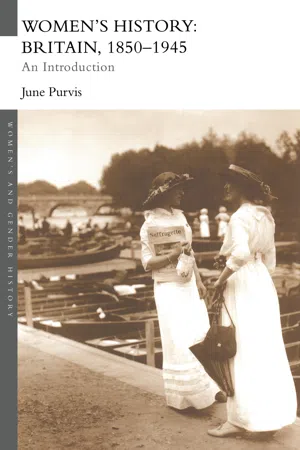
Women's History: Britain 1850-1945 introduces the main themes and debates of feminist history during this period of change, and brings together the findings of new research.
It examines the suffrage movement, race and empire, industrialisation, the impact of war and womens literature. Specialists in their own fields have each written a chapter on a key aspect of womens lives including health, the family, education, sexuality, work and politics. Each contribution provides an overview of the main issues and debates within each area and offers suggestions for further reading.
It not only provides an invaluable introduction to every aspect of womens participation in the political, social and economic history of Britain, but also brings the reader up to date with current historical thinking on the study of womens history itself.
- 352 pages
- English
- ePUB (mobile friendly)
- Available on iOS & Android
eBook - ePub
About this book
Information
Chapter One
From “women worthies” to poststructuralism? Debate and controversy in women’s history in Britain1
Introduction
In 1929, the well-known English essayist and novelist Virginia Woolf lamented the fact that so few histories of women had been written:
The history of England is the history of the male line, not of the female. Of our fathers we know always some fact, some distinction. They were soldiers or they were sailors; they filled that office or they made that law. But of our mothers, our grandmothers, our great-grandmothers, what remains?… We know nothing of their marriages and the number of children they bore.2
The printed works on women that Woolf might have consulted were few, despite the fact that in the nineteenth and early twentieth centuries in particular, there were a number of writers researching women’s past.3 Indeed, it was not until the 1970s that publications in women’s history became more numerous, and since then they have proliferated into a booming publishing field. My aim in this chapter is to offer a brief overview of the development of women’s history in Britain, from the nineteenth century to the 1990s, highlighting key concerns, debates and controversies.
Early work
It would appear that before the professionalisation of history in the nineteenth century, there were at least two main (and often overlapping) strands of women’s history—the lives of “women worthies” and the biography of an individual woman, often a political or religious figure of some importance. As Natalie Zemon Davis observes, the “women worthies” tradition had a polemical purpose, namely to reveal the range of women’s capacity, to provide exemplars for female readers, to argue from what some women had done to what “all could do, if given the chance and the education”.4 Not unexpectedly, this tradition often intertwined with the individual biography approach that focused much more on a woman within her society and culture, although even here the author did not necessarily seek to explain how her subject’s sex and gender as a woman might shape her expectations and public role.5
One such prominent nineteenth-century temperance writer and lecturer was Mrs Clara Lucas Balfour, who published a number of works with titles such as Working women of the last half century: the lessons of their lives and Women worth emulating.6 In her preface to the latter, she claimed that emulation was the spirit “most desirable to arouse in the young”. That which we approve and admire, she coaxed her readers, we are led to emulate: “The sterling qualities which made a character excellent, still more than the mental powers which made it remarkable, convey lessons for instruction and encouragement that all can apply”.7 It was with this purpose in mind that she selected various women of “womanly worth and wisdom” for the young of her own sex “in the hope that studious habits, intellectual pursuits, domestic industry, and sound religious principles, may be promoted and confirmed by such examples”.8 The women whose biographies she discussed include the scientist Mary Somerville, the astronomer Caroline Herschel, the hymn writer Charlotte Elliott, the authoress Amelia Opie and the philanthropic prison visitor Sarah Martin. What distinguished these women for Mrs Balfour was their humility and the acceptance of “traditional” feminine qualities, such as self-sacrifice. Sarah Martin, for example, although a “humble seamstress”,9 wished to be useful to God and became a well-known prison visitor in her home town of Great Yarmouth. “All workers in the Lord’s vineyard,” entreated Mrs Balfour, “can emulate her self-sacrifice, her diligence, her faith, her love, and thus live blessing and blessed”.10
Another prolific nineteenth-century writer in this genre was William H. Davenport Adams, producing books with such titles as Stories of the lives of noble women, Celebrated women travellers of the nineteenth century, and Some historic women or, biographical studies of women who have made history.11 In the latter, he claimed to bring together “a group of Celebrated Women, who might fairly be considered representative of the higher qualities of Womanhood,—such qualities as patriotism, religious enthusiasm, fidelity, moral courage, fortitude, devotion, and the capacity of governing”.12 Such qualities were frequently stressed in the many biographies of well-known women, such as the upper middle-class spinster Florence Nightingale who, as Superintendent of the female nursing establishment in the Crimea War, drastically reduced the death rate of British soldiers.13 These accounts, how-ever, presented Miss Nightingale as the self-sacrificing “Lady with the Lamp”, mopping the brow of sick soldiers and overcoming the barriers of her “ladylike” status to nurse men who were her social inferiors. No mention is made of her ambition, ruthlessness and iron determination since, as Vicinus observes, such characteristics did not fit public expectations about middle-class women.14
Many of these studies were, therefore, celebratory; in addition, they rarely cited sources for assumptions or generalizations made. But other biographies of well-known women, such as the 12 volumes by Agnes and Elizabeth Strickland on the Lives of the queens of England from the Norman Conquest, first published 1840–48 and then reprinted in a widely read, cheap and popular edition in 1864–5, were based on careful research.15 As Thirsk notes, these first of the nineteenth-century women historians were at the forefront of historical research since they searched out original documents, letting them “speak for themselves”.16 Working at a time before the calendaring of state papers and private archives began in the 1860s, the Strickland sisters often had to fight to gain access to such sources. Nevertheless, they were successful in their endeavours and gained entry to the State Paper Office, the British Museum and the Bodleian Library, as well as many private collections. A well-known contemporary of theirs, Mary Anne Everett Green, similarly made extensive use of primary sources. From 1849 to 1855 she published a series of volumes on the Lives of the princesses of England, dating from the Norman Conquest of 1066 to the end of Charles II’s reign in the seventeenth century.17
Other histories about women, published in the nineteenth century, were often written by feminists active in various campaigns, such as women’s right to higher education and to the franchise. The women’s educational reform movement seems to have begun almost abruptly in the late 1840s and to have gathered momentum in the 1850s and 1860s, with London University, in 1878, being the first university to award women degrees on equal terms with men.18 Charlotte Carmichael Stopes, the first woman in Scotland to take a university certificate, was one of this new generation of university educated women who combined her feminist activities with a keen interest in women’s history. She campaigned for women’s suffrage and participation in local government, and was also a member of the Rational Dress Society that was critical of the corsets, flannel petticoats and flounced skirts that “feminine” Victorian ladies were supposed to wear, and advocated instead the wearing of “sensible” clothes.19 In 1894, Stopes’ British freewomen, their historical privileges first appeared, in which she investigated the ancient rights of women through an analysis of state papers, parliamentary writs, journals of the House of Commons, and works on law, history and archaeology.20 Two years later, another book was published by a supporter of women’s suffrage, namely Women in English life from medieval to modern times by Georgina Hill. Hill contested the common assumption of male historians who, adopting a Whiggish interpretation of the past, suggested that “mankind” was moving toward a better world. Thus she contended that the position of women in England “cannot be regarded as an orderly evolution. It does not show unvarying progress from age to age. In one direction there has been improvement, in another deterioration”.21
Hill gave some consideration to the everyday lives of “ordinary” as opposed to “great” women, a topic that began to attract the attention of academic historians in the 1890s as they researched a new field of enquiry, namely the social and economic life of the nation.22 Since working-class women as well as their menfolk had always been involved in paid work, whether as single women, wives or mothers, their contribution to the economy now came under scholarly scrutiny. At the newly established London School of Economics (LSE), for example, associated with the Fabians Sidney and Beatrice Webb, the history of women especially focused on the period 1760 to 1900 and with women’s part in the agric...
Table of contents
- Women’s History
- Contents
- Preface
- Notes on contributors
- For my beloved daughter, Catherine Malvina
- Chapter One From “women worthies” to poststructuralism? Debate and controversy in women’s history in Britain1
- Chapter Two Women and industrialization1
- Chapter Three Women and the family
- Chapter Four Women and paid work
- Chapter Five Women and education
- Chapter Six Women and popular literature
- Chapter Seven Women and health
- Chapter Eight Women and sexuality
- Chapter Nine Women and politics
- Chapter Ten Ethnicity, “race” and empire1
- Chapter Eleven Women and the vote
- Chapter Twelve Women and war in the twentieth century
- Index
Trusted by 375,005 students
Access to over 1.5 million titles for a fair monthly price.
Study more efficiently using our study tools.
Frequently asked questions
Yes, you can cancel anytime from the Subscription tab in your account settings on the Perlego website. Your subscription will stay active until the end of your current billing period. Learn how to cancel your subscription
No, books cannot be downloaded as external files, such as PDFs, for use outside of Perlego. However, you can download books within the Perlego app for offline reading on mobile or tablet. Learn how to download books offline
We are an online textbook subscription service, where you can get access to an entire online library for less than the price of a single book per month. With over 1.5 million books across 990+ topics, we’ve got you covered! Learn about our mission
Look out for the read-aloud symbol on your next book to see if you can listen to it. The read-aloud tool reads text aloud for you, highlighting the text as it is being read. You can pause it, speed it up and slow it down. Learn more about Read Aloud
Yes! You can use the Perlego app on both iOS and Android devices to read anytime, anywhere — even offline. Perfect for commutes or when you’re on the go.
Please note we cannot support devices running on iOS 13 and Android 7 or earlier. Learn more about using the app
Please note we cannot support devices running on iOS 13 and Android 7 or earlier. Learn more about using the app
Yes, you can access Women's History: Britain, 1850-1945 by June Purvis in PDF and/or ePUB format, as well as other popular books in Historia & Historia británica. We have over 1.5 million books available in our catalogue for you to explore.