eBook - ePub
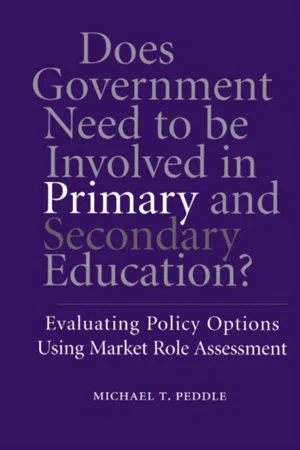
Does Government Need to be Involved in Primary and Secondary Education
Evaluating Policy Options Using Market Role Assessment
- 280 pages
- English
- ePUB (mobile friendly)
- Available on iOS & Android
eBook - ePub
Does Government Need to be Involved in Primary and Secondary Education
Evaluating Policy Options Using Market Role Assessment
About this book
This book is an investigation of some of the policy issues related to the government's role in the reform of primary and secondary education in the United States.
Information
CHAPTER 1
An Introduction to Market Role Assessment
Government’s Functions in a Mixed Economy
As mentioned in the Prologue, market role assessment can be a particularly useful part of the tool kit of contemporary public administrators. With government coming under increasing fiscal stress; debate regarding privatization of certain governmental activities; calls for improved accountability; and more emphasis on responsiveness and accountability to constituents, it is essential to understand the foundations for government involvement in the economy; this is an important ingredient in making good public policy decisions. The contemporary public administrator can benefit from being well versed in the application and use of market role assessment.
Market role assessment can be put to use directly as part of the public policy decisionmaking process and in the analysis of public policy proposals, including those brought forth by elected officials, interest groups, and citizens in general. At the most basic level, the framework provided by market role assessment enables the contemporary public administrator to evaluate his or her institution’s relationship to its environment, as well as to assess the appropriateness of changes in that relationship or role.
Our introduction to market role assessment will proceed in two steps. First, government’s functions in a mixed economy will be discussed and explored in this chapter. Then, market roles and their use as an analytical tool will be developed in Chapter 2.
Exploration of the use of market role assessment for analysis requires a clear understanding of how government’s functions can be defined in a mixed economy. The framework outlined in this chapter represents a description of a mainstream formulation of government’s economic role.1 This formulation is not only the general foundation on which government provision of goods and services to constituents is justified and built, but it is also the foundation on which general boundaries are constructed between public sector and private sector activities. It is from this foundation that an understanding of market role assessment and its use as an analytical tool will be built.
A modern economy would have great difficulty surviving in the absence of a government. Even the most ardent libertarians and modern conservatives acknowledge that (at least conceptually) government is necessary, although many might say it is a necessary evil. At the same time, one might note that events of the past decade or so in Eastern Europe, the former Soviet Union, and China have reinforced the importance of markets to the sustainability and vitality of an economy.
An economy with both a private sector and a public sector, linked through the operation of markets, can be referred to as a mixed economy. The notion of a mixed economy describes the economic structure of nearly every country in the world, which speaks to the general applicability of the following analysis.
The characteristics and typical operation of a mixed economy leave several important functions for government. Among these functions are the following:
- establishment and enforcement of a legal framework that makes voluntary economic transactions within a price system2 a viable means of economic interaction;
- adjusting market outcomes to aid in more closely conforming to collective notions of fairness or equity; and
- interventions designed to mitigate private market failures.
Stated in another way, government is asked to provide a framework that allows for the smooth operation of the price system, a framework for adjusting “undesirable” market outcomes that may result even when the market system performs as expected or designed, and a framework for adjusting “undesirable” market outcomes produced as a result of the assumptions of a perfectly competitive market system being violated.3 These three generic roles for government are instructive of the broad expectations often placed on government4 with respect to economic performance. This point becomes even clearer when we examine each role in more depth.
A FRAMEWORK FOR OPERATION OF THE PRICE SYSTEM
The smooth operation of a private market system requires much more than the application of simple assumptions like those underlying the circular flow model5 presented at the beginning of a Principles of Economics course. For example, as students of comparative economic systems know, the circular flow assumption of a basic attribute such as private ownership of resources is not met in all economies. Furthermore, notions of private property and property rights do not appear to have a natural existence apart from explicit efforts to define and enforce the concepts. Yet, notions of private property and property rights are fundamental to the operation of a market system based upon voluntary economic transactions. Government plays an integral role in helping to define and enforce a legal framework within which a market system can operate more smoothly. This fundamental and overarching government function manifests itself in several ways.
Government generally is the institution through which property rights are defined and enforced.6 Voluntary economic exchange is also fostered through the establishment and enforcement of contract law. The police powers granted to governments by constitution or statute help ensure orderly structure and reliable law enforcement or other types of intervention in the name of general welfare.7 It should be noted that the nature of property rights and protection of the process and outcomes of voluntary economic transactions vary from nation to nation and government to government.
In the United States, the primary definition and enforcement of property rights occur through federal law (which may be administered through state and local judicial systems), whereas police powers are retained and exercised by all general purpose governments.8 Furthermore, the definition of intellectual property rights in the United States is broader and these rights are more aggressively enforced than in most other countries. As an aside, this has created significant international relations issues as the U.S. government actively assists businesses and individuals in protecting their intellectual property from foreign piracy, counterfeiting, and patent infringement. Indeed, this has been a barrier in numerous recent trade negotiations, because many nations do not view intellectual property protection with the same priority that the United States does. This suggests that different market roles for government may be observed across nations with respect to intellectual property rights.
We now turn to other government functions in a mixed economy.
INTERVENTION TO IMPROVE MARKET OUTCOMES
The unfettered operation of a system of perfectly competitive markets9 results in an economically efficient outcome, also referred to as a Pareto efficient outcome.10 Pareto efficiency refers to a condition in which no person can be made better off without making at least one other person worse off. This said, it should be noted that the notion of economic efficiency is a distinctly positive, not normative, criterion. The criterion effectively differentiates between inefficient and efficient outcomes, but it offers no assistance in choosing between efficient outcomes or between inefficient outcomes. Thus, although an economic outcome may be produced by an unfettered system of perfectly competitive markets, and therefore be efficient in the economic sense, this same outcome may not be deemed a “good” outcome or a preferred outcome when evaluated on other criteria besides efficiency.
It is quite easy to develop scenarios in which an inefficient outcome would generally11 be preferred to an efficient one, but this preference will be grounded in criteria other than that of efficiency. Thus, circumstances may be identified in which the market “works” in the sense of an economically efficient outcome but produces an undesirable outcome. In particular, market outcomes that are otherwise efficient are often criticized for being unfair or unjust.
One should note that when economists go about analyzing the gains from trade or the results of the operation of the free market from the perspective of economic efficiency, they typically assume that the initial endowments or shares of resources are fixed. An extreme but illuminating example of this analysis can be seen in an exercise known as the “divide a dollar” game.
The rules of this game are quite simple: two participants are asked to divide up one dollar in any way they choose. In the absence of (1) unequal power between the two individuals, or (2) an initial division of the dollar by the arbiter of the game, one might expect an equal division of the dollar. Not only would this division seem “fair” to most people, but it is evident that any other division would make one of the participants worse off, thereby qualifying the solution as a Pareto efficient outcome.12 What is often less clear to observers of the game is that any division of the dollar would be Pareto efficient. Furthermore, on the basis of efficiency, one cannot choose one outcome over another, even if the division were to leave one person with the entire dollar and the other person with nothing.
Carrying the “divide a dollar” example just a bit further, imagine that the game began with the dollar divided in some fashion between the two participants by the game arbiter. Again, any such division would represent a Pareto efficient outcome, and there would be no reason to expect any trade or redivision of the dollar to result from voluntary action of the participants, because one of the participants would by necessity be made worse off by any exchange between the parties. However, it should be noted that the outcome of the game under these circumstances is determined by the initial division of the dollar by the arbiter.13
The initial division of the dollar is analogous to the endowment of resources with which one enters a market system. The efficient workings of the market system cannot overcome inequities in initial resource endowments, nor can it ensure that any market outcome meets any normative equity standard. To the extent that one values equity in economic outcomes and that the equity notion is not fulfilled by the operation of the unfettered market, one might look to outside intervention for improvement of market outcomes. The most common source of such outside intervention is government.
There are numerous examples of government intervening in markets to make outcomes more just or equitable, but it is once again important to distinguish between two distinct situations in which such intervention might take place: situations in which the market has operated soundly from the point of view of economic theory, and situations in which the market has failed to operate appropriately owing to a violation of one or more of the perfect competition assumptions. Our current discussion focuses on government interventions of the first type, whereas the next section of the chapter focuses on interventions that address the other set of situations, those economists generally call market failures.
As one example of an unpleasant market outcome, a worker may lose his or her job as a result of economic restructuring like that which has occurred in the U.S. steel industry and the U.S. textile industry. In such a case, one could argue that the market system has worked, through the reallocation of resources and job opportunities to industries and areas of the world where those resources find their greatest economic returns. Furthermore, the U.S. experience has indicated that many workers who are displaced by economic restructuring often remain unemployed or under employed as a result of lacking skills that are in high demand in the labor market (Reich 1991; Carnevale 1991; Krugman 1994; Barlett and Steele 1996).
Government intervention has often taken place in such situations. This intervention has ranged from subsidies to industries adversely affected by economic restructuring, to unemployment payments to displaced workers, to retraining programs targeted at displaced workers.14 Indeed, one of the very significant issues in local economic development and higher education is the appropriate delivery of education and training programs to assist workers who are displaced or placebound, or whose skills are mismatched with the needs of local employers. Although primary and secondary education constitute an integral part of many of these solutions (e.g., school-to-work, cooperative education, English as a Second Language), the relationship among education, training, economic competitiveness, and government action is much richer and more controversial.15
Similarly, the government has intervened on behalf of other labor market participants who have had trouble finding employment as a result of skill deficiencies and other market-based barriers. Programs such the Comprehensive Employment and Training Act (CETA) and the Job Training Partnership Act (JTPA) were designed to help overcome barriers to employment that were grounded in the workings of the market. Pell Grants were designed to help fund education for those who would be precluded from purchasing higher education services at a market-driven price. School lunch programs are designed to improve nutrition among children whose families may not be able to regularly purchase the ingredients for nutritious meals or who may not understand the components of such meals. Thus, one need not look far to find examples of a wide variety of government interventions designed to improve market outcomes—including many that apply to education in general, and to the market for primary and secondary education in particular.
We now turn our attention to government interventions designed to improve outcomes in cases where the market has failed, (i.e., not produced a Pareto efficient outcome.)
INTERVENTION TO MITIGATE PRIVATE MARKET FAILURES
The conditions that must be met by a system of markets in order to ensure a Pareto efficient outcome are numerous and difficult to fulfill. The violation of any one of the assumptions of perfect competition may lead to undesirable market outcomes. Unlike the undesirable outcomes discussed in the previous section, this category of deficient outcomes is produced by a failure of the market system to achieve an efficient outcome owing to violation of one or more of the conditions required of a system of perfectly competitive markets. Such outcomes are called market failures.
Economic efficiency is a crucial condition in terms of resource allocation and consumer choice. When the conditions of perfectly competitive markets are met, market prices are accurate reflections of the valuation of goods and services by buyers and sellers, and the prices serve a rationing function. That is, the price a buyer is willing to pay under perfectly competitive circumstances is an accurate reflection of the value that buyer places on that unit of the product. Similarly, the price a seller is willing to accept for a unit of a product is an accurate reflection of the price required to compensate the seller for the costs of production, including a market-determined profit that serves as the return to entrepreneurial services. The effective operation of a perfectly competitive market system means that resources will be allocated to their highest value uses, the goods and services produced in the market will be those most desired by consumers, and products will be produced by the most efficient producers and purchased by those consumers who place the highest value on consumption of that good or service.
Unfortunately, the conditions required for such desirable allocative outcomes are rarely met in unfettered markets. Because government provides the major alternative to the market system in allocating resources, government...
Table of contents
- Cover Page
- Title Page
- Copyright Page
- Series Editors’ Foreword
- Acknowledgments
- Prologue
- Chapter 1
- Chapter 2
- Chapter 3
- Chapter 4
- Chapter 5
- Chapter 6
- Chapter 7
- Chapter 8
- Chapter 9
- Chapter 10
- Chapter 11
- Chapter 12
- Chapter 13
- Epilogue
- Bibliography
Trusted by 375,005 students
Access to over 1.5 million titles for a fair monthly price.
Study more efficiently using our study tools.
Frequently asked questions
Yes, you can cancel anytime from the Subscription tab in your account settings on the Perlego website. Your subscription will stay active until the end of your current billing period. Learn how to cancel your subscription
No, books cannot be downloaded as external files, such as PDFs, for use outside of Perlego. However, you can download books within the Perlego app for offline reading on mobile or tablet. Learn how to download books offline
Perlego offers two plans: Essential and Complete
- Essential is ideal for learners and professionals who enjoy exploring a wide range of subjects. Access the Essential Library with 800,000+ trusted titles and best-sellers across business, personal growth, and the humanities. Includes unlimited reading time and Standard Read Aloud voice.
- Complete: Perfect for advanced learners and researchers needing full, unrestricted access. Unlock 1.5M+ books across hundreds of subjects, including academic and specialized titles. The Complete Plan also includes advanced features like Premium Read Aloud and Research Assistant.
We are an online textbook subscription service, where you can get access to an entire online library for less than the price of a single book per month. With over 1.5 million books across 990+ topics, we’ve got you covered! Learn about our mission
Look out for the read-aloud symbol on your next book to see if you can listen to it. The read-aloud tool reads text aloud for you, highlighting the text as it is being read. You can pause it, speed it up and slow it down. Learn more about Read Aloud
Yes! You can use the Perlego app on both iOS and Android devices to read anytime, anywhere — even offline. Perfect for commutes or when you’re on the go.
Please note we cannot support devices running on iOS 13 and Android 7 or earlier. Learn more about using the app
Please note we cannot support devices running on iOS 13 and Android 7 or earlier. Learn more about using the app
Yes, you can access Does Government Need to be Involved in Primary and Secondary Education by Michael T. Peddle in PDF and/or ePUB format, as well as other popular books in Education & Education Administration. We have over 1.5 million books available in our catalogue for you to explore.