A young female client presents with anorexia nervosa and believes that her problem has its roots in magic; parents are helpless in the face of their son's substance abuse issues; an interracial couple cannot agree on how to discipline their children.How would you effectively help these clients while balancing appropriate interventions that are sensitive to religious, cultural, social, and gender differences? This handbook answers these difficult questions and helps behavioral health practitioners provide religio-culturally-competent care to Muslim clients living in territories such as North America, Australia, and Europe.
The issues and interventions discussed in this book, by authoritative contributors, are diverse and multifaceted. Topics that have been ignored in previous literature are introduced, such as sex therapy, substance abuse counseling, university counseling, and community-based prevention. Chapters integrate tables, lists, and suggested phrasing for practitioners, along with case studies that are used by the authors to help illustrate concepts and potential interventions.
Counseling Muslims is also unique in its broad scope, which reflects interventions ranging from the individual to community levels, and includes chapters that discuss persons born in the West, converts to Islam, and those from smaller ethnic minorities. It is the only guide practitioners need for information on effective service delivery for Muslims, who already bypass significant cultural stigma and shame to access mental health services.
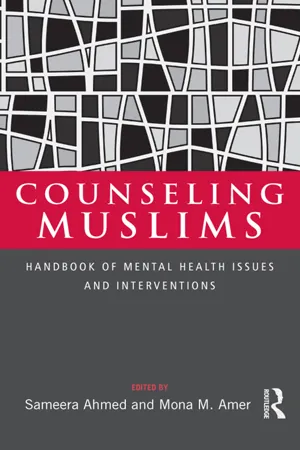
eBook - ePub
Counseling Muslims
Handbook of Mental Health Issues and Interventions
- 416 pages
- English
- ePUB (mobile friendly)
- Available on iOS & Android
eBook - ePub
Counseling Muslims
Handbook of Mental Health Issues and Interventions
About this book
Information
PART I
Muslim Beliefs Within a Counseling Framework
CHAPTER 1
Islam, Muslims, and Mental Health
Muslims constitute approximately 23% of the world’s population and serve as a majority in approximately 50 countries around the globe (Miller, 2009). Although Islam dates back more than 1,400 years and has roots in Western nations for many centuries, interest in Islam and Muslims prior to the 9/11 incidents in America was minimal. However, 9/11 and the subsequent attacks in Madrid and London led to an increased visibility of Muslims and an interest in Islam. These events, in addition to the growing diversity and multicultural awareness in Western countries, has resulted in increased curiosity about Islam, how Muslims conduct their daily lives, and what the Qur’an preaches. Despite the increased interest in Islam, the average person has very little knowledge about the religion and its followers (Pew, 2007).
Lack of knowledge about the beliefs and values of a religious group that is under continuous scrutiny can be problematic within a clinical setting, especially in light of the potential importance spirituality may have for a client. The spiritual perspective posits that one of the main sources of clients’ strengths is their spirituality, which can be used to help clients face their problems and obstacles (Sermabeikian, 1994). The spiritual perspective complements well the strengths perspective in which clients’ personal and environmental strengths are emphasized in the recovery process (Hodge, 2001). Therefore, it is important for mental health practitioners to have knowledge about the basic beliefs and practices of Islam. In addition, they should be aware of common misconceptions about Islam and their impact on the psychological well-being of Muslims. This would increase and strengthen the therapeutic relationship between the client and the practitioner, thus forming the foundation from which the therapeutic process can progress. Knowledge of Islam can also bring to the forefront any biases a practitioner may have and decrease the negative impact of transference or countertransference. Lastly, it is important for the practitioner to realize that Muslims range in religious adherence, much like followers of other religions.
This chapter begins by presenting the basic tenets of Islam to orient the clinician about beliefs and practices that may be integral to clients’ lives and potentially be incorporated in treatment. Second, the importance of psychology in Islam will be highlighted in order to provide a starting point for clinicians working with Muslim clients. Third, some basic demographic information is presented regarding Muslims living as minorities in the West so that clinicians can be aware of the possible cultural issues intermixed with the religious issues facing Muslims. Finally, a discussion of important contemporary issues facing Muslims in the West and the clinical ramifications will be presented.
Basic Tenets of Islam
Islam comes from the Arabic root word meaning peace. The word aslama is derived from these letters and refers to the one who has submitted to Allah, Arabic for God. The name Allah was a term used to refer to God even before the Qur’an, the Muslim holy book, was revealed and continues to be used today by Arabic-speaking Jews and Christians.
Islam is a monotheistic religion and asserts that since the beginning of time, Allah has sent to nations numerous prophets or messengers who brought the message of tawhid, or the Oneness of God. Examples of earlier prophets include Solomon, David, Noah, Moses, Abraham, Ismail, and Jesus. Muslims not only believe and are taught to respect previous prophets, they are also instructed not to deny the Truth in other religions sent to humankind. Islam preaches the same principles given by Abraham, and therefore is one of the three Abrahamic religions, which also includes Christianity and Judaism.
There are six basic beliefs in Islam. The first is to have faith in Allah. According to Islamic beliefs, Allah created everything and is All-Powerful. The second belief is the existence of angels who also obey Allah. The third belief is in the prophets and messengers of God and that Prophet Muhammad was the last prophet. Muslims also believe in all the religious texts revealed by God such as the Bible, Torah, and the Qur’an. However, they also believe that additions and deletions were made to the previous religious texts by their followers. As such, the Prophet Muhammad was sent to spread the final Message, which is considered to be the same, word-for-word, as it was 1,400 years ago. Thus, the Qur’an is the book of guidance for Muslims. The fifth belief is the existence of the Day of Judgment when individuals will be resurrected in front of God and be judged according to their deeds. The last basic belief is the belief in Al-Qadr, or predestination. Muslims believe that God knows what will happen to an individual, but at the same time the individual has free will. This last belief in predestination is important for the clinician as it could undermine a Muslim client’s willingness and ability to engage in the change process. Free will is a major component of this belief, which Muslim clients may not acknowledge, and the clinician can highlight. In addition, understanding the beliefs of Muslims will enable clinicians to avoid making misdiagnoses, as in the case of a patient’s mention of the presence of angels, which could be interpreted as a psychotic delusion.
In addition to the main beliefs, there are five pillars, or essential practices, in Islam. The Shahadah, or the belief that there is only one God and Muhammad is the last messenger, is the central pillar. The second pillar is salah, performing the five daily prayers. The third is sawm, or fasting, refraining from eating or drinking from dawn to sunset, during the month of Ramadan. The fourth pillar is zakat, giving charity to the poor and needy. The last pillar is hajj, performing pilgrimage to the holy city of Makkah, if one is able to financially and physically. Religious practices can influence treatment. For example, patients may not be able to schedule sessions at certain times because of conflicts with prayer times. In addition, some rituals can be incorporated into the client’s treatment plan, such as praying or reading the Qur’an to relieve stress or fast to overcome negative desires that may contribute to depression. It is important to mention here that Muslims, like any other followers of a religion, have varied levels of religiosity, and it is critical for a clinician to explore the role and importance of Islam to the individual client during the intake assessment.
Sources of Muslim Legal Code
Understanding the Islamic legal code and process of legislation will help the clinician appreciate how Muslims may arrive at different perspectives and practices on a particular issues. For example, there are various views held by Islamic scholars on issues such as conflict management, divorce, parenting, and the roles and responsibilities of spouses. During a counseling session, different family members can present conflicting views that may be confusing if the sources of legal code are not understood. The clinician can assist them in understanding each other’s perspective or coming to a compromise without being confused by the apparent conflict in religious perspectives.
In order to act in accordance with Islamic beliefs, Muslims turn to the Qur’an, the Muslim Book of Guidance, and the hadith, sayings of the Prophet Mohammad, which provide the basic structure of the laws of human conduct, also known as Shariah or Divine Laws. The literal meaning of shariah is “to introduce” or “prescribe.” Shariah is more than just rules about religious rituals, and civil and criminal matters—it also includes ethical and moral principles. Unfortunately, shariah is discussed in negative terms by ideologues and propagated through the different media outlets, and is described as a set of laws that Muslims want to enforce on the world regarding criminal punishments.
Islamic jurisprudence or fiqh is based on shariah or Divine Laws. These laws cover ways of worship, right and wrong, and dealings in one’s everyday lives, including business transactions, family issues, societal issues, etc. Although all prophets preached the same faith, the Divine Laws each prophet brought were suited for their specific time and helped to build a civilized and moral society. Muslims believe that Muhammad, as the last prophet of Allah, brought the final version of the Divine Laws, which apply to all of humanity and for all times. Islamic jurisprudence is derived primarily from the Qur’an and Sunnah and is dynamic in nature because individual and societal considerations are taken into account. The Qur’an is considered the Word of Allah, and is understood to have stronger proofs than the sunnah, or the sayings, actions, and attitudes of Prophet Muhammad. The details of the application of Islam in everyday life may not always be explained in the Qur’an. As such, Muslims rely on the Prophet’s Sunnah for such guidance. As a result, there is much attention dedicated to the verification and authentication of sayings and actions of Prophet Mohammad, and depending on the scholar and the importance given to the different criteria for authentication, one can find more than one opinion on an issue.
For matters that fall beyond the direct orders written explicitly in the Qur’an or espoused by the Prophet’s sayings, actions, and attitudes, Islamic scholars use juristic consensus (ijma) or analogy (qiyas). Ijma refers to a consensus on an issue by Islamic scholars. Qiyas refers to laws that are made by analogy. For example, wine is forbidden in Islam due to its intoxicating effects, so by analogy other intoxicating drugs are also forbidden by Islamic law. When other jurists do not agree on qiyas, one can follow juristic preference (istihsan) between two analogies, which can also result in differing scholarly interpretations on a particular issue. At certain times, Islamic rulings can be made in the interest of the society, balancing individual and collective rights. Islamic law also allows for the inclusion of local social norms and customs into consideration, as long as the local norms and customs do not contradict the principles of the Qur’an and Sunnah.
In addition to rules on dealing with one’s everyday life, Islamic jurisprudence also covers mental health. Islamic law governing mental illness and insanity dates back to the seventh and eighth centuries. Islamic laws also address patient confidentiality, insanity defense, involuntary hospitalization and treatment, mental competencies, family laws related to the mentally handicapped, child custody issues, child abuse and child witness, etc. A book by Chaleby (2001) covers citations of original sources in detail, and Haque (2002) covers its critical review.
Historical Perspective
It may be helpful for the clinician to understand the historical context from which Muslims have obtained their code of conduct, how the advent of Islam in Arabia caused a moral conflict, and what Muslims find inspiring in the history of Islam. In addition, allowing Muslim clients to speak about the history of Islam from their perspective promotes a “shedding the cloak of the expert who knows best” and provides the clinician critical information about the beliefs and values of the client (Brandell, 2010).
Muhammad was born in Mecca in 570 A.D., and it was in his 40th year that he started receiving his revelations and preaching Islam. As a result of conveying the message of Islam, Muhammad was tortured by his tribesmen, who tried to kill him on many occasions. He preached monotheism and perfecting one’s character while in Mecca. After 13 years of persecution, Muhammad migrated to Medina where he established the first Muslim community. In Medina, Prophet Muhammad continued to teach Islam to people. Much of the shariah was revealed in Medina, and Muhammad elaborated on the rituals in Islam for the Muslim community. It was also in Medina that Muhammad began to teach people general concepts of justice, freedom, tolerance, and understanding. He made treaties with nearby tribes and groups that consisted of people of other faiths. The Arabs from Mecca fought battles with the Muslims on multiple occasions in an effort to eradicate Islam in its infancy stage, but were not successful. By the time he died in 633 A.D., the entire Arabian Peninsula had adopted Islam (al-Mubarkpuri, 2002).
After the Prophet’s death, a political difference emerged over views on who should become the successor of Prophet Muhammad. The Muslims at the time were divided into two different groups. The first group believed that the caliphate, or successor, should have remained within the Prophet’s family (Shi’a). The second group believed that the caliph should be chosen through an elective process (Sunni). Modern-day Sunni and Shi’a share basic Islamic beliefs but differ in their interpretation of Islamic jurisprudence.
Contributions to Psychology
Muslim scholars have made major contributions to the arts and sciences, especially in the area of psychology (Haque, 2004b; Badri, 2000). Muslims were pioneers in specializations such as child devel...
Table of contents
- Cover Page
- Half-Title Page
- Epigraph
- Title Page
- Copyright Page
- Table Of Contents
- Acknowledgments
- Editors
- Contributors
- Foreword
- Preface
- Part I Muslim Beliefs Within a Counseling Framework
- Part II Models and Interventions
- Part III Service Settings
- Part IV Special Populations
- Part V Special Issues
- Index
Trusted by 375,005 students
Access to over 1.5 million titles for a fair monthly price.
Study more efficiently using our study tools.
Frequently asked questions
Yes, you can cancel anytime from the Subscription tab in your account settings on the Perlego website. Your subscription will stay active until the end of your current billing period. Learn how to cancel your subscription
No, books cannot be downloaded as external files, such as PDFs, for use outside of Perlego. However, you can download books within the Perlego app for offline reading on mobile or tablet. Learn how to download books offline
Perlego offers two plans: Essential and Complete
- Essential is ideal for learners and professionals who enjoy exploring a wide range of subjects. Access the Essential Library with 800,000+ trusted titles and best-sellers across business, personal growth, and the humanities. Includes unlimited reading time and Standard Read Aloud voice.
- Complete: Perfect for advanced learners and researchers needing full, unrestricted access. Unlock 1.5M+ books across hundreds of subjects, including academic and specialized titles. The Complete Plan also includes advanced features like Premium Read Aloud and Research Assistant.
We are an online textbook subscription service, where you can get access to an entire online library for less than the price of a single book per month. With over 1.5 million books across 990+ topics, we’ve got you covered! Learn about our mission
Look out for the read-aloud symbol on your next book to see if you can listen to it. The read-aloud tool reads text aloud for you, highlighting the text as it is being read. You can pause it, speed it up and slow it down. Learn more about Read Aloud
Yes! You can use the Perlego app on both iOS and Android devices to read anytime, anywhere — even offline. Perfect for commutes or when you’re on the go.
Please note we cannot support devices running on iOS 13 and Android 7 or earlier. Learn more about using the app
Please note we cannot support devices running on iOS 13 and Android 7 or earlier. Learn more about using the app
Yes, you can access Counseling Muslims by Sameera Ahmed, Mona M. Amer, Sameera Ahmed,Mona M. Amer in PDF and/or ePUB format, as well as other popular books in Psychology & Mental Health in Psychology. We have over 1.5 million books available in our catalogue for you to explore.