- 288 pages
- English
- ePUB (mobile friendly)
- Available on iOS & Android
eBook - ePub
About this book
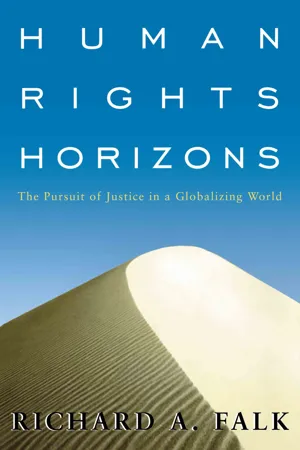
In Human Rights Horizons, one of the world's foremost authorities on human rights and international relations maps out the way to a more just and human global society. Borders are being erased; democracy and capitalism are spreading. The world is rapidly changing, and these changes are opening the door for the promotion of human rights to become and integral part of worldwide politics and law.In his provocative new book, Falk discusses the borderline between the promotion of human rights and the promotion of interventionist and coercive diplomacy. Can the US and the UN find an acceptable balance between unnecessary, protracted violence (Somalia) and simply letting genocide spread (Rwanda)? While looking at specific cases, Falk also sheds important new light on non-Western attitudes toward human rights, the challenge of genocidal politics, the intersection of morality and global security, and the pursuit of international justice. Thoughtful and very accessibly written, Human Rights Horizons clearly presents a path to an original new humanitarian policy for the 21st century.
Information
PART 1
Framing the Inquiry
| Pursuing Global Justice | 1 |
Obstacles of an ideological and structural character complicate the pursuit of global justice during this early phase of globalization. At the same time, several developments associated with globalization are encouraging to those committed to the promotion of global justice. The most salient obstacles arise from the persisting fragmentation of the world in terms of sovereign territorial states, and the widespread acceptance of efficiency and competitiveness criteria as the basis for assessing economic performance. The most promising developments arise from the plausibility of conceiving the world as a unity and from the beginnings of a global civil society due to the efforts of transnational social forces.
This chapter is intended to clarify the character of both the obstacles and the opportunities currently facing proponents of global justice. Five dilemmas are identified in this discussion; these dilemmas arise from efforts to promote global justice within the nonideal conditions of the world as we find it. This chapter concludes with a consideration of ways in which the transformation of the character of world order could greatly enhance the realization of global justice with far fewer of the disappointments and debilitating compromises that characterize the present global setting.
Part of the undertaking of this book is to consider the contribution being made by international institutions, including the United Nations, with respect to global justice. The role of institutions is central to all aspects of this inquiry, but it is also ambiguous. International institutions definitely promote and consolidate the ends of global justice in various respects, but they are also vulnerable to manipulation and control by political forces that are responsible for some of the worst forms of injustice, including patterns of domination, exploitation, and victimization. International institutions, while they merit appreciation for their achievements, must also be criticized for their deficiencies.
At present, the most promising avenues for the immediate actualization of global justice involve sensitive adjustments to variations of state and society makeup, as in the numerous peace, reconciliation, and accountability procedures established in a number of countries. Also encouraging are various collaborations between transnational social forces and those governments that are more value-oriented and sensitive to the claims of global justice, as opposed to those that define their role according to the maximization of power, wealth, and influence. Such projects include a push for treaties that prohibit antipersonnel landmines, outlaw reliance on nuclear weaponry, and establish an international criminal court. Each of these initiatives has its own distinct character, but all of them disclose a new form of global politics in which states are more motivated by values and human solidarity than by narrowly conceived national interests. Such encouraging developments treat global security as based on a demilitarizing respect for law in relation to effective international institutions that are constitutionally oriented.
It is also important to acknowledge the contributions being made within regional frameworks, particularly the European Union. European regionalism in relation to economic cooperation and the protection of human rights is undoubtedly the boldest world order experiment currently under way. If the European Union is perceived as successful in other parts of the world, it could rapidly lead to the extension of a regional approach to neglected instances of injustice. Especially in view of the current mood of disillusionment with the United Nations, it seems likely that, institutionally and substantively, regional arenas will provide the most promising opportunities in the near future to pursue global justice in contexts beyond the boundaries of territorial states.
FRAMING GLOBAL JUSTICE
The background of analysis and reflection about the nature of global justice mainly derives from earlier efforts to conceive of justice in relation to a specific community. This tradition in the West can be traced back to ancient Athens and the conceptions of justice set forth by Plato and Aristotle, and carried forward to our contemporary circumstances perhaps most prominently by John Rawls.1
The evolution of thought about justice as it applies to political communities has been the central preoccupation of political philosophy through the centuries. Such thought relies on a dualism, most clearly evident in the Leviathan of Thomas Hobbes; specifically, justice and ethics are inappli cable in the absence of a viable international community. Without community sentiments and institutions, separate sovereign states will continue to pursue their own ends unconditionally.2 The idea of a just society of sovereign states was initially embedded in the medieval universalism of the Roman Catholic Church. It was also embodied in the shared Christendom of European states, which established the modern system of world order in the mid-seventeenth century. The concept of justice coexisted with the idea of sovereignty, which in effect relegated most dimensions of justice to the internal relations between state and society. With the separation of church and state that accompanied the rise of the modern state, the notion of justice assumed a specifically and predominantly secular character that could no longer be interpreted merely as an extension of religious thought.3
Two developments are crucial to the framing of global justice: the idea and practice of sovereignty at the level of the territorial state, and the increasing secularization of the most influential forms of speculation about the nature of justice. At the same time, various schools of natural law associated with Catholicism and other formulations of rights and laws rested on divine revelation, the timeless intuitions of rationality, and the objective order of the universe. These approaches persisted as minority countertraditions that challenged the view of justice as socially constructed by human will in the specific settings of historical societies.4 It is arguable that the positing of the Universal Declaration of Human Rights as a moral and legal foundation for political, social, economic, and cultural behavior amounts to the reassertion of natural law as a legitimate underlying arrangement of governance.
A series of prominent jurists tried to make the transition to modernity, taking account of the rise of secularism and territorial sovereignty. Pre-Westphalian thinking about the nature of international political life was particularly well developed by the Spanish school of international law, especially by Francisco de Vittoria and Francisco Suarez. Their outlook was essentially an extension and application of Catholic jurisprudence to the special circumstances of international life.5 The birth of modern international law is generally associated with the treatise The Law of War and Peace, written by the Dutch jurist Hugo Grotius in reaction to the destructive and barbarous Thirty Years War.6 Grotius has remained a pivotal figure in international studies because his historical and intellectual location—with its appropriate particular emphasis on war—spanned the transition from medieval to modern times.7 His insistence that the just-war doctrine formed an essential part of international law was an attempt to find an acceptable means of combining the realities of sovereign, secular statehood with the normative—in both the moral and legal sense—aspirations of the European system of world order.
This order presumed to impose limits on behavior even under conditions of warfare. Grotius also wrote at a time in which the common adherence to Christendom gave credence to the view that statehood could be combined with a sense of an international community that could, over time, establish a true international society. As the state gained in strength and capability, the notion of some sort of solidarity based on a shared cultural or religious background faded, and more absolute notions of sovereignty prevailed. These views were expressed most influentially by the seventeenth-century political philosopher Jean Bodin, and by the Swiss jurist Emmerich de Vattel in the mid-eighteenth century.8
Whether the Grotian evolutionary outlook was “utopian” has been subsequently debated in many settings, but most significantly in terms of whether the statist idea set definite limits on the degree of solidarity that could be effectively established in the relations among states.9 The minimalist view that persists to this day is that a world of states can operate successfully only if it accepts such restraining ideas as nonintervention, the failure of efforts to outlaw war, and the nonaccountability of leaders.10 The contending view, which can be identified as the evolutionary or progressivist view, envisages steady progress toward a well-ordered international community premised on the supranational implementation of human rights (inherently interventionist), the prohibition of war, and the accountability of leaders. A revival of interest in Grotius is partly occasioned by the ambiguity of the present historical circumstance, namely, whether we are situated in a great transition from a statist world to some type of emergent global village.11
Aside from the relevance of justice to the international law tradition, there is the further preoccupation about how to escape from the core predicaments of an anarchical international society—especially from the Hobbesian idea of the war of all against all—without ignoring the structural reality that interacting sovereign states are grossly unequal in their capabilities.12 Even before the emergence of the modern state, visionary thinkers conceived of a world more structured around some central institutional authority. Justice was mainly conflated with order, and order was so highly valued because it was conceived to be the indispensable foundation for a durable peace.13
This tradition has been expressed in this century mainly in postwar settings that advanced plans for world government.14 In effect, global justice was associated almost exclusively with the problem of war, and the solution was sought by institutionalizing the rule of law with respect to the use of force in international relations. The basic conception of world government evolved from state-society relations that conformed to a federalist model. The main anxiety among advocates and critics of world government, aside from the difficulty of its attainability, was the danger that such a centralization of authority would likely, or even inevitably, degenerate into a demonic superstate that would establish a totalitarian reign of global scope.15 Thus the challenge for advocates of world government, or enhanced central guidance, was to design a constitutional structure of checks and balances that was effective enough to prevent war, yet decentralized enough to resist morphing into the ultimate Frankenstein's monster of global authoritarianism.16
In an important sense, the establishment of the League of Nations after the First World War, and the United Nations after the Second World War, represented diluted moves in this direction of institutionalized authority. Beset both by problems associated with the unwillingness of states to renounce their own sovereignty (the problem of attainability), and by a concern about the menace of premature centralization of authority (the problem of global authoritarianism), these steps toward creating the structures of global justice disappointed visionaries and disillusioned even those neo-Grotians who took refuge in optimistic expectations associated with an evolutionary view of global political development. At the same time, these moves toward the establishment of an organized international community disappointed world federalists who regarded such steps as far too modest to achieve the goal of war prevention. They also frightened ultranationalists who saw these steps as moving inexorably toward a diabolical world state. But such moves generally satisfied liberal internationalists who, placing particular hope in the eventual prospect of ever greater cooperation of a functional character, believed that progress at the global level could be achieved only by small, incremental steps.17
INSTITUTIONALIZING THE QUEST FOR GLOBAL JUSTICE
As a result, there have been three adaptations of a system designed to pursue global justice. First, there have been those who viewed the UN system as containing an evolutionary promise that could be fulfilled by bold action to convert the organization from its relatively impotent present character into an entity of sufficient capabilities and authority to bring peace—and thereby justice—to the world. Grenville Clark and Louis B. Sohn, in World Peace through World Law,18 proposed the most widely articulated version of this reformist strain, although this line of thought has not persisted essentially because it has failed to attract adherents. This may well reflect the perception that its solution to the problem of attainability did not seem at all commensurate with the severity of the resistance arising from an attachment to sovereign rights and the creeds of nationalism. Additionally, the United Nations, although the site of many notable innovations at the margins of world politics, has not provided a receptive arena for any further structural modifications that moved away from a sovereignty-centered world.19 Such institutional rigidity has been especially manifest with respect to the inability of the United Nations to “fix” the composition of the permanent membership of the Security Council in a manner that better reflects the changes in the character of international society since 1945, particularly the impact of decolonization on the participation of the non-Western world.
A second and more promising line of adaptations involves a different way of envisioning evolution and progress in state relations—an approach that goes back to Immanuel Kant's immensely suggestive essay Perpetual Peace, first published in 1795.20 Although the interpretation of Kant's worldview remains contested, one idea has been derived and recontextualized in the conditions of the late twentieth century—the idea of “democratic peace,” which has been invoked in many guises and has generated an enormous body of recent literature, particularly in the United States.21 The essential claim of this theory is that democratically organized states do not wage war against one another, and that democracy is spreading throughout the world as the basis of legitimate government.22 The attractiveness of the idea is that it seems empirically grounded and follows the course of history. Also relevant is the liberal idea that support for international human rights creates a just world society that extends its reach beyond the external relations of states to encompass the relations between governments and their citizens. Present in this idea is the expectation that a democratized world community would be able to agree upon far more ambitious institutional arrangements. This possibility is given added plausibility by the institutionalization of relations in the European regional context, even on sensitive issues of rights and money.23
Whether these views on democracy can be extended to non-Western countries and regions remains in doubt. It may turn out that a democratic peace holds only among Western democracies. Furthermore, the rise of global market forces is challenging the centrality of the state in the construction of world order, specifically by emphasizing the priorities of global capital as opposed to individuals within a given territorial community, and by generating policies in arenas that are beyond state control.24 As such, the degree of institutionalization represented by the UN system seems to be slipping into the abyss of globalization despite the notable progress of recent decades toward democratization at the state level.25 The United Nations may be too statist in conception to serve a world order in which both global market forces and transnational social actors are playing increasingly significant roles.26 The seductive premise in the presumption of the democratic peace approach is that institutionalization at regional and global levels is not indispensable for a just world order. Rather, the inner orientation of states (especially, states' commitment to democracy and human rights) is what forms their pattern of behavior in world society. This adaptation also tests the limits of plausibility, given the rising levels of interconnectedness that characterize so many aspects of international life and that produce intractable problems ranging from the control of transnational crime and international migration to the rise of international terrorism, the spread of weapons of mass destruction, and the protection of the global commons.
The third line of adaptation takes the form of normative adjustment— deliberate transformative changes made in different arenas of authority to lessen human suffering. The World Order Models Project (WOMP) was initiated in 1967 to encourage systematic thinking by leading academics in different cultural and ideological settings about how to achieve a just world order. In the course of more than thirty years of activity, WOMP has generated a series of distinct perspectives on how to proceed toward the realization of global justice, but it has significantly failed to agree upon a single approach.27 Although WOMP has avoided much of the Eurocentrism that appears to have afflicted earlier efforts to shape a just world order, it is vulnerable to allegations of utopianism for not having addressed the attainability problem in a convincing fashion. It does, however, move the global justice concern off an exclusively war/peace axis to embrace global concerns about poverty, inequality, environmental protection, and social, economic, and cultural rights.
WOMP's attitude toward international institutions is diverse and ambivalent. Aside from its main organizational leader, Saul Mendlovitz, the other main partici...
Table of contents
- Cover Page
- Half Title page
- Title Page
- Copyright Page
- Dedication
- Contents
- Acknowledgments
- Introduction
- Part 1 Framing The Inquiry
- 1 Pursuing Global Justice
- 2 A Half-Century of Human Rights
- 3 Taking Human Rights Seriously at Home
- 4 Moving Toward Implementation
- 5 Patterns of Global Dominance and Non-Western Attitudes Toward Human Rights
- Part 2 Substantive Dilemmas
- 6 Revisiting the Right of Self-Determination
- 7 Group Claims within the UN System The Rights of Indigenous Peoples
- 8 The Geopolitics of Exclusion The Case of Islam
- 9 The Unmet Challenges of Genocide in Bosnia and Rwanda
- 10 The Challenge of Genocidal Politics in an Era of Globalization
- Part 3 The Future Prospect
- 11 The Extension of Human Rights to Past and Future Generations
- 12 The Redress of Past Grievances The Nanking Massacre
- 13 Morality and Global Security A Human Rights Perspective
- Notes
- Index
Trusted by 375,005 students
Access to over 1.5 million titles for a fair monthly price.
Study more efficiently using our study tools.
Frequently asked questions
Yes, you can cancel anytime from the Subscription tab in your account settings on the Perlego website. Your subscription will stay active until the end of your current billing period. Learn how to cancel your subscription
No, books cannot be downloaded as external files, such as PDFs, for use outside of Perlego. However, you can download books within the Perlego app for offline reading on mobile or tablet. Learn how to download books offline
Perlego offers two plans: Essential and Complete
- Essential is ideal for learners and professionals who enjoy exploring a wide range of subjects. Access the Essential Library with 800,000+ trusted titles and best-sellers across business, personal growth, and the humanities. Includes unlimited reading time and Standard Read Aloud voice.
- Complete: Perfect for advanced learners and researchers needing full, unrestricted access. Unlock 1.5M+ books across hundreds of subjects, including academic and specialized titles. The Complete Plan also includes advanced features like Premium Read Aloud and Research Assistant.
We are an online textbook subscription service, where you can get access to an entire online library for less than the price of a single book per month. With over 1.5 million books across 990+ topics, we’ve got you covered! Learn about our mission
Look out for the read-aloud symbol on your next book to see if you can listen to it. The read-aloud tool reads text aloud for you, highlighting the text as it is being read. You can pause it, speed it up and slow it down. Learn more about Read Aloud
Yes! You can use the Perlego app on both iOS and Android devices to read anytime, anywhere — even offline. Perfect for commutes or when you’re on the go.
Please note we cannot support devices running on iOS 13 and Android 7 or earlier. Learn more about using the app
Please note we cannot support devices running on iOS 13 and Android 7 or earlier. Learn more about using the app
Yes, you can access Human Rights Horizons by Richard A. Falk in PDF and/or ePUB format, as well as other popular books in Politics & International Relations & Diplomacy & Treaties. We have over 1.5 million books available in our catalogue for you to explore.