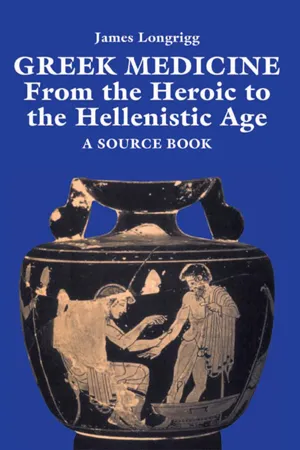
The Greeks were the first to use rational systems of medicine, based upon belief in natural causation, rather than magical and religious elements, which resulted in a new conception of disease, accounting for causes and symptoms of illness. Greek Medicine places ancient Greek medicine, from Homer to the Alexandrians, within its historical and intellectual context by presenting a selection of source material in translation.
The book provides a chronological account on the most important aspects of ancient medicine, and includes chapters on specific areas of medicine, such as gynecology, dietetics, pharmacology and surgery.
- 256 pages
- English
- ePUB (mobile friendly)
- Available on iOS & Android
eBook - ePub
About this book
General Index
absinthe, 195
Achilles, 16, 134, 165, 168, 178, 188
Achilles tendon, 158
Acron of Acragas, 62
Aeneas, 10, 15
Aeschines, 13
Aesculapius, 42
Agamemnon, 134, 146, 154
Agave, 29
ague, 22, 109, 191, 199
ailments, caused by dislocated womb, 195
air, vector of epidemic disease, 124–5, 133–4
Ajax, 29
Alcmaeon of Croton: first doctor to reveal influence of Ionian Natural Philosophy, 31; theory of health, 31, 38, 59, 155; empirical approach to medicine, 33, 39, 53; researches into nature of sense organs, 34, 38; locates seat of intellect in head, 70; pioneer of rational medicine, 79; philosophical influence upon, 107; regards disease as due to seasonal and environmental factors, 107–8; disease as part of nature, 117; first to employ human dissection (?), 169, 176; also mentioned, 61, 83
Alexander, i.e. Paris of Troy, 179
Alexandria, human anatomy at, 84, 98–100
Alexandrian technology, 189
Alexandrians: views on nature of semen, 79, 83; employ treatment by contrary remedies, 152, 156; interest in healing properties of drugs, 164, 167; anatomical researches of, 84–100
Alfred of Sareshel, 166
almond oil, 195
Ambrosia of Athens, 12, 181, 188
Ammianus, 19
Amphiaraus, cult of, 11, 16
Amyntas III, King of Macedon, 81
anaglyphê kalamou (calamus scriptorius or calamus Herophili), 86–7
Anatomai, Dissections, 81
anatomy of heart, 94
Anaxagoras: influence on Regimen I, 56, 60
Anaximander, on the cause of thunder, lightning etc., 19; of sun's eclipse, 20; of moon's eclipse, 20; attitude to world around him, 28; conceives universe as balance between opposing forces, 31, 38; declares first principle apeiron, 31; influence on Alcmaeon, 59
Anaximenes: rejects belief that Zeus sends rain, 19; attributes earthquakes to natural causes, 19; attitude to world around him, 28
Andreas of Carystus: preserves evidence of Alexandrian pharmacology, 164, 167; Herophilus's pupil &...
Table of contents
- Cover
- Half Title
- Full Title
- Copyright
- Contents
- Dedication
- Preface
- Introduction
- Abbreviations
- I. Pre-rational and irrational medicine in ancient Greece and neighbouring cultures
- II. The rise and development of rational medicine in ancient Greece
- III. Philosophy and medicine in the fifth century I: Alcmaeon and the Presocratic philosophers
- IV. The Hippocratic Corpus and the Hippocratic question
- V. Philosophy and medicine in the fifth century II: Presocratic philosophy and the Hippocratic Corpus
- VI. Philosophy and medicine until the fourth century: ‘Sicilian’ medicine and its influence
- VII. Early Alexandrian medical science
- VIII. Hippocratic deontology
- IX. Disease and human physiology
- X. Epidemic disease
- XI. Prognosis and diagnosis
- XII. Dietetics and regimen
- XIII. Pharmacology
- XIV. Anatomy
- XV. Surgery
- XVI. Gynaecology
- Chronological table
- Glossary of technical terms
- Bibliography
- Concordance of quoted passages
- General index
Trusted by 375,005 students
Access to over 1.5 million titles for a fair monthly price.
Study more efficiently using our study tools.
Frequently asked questions
Yes, you can cancel anytime from the Subscription tab in your account settings on the Perlego website. Your subscription will stay active until the end of your current billing period. Learn how to cancel your subscription
No, books cannot be downloaded as external files, such as PDFs, for use outside of Perlego. However, you can download books within the Perlego app for offline reading on mobile or tablet. Learn how to download books offline
We are an online textbook subscription service, where you can get access to an entire online library for less than the price of a single book per month. With over 1.5 million books across 990+ topics, we’ve got you covered! Learn about our mission
Look out for the read-aloud symbol on your next book to see if you can listen to it. The read-aloud tool reads text aloud for you, highlighting the text as it is being read. You can pause it, speed it up and slow it down. Learn more about Read Aloud
Yes! You can use the Perlego app on both iOS and Android devices to read anytime, anywhere — even offline. Perfect for commutes or when you’re on the go.
Please note we cannot support devices running on iOS 13 and Android 7 or earlier. Learn more about using the app
Please note we cannot support devices running on iOS 13 and Android 7 or earlier. Learn more about using the app
Yes, you can access Greek Medicine by James Longrigg in PDF and/or ePUB format, as well as other popular books in History & Ancient History. We have over 1.5 million books available in our catalogue for you to explore.