1 If you build it they will learn
Constructing a learning community
Teaching and learning principles
- The relationships teachers build with their students profoundly impact on their learning.
- Each learner needs to feel valued for who they are.
- A learning community is more effective when open mindedness and risk taking are encouraged.
- Shared laughter can build classroom team spirit.
- Learners will take risks and embrace challenges in an environment that feels safe, supportive and secure.
- Learners benefit from playing an active role in classroom decision making.
- Clear goals, processes, expectations, rules, routines and a discipline plan enable students to take more responsibility for learning.
- Understanding the learning process and personal learning attributes enhances learning.
Introductory statement
Building an effective learning community is fundamental to each of the aspects of strategy teaching explored in this book. The idea of a ‘learning community’ can be used to describe a school or other organisations. In this chapter, we explore the notion in relation to the classroom.
We believe that taking the time and effort to build an effective learning community is not only worth it, but crucial for constructive learning. By nurturing a community of learners in our classrooms, we help position students to collaborate, think, inquire and act more effectively. This involves three key elements:
- creating a positive team spirit
- helping students learn about learning
- skill development (see also Chapter 2).
Feeling valued as a team member can encourage risk taking and motivate learners to think, perform and make responsible learning decisions. Without a healthy classroom team spirit, students can feel isolated, lack motivation and be inhibited or destructive in their relationships and behaviour. When students have a positive self-concept, trust and communicate well with their peers and teachers, and have fun together, they are more likely to be receptive to learning and self-appraisal (the latter is discussed in Chapter 6).
While the importance of team building is increasingly being recognised, it is sometimes considered ‘done’ in the first week. Teachers often spend time at the beginning of the year getting to know students personally, learning names and negotiating rules, but this team building needs to be frequently revisited throughout the year. We believe that an effective classroom community requires regular ‘servicing’. The frequency of this depends on classroom personalities and dynamics.
The relationships we have with our students – both collectively and individually – are at the heart of our teaching. This chapter offers some ideas for establishing, reviewing and maintaining constructive classroom relationships where all students feel a respected and important part of the team. It also outlines guidelines and strategies for focussing on learning. This relies on establishing core rules, routines and a discipline plan.
Making it happen: guidelines for constructing a learning community
Establishing core rules, routines and a discipline plan
When students understand and are part of establishing the class (and individual) goals, rules and discipline plan, they feel greater ownership and take more responsibility for learning. This important part of the beginning-of-the-year routine helps to raise the issues of common rights and responsibilities, to value the community of learners and to reinforce the importance of democratic processes. This is a time to reassure students that it is safe to learn and that you expect everyone to treat others with respect.
Once reasonable and agreed rules and routines are established these need to be consistently and positively reinforced. Class time is learning time and the class rules should enforce this. A plan for corrective discipline should be established in advance and be seen to be fair and respectful to all. Rogers (1995) argues that when teachers approach the issue of discipline with respect for students’ dignity and humanity, they will respond positively. Otherwise, we risk losing the cooperation and goodwill of the class. The smooth execution of this is underpinned by teachers and their ability to maintain respectful, calm and constructive relationships with each individual despite any discipline hic-cups. (See Chapter 2 for further ideas involving students in developing protocols and organisation for shared decision making.)
Getting to know everybody
When teachers can truly understand the uniqueness of each student and their learning preferences, they are in a better position to develop a curriculum that is responsive to their needs and contributes positively to their learning outcomes. Parents often view great teachers as those who have ‘suited their child’. It is our belief that children should not be moulded to suit a teacher. Instead, teachers should cater for and accommodate the needs of each child, bring out their highly individualised talents and develop a love of learning. Understanding students means taking the time to find out about them, their interests, home lives, skills and their preferred learning styles.
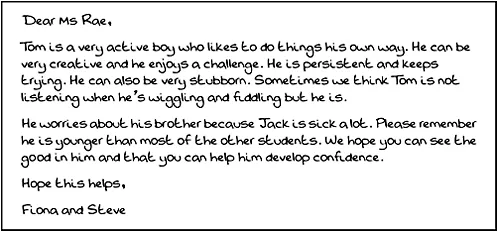
The strategies in this chapter have been designed to help teachers get to know students – their goals, self-beliefs and preferred learning conditions. Parents are also a great source of information about children. Many teachers set up a brief information night at the beginning of the year to find out about their students from parents. Some schools ask parents to write to them about their children. This requires little work on behalf of the teacher but reveals much useful information.
Build trusting relationships
Developing trusting relationships among students and with teachers can promote better communication and minimise behavioural problems. Teachers can help break down the power relationships that exist in some classrooms and inhibit the development of trusting relationships. For example, teachers might tell students why they are lucky to have them as a teacher and then ask students to tell them why the teacher is fortunate to have them in the class.
The A Letter to My Teacher worksheet (page 23) provides a written structure to collect information that might be the basis for developing relationships. The following questions could also be used for the same purpose at a class or individual level:
- How do you feel about your learning?
- What are you looking forward to this year/term?
- What do you really want to learn?
- What annoys you at school?
- What worries you about learning?
- What do you want your teacher to know about you?
- What could you do to help others at school?
- What excites you about learning?
- What motivates you to want to learn?
- What are some of your goals for this year?
- What are some of your challenges for this year?
- How do you want the teacher to help you learn?
A ‘Worries Postbox’ can be placed in the classroom for students to post their concerns. Ensure the concerns are responded to promptly or students will stop using the postbox.
Shared decision making
Where joint decision making is used in the classroom, teacher preparation is important. Teachers must first decide on what’s negotiable and what’s not. Some aspects of the curriculum that may be considered for negotiation are classroom activities, rules, routines, homework and assessment.
Approaches to negotiation can vary. For example, learning centres, projects or contracts might be used to negotiate classroom activities. Parameters relating to length of time or who is involved must also be considered and made explicit.
Value individuals and develop self-esteem
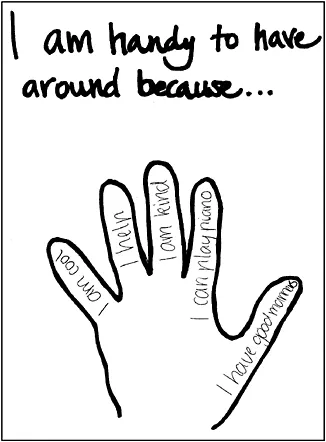
Frequent and explicit demonstrations that we value each other’s ideas and contributions help to build self-esteem. Pats on the back (literal and metaphoric) at the end of the day are a nice way to encourage the values we respect at school. For example, the teacher might say, ‘I’d like to give Ethan a pat on the back for listening so well today. Who else would like to give someone a pat on the back?’ This can be varied in many ways, focusing on recognising individual strengths.
As visitors to classrooms, we are often surprised to find that students do not know everybody else’s names. The importance of this should not be underestimated. Not knowing (or using) others’ names makes it hard to communicate effectively and work with others. When names are used, a person’s contribution is publicly acknowledged. One frequently used classroom method for learning names and the qualities of individuals is to construct a class directory or website (see Chapter 4).
Develop communication skills
Communication skills depend on a healthy team spirit and both are essential for effective cooperative team work. Two important communication skills are active listening and assertive speaking. The former is often considered a problem in classrooms and requires much reinforcement and frequent teacher modelling.
The importance of communication skills must be clearly demonstrated to students. For example, activities that require students to follow directions to achieve a group goal are useful. Simulation and role-play can also highlight difficulties associated with ineffective communication. The Fishbowl strategy (page 28) can be used to demonstrate communication skills.
It is useful to spend time reflecting on and reinforcing important communication skills and preferred ways of working with each other. The table below is an exam...