- 304 pages
- English
- ePUB (mobile friendly)
- Available on iOS & Android
eBook - ePub
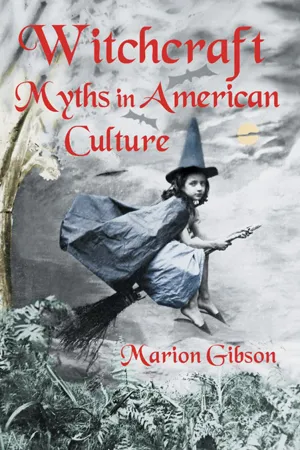
Witchcraft Myths in American Culture
About this book
A fascinating examination of how Americans think about and write about witches, from the 'real' witches tried and sometimes executed in early New England to modern re-imaginings of witches as pagan priestesses, comic-strip heroines and feminist icons.
The first half of the book is a thorough re-reading of the original documents describing witchcraft prosecutions from 1640-1700 and a re-thinking of these sources as far less coherent and trustworthy than most historians have considered them to be.
The second half of the book examines how these historical narratives have transformed into myths of witchcraft still current in American society, writing and visual culture. The discussion includes references to everything from Increase Mather and Edgar Allan Poe to Joss Whedon (the writer/director of Buffy the Vampire Slayer, which includes a Wiccan character) and The Blair Witch Project.
Information
1
E PLURIBUS UNUM? MYTHIC AND MISSING HISTORIES AND THE POLITICS OF AMERICAN WITCHCRAFT
“Stop” says the seventeenth century, “stop, my conceited nineteenth, before you fling your stones at me. … Every century, my vainglorious nineteenth, has its own glasshouse; and yours may yet be spacious enough to merit the name of a crystal palace.”
“The project of memorializing the New England past … became, in the long run, more of a rattling of the skeletons in the closet.”1
Witchcraft in the New World
In the century and a quarter after the founding of the Jamestown colony announced the arrival of large numbers of European settlers on America’s northeastern shores, we know that at least three hundred and fifty cases of witchcraft were reported to the colonial courts of the “New World.” Many more people were accused or believed guilty of the crime without the matter ever coming to court: statements made by and against them as well as scattered references in contemporary records remind us of their existence, but without revealing to us the true number of those suspected. It is almost certainly much larger, over five hundred — and many people undoubtedly carried on magical practices without ever thinking of them as witchcraft, until it appeared that their neighbors thought differently. The records of many courts are also incomplete, which allows us to imagine that accounts of other trials may have been lost and makes the events of some trials very difficult to follow. Surviving documents show that between thirty-eight and forty people were hanged for witchcraft offenses (witches were not burned in America, contrary to one of many persistent myths). Yet even here it is quite possible that the true number was higher. Some executions are known only through a chance reference, and sometimes it is not made clear even in otherwise complete records whether a convicted witch was executed as was legally warranted, or not. We know, then, that witchcraft was a subject of great interest to early Americans, and that they took pains to record its occurrence among them. But we can also see that the information we have about the place of witchcraft in their differing colonial cultures has built-in unreliabilities and gaps, in which conflicting interpretations, myth, and confusion can flourish.
There are great stories to be told about American witches and their accusers — and also some unexpected contradictions lurking behind the stereotypes to which we have all become accustomed. The surprises start with the first person we know to have been accused of witchcraft in America. She was not from Massachusetts, which has become famous for its “Salem” witchcraft trials and has a reputation for enthusiastic witch-hunting. She was not from Connecticut, which executed the highest number of witches. She was not even from Puritan New England. Joan Wright, who was accused of witchcraft in the surprisingly early year of 1626, was from Virginia. In fact, even with the massive loss of records during the Civil War, Virginia is not that far behind Connecticut in the number of people whom we know were suspected of witchcraft in the colony during the time that witchcraft was a criminal offense.2 Before 1730 Connecticut proper, excluding New Haven and New York territories, saw at least forty-three cases in which a text was created detailing the crimes of a suspected witch: Virginia had thirty, including the last known case. Massachusetts had the largest number: eighty-two without the “Salem” or more properly “Essex County” cases, which by themselves totaled just over 140 for whom formal records remain. One contemporary source speaks of up to two hundred more accused. Maryland, meanwhile, has only ten recorded witches. New Hampshire, in the period of its judicial union with Massachusetts and afterward, has twelve, while Maine (with a similar political history) has four. Many of its residents were displaced by “Indian” wars and returned to Massachusetts, where, as Mary Beth Norton has shown, they took part in the Essex County witch trials, so that these figures are certainly distorted. Plymouth, later part of Massachusetts, had two cases. New Haven, before its absorption by Connecticut, had nine, and the parts of New York governed by Connecticut five, with three elsewhere in the colony or under English rule. North Carolina had one; Rhode Island had one, and was a place to which witches accused elsewhere traditionally fled; and Pennsylvania had six.3
Witchcraft was defined in two ways, in practice if not formally in law — and, as we shall see, laws and their enforcement differed between colonies. The first definition involved the making of a pact or covenant with Satan or a familiar spirit by the suspected witch, which was in itself a hanging offense. But second, that pact enabled the witch to cause harm to people, animals, and goods, and such unexplained misfortune was often the way in which the presence of a witch could initially be identified. Suspicion might then fall on a person who was known to wish ill to the victim, and evidence of this could be given in court, from which it might be inferred that the accused had made a demonic covenant. But other magical offenses also came under the umbrella of “witchcraft,” although they seldom involved the death penalty. Included in the figures above are also witchcraft-related cases: accusations of practicing divination, of fortune-telling, or of reading and using magical books, and also cases where those who had hastily executed a suspected witch on board ships bound for America were themselves tried. These all add information about the culture of witchcraft prosecution in America. Finally, there are further details about who was suspected and why, even if their cases never came to court, in the substantial number of records of slander suits brought by those who had been called “witch” and had decided to fight back. After 1730, witches were no longer being formally accused, and slander suits had tailed off, too, although clearly magical beliefs and even lynchings and other kinds of antiwitchcraft violence persisted. In Virginia, the last case that I have identified (in 1730) resulted in a woman being convicted of using witchcraft to find treasure or lost goods and being whipped. But 1730 was also the year in which Benjamin Franklin published in the Pennsylvania Gazette a satirical account of a fake witchcraft trial in which four people (accused and accusers) were tried by being weighed against a Bible and swum to see if they would float. Among their supposed crimes were making sheep dance and hogs sing psalms. Attitudes were changing decisively, and 1730 will be the end date of this chapter’s account of early American witchcraft texts.4 It must also be said that new cases of witchcraft are being uncovered quite frequently in repositories and libraries: the subject is by no means cut-and-dried, and all the documents that we have can only give us a provisional understanding of the offense and its appearance in the courts.5
How, then, can we best explore this vast, incomplete, and complex body of texts — telling the stories of early American witches and their accusers while acknowledging the importance of local differences among the original American colonies, the fragmentary nature of the texts about witches, and the multiplicity of theories and interpretations of what witchcraft meant? This book attempts to do just that, focusing on differences, gaps, and interpretive choices not just as problematic but rather as important and interesting in their own right. The first chapter explains the colonial legal systems that tried the witches, before exploring the ways in which their stories were recorded, delving into the importance of lost records and untold histories, and finally analyzing how American historians began in the mid-nineteenth century to think about their country’s witchcraft history in the (rather unexpected) terms of local politics and interstate rivalry.
American Law, Courts, and the Records of Witchcraft Prosecutions
The whole tenor of American courts was very different to that of English Assizes, where the mother country usually tried her witches. Where England had a largely unified, fixed system, Americans embraced difference, inclusivity, and flexibility as rights. So when someone was accused of witchcraft in one of the American colonies, his or her path to court, the verdict, and the sentence depended to a great extent on where he or she lived, on the circumstances of the accusation, who was involved in accusing and judging him or her, and on the period in which the trial took place.6 Each colony had its own legal code, most of them specifying particular demonic or magical crimes, and offenses of slander that could be applied to witchcraft cases. Massachusetts and Connecticut and the territories that they governed based their fundamental laws on biblical injunctions concerning witches, notably that they should not be suffered to live, as did New Haven and Plymouth. The laws did not concentrate on the harm witches were thought to do to their victims (maleficium) but rather on witches’ offenses against God. Virginia, Rhode Island, and Maryland adopted English witchcraft laws, which were more worldly in their focus on maleficium, as did the colonies later under English rule, such as New York. Meanwhile Pennsylvania, and New York when it was under Dutch rule, had no witchcraft laws at all. Pennsylvania adopted a mass of English statutes in 1718 and the Witchcraft Act was among them. This was one of a number of surprisingly late adjustments to colonial laws on witchcraft: in 1712, for example, South Carolina adopted English witchcraft law but no evidence of formal proceedings against witches there has yet been found.
The importance of apparently dry legal forms to the history of witchcraft and its literature becomes obvious when we see that no sooner had previously witch-free New York adopted English laws, in the form of the “Duke’s Laws” in 1665, than a witchcraft trial was recorded.7 Although the Duke’s Laws did not specify the crime, English law did, and it seems that therefore witchcraft was accepted as an offense worthy of investigation. Ralph and Mary Hall of Long Island were immediately indicted at an Assize court. Ralph, a substantial freeman, was acquitted and Mary was found to be suspicious but not guilty to the extent that she should be executed. Yet this was hardly a regular English verdict (which should have been “guilty” or “not guilty”), and the penalty was also unusual (imprisonment or hanging were the English penalties for conviction).8 Neither acquitted nor condemned, Mary Hall was sentenced to appear for monitoring before each subsequent court session for as long as the couple continued to live in New York. They were released from further court appearances and bonds by the governor three years later.9 Another witchcraft matter also came to the English governor’s attention in New York in 1670. The inhabitants of Westchester petitioned him that a woman newly arrived in their town from Connecticut be asked to leave because she had previously been suspected of witchcraft. This woman, Katherine Harrison (of whom we will hear more later), refused to leave despite her neighbors being granted their petition, and a month later the governor agreed to meet her and her opponents to resolve their differences. There was no trial, and Harrison was allowed to stay.10 New Yorkers prosecuted very few witches — but when they had a legal process in place, however shakily, complaints and prosecutions did occur.
Even where there were no witchcraft laws, however, a way might be found to indict witches. In 1683 in Pennsylvania, which completely lacked witchcraft statutes, two suspected witches were referred to the governor and council: Margaret Mattson and Yeshro Hendrickson, accused at Philadelphia. The allegations against them were taken as far as a trial, although since the indictment itself is lost it is not clear how the charges were legally (or illegally?) expressed. Like Mary Hall, Mattson was found guilty only of having the “Comon fame” of being a witch and not of the crime itself. This was not the complete acquittal that some historians have supposed: as we have seen, it still indicated suspicion, and might lead to further legal measures. In 1695, too, the Quakers of the Chichester and Concord meeting in Pennsylvania also investigated two of their members for practicing astrology and other magic, and took the matter as far as court, where one was admonished and fined. In 1701 two more Philadelphia “witches,” Robert Guard and his wife, brought what was in effect a slander suit against accusers by petitioning the governor and council, but the case was dismissed as “trifling” and the accusers went unpunished. Despite their lack of a law, then, Pennsylvanians brought witchcraft and witchcraft-related cases almost as often as New Haven’s inhabitants and more often than the people of Plymouth, Rhode Island, or New York.
A witchcraft case and the records that went with it began when someone felt strongly enough that a neighbor was a witch to complain to the magistrate about him or her. The suspect would be questioned by the magistrate or “assistant” (so called in some colonies because magistrates assisted in colonial government). Testimony would be collected from the suspect’s accusers and written down to be sent to a higher court. But the constant proliferation of new communities in America meant that pragmatic modifications to this process and the trial itself were inevitable. Court systems took time to develop when the priorities were finding food and building homes, and if a person was accused of witchcraft in a new colony or town then judicial processes had to take that into account. So, for example, in Springfield, Massachusetts, in the 1630s, a court specific to the new town was given power over all offenses including capital crimes. There was no requirement for a higher court to become involved. No witchcraft cases were tried, as far as we know, but they could have been if necessary, in a way unprecedented in English law.11 New settlements were also often far from the centers of colonial governance, easily cut off by winter or “Indian” wars. In such cases, the local magistrate might be given the power to hold further hearings in his own court, and to delay the transportation of the suspect to a higher court that would eventually judge him or her. Some colonies also suffered periods of turbulence that made normal judicial processes impossible, such as Maryland’s mini–civil war, known as “the plundering time,” in the mid-1640s, or the northern Pequot wars.12 Even a mild version of this kind of disruption would influence the making and keeping of records, and it is almost certain that some undocumented witchcraft cases from early America have simply disappeared.
This is made more likely because written evidence was intended only an aide-mémoire. The spoken word had more power than the written one, and the story had to be told verbally in court. To this end, courts enforced attendance strictly. In 1656 the County Court of Hampshire, into which Springfield was eventually incorporated, was not impressed by accuser Sarah Bridgeman’s written testimony or her excuse that she could not attend court because she was “weeke and with childe”— even though the constable endorsed it with the statement that she “is not abele to a peare at this court with out hassard to her life.”13 The Massachusetts Court of Assistants jury and the General Court prevented the conviction for witchcraft of Hugh Parsons of Springfield in 1652 partly because evidence against him had not been given in person in Boston.14 So important was verbal testimony that commissioners might even be deputed by a superior court to investigate a case locally, so that the suspect and witnesses could be interviewed initially without leaving their hometown. Commissioners were sent to hear Eunice Cole’s accusers at Hampton, New Hampshire, in 1673 because there were no resident assistants, and Hampton was a long way from Boston, where the Court of Assistants met.15 In such cases, the suspect might take several months to progress to the next stage of the legal process, or he or she might never reach it at all if the case could be resolved locally. Any records might at this stage be lost, or pared down. But as the colonies grew and became more stable, increasingly the assumption was that the local magistrate would pass on all written depositions to a higher court that would continue the case.
In the early years of each colony, this was generally the highest (and often only) colonial court. But as the colonies developed, the court to which the magistrate would forward the less serious depositions — such as those in slander cases or where there were accusations that a suspect had been heard muttering magical words — was often at town, county, or equivalent level.16 Since the 1620s Virginia, for example, had had county courts, which could hear capital cases until 1628 and for a brief period during the English interregnum. This provision was, however, unusual and county courts normally dealt with lesser offenses.17 The testimonies taken by the original magistrate would be sent to the place where the court was meeting, and indictments would be drawn up based on the depositions. These would usually be examined first by a grand jury to see if they were worthy of the court’s attention, and then determined by a petty jury and the panel of magistrates. If a witchcraft case was not judged to involve a capital offense, the matter would in most cases be resolved here. For example, John Bradstreet, presented to Essex County Court, Massachusetts, for reading a magic book and conversing with the devil, was judged (he was found guilty only of lying) and sentenced at Ipswich and that was the end of the matter.18
When a case involved a capital crime, however, it usually went straight to the higher judicial level. The higher courts were, essentially, the governing body of the colony in one of its forms, and they were roughly equivalent to the English Assizes in the witch-trial procedure: indeed, some of them were renamed “Assizes” in Massachusetts and Connecticut in the 1680s, and they were also so called, as we ...
Table of contents
- Cover
- Title
- Copyright
- Contents
- Introduction
- 1. E pluribus unum? Mythic and Missing Histories and the Politics of American Witchcraft
- 2. “Our Witch”: Local Histories of America’s Witches
- 3. “There’s a Little Witch in Every Woman”: Psychology and the Social History of Witches
- 4. “We Will Not Fly Silently Into the Night”: Wicca and American Witchcraft
- 5. Witches in the Family: Comedy, Drama, and the Acceptance of American Witches
- Notes
- Bibliography
- Index
Trusted by 375,005 students
Access to over 1.5 million titles for a fair monthly price.
Study more efficiently using our study tools.
Frequently asked questions
Yes, you can cancel anytime from the Subscription tab in your account settings on the Perlego website. Your subscription will stay active until the end of your current billing period. Learn how to cancel your subscription
No, books cannot be downloaded as external files, such as PDFs, for use outside of Perlego. However, you can download books within the Perlego app for offline reading on mobile or tablet. Learn how to download books offline
Perlego offers two plans: Essential and Complete
- Essential is ideal for learners and professionals who enjoy exploring a wide range of subjects. Access the Essential Library with 800,000+ trusted titles and best-sellers across business, personal growth, and the humanities. Includes unlimited reading time and Standard Read Aloud voice.
- Complete: Perfect for advanced learners and researchers needing full, unrestricted access. Unlock 1.5M+ books across hundreds of subjects, including academic and specialized titles. The Complete Plan also includes advanced features like Premium Read Aloud and Research Assistant.
We are an online textbook subscription service, where you can get access to an entire online library for less than the price of a single book per month. With over 1.5 million books across 990+ topics, we’ve got you covered! Learn about our mission
Look out for the read-aloud symbol on your next book to see if you can listen to it. The read-aloud tool reads text aloud for you, highlighting the text as it is being read. You can pause it, speed it up and slow it down. Learn more about Read Aloud
Yes! You can use the Perlego app on both iOS and Android devices to read anytime, anywhere — even offline. Perfect for commutes or when you’re on the go.
Please note we cannot support devices running on iOS 13 and Android 7 or earlier. Learn more about using the app
Please note we cannot support devices running on iOS 13 and Android 7 or earlier. Learn more about using the app
Yes, you can access Witchcraft Myths in American Culture by Marion Gibson in PDF and/or ePUB format, as well as other popular books in Social Sciences & Early American History. We have over 1.5 million books available in our catalogue for you to explore.