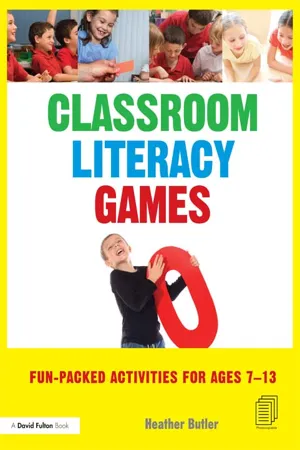
Classroom Literacy Games
eBook - ePub

Classroom Literacy Games

Fun-packed activities for ages 7-13

  1. 122 pages
  2. English
  3. ePUB (mobile friendly)
  4. Available on iOS & Android
eBook - ePub

Classroom Literacy Games

Fun-packed activities for ages 7-13

About this book

Children enjoyed it so much they didn't realise they were being worked so hard.Jo Miles, Learning Support Assistant at Manor Farm Community Junior School, Hazlemere, Buckinghamshire

Great speaking and listening activity-setting-up ideas for the Big Write. The games extended the children's vocabulary. Purposeful learning – love it!Liz Pilgrim, Senior Teacher at Manor Farm Community Junior School, Hazlemere, Buckinghamshire

Educational games played in groups or pairs help develop key language and social skills. Based on a range of material to extend vocabulary, punctuation and cross-curricular creativity, Classroom Literacy Games contains original games with suggestions of how to develop writing tasks after playing them.

Each game is differentiated four ways and aims to teach literacy (including vocabularly, connectives, openers and punctuation) to higher KS1, KS2 and lower KS3. Printed with dyslexia-friendly fonts, these cross-curricular games are suitable for mixed-ability classrooms, small groups or one-to-one teaching situations. As either photocopiable resources to be used in the classroom or as homework activities, these games will create situations to generate creative writing and for the children to create their own games. They can also be used for EAL, guided reading and weekly Big Write exercises.

With minimal preparation time required and a vast number of games, these user-friendly, pick-up-and-go activities will be of interest to any practicing primary and lower KS3 teacher.

Trusted by 375,005 students

Access to over 1.5 million titles for a fair monthly price.

Study more efficiently using our study tools.

Information

Publisher
Routledge
Year
2015
Print ISBN
9781138834811
eBook ISBN
9781136728846

1 Punctuation Pieces

A competitive (or non-competitive) game for pairs and small groups working with an adult
Punctuation Pieces helps children recognise what punctuation is, where it needs to go and how it adds meaning to groups of words.
It also:
  • helps children use vocabulary associated with punctuation
  • encourages children to see that punctuation is integral to interesting sentences
  • is good for researching the Second World War and the Tudors
  • includes a ‘learn how to play’ game about sandwiches, which introduces children to the game before they create their own
  • allows all children in a mixed-ability class to engage in the same activity
  • includes a template for children to create their own game.

What children do

  • Read sentences noting how punctuation is used.
  • Working together, move a counter round a board, collecting words and punctuation to recreate given sentences.
  • Create their own game.

Time

20-30 minutes

Provided

‘Learn how to play’ game followed by two games based on the Second World War and the Tudors. Each of the full games includes:
  • 4 sets of sentence sheets (the easiest is first, the hardest last) with necessary punctuation written underneath each sentence
  • 4 boards, one for each of the sentence sheets, with words and punctuation
  • template for children to make their own game.

Other resources needed

  • something to write with - if competitive, each child needs a coloured pen/pencil that is ‘their’ colour to underline the words/phrases they claim as theirs
  • counters - one per pair/group if non-competitive; one per person if competitive
  • dice - one per pair/group.

Other preparation

  • Decide which game level/information is best for each pair/group and photocopy the appropriate sentence sheets, one per pair/group.
  • Photocopy the appropriate boards - these must correspond to the sentence sheets.

Instructions for playing Punctuation Pieces

  1. 1 Hand out sentence sheets suitable for each pair/group.
  2. 2 Working in pairs, read them out loud, actually saying the words for the punctuation, including capital letters. ‘In 1940, British and French soldiers’ would be read as ‘capital letter in 1940 comma capital letter British and capital letter French soldiers’.
  3. 3 Now hand out boards and counters - one board per pair and one counter per pair/group if non-competitive; one counter each if competitive. Children may enjoy decorating the empty boxes with suitable illustrations at some point.
  4. 4 Less able children could read the words on their board before beginning.
  5. 5 Explain the game
    Children move a counter around the board to collect words and punctuation needed for each sentence. As they claim punctuation or words/phrases, they underline it on the sentence sheet until everything is underlined. If playing competitively, children underline words in their own colour. The child with the most words underlined is the winner.
  6. 6 Read the first sentence on the sentence sheet and locate all the parts of that sentence (including necessary punctuation) on the board.
  7. 7 Place the counter on the START box and roll the die. The counter can be moved in straight lines in any direction (up, down, across or diagonally). If it reaches an empty box or can go no further, the counter can be moved in any direction as long as it does not revisit a box it has already landed on during this turn.
  8. 8 If, after moving the counter, it is in a box with any part of the first sentence or its punctuation, underline the words on the sentence sheet (not on the board as some phrases are used more than once).
  9. 9 If playing competitively, children take it in turns to roll the die and underline words on the sentence sheet using their own colour. At the end, the number of words/pieces of punctuation underlined are added up to find the winner.
  10. 10 Phrases/words/punctuation pieces can be used as many times as they are landed on.
  11. 11 If, at the end of their turn, a player lands on the START box, they may move their counter to any box on the board and claim whatever is in that box.
  12. 12 Once the first sentence is completed, children move on to the second sentence and repeat the process until all sentences and necessary punctuation are underlined.
  13. 13 Hand out the dice and begin playing.

Teacher's notes

Before playing

Children need some knowledge about the topic so that they can write their initial sentences when making their own games.
Encourage children to see the games provided as models for how to make their own.

Differentiation

The ‘learn how to play’ easy version of the game about sandwiches is aimed at difficulty level 2. This is so that children can find out how the game works before creating their own games based on their own research.
Following that are two games based on the Second World War and the Tudors.
Each set of the full games has four levels of difficulty.
Easiest game — level 1 — Dunkirk and Henry VIII
These games use capital letters, full stops, commas and the easiest vocabulary and reading levels.
  • sentences need capital letters and full stops
  • proper nouns need capital letters
  • commas in numbers above 999
  • commas in lists.
Second easiest game — level 2 — Battle of Britain and Life in Tudor Times
These games use capital letters, full stops, commas, speech marks and exclamation marks.
  • sentences need capital letters a...

Table of contents

  1. Front Cover
  2. Half Title
  3. Title Page
  4. Copyright
  5. Contents
  6. Acknowledgements
  7. 1 Punctuation Pieces
  8. 2 In Other Words
  9. 3 Four Starters
  10. 4 Cunning Connectives
  11. 5 Cool Sentences
  12. Index

Frequently asked questions

Yes, you can cancel anytime from the Subscription tab in your account settings on the Perlego website. Your subscription will stay active until the end of your current billing period. Learn how to cancel your subscription
No, books cannot be downloaded as external files, such as PDFs, for use outside of Perlego. However, you can download books within the Perlego app for offline reading on mobile or tablet. Learn how to download books offline
Perlego offers two plans: Essential and Complete
  • Essential is ideal for learners and professionals who enjoy exploring a wide range of subjects. Access the Essential Library with 800,000+ trusted titles and best-sellers across business, personal growth, and the humanities. Includes unlimited reading time and Standard Read Aloud voice.
  • Complete: Perfect for advanced learners and researchers needing full, unrestricted access. Unlock 1.5M+ books across hundreds of subjects, including academic and specialized titles. The Complete Plan also includes advanced features like Premium Read Aloud and Research Assistant.
Both plans are available with monthly, semester, or annual billing cycles.
We are an online textbook subscription service, where you can get access to an entire online library for less than the price of a single book per month. With over 1.5 million books across 990+ topics, we’ve got you covered! Learn about our mission
Look out for the read-aloud symbol on your next book to see if you can listen to it. The read-aloud tool reads text aloud for you, highlighting the text as it is being read. You can pause it, speed it up and slow it down. Learn more about Read Aloud
Yes! You can use the Perlego app on both iOS and Android devices to read anytime, anywhere — even offline. Perfect for commutes or when you’re on the go.
Please note we cannot support devices running on iOS 13 and Android 7 or earlier. Learn more about using the app
Yes, you can access Classroom Literacy Games by Heather Butler in PDF and/or ePUB format, as well as other popular books in Education & Education General. We have over 1.5 million books available in our catalogue for you to explore.