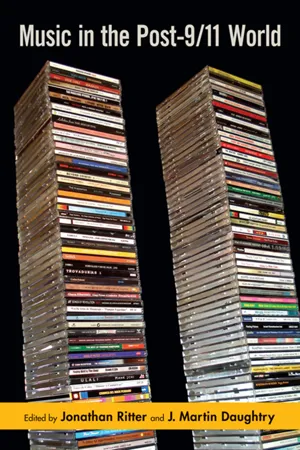
Music in the Post-9/11 World addresses the varied and complex roles music has played in the wake of September 11, 2001. Interdisciplinary in approach, international in scope, and critical in orientation, the twelve essays in this groundbreaking volume examine a diverse array of musical responses to the terrorist attacks of that day, and reflect upon the altered social, economic, and political environment of "post-9/11" music production and consumption. Individual essays are devoted to the mass-mediated works of popular musicians such as Bruce Springsteen and Darryl Worley, as well as to lesser-known musical responses by artists in countries including Afghanistan, Egypt, Mexico, Morocco, Peru, and Senegal. Contributors also discuss a range of themes including the role played by Western classical music in rites of mourning and commemoration, "invisible" musical practices such as the creation of television news music, and implicit censorship in the mainstream media. Taken as a whole, this collection presents powerful evidence of the central role music has played in expressing, shaping, and contesting worldwide public attitudes toward the defining event of the early twenty-first century.
eBook - ePub
Music in the Post-9/11 World
- 360 pages
- English
- ePUB (mobile friendly)
- Available on iOS & Android
eBook - ePub
Music in the Post-9/11 World
About this book
Trusted by 375,005 students
Access to over 1.5 million titles for a fair monthly price.
Study more efficiently using our study tools.
Information
Subtopic
EthnomusikologiePart One:
Music, the United States, and the Mass Media After 9/11
1
Pop goes to War, 2001–2004:
U.S. Popular Music after 9/11
Mainstream popular music in the United States has always provided a window on national politics. The middle-of-the-road sensibilities of Tin Pan Alley told us as much about societal values in the early twentieth century as rock and roll’s spirit of rebellion did in the fifties and sixties. To cite but one prominent example, as the war in Vietnam escalated in the mid-sixties, popular music provided something of a national referendum on our involvement. In 1965 and 1966, while the nation was sorely divided on the issue, both the antiwar “Eve of Destruction” by Barry McGuire and the military ode “The Ballad of the Green Berets” by Barry Sadler hit number one within months of each other. As the war dragged on through the Nixon years and military victory seemed more and more remote, however, public opinion began to turn against the war, and popular music became more and more clearly identified with the antiwar movement.
Popular music—and in particular, rock—has nonetheless served contradictory functions in American history. While popular music fueled opposition to the Vietnam War at home, alienated, homesick GIs eased the passage of time by blaring those same sounds on the battlefield (as films such as Apocalypse Now and Good Morning, Vietnam accurately document). Rock thus was not only the soundtrack of domestic opposition to the war; it was the soundtrack of the war itself. This phenomenon was not wasted on military strategists, who soon began routinely incorporating music into U.S. military “psychological operations.” When the United States invaded Grenada in 1983, one of the first military objectives was to take over the government-run radio station. Just before Manuel Noriega was arrested in Panama, the military “blasted” him out of his compound with barrages of high-volume rock. The United States has used rock more recently in similar ways throughout the Middle East. In some sense, then, rock has become the sound that the U.S. military uses to announce its presence in foreign lands. Still, until recently, popular music—or what I would identify more precisely as the rock and rap axis of popular music—has been linked primarily with liberal to left-wing issues and causes.
In the mid-eighties and nineties, a new chapter in the politics of American popular music opened with a series of globalized fund-raising concerts and politicized rock and rap songs, all addressing a range of social issues that included hunger and starvation in Africa, apartheid, the deteriorating environment, homelessness, child abuse, racism, AIDS, industrial plant closings, and U.S. intervention in Central America, to name but a few. Providing a counterpoint to this liberal humanitarian impulse, the Parents Music Resource Center, joined by a number of conservative Christian organizations, waged a campaign against popular music to promote their vision of a more wholesome culture. In this way popular music became a primary site of contestation over American values and identities, with conservatives (and some prominent liberals) opposing prevailing musical practices at every turn.
Then came September 11, 2001. The terrorist attacks that leveled the World Trade Center towers, blew a hole in the side of the Pentagon, and crashed a plane in a Pennsylvania field shook the United States out of its sense of security, elicited sympathy (however short-lived) from nations around the world, and plunged the economy into a prolonged tailspin. The role of contemporary popular music also changed dramatically as it adjusted to this new political reality. If popular music had previously been associated with rebellion, defiance, protest, opposition, and resistance, it would now be used in the service of mourning, healing, patriotism, and nation building. In this new order, the dissent—and in particular the antiwar protest music—that helped provide the basis for the national debate on Vietnam was nowhere to be found on mainstream media during the invasions of Afghanistan and Iraq. If anything, country anthems that pushed the envelope in support of government policy seemed more likely to capture the popular imagination.
As Martin Cloonan has argued, “post 9/11 it became increasingly hard for musicians to express dissent, not because music had lost its power to be able to do this, but because of a changed political climate.”1 This new political context included decisive conservative control over all three branches of government, legislation and executive practices that privileged national security over civil liberties, and concentration and consolidation in the music industry itself that narrowed the diversity of voices in the musical marketplace. The purpose of this essay is to document the events that have ushered in this new context within the American mediascape, and discuss their effects on freedom of expression generally and on popular music as a social indicator in particular. I focus on five aspects of this recent history: (1) initial popular music responses to 9/11; (2) the role of country music in endorsing military action; (3) the new conservative activism of corporate radio; (4) musicians’ responses to government disincentives to political protest; and (5) fledgling attempts by progressive musicians to engage the political process.
Initial Responses
While the initial shock of 9/11 briefly transformed all media into news outlets—and, for a time, even held out the possibility that hard news might replace the tabloid fare consumers had come to expect—people soon returned to music to minister to their emotional (if not their intellectual) needs. In fact, the music industry was among the first to mount an institutional response to the tragic events. In addition to massive individual contributions—Dr. Dre, for example, personally donated one million dollars to the victim-relief effort and countless others earmarked proceeds from tour dates—the music/entertainment community turned to the ensemble benefit concerts and all-star recordings that had become tried and true fund-raising strategies since Live Aid and “We Are the World.”
Prior to the attacks, U2’s Bono had already recruited hip-hop producer Jermaine Dupree and artists Christina Aguilera, Backstreet Boys, Mary J. Blige, Wyclef Jean, Michael Stipe, and others to record an ensemble version of Marvin Gaye’s 1971 classic “What’s Goin’ On” for Artists Against AIDS Worldwide. In the aftermath of 9/11, they added the United Way’s September 11 Fund as a beneficiary. Arista re-released Whitney Houston’s stirring 1991 Super Bowl performance of “The Star-Spangled Banner,” with proceeds earmarked for New York firefighters. The Houston single shot up charts, peaking at number six, and sustained enough momentum to finish 2002 as the ninth most popular song of the year. Columbia rushed production on a compilation album called God Bless America, featuring a cross section of artists such as Celine Dion, Bruce Springsteen, Mariah Carey, Lee Greenwood, Bob Dylan, and Frank Sinatra, with “a substantial portion of the proceeds” earmarked for The Twin Towers Fund. Michael Jackson ultimately failed to release an ensemble recording of his new composition “What More Can I Give,” which included Destiny’s Child, Backstreet Boys, Tom Petty, and Seal, among many others, but the song was performed at the October 22 “United We Stand” benefit in Washington, D.C., which raised $3 million.
Concerts to benefit the victims of 9/11 were organized with remarkable efficiency and cooperation among all sectors of the music business. The first and most impressive of these, staged on September 21, just ten days after the attacks, was “America: A Tribute to Heroes.” The event included twenty-two performing artists and fifty actors staffing telephones, and was transmitted over the big four commercial networks, as well as thirty cable channels, without credits or commercial interruptions. The Tribute raised $160 million from its East Coast broadcast alone, making it the largest single fund-raising event in history, even before the DVD and compilation CD were released. A month later, on October 21, the “Concert for New York City” was held in Madison Square Garden. Produced by VH-1, Cablevision, Miramax, and AOL, and headlined by Paul McCartney, the concert featured a number of British and American rock acts, and generated $30 million for the New York Fire Department. Finally, the Beastie Boys organized “New Yorkers Against Violence,” a two-night fund-raiser at the Hammerstein Ballroom that brought together Moby, Michael Stipe, Bono, Mos Def, and the Strokes. Significantly, it was the only U.S.-based 9/11 event of its kind that was explicitly committed to nonviolence.
A comparison between “America: A Tribute to Heroes” and the “Concert for New York City,” produced just one month apart, reveals the trajectory of the new social role for popular music in the post-9/11 context. In the month that separated these two events, the United States invaded Afghanistan. The character of these two events thus marked the transition from the initial shock immediately following 9/11, when the nation was plunged into grief, to the more calculated and vengeful search for those responsible.
“America: A Tribute to Heroes” was an understated, reverential event, which captured the national mood during a brief moment of what I would call “gentle patriotism.” In an effort to achieve the proper tone, the tribute’s dominant aesthetic was that of MTV Unplugged, within which the event scheduled a diversity of performers including Bruce Springsteen, Bon Jovi, Mariah Carey, Alicia Keys, Faith Hill, the Dixie Chicks, Sting, Paul Simon, Limp Bizkit, Sheryl Crow, and Wyclef Jean, among others. As Kip Pegley and Susan Fast note elsewhere in this volume, the event downplayed the star power of these performers to create a sense of community that included the performers and television viewers at home. Within the generally respectful atmosphere, a number of performers articulated sentiments that hinted at the mixed concerns and competing agendas that characterized the initial response to the attacks. Will Smith introduced Mohammad Ali as a Muslim in a segment that included footage of Muslim children in America expressing fears of retaliation. In their defense, Stevie Wonder chastised those who “hate in the name of God or Allah” in his intro to “Love’s in Need of Love Today.” The only overtly conservative commentary was offered by Clint Eastwood, who referred to 9/11 as “the twenty-first century’s day of infamy.” If Tom Petty’s toned down, but still somewhat aggressive, rendition of “I Won’t Back Down” was a call to arms for the nationalist project that was about to get underway, it was offset by Neil Young’s stirring performance of John Lennon’s “Imagine,” which conjured up visions of a world with neither religions nor countries and “nothing to fight or die for.” And if something like Celine Dion’s bloated arrangement of “God Bless America” was considered obligatory for a moment like this, noticeably absent was “The Star-Spangled Banner” with its “rockets’ red glare” and “bombs bursting in air.” It should also be noted that the all-cast version of “America the Beautiful” led by Willie Nelson that closed the show included the second verse, which calls on America to “Confirm thy soul in self-control/Thy liberty in law.”
If “America: A Tribute to Heroes” attempted to be a muted, measured response to the tragedy of 9/11, the “Concert for New York City” was a grand, commercialized, public extravaganza staged at Madison Square Garden that announced to the world, as host Billy Crystal said in his opening remarks, “that we’re not afraid to go out”—this in contrast to the “America” tribute, which, for security reasons, was staged in undisclosed locations. Crystal then introduced “6,000 special guests”—all the firefighters, policemen, and emergency workers for whom the show was produced, who were present in uniform and assigned to the best seats in the house—in contrast to the “America” tribute, which had no live audience. While the “America” tribute tended to obscure celebrity, the New York concert welcomed it with all its attendant fanfare, as each media personality, actor, political figure, and performer was introduced by name. Crystal set the political tone for the event with his introductory comment that “We’re showing everybody that we don’t hide in caves like cowards,” a sentiment later echoed by former president Bill Clinton. The concert also offered a platform to other political figures ranging from Tom Daschle and Hillary Clinton to Geor...
Table of contents
- Cover
- Half Title
- Title Page
- Copyright Page
- Table of Contents
- Acknowledgments
- Foreword
- Charting Courses through Terror’s Wake: An Introduction
- Part One: Music, The United States, and the Mass Media After 9/11
- Part Two: Music and 9/11 beyond the United States
- Contributors
- Index
Frequently asked questions
Yes, you can cancel anytime from the Subscription tab in your account settings on the Perlego website. Your subscription will stay active until the end of your current billing period. Learn how to cancel your subscription
No, books cannot be downloaded as external files, such as PDFs, for use outside of Perlego. However, you can download books within the Perlego app for offline reading on mobile or tablet. Learn how to download books offline
Perlego offers two plans: Essential and Complete
- Essential is ideal for learners and professionals who enjoy exploring a wide range of subjects. Access the Essential Library with 800,000+ trusted titles and best-sellers across business, personal growth, and the humanities. Includes unlimited reading time and Standard Read Aloud voice.
- Complete: Perfect for advanced learners and researchers needing full, unrestricted access. Unlock 1.5M+ books across hundreds of subjects, including academic and specialized titles. The Complete Plan also includes advanced features like Premium Read Aloud and Research Assistant.
We are an online textbook subscription service, where you can get access to an entire online library for less than the price of a single book per month. With over 1.5 million books across 990+ topics, we’ve got you covered! Learn about our mission
Look out for the read-aloud symbol on your next book to see if you can listen to it. The read-aloud tool reads text aloud for you, highlighting the text as it is being read. You can pause it, speed it up and slow it down. Learn more about Read Aloud
Yes! You can use the Perlego app on both iOS and Android devices to read anytime, anywhere — even offline. Perfect for commutes or when you’re on the go.
Please note we cannot support devices running on iOS 13 and Android 7 or earlier. Learn more about using the app
Please note we cannot support devices running on iOS 13 and Android 7 or earlier. Learn more about using the app
Yes, you can access Music in the Post-9/11 World by Jonathan Ritter, J. Martin Daughtry, Jonathan Ritter,J. Martin Daughtry in PDF and/or ePUB format, as well as other popular books in Medien & darstellende Kunst & Ethnomusikologie. We have over 1.5 million books available in our catalogue for you to explore.