Winner of the prestigious Yoshida Shigeru Prize 1999 for the best book in public history when it was published in its original Japanese, this book presents a comprehensive and up-to-date overview of Japan's international relations from the end of the Pacific War to the present. Written by leading Japanese authorities on the subject, it makes extensive use of the most recently declassified Japanese documents, memoirs, and diaries. It introduces the personalities and approaches Japan's postwar leaders and statesmen took in dealing with a rapidly changing world and the challenges they faced. Importantly, the book also discusses the evolution of Japan's presence on the international stage and the important – if underappreciated role – Japan has played. The book examines the many issues which Japan has had to confront in this important period: from the occupation authorities in the latter half 1940s, to the crisis-filled 1970s; from the post-Cold War decade to the contemporary war on terrorism. The book examines the effect of the changing international climate and domestic scene on Japan's foreign policy; and the way its foreign policy has been conducted. It discusses how the aims of Japan's foreign relations, and how its relationships with its neighbours, allies and other major world powers have developed, and assesses how far Japan has succeeded in realising its aims. It concludes by discussing the current state of Japanese foreign policy and likely future developments.
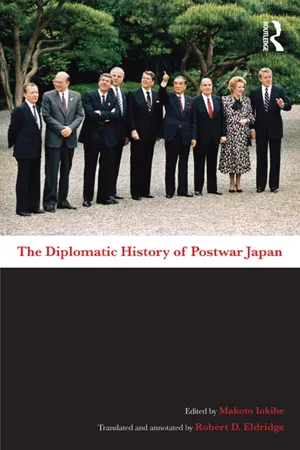
eBook - ePub
The Diplomatic History of Postwar Japan
- 258 pages
- English
- ePUB (mobile friendly)
- Available on iOS & Android
eBook - ePub
The Diplomatic History of Postwar Japan
About this book
Information
1 Diplomacy in occupied Japan
Japanese diplomacy in the 1940s
While the occupation period is, on the surface, a time in which Japan lost its diplomatic rights after accepting the terms of the 1945 Potsdam Declaration and Instrument of Surrender, it was also a time in which highly skilled diplomacy took place between Japan and GHQ, an international organization of sorts that was based in the country, on a daily basis. The negotiations between Japan and the occupation forces over continuance of the emperor system and constitutional revision would have a fundamental and long-term impact on Japan. Moreover, although Japan was defeated, its handling of the negotiations for the peace treaty and the U.S.–Japan security treaty was quite impressive.
The formation of U.S. occupation policy
For modern Japan, the international environment has always been important. No external factor has had as deep an impact on Japanese society, however, as did the occupation period. Japan’s extreme antiforeign, exclusionary, go-it-alone approach that had formed the basis of its expansionary wartime policies had in the end the opposite effect, causing the outside world to occupy and control Japan. The occupation policies, as external factors, were planted in the soil of traditional Japanese society, and what emerged was postwar Japan. It is necessary therefore to look at how these external factors—the occupation policies—were developed and how they were introduced into Japan.1
Postwar planning began before America’s participation in the war
Occupation policy was formulated by the United States, the same country that played a central role in bringing about the surrender of Japan. The U.S. government began preparing for the postwar world at an early point, even before it was actually involved in World War II. With the outbreak of war in Europe in September 1939, more than two years before America’s entry into the war in December 1941, Secretary of State Cordell Hull directed that studies be quietly begun on the future postwar world, establishing an advisory committee within the State Department as well as obtaining substantial support from the “War and Peace Study” conducted by the Council on Foreign Relations in New York.
For America, World War II was perhaps the most fulfilling moment in its history. Not only was it economically, technologically, and militarily allpowerful, but it earnestly hoped to use this influence positively to build a new, better world after the terrible destruction of total war.
In November 1940, after winning an unprecedented third term as president, Franklin D. Roosevelt stated that the United States would be the “arsenal of democracy,” and in March 1941 Congress passed the Lend-Lease Act to permit the United States government to aid countries fighting Nazi Germany. In order to further help solidify support for the war, Roosevelt, along with British prime minister Winston S. Churchill, announced the Atlantic Charter in August 1941, calling for the creation of a new world order calling for freedom, equality, and peace.
The Japan hands and the drafting of occupation policy
Entering the war after the Japanese attack on Pearl Harbor, the United States simultaneously stepped up its planning for the postwar period. With Secretary Hull as chair, a new advisory committee for the president was established and the Special Research Division within the State Department was strengthened and expanded by bringing in many specialists from both inside and outside government, in essence creating a large internal think tank to plan for the creation of a new world after hostilities ended. A Far Eastern Unit was established in the summer of 1942, and two Japan hands, Clark University professor George H. Blakeslee, an authority on international relations and Far Eastern affairs, and Columbia University assistant professor Hugh Borton, a young specialist on Japanese history, were tapped to work on developing occupation policies for Japan.
The Atlantic Charter declared that “all States, great or small, victor or vanquished” would be allowed to participate in a postwar international economy on a nondiscriminatory basis. The Japan hands adopted this policy of egalitarianism as a guideline when drafting occupation policy. They tried to provide a chance to allow Japan to live as a peaceful economic state following its collapse as a military empire.
In order to realize this objective, the Japan hands believed that postwar Japan should be demilitarized and democratized and its territory reduced in size. At the same time, however, they argued that reforms and changes which were punitive in nature or sought to excessively intervene in the domestic affairs of Japan should be avoided. Instead, they emphasized the positive aspects of Japan’s modern history: its efforts to learn from the West and its development of an indigenous democracy as demonstrated in the period of so-called Taisho Democracy. They believed that once militarism was done away with, internationally oriented Japanese liberals would re-emerge to become the driving force behind Japan’s rebirth and reform.
Unconditional surrender
Roosevelt, however, was not willing to accept so generous a peace for an enemy like Japan. He believed that the failure to completely crush Germany militarily during World War I by accepting an incomplete armistice was one of the major reasons for Hitler’s revisionist rise and World War II. In order to maintain peace in the postwar world, Roosevelt considered it necessary not only to destroy the aggressor completely but also to give the victor the right to alter the defeated country’s mistaken beliefs and make whatever changes it desired in that country’s internal makeup. This position was made clear in the “Unconditional Surrender” declaration announced in Casablanca in January 1943.
In addition to semi-permanently rendering the aggressors powerless, the major Allied powers would have to undertake the role of “world policemen” to maintain the postwar peace. In other words, Roosevelt believed in a perpendicular world order in which the main enemy states would be placed below ordinary states under the supervision of the great powers. Since this policy was widely supported by the American people, it was likely that the justice meted out to Japan would be severe indeed.
In the Cairo Declaration of November 1943, policies regarding the disposition of the Japanese empire, namely the reduction of its territory to what it had prior to seizing through “by violence and greed,” were spelled out based on this line of thinking. Furthermore, the Teheran Conference of December 1943 emphasized the Allies’ joint will to establish a postwar order and to protect that peace by the cooperation of the great powers—the United States, Great Britain, and the Soviet Union.
By 1944, as the likely defeat of Germany and Japan became more apparent, the U.S. government found it necessary to speed up its policy planning with regard to the disposition of the enemy states. In February a Postwar Programs Committee (PWC) was established in the State Department, and in April it began focusing its discussions on actual plans for the occupation of Japan.
The two burning issues for the PWC in 1944 were the future of the emperor system and the Japanese bureaucracy. The Japan experts who were in charge of drafting the policy papers for Japan favored retaining the emperor system as a symbol of a moderate and enlightened leadership, while higher-ranking officials in the department demanded the abolishment of the emperor system, seeing it as the core of Japan’s militaristic nationalism. These officials instructed the PWC some five times to revise its drafts (PWC 93 series), but the Japan hands within the group argued that the emperor system could be an asset for America in both peace-making and occupation reforms. The PWC was not able to reach a final conclusion, and instead decided to continue to watch the situation. As for the Japanese bureaucracy, top officials in the State Department sought to suspend the powers of not only senior Japanese leaders such as the members of the cabinet and the Diet, the ministers and vice ministers of each ministry, which they called “policymaking organs,” but also most of the bureaucrats as a whole that were in charge of implementing those policies. The Japan hands, however, countered that unless the United States prepared some 500,000 troops and other military personnel who were fluent in the Japanese language for the military government, the Allies would not be able to control Japan—a highly sophisticated but different society. In the end, the PWC agreed to utilize the Japanese administrative organs for occupation purposes. Thus it can be said that while the possibility of indirect control using existing Japanese agencies was not entirely eliminated, the United States continued at this time to seek the establishment of a direct military government in Japan under the occupation forces.
According to those discussions, wide-ranging reforms of Japan focused on demilitarization and democratization would take place under a U.S.-led Allied occupation. Not only the military machinery, but also the functioning of the cabinet and Diet among other main Japanese governmental organizations would be stopped during the occupation, and a military government would be placed in charge of all functions of government, including the administrative and legislative bodies. The Japanese government would cease to exist and a military government would take its place. Amid this debate, the Japan hands continued to argue that the decision as to whether to remove the emperor and end the emperor system should be postponed in order to watch how the situation developed, and that all of the Japanese government functions should not be ended but instead used by the occupation forces. Approximately two months before the end of the war in June 1945, the policy paper known as “SWNCC 150,” calling for a direct military occupation, was drafted in June 1945 by the State-War-Navy Coordinating Committee, a coordinating body created in November 1944. The Potsdam Declaration in July subsequently overturned this policy.
The Potsdam Declaration and the revision of occupation policy
In April 1945, just as Germany was about to surrender unconditionally, Roosevelt suddenly died and was succeeded by Vice President Harry S. Truman. That spring, under the initiative of two senior statesmen intimately familiar with Japan, Under Secretary of State Joseph C. Grew and Secretary of War Henry L. Stimson, the United States considered relaxing its demands on Japan and its occupation policy. In June the U.S. government prepared the Potsdam Declaration, which moved away from the policies of unconditional surrender and direct military occupation. A number of important factors lay behind this.
First, from the time of the Yalta Conference in February of that year, the Soviet–American dispute over Poland and other issues became more pronounced, and the framework of U.S.–Soviet cooperation for German and Japanese unconditional surrender began to come apart. Second, there were voices within the U.S. government, including not only Japan hands in the State Department but also those in military and intelligence circles, that called for more moderate surrender terms toward Japan in order to bring about a quick end to the war, where American casualties were very high in the battles of Iwo Jima (February–March) and Okinawa (March–June). Third, the incredible destruction in Germany was viewed as something that should not be repeated. After visiting Germany in April, Assistant Secretary of War John J. McCloy, in a report to Stimson, described what he saw as “Hell on Earth” and suggested that the “mistake made in Germany” under the doctrine of unconditional surrender should not be repeated vis-à-vis Japan.2
In light of the above developments, Under Secretary Grew at the end of May proposed that a presidential announcement to the Japanese be made that would include more moderate demands, including the retention of the emperor system. Grew wanted to bring Japan around to surrendering before the dropping of the atomic bomb and Soviet entry into that theater of the war. Stimson agreed with Grew on the need to avoid the complete destruction of Japanese society, pointing out the names of such pro-Western leaders in the 1920s as Shidehara, Wakatsuki Reijiro, and Hamaguchi Osachi. At the same time, he felt that any statement alone would not be enough to get the Japanese military to recognize and accept defeat. Stimson thus urged that the atomic bomb, which would have a huge psychological impact on the Japanese, should be used along with such a statement, and it was the combination of these two factors that brought about Japan’s surrender.
Stimson passed the draft of the Potsdam Declaration to Truman on July 2. According to paragraph 12 of the declaration, “a constitutional monarchy under the present dynasty” was to be permitted in postwar Japan, “based on the freely expressed will by the people.” However, the new secretary of state, James F. Byrnes, deleted that line, thus removing the open guarantee of the continuation of the emperor institution, which was Japan’s primary concern.
At the same time, based on the opinion of the British at the Potsdam Conference, a decision was reached to make clearer the policy of an indirect occupation, which would allow for the continuation of the Japanese government. Paragraph 10 of the Potsdam Declaration, which stated, “The Japanese Government shall remove all obstacles to the revival and strengthening of democratic tendencies among the Japanese people,” implied that the Japanese government would assume the responsibility for democratic reforms. As the inclusion of the word “revival” suggests, the declaration recognized that Japan had developed a democracy on its own in the prewar years. Furthermore, paragraph 11 spelled out the path for Japan to rebuild as a peaceful economy, stating, “Eventual Japanese participation in world trade relations shall be permitted.”
Although tragically ignored (mokusatsu, literally “killed with silence”) initially by the Japanese government, the Potsdam Declaration, announced on July 26, was eventually accepted by the Suzuki Kantaro Cabinet on August 14, following the dropping of atomic bombs on Hiroshima (August 6) and Nagasaki (August 9) and the entry of the Soviet Union into the war (August 8).
The German surrender in May did not include any conditions—the loser was simply forced to accept all demands to be made by the victor. In this unconditional surrender the victors had carte blanche over the vanquished. The Japanese surrender of August, however, can be said to have been a “conditional surrender” based on the acceptance of the provisions appearing in the Potsdam Declaration. Japan’s “unconditional surrender” therefore could probably be best described as an “unconditional acceptance by the loser of conditions provided by the victor.” In the text of the Potsdam Declaration, it was not the Japanese “nation” but only “all Japanese armed forces” that had to “surrender unconditionally.”3
Overall, U.S. occupation policy for Japan, prepared during the war, was a balance of constructive measures—militarily disarming Japan and undoing the problems of prewar militarism, establishing democratic society in postwar Japan, and permitting Japan’s economic return to the international community. It was not punitive or destructive in nature. It was not based on revenge or hostility. The Japan specialists involved in drafting the occupation policies possessed an understanding of Japan. While with the exception of Stimson, the senior leadership did not possess any knowledge of Japan, it did not prevent them from realizing that ...
Table of contents
- Cover
- Half Title
- Title Page
- Copyright Page
- Table of Contents
- List of figures
- Preface to the English edition
- Preface to the original edition
- About the contributors
- Introduction: Japanese diplomacy from prewar to postwar
- 1. Diplomacy in occupied Japan: Japanese diplomacy in the 1940s
- 2. Conditions of an independent state: Japanese diplomacy in the 1950s
- 3. The model of an economic power: Japanese diplomacy in the 1960s
- 4. Overcoming the crises: Japanese diplomacy in the 1970s
- 5. The mission and trials of an emerging international state: Japanese diplomacy in the 1980s
- 6. Japanese diplomacy after the Cold War
- Conclusion: what was postwar Japanese diplomacy?
- Index
Trusted by 375,005 students
Access to over 1.5 million titles for a fair monthly price.
Study more efficiently using our study tools.
Frequently asked questions
Yes, you can cancel anytime from the Subscription tab in your account settings on the Perlego website. Your subscription will stay active until the end of your current billing period. Learn how to cancel your subscription
No, books cannot be downloaded as external files, such as PDFs, for use outside of Perlego. However, you can download books within the Perlego app for offline reading on mobile or tablet. Learn how to download books offline
Perlego offers two plans: Essential and Complete
- Essential is ideal for learners and professionals who enjoy exploring a wide range of subjects. Access the Essential Library with 800,000+ trusted titles and best-sellers across business, personal growth, and the humanities. Includes unlimited reading time and Standard Read Aloud voice.
- Complete: Perfect for advanced learners and researchers needing full, unrestricted access. Unlock 1.5M+ books across hundreds of subjects, including academic and specialized titles. The Complete Plan also includes advanced features like Premium Read Aloud and Research Assistant.
We are an online textbook subscription service, where you can get access to an entire online library for less than the price of a single book per month. With over 1.5 million books across 990+ topics, we’ve got you covered! Learn about our mission
Look out for the read-aloud symbol on your next book to see if you can listen to it. The read-aloud tool reads text aloud for you, highlighting the text as it is being read. You can pause it, speed it up and slow it down. Learn more about Read Aloud
Yes! You can use the Perlego app on both iOS and Android devices to read anytime, anywhere — even offline. Perfect for commutes or when you’re on the go.
Please note we cannot support devices running on iOS 13 and Android 7 or earlier. Learn more about using the app
Please note we cannot support devices running on iOS 13 and Android 7 or earlier. Learn more about using the app
Yes, you can access The Diplomatic History of Postwar Japan by Makoto Iokibe, Translated and Annotated by Robert D. Eldridge, Makoto Iokibe,Translated and Annotated by Robert D. Eldridge, Translated and Annotated by Robert D. Eldridge in PDF and/or ePUB format, as well as other popular books in Histoire & Histoire de l'Asie. We have over 1.5 million books available in our catalogue for you to explore.