- 264 pages
- English
- ePUB (mobile friendly)
- Available on iOS & Android
eBook - ePub
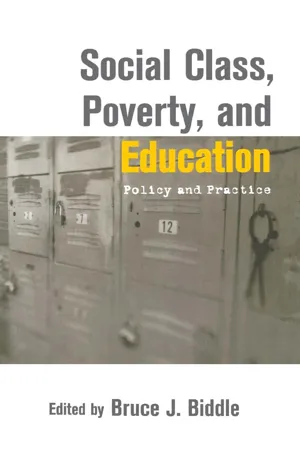
Social Class, Poverty and Education
About this book
Equal access to education is an important American ideal, yet for many years it has been unavailable to a large number of Americans living in impoverished communities. Biddle gives an insightful progress report on today's educational system.
Information
Chapter One
Poverty, Ethnicity, and Achievement in American Schools
Bruce J. Biddle
All nations begin with the issue of preventing severe poverty and disadvantage for at-risk children. The major difference we note is that other nations are able to produce [much] lower levels of child poverty than in the United States …. Our high-income children do very well in real terms compared to similar children in other nations. No one wants to take away these advantages for which the parents of these children work long and hard. What is needed is a reasonable response to the real needs of low-income American children. And as other nations have shown, there is an answer that we can find if we have the national will to face up to the sobering facts.Lee Rainwater & Timothy Smeeding (1995, p. 22)
Widespread inequalities among school districts in the financial resources available to schools and the relative allocation of finances have been carefully documented …. These findings have precipitated dozens of lawsuits against states to demand adequate and niore equitable funding practices. Most parents and educators assume that greater resources make it possible to improve schools. Nonetheless, there is considerable controversy among educational researchers over the relationship between school finance and students' achievement.Marta Elliott (1998, p. 223)
This volume concerns the complex set of problems that swirl around poverty, social class, minority status, and education in America. On the one hand, equal access to education is one of the most important boons that can be provided in any industrial democracy, and Americans have long embraced the idea that our educational system should provide equal opportunities for all children in the land. Indeed, many Americans seem to assume that this blessed state of affairs is already at hand and support social policies based on the notion that all Americans are now provided a “level playing field” generated by public education.
On the other, it has been clear for years that access to, and achievements within, education are radically unequal in the United States, and this means that students who are Black, Hispanic, or Native American-or who come from homes that are impoverished or are not fluent in English-have a much harder time in American schools than students who do not possess these disadvantages (Miller, 1995; Natriello, McDill, & Pallas, 1990).
But how are these disadvantages related to one another, why do they have such striking effects in education, and what can be done about those effects? These latter questions have proven hard to answer-in part, because the phenomena with which they are concerned are complex and require carefully wrought studies to ferret out clear answers; in part, because some people-often those who are rich and powerful-benefit greatly from inequalities in education and resist both research and action that might disturb the status quo; and in part, because educational “reform” in our country is more often driven by ideology and political expediency than by research knowledge.
Nevertheless, insightful thinking and research have begun to appear on these issues, and the chapters of this volume provide examples and reviews of these efforts. Thus, a key task of our book is to help advance knowledge concerning the effects of disadvantage on education and to explore insights and evidence about these effects and what might be done about them.
In addition, we focus much of our attention on the impact of income inequality-and, particularly, poverty-in education. This does not mean that we ignore other forms of disadvantage; indeed, at many points in our chapters we write about the effects of race, ethnicity, other aspects of social class, and immigrant status, and how these effects interact with those of income inequality. But-as we shall show shortly-income inequality poses a huge problem in America-indeed, the gap between the rich and poor is more extreme in our country than in most comparable nations-and this means that, by comparison, The Rich in our country have far more wealth and power and The Poor are far more numerous.
Moreover, many Americans seem to be oblivious of the poverty problem in their country and its implications. This is hardly the case for problems associated with race, ethnicity, and immigrant status. Indeed, for reasons associated with history, as well as obvious physical and behavioral cues, Americans focus a good deal of their public thinking and social actions on “minority groups” that are defined in terms of race, ethnicity, and immigrancy. Traditions of discrimination against such groups have long characterized our culture, and these traditions are often backed by beliefs about the “innate” shortcomings of minority persons. Laws are debated that would allow, prevent, or compensate for such treatments, data are regularly collected about persons who belong to minority groups, and social surveys normally build controls for race, ethnicity, and immigrant status into their designs.
In contrast, Americans seem to have difficulty thinking or talking about poverty. They have long believed that the United States is the richest and freest country in the world and that individuals can always “make it” in America if they have sufficient talent and are willing to work hard. The Poor are hard to identify through physical characteristics or behavioral cues, impoverished persons are not normally thought of as members of a “minority group,” laws are rarely debated about discrimination against them, and data are not routinely collected about their treatments or behaviors. Marxist ideology provides tools for thinking about the plights of poor persons, and where this ideology is more popular-in Europe, for example- public debates about poverty and policies designed to mitigate its effects more often appear. But this ideology sounds “foreign” to many middle- and upper-class Americans who have often moved to the suburbs to get away from “those people” and resent being reminded that many of their fellow citizens still live in dire straits due, in part, to social policies from which they, themselves, have personally benefitted.
Moreover, poverty has significant effects on student participation, treatment, and achievement within American schools. These effects are also often ignored in statistics and debates about education today which are more likely to focus on how minority groups fare in schools. But many members of minority groups are also impoverished, and the problems they experience in American schools reflect their poverty as well as the prejudices, discriminations, or other evil phenomena they also experience. And when researchers bother to separate the independent effects of poverty and minority status in education, they find that the net effects of poverty are not only substantial but are often larger than the net effects of minority status.
Unfortunately, most Americans (even educators, let alone politicians) seem to be unaware of the size of poverty effects in education, and the concept of poverty is largely absent from today's debates about educational policy and “reform.” Nor has much research yet surfaced concerned with the mechanisms through which poverty plays out its evil effects in education. Indeed, as Elizabeth Cohen (1996) has dramatically expressed it, poverty constitutes “the unexamined, 600-pound gorilla” which affects American education today, and in this volume we also try to shine some light on the “gorilla.”
Poverty and Its Effects in Education
Since many Americans seem to be unfamiliar with the issue, it is useful to begin by summarizing what is known about poverty in America today, how it compares with poverty in other countries, and the effects of that poverty in education.
Poverty, American Style
All attempts to study poverty must confront dilemmas associated with definition and measurement. What do we mean by “poverty,” and how do we distinguish between those who are and are not “poor”? I begin with questions about the unit of analysis chosen for study. Is it meaningful to rate individuals for their poverty? Most analysts don't think so. They reason that the typical person lives in homes where incomes and other resources are shared, so the proper unit for studying poverty is the family. However, other analysts argue that major experiences of poverty are not associated with the isolated home but, rather, appear only when larger human assemblies—the neighborhood, city, or state—are impoverished. I will not take sides in this argument but rather suggest that some concommitants of poverty (such as poor nutrition or the lack of cultural artifacts in the home) are associated with the family whereas others (such as the decay of streets and buildings, the breakdown of law and order in the neighborhood, and the absence of health and other support services in the community) appear only within larger human assemblies.
But let us assume that we have decided on a given unit of analysis-the family. How do we detect when a family is impoverished? Do we base our judgment on the pre-tax, cash income the family enjoys? Hardly. Many families (those of farmers, for example) have substantial non-cash income, whereas others may receive sizable earnings from illegal activities, and we would want to take note these other sources of income. Nearly all families pay at least some taxes and receive at least some social benefits in return, and these should also be factored into the picture. And what about the composition of the family? Families differ both in terms of size and in the numbers of working adults, children, adolescents, college students, and other dependent persons they include, and these differences should also be considered when calculating poverty.
In addition, how poor must a family be before we judge that it is truly “impoverished”? Do we reach this conclusion when the family's net income falls below a specific level, or do we demand objective evidence (such as the lack of adequate heating, indoor plumbing, or a television set in the home)?
Perhaps the best, recent thinking and research on these questions has appeared from a team of researchers entitled the Luxembourg Income Study (LIS) project. This team regularly compiles data released by advanced, industrialized countries on their income distributions, and much of the data I now summarize are drawn from LIS “working papers.” In order to make comparisons among nations, LIS uses a common definition of poverty. They argue that a family's net income should be calculated as the total value of all pre-tax income and social benefits it receives minus its outgo for taxes, and that a family is “impoverished” when it receives less than half the median net income for families of their size and composition in the land they live in. To illustrate, in 1991 the median net annual income for a four-person American family with two children was $34,675 (Rainwater & Smeeding, 1995), and this means that a four-person, American family that was then trying to make do with a net annual income of $17,337 or less should be judged as “impoverished.” Similar statistics can be calculated for other Western countries, of course, and this enables one to compare the numbers and proportions of persons living in poverty within those countries.
Using LIS data from the early 1990s, Forssen (1998) recently published estimations for poverty rates among OECD countries. His calculations suggested that about seventeen percent of Americans were then living in impoverished families. This is a shocking statistic when one realizes that in about half of the other OECD countries (Finland, Sweden, Norway, Belgium, Denmark, and the Netherlands) the general poverty rate was then less than five percent-or less than one-third that of America-whereas in Germany, Italy, Spain, Australia, and Canada it was between five and ten percent. (Only Britain then had a general poverty rate-21 percent-which exceeded that of the United States.)
But this tells only part of the story. Because the United States provides very few tax-supported social services for infants and youths, the poverty rate among children is far worse in America than elsewhere. Recent estimates for that rate depend on how one adjusts for family composition but range from 21.5 percent (Rainwater & Smeeding, 1995) to 27 percent (Forssen, 1998). What this means is that at least one-fifth of all children who come through the schoolhouse door in America today are likely to be experiencing poverty-associated problems such as substandard housing, an inadequate diet, threadbare or hand-me-down clothes, lack of health insurance, chronic dental or health problems, deprivation and violence in their communities, little or no funds for school supplies, and whose overburdened parents subsist on welfare or work long hours at miserably paid jobs. These facts pose enormous problems for America's schools.
As it happens, the American rate of childhood poverty is at least one-and-one-half times greater than that for any other advanced, industrial democracy, and this means that problems of this magnitude simply do not appear elsewhere. (Indeed, in a host of countries including Austria, Belgium, Denmark, Finland, Luxembourg, Norway, Sweden, and Switzerland, the rates for childhood poverty are less than five percent.) Moreover, “low income American children suffer in both absolute and relative terms. The average low-income child in the other 17 countries [we studied] is at least one-third better off than is the average low-income American child” (Rainwater & Smeeding, 1995, p. 9). And this means that public schools in other Western countries need spend much less of their resources on crisis intervention and can devote far more effort to instructional tasks.
Historical evidence suggests that the American rate of childhood poverty was not always this high, indeed that it hovered around 15 percent in the early 1970s (see Children's Defense Fund, 1996; Danziger, Smeeding, & Rainwater, 1995; Rainwater & Smeeding, 1995). It shot ahead sharply in the 1980s due to several forces: an increase in the number of families headed by mothers who are not married; American failure to enact childcentered social services that are by now common in other countries; and a sharp redistribution of income and wealth upwards. To illustrate merely the latter, while the American economy grew only slowly during the 1980s, the average income of the bottom 20 percent of families actually fell while those of The Rich and Super-Rich rose dramatically (Children's Defense Fund, 1996). In specific terms, this means that “from 1977 to 1992, the richest 1 percent of Americans gained 91 percent in after-tax income, while the poorest fifth actually lost 17 percent” (Wellstone, 1997) and that by the early 1990s the real dollar gap in disposable income between the rich and poor was far larger in America than in other advanced countries (Smeeding & Gottschalk, 1996). Moreover, the situation is not likely to improve soon in the United States. Indeed, the Urban Institute has estimated that as a result of the recent “welfare reform” legislation passed by the Congress and signed by President Clinton, 1.1 million more children will now be added to the poverty rolls in America (Edelman, 1997).
To summarize then, child poverty is now massive in the United States, is much larger in America than in other, comparable, Western democracies, and is, if anything, getting worse. These facts pose a host of problems and challenges.
Poverty and Education
Major problems associated with child poverty concern its effects in education. Logic suggests that children who are impoverished will not do well in education, and aggregate American statistics indicate that they are more likely to fall behind their classmates in school, to be assigned to lower “tracks” in education, to be retained in grade, to be labeled as “problem” students, to be absent, truant, and to drop out of school altogether, andover time-to earn lower scores in standardized tests of knowledge and achievement (for reviews, see Duncan, Brooks-Gunn, Yeung, & Smith, 1998; Haveman & Wolfe, 1995; Mayer, 1997; Natriello et al., 1990).
Unfortunately, many studies of these effects have exhibited flaws. For one thing, much early research on the impact of poverty did not bother to control for minority status, and since prominent minority groups in America-particularly Blacks, Hispanics, and Native Americans-are both impoverished and subject to discrimination, it was difficult to tell from these studies whether one was looking at the effects of poverty or discriminatory treatment. However, a number of studies have recently appeared in which the educational effects of poverty are differentiated from those of minor...
Table of contents
- Cover
- Half Title
- Title Page
- Copyright Page
- Table of Contents
- Series Preface
- Preface
- Chapter One Poverty, Ethnicity, and Achievement in American Schools
- Chapter Two First Person Plural: Education as Public Property
- Chapter Three Poverty, Welfare Reform, and Children's Achievement
- Chapter Four Linking Bourdieu's Concept of Captial to the Broader Field: The Case of Family- School Relationships
- Chapter Five Defensive Network Orientations as Internalized Oppression: How Schools Mediate the Influence of Social Class on Adolescent Development
- Chapter Six Family Disadvantage, the Self, and Academic Achievement
- Chapter Seven Policy, Poverty, and Capable Teaching: Assumptions and Issues in Policy Design
- Chapter Eight Social Class, Poverty, and Schooling: Social Contexts, Educational Practices, and Policy Options
- List of Contributors
- Index
Trusted by 375,005 students
Access to over 1.5 million titles for a fair monthly price.
Study more efficiently using our study tools.
Frequently asked questions
Yes, you can cancel anytime from the Subscription tab in your account settings on the Perlego website. Your subscription will stay active until the end of your current billing period. Learn how to cancel your subscription
No, books cannot be downloaded as external files, such as PDFs, for use outside of Perlego. However, you can download books within the Perlego app for offline reading on mobile or tablet. Learn how to download books offline
Perlego offers two plans: Essential and Complete
- Essential is ideal for learners and professionals who enjoy exploring a wide range of subjects. Access the Essential Library with 800,000+ trusted titles and best-sellers across business, personal growth, and the humanities. Includes unlimited reading time and Standard Read Aloud voice.
- Complete: Perfect for advanced learners and researchers needing full, unrestricted access. Unlock 1.5M+ books across hundreds of subjects, including academic and specialized titles. The Complete Plan also includes advanced features like Premium Read Aloud and Research Assistant.
We are an online textbook subscription service, where you can get access to an entire online library for less than the price of a single book per month. With over 1.5 million books across 990+ topics, we’ve got you covered! Learn about our mission
Look out for the read-aloud symbol on your next book to see if you can listen to it. The read-aloud tool reads text aloud for you, highlighting the text as it is being read. You can pause it, speed it up and slow it down. Learn more about Read Aloud
Yes! You can use the Perlego app on both iOS and Android devices to read anytime, anywhere — even offline. Perfect for commutes or when you’re on the go.
Please note we cannot support devices running on iOS 13 and Android 7 or earlier. Learn more about using the app
Please note we cannot support devices running on iOS 13 and Android 7 or earlier. Learn more about using the app
Yes, you can access Social Class, Poverty and Education by Bruce Biddle in PDF and/or ePUB format, as well as other popular books in Education & Education General. We have over 1.5 million books available in our catalogue for you to explore.