- 216 pages
- English
- ePUB (mobile friendly)
- Available on iOS & Android
eBook - ePub
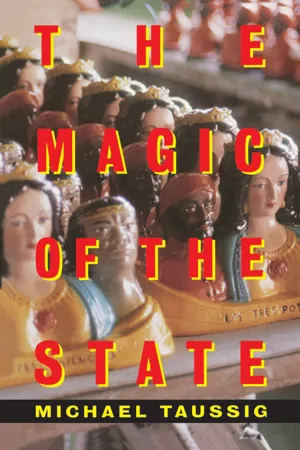
The Magic of the State
About this book
Set in the enchanted mountain of a spirit-queen presiding over an unnamed, postcolonial country, this ethnographic work of ficto-criticism recreates in written form the shrines by which the dead--notably the fetishized forms of Europe's Others, Indians and Blacks--generate the magical powers of the modern state.
Information
PART ONE — THE SPIRIT QUEEN’S COURT
1 — The Spirit Queen
How naturally we entify and give life to such. Take the case of God, the economy, and the state, abstract entities we credit with Being, species of things awesome with life-force of their own, transcendent over mere mortals. Clearly they are fetishes, invented wholes of materialized artifice into whose woeful insufficiency of being we have placed soulstuff. Hence the big S of the State. Hence its magic of attraction and repulsion, tied to the Nation, to more than a whiff of a certain sexuality reminiscent of the Law of the Father and, lest we forget, to the specter of death, human death in that soul-stirring insufficiency of Being. It is with this, then, with the magical harnessing of the dead for stately purpose, that I wish, on an admittedly unsure and naive footing, to begin.
What it is about the dead that makes them so powerful in this regard, I do not know. Could it be that with disembodiment, presence expands? Language is like that too. In fact language depends on this lingering on as an idea tracing an outline around a once solid, breathing form, troubling the body’s once bodiedness. Circling endlessly, now and again pausing for breath, words and things, drifting apart, coming together. If only for the moment, death stills the circuit in a frenzy of anxious embodiment-lust—just as spirit possession and shock can do, types of death holding spirit and body at arm’s length from one another. Eyeing each other. Imagine the tension. The shoot out at the OK Corral. Your metaphor. My literality. Just the quiet, occasionally interrupted by the stamping of hooves. In the stillness of this stand-off where death interrupts the circle of exchange between the real and the figure of the real, time turns on itself and there begins the glow, the glow of the strange after-life akin to an after-image that surges from radical incompleteness, which is, perhaps, an odd way of putting it—this constant surging, the incompleteness of life, staggering along, now this way, now that, then physically ended and given some sort of narrative structure by posterity, another form of incompleteness, really, too definitive a bodily closure on what might have been. Which is why the soul is so important, the indispensable relic that holds open the possibilities for the might have been—back then, and over there.
And because I feel that I am more known by this than knowing, as though there were an ultimate yet elusive truth in death, inaccessible to people like me for whom death has been supremely sterilized, not to mention repressed and further mystified, I hope to clarify matters somewhat, and not only for myself, by thinking about the magic of the state in a European Elsewhere—your metaphor, my literality—as related by a free spirit who frequented those parts, a sunny place, she said, from where oil flows out, cars, ammo, and videos flow in, and where a crucial quality of being is granted the state of the whole by virtue of death, casting an aura of magic over the mountain at its center.
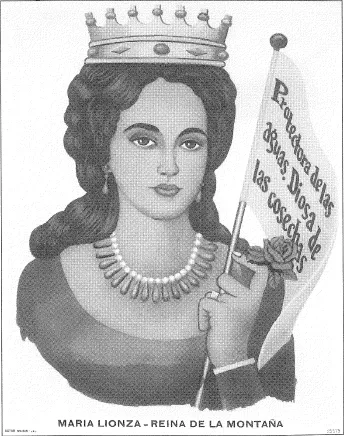
Imagine, she had said, imagine the live bodies trembling there on the spirit queen’s mountain rising into the mist sheer from the plain where ghostly laborers tend the sugar cane and clouds swirl around high-voltage pylons. Imagine what it means to enter that space where she rules over the courts of spirits swarming there together with the serpents and the dragons. Imagine your body in its spasmodic resurrection of those who died in the anti-colonial wars that founded the state of the whole. That, my friend, is really something!
She smiled.
Yes! A whole type-cast set of spirits of Europe’s Others; the fierce Indians who fought the early conquistadores, the African slaves and freedmen, and then all manner of riff-raff insinuated into the hearts of the people the past few years; Vikings like Eric the Red, not to mention fat smiling Buddhas and cruel dictators who sunk this country in blood turning neighbour against neighbour; all in all an impossible mix, a fantastic martyrology of colonial history enlivened and derailed by inexplicable meanderings.… And her voice trailed off as if she, too, in her effort to explain, had succumbed to the impossibility of that very imagining and was about to be silenced forever as glowing image in that luminous space of death recruited with such perfection by the fantasy theater of the state of the whole.
She held out her hands in mock despair as if searching for an image adequate to convey the character of death enlarging life under the banner of the state thrust brazenly at the elements. It was the extremity of it all, the extremity of the figures, the extremity of the changes, the passion no less than the stupefaction. Where a mere flick of a gesture towards the literal was intended by stately poetics, here, in the theater of spirit possession, death-work excavates the wordless experience within submission no less than within the power to command.
She leaned forward as if challenging me. And doesn’t a caricature capture the essence, making the copy magically powerful over the original? And what could be more powerful than the modern state? For the world of magic is changing, has changed.… Wasn’t it Lenin himself who wrote in 1919 that now nearly all political disputes and differences of opinion turn on the concept of the state, and added “more particularly on the question: what is the state?”—and her voice trailed away with the wonder of it all, that the primary political thing could be so taken for granted yet be so utterly opaque and mysterious that at the end of all her pontificating she was driven to an awkward silence, aware that sooner or later there was this perfidious contagion of power, that might made right no less than right made might. Was this the magic she was referring to, and in that case would self-awareness help any, or was something else required?
She grabbed my wrist. You want to know the secret, don’t you?
Slowly she released her grip and when she spoke her voice held the forlorn note of someone unsure as to whether she would ever be understood, poised, as she was, on the brink of stupendous truths that any moment could collapse under their own weight. The labor of the negative, she sighed, and the whole mad scheme unplanned as if it were there all along with the invention of the state, the form within the form with its danger and with its decay too, underbelly of stately prowess and sanitized rigidity. Only people with a superb talent for the theater could pull this off. And you too can be part of this. After all, it touches every one of us. If you miss your chance now, you miss it forever!
And this death-space?
Not life after death, she replied, but more edge to life, now they’re pure, pure image, these spirits stalking there where together Europe and its colonies, white and colored, reflect back stunning fantasies of each other’s underworlds from conquest and slavery onward, brimful with the vivacity of treachery and obscure design. A strange beauty, despite the magnificence of evil and the idiosyncrasies of its inhabitants, wellspring of the imagination where the Last Judgment on History never ceases, so many stories erased, so many repressed, the simplifications, the passions—blessed are the caudillos raging wild through time and space—the passion of armed combat, the anti-colonial wars, the even greater wars within those wars of class against class, colored and white, the bullshit piled higher and higher, a storm of bullshit awaiting the golden buckets of the Redeemer. More a contorted presence than a space, an eye-bulging dangerous presence at that, so full it is of half-rendered beings and amputees of history looking for a substantial body with which to act and re-enact, bursting the dams of memory.
But what sort of body could contain that history, let alone give it adequate shape? Is this the body of woman that is the mountain rearing high above the plain, clouds tumbling? Is this the body of woman, more presence than image, shrines as gateways bedecking her capacious being like jewels, glowing entry points into the jumble of lives cut short that here in this charged space erupt into the possessed body as foaming silhouettes etched from the cliches of the founding violence—as remembered—the colony shaken free of old Europe in a massive bloodletting of class warfare and populist rage no less directed against the white creole patrician class than led by the latter against the colonial power? The great killers with the supernatural grace that killing endows—“he ate with them, he slept among them, and they were his whole diversion and entertainment” (Boves and his black cowboys). “War to the Death.” The famous proclamation of January 16th, 1813, taken up by the Liberator. “Do not fear the sword that comes to avenge you and to sever the ties with which your executioners have bound you to their fate.” Oh yes my friend! You will hear more of this sword despite its size, this sword that severs fate, she said, twirling her golden flag on which was embroidered “Goddess of the Harvests and the Waters.”
She smiled and took up where she’d left off. The edge of the cliffs lit up for an instant where long long ago the sea had been, leaving those stark rock faces. And still I can see her there become so much stronger than he ever was alive. You don’t see flags like that anymore, carnivalesque and once upon a time fancy free like up north with symbols such as pine trees, beavers, anchors, and rattle snakes, bearing slogans such as “Liberty or Death,” “Hope,” “An Appeal to Heaven,” “Don’t Tread On Me,” or down south with an Indian holding aloft the symbols of the French revolution while seated on an alligator bearing the message of freedom from old Europe. Even today with flags so severe, standing for nations as they do, with two or three stripes of primary color and stars in rows regimenting the very heavens, even so, kids love them and as she talked I wondered whether it could be that death and the children meet on this very point to constitute the magic of the state?
But here I was, once again, descending into obscurity as irony crept into her world-weary voice. The European Elsewhere has here perfected the European ideal, she said. Wasn’t it Hegel, that most Eurocentric of philosophers who thought the modern state was born in the terror of revolution so as to realize the Christian synthesis not after death but on earth during life? Exactly! That’s what goes on here. Thanks to spirit-possession, death is fast-forwarded into life. Quite an advance, really. Not that it’s easy or ever guaranteed. Indeed, that’s the point. She paused, searching her memory. “The life of the mind endures death and in death maintains its being. It only wins to truth when it finds itself utterly torn asunder. It is this mighty power only by looking the negative in the face and dwelling within it.”
Beholden, we are, to those who go to the mountain to make their shrines to become possessed by the dead wandering footloose and fancy free from their abode in the National Pantheon. And what a pantheon! Pell-mell they pour out, evacuees from the state’s marbled interior, frightened and delirious with their new-found freedom, too much freedom, the low-lifes scouring the land for a puddle, a dark drain, or a warm, live body, the nobility like the wild Indians and Africans uniting finally in the body of woman that is the mountain rising sheer from the cities of the plain. Hustling into present-time. Woman’s time. Her eyes blazed. She was like someone possessed. The mountain. The way it holds the state of the whole! Like a fable. Like a stage, but real, on which the dead who are said to have made the whole are brought back to inhabit the bodies of the living, lying still under the trees concentrating the quietness into themselves, others kicking and screaming, walking on fire, skewering themselves with needles from which hang the national colors.
Oh! No! She went on, looking up. It’s not the weirdness of the pilgrims. To the contrary. It’s the weirdness of the state.
Here is a picture of the European Elsewhere. She was more a recorder, as you can see, than an artist.
Is this a real place? I asked?
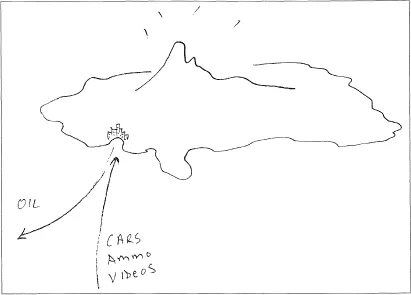
No more, no less, than any other. She smiled. Only the names have been changed to protect the innocent.
It’s more a question of what it is that seems to make a place real, she continued, making a wavy motion with her hands, where the shapely solidity of space, gives way to its meaning.… Her hands hovered like bats’ wings over her sketch. Shapely solidity indeed.
Places are real enough, in their way, she went on, gesturing at the picture, her eyes narrowing to points of flame as darkness descended and crescent moons flashed, but after all what’s at stake here is a crucial quality of being granted the state of the whole. That’s not so much real as surreal—and that, she hissed, is a question of fear and seduction. She was an impossible being, holding dissimilar things together, bringing the back-then and the over-there slap up against the here-and-now, hovering between estrangement and familiarization. Then I ask myself, she said, what do you want when you want knowledge? Nothing more than this. Fear drives you to reduce something strange to something familiar so you no longer marvel at it. And then the familiar itself becomes more difficult to see as strange. Is that what the trick takes, I wondered, to abut the here-and-now with the back-then and over-there so you see your world anew?
And then, and only then, characters emerge who make time stop and dreams erupt in the face of great peril into which I too must enter.
But do the resources exist for this estrangement? The figures? The moods?
She looked away. I felt sorry I’d pushed her into a search for a method. I was being unfaithful. Our pact had always been to steer clear of that. Method was like a drug.
It’s the danger, she said. The underground caverns. The disappearances. The going mad. The killers and the rapists. And the beauty … the waterfalls, the soaring green of the mountain, the shrines so pretty, blinking with the fury of their images and candles, the bodies laid out one after the other. Who would take that risk? Letting that tumultuous crew tumble into our time. Dread shot through with uplift. She was jabbing her finger, the one with the ring with the red rose, at the picture of the mountain. Her voice had a tired and angry edge. And the emptiness. Gaudiness. Decay. Glassy-eyed superstition. The usual suspects. Altars slowly washed away. Outlines of the human form in talcum powder passing into the mud. Garbage. Ugly slabs of concrete crumbling under the marching feet of centipedes. Vacant stares. Congealed visions run rancid.
What words to use? she went on. Old words, leaden words, pompous and heavy on the tongue, primal words with double meanings. Sacred/Accursed. Holy/Polluted. Power born in transgression. Overused words that through priestly control mean nothing any more. The tragedy it all began with. The original sacrifice, endlessly repeated. Or was it a crime? With whom do we identify? The victim or the killer? They took the power, cruel and beautiful and hard to pin down as it was. But why do I feel compelled to put it in a story? Before and after. Our fate to be always after. So we strive for another way of saying these things. Does transgression merely suspend the taboo? “Lightning and thunder re...
Table of contents
- Cover
- Half Title
- Title Page
- Copyright Page
- — ACKNOWLEDGMENTS
- CONTENTS
- — Preface: A Note on Names and Naming
- PART ONE — THE SPIRIT QUEEN’S COURT
- PART TWO — THE LIBERATOR’S COURT
- PART THREE — THE THEATER OF DIVINE JUSTICE
- — Bibliography
Trusted by 375,005 students
Access to over 1.5 million titles for a fair monthly price.
Study more efficiently using our study tools.
Frequently asked questions
Yes, you can cancel anytime from the Subscription tab in your account settings on the Perlego website. Your subscription will stay active until the end of your current billing period. Learn how to cancel your subscription
No, books cannot be downloaded as external files, such as PDFs, for use outside of Perlego. However, you can download books within the Perlego app for offline reading on mobile or tablet. Learn how to download books offline
We are an online textbook subscription service, where you can get access to an entire online library for less than the price of a single book per month. With over 1.5 million books across 990+ topics, we’ve got you covered! Learn about our mission
Look out for the read-aloud symbol on your next book to see if you can listen to it. The read-aloud tool reads text aloud for you, highlighting the text as it is being read. You can pause it, speed it up and slow it down. Learn more about Read Aloud
Yes! You can use the Perlego app on both iOS and Android devices to read anytime, anywhere — even offline. Perfect for commutes or when you’re on the go.
Please note we cannot support devices running on iOS 13 and Android 7 or earlier. Learn more about using the app
Please note we cannot support devices running on iOS 13 and Android 7 or earlier. Learn more about using the app
Yes, you can access The Magic of the State by Michael Taussig in PDF and/or ePUB format, as well as other popular books in Social Sciences & Anthropology. We have over 1.5 million books available in our catalogue for you to explore.