Chapter 1
What is Knowledge Management?
INTRODUCTION
Significant quantities of data and information permeate the healthcare industry. However, the healthcare industry has not fully embraced key business management processes (such as KM) or techniques (such as data mining) to capitalize on realizing the full value of this data/ information resource. The inherent limitations of organizational structures in healthcare, coupled with the demographic, financial and technical challenges of integrating patient care inhibit the introduction of these management processes.
However, KM and data mining are of tremendous value to healthcare, particularly in enabling and facilitating superior clinical practice and administrative management. Given the current challenges facing healthcare globally, many are confident that the tools, techniques, technologies and tactics of KM hold the key to effecting the healthcare value proposition. So this chapter presents the fundamentals of KM and how KM might benefit superior healthcare operations. Further, clinical examples help to illustrate how the value proposition can be achieved in a clinical setting.
KNOWLEDGE MANAGEMENT (KM)
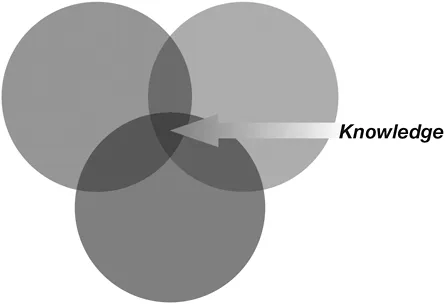
Central to KM is organizational knowledge, which exists at the confluence of people, process and technology (see Figure 1.1).
KM is an emerging management approach that is aimed at solving the current business challenges to increase efficiency and efficacy of core business processes while simultaneously incorporating continuous innovation. Specifically, KM through the use of various tools, processes and techniques combines germane organizational data, information and knowledge to create business value and enable an organization to capitalize on its intangible and human assets so that it can effectively achieve its primary business goals as well as maximize its core business competencies (Davenport and Prusak, 1998; Swan et al., 1999). The premise for the need for KM is based on a paradigm shift in the business environment where knowledge is central to organizational performance (Drucker, 1993).
Figure 1.1 Knowledge: Intersection of People, Process and Technology.
Reproduced with kind permission of Doctrina Applied Research and Consulting LLC—www.consultdoctrina.com
In today’s context of escalating costs in healthcare, managed care, regulations and a technology and health information savvy patient, the healthcare industry can no longer be complacent regarding embracing key processes and techniques to enable better, more effective and efficient practice management. We believe such an environment is appropriate for the adoption of a KM perspective and key tools and technologies such as data mining.
HOW DID KNOWLEDGE MANAGEMENT COME ABOUT?
There are few who would argue that the current business environment is global as well as complex and dynamic. To survive in such an environment requires the attainment of a competitive advantage. Such a competitive advantage must be sustainable, i.e. difficult for competitors to imitate.
Sustainable competitive advantage is dependent on building and exploiting an organization’s core competencies (Prahalad and Hamel, 1990). In order to sustain competitive advantage, resources that are idiosyncratic (and thus scarce), and hence difficult to transfer or replicate are of paramount importance (Grant, 1991). A knowledge-based view of the firm identifies knowledge as the organizational asset that enables sustainable competitive advantage, especially in hyper competitive environments (Davenport and Prusak, 1998; Alavi, 1999; Zack,1999). This is attributed to the fact that barriers exist regarding the transfer and replication of knowledge (Alavi, 2000); thus making knowledge and KM of strategic significance (Kanter, 1999).
Since the late 1980s, organizations have embraced technology at an exponential rate. This rapid rate of adoption and diffusion of ICTs (information and communication technologies), coupled with the ever increasing data stored in databases or information that is being continually exchanged throughout networks, necessitates organizations to develop and embrace appropriate tools, tactics, techniques and technologies to facilitate prudent management of these raw knowledge assets; i.e. adopt KM.
Finally, during the late 1990s many organizations, especially in the U.S., have been experiencing significant downsizing and the reduction of senior employees. These employees over time have gained much experience and expertise and, as they leave their respective organizations, this expertise leaves too. In an attempt to stem the loss of expertise and vital know-how, organizations needed to embrace KM.
Taking together the need for a sustainable competitive advantage, the need to manage terabytes of data and information, and the need to retain vital expertise and knowledge residing in experts’ heads, organizations throughout the world are turning to KM solutions.
KEY CONCEPTS
In order to understand what KM is, it is essential to understand several key concepts. Since, KM addresses the generation, representation, storage, transfer and transformation of knowledge (Hedlund, 1990), the knowledge architecture is designed to capture knowledge and thereby enable KM processes to take place. Underlying the knowledge architecture is the recognition of the binary nature of knowledge; namely its objective and subjective components.
Knowledge can exist as an object, in essentially two forms, explicit or factual knowledge, which is typically written or documented knowledge, and tacit or “know how,” which typically resides in people’s heads (Polanyi, 1958, 1966). It is well established that while both types of knowledge are important, tacit knowledge, as it is intangible, is more difficult to identify and thus manage (Nonaka, 1991, 1994).
Further, objective knowledge, be it tacit or explicit, can be located at various levels; e.g. the individual, group or organization (Hedlund, 1994). Of equal importance, though perhaps less well defined, knowledge also has a subjective component and can be viewed as an ongoing phenomenon, being shaped by social practices of communities (Boland and Tenkasi, 1995).
The objective elements of knowledge can be thought of as primarily having an impact on process. Underpinning such a perspective is a Lockean/Leibnitzian standpoint (Malhotra, 2000; Wickramasinghe and von Lubitz, 2007) where knowledge leads to greater effectiveness and efficiency. In contrast, the subjective elements of knowledge typically impact innovation by supporting divergent or multiple meanings consistent with Hegelian/Kantian modes of inquiry (ibid) essential for brainstorming or idea generation and social discourse. Both effective and efficient processes, as well as the function of supporting and fostering innovation, are key concerns of KM in theory. These issues are critical if a sustainable competitive advantage is to be attained as well as maximization of an organization’s tangible and intangible assets.
The knowledge architecture recognizes these two different, yet key aspects of knowledge and provides the blueprints for an all-encompassing KMS (Wickramasinghe and von Lubitz, 2007). By so doing, the knowledge architecture is defining a KMS that supports both objective and subjective attributes of knowledge. The pivotal function underlined by the knowledge architecture is the flow of knowledge. The flow of knowledge is fundamentally enabled (or not) by the KMS.
In addition, it is possible to change from one type of knowledge to another type of knowledge and this too must be captured in the knowledge architecture. Specifically, as proposed by Nonaka (1994), there exist four possible transformations: 1) combination—where new explicit knowledge is created from existing bodies of explicit knowledge, 2) externalization—where new explicit knowledge is created from tacit knowledge, 3) internalization—where new tacit knowledge is created from explicit knowledge and 4) socialization—where new tacit knowledge is created from existing tacit knowledge. The continuous change and enriching process of the extant knowledge base is known as the knowledge spiral (Nonaka, 1994).
Once the knowledge architecture has been developed, it is then necessary to consider the knowledge infrastructure. The knowledge infrastructure consists of technology components and people that together make up the knowledge sharing system, and hence it is a socio-technical system (Wickramasinghe and von Lubitz, 2007). Table 1.1 provides a succinct definition of these key concepts relating to KM.
DATA, INFORMATION, KNOWLEDGE AND WISDOM
Data is a series of discrete events, observations, measurements or facts that can take the form of numbers, words, sounds and/or images. Most useful organizational data is in the form of transaction records, stored in databases and generated through various business processes and activities. Today organizations generate large amounts of multi-spectral data. Given its discrete form, data in itself may not be very useful and thus it is often termed a raw knowledge asset. When data is processed, and organized into a context, it becomes information.
Table 1.1 Key KM Concepts
Information is data that has been arranged into a meaningful pattern and thus has a recognizable shape, i.e. data that has been endowed with relevance and purpose. An example is a report created from intelligent database queries. ICTs (information and communication technology) not only enhance the communication capabilities with data but also facilitate the transferring and processing of this data into information.
According to Webster’s Dictionary, knowledge is the fact or condition of knowing something with familiarity gained through experience or association. Another useful way to understand knowledge is to define it as contextualized information. The literature is peppered with numerous definitions of knowledge. However, a frequently referenced definition is that given by Davenport and Prusak (1998:5):
Knowledge is a fluid mix of framed experiences, values, contextual information, and expert insights that provides a framework for evaluating and incorporating new experiences and information. It originates and is applied in the minds of knowers. In organizations, it is often embedded not only in documents or repositories but also in organizational routine, processes, practices and norms.
It is important to note that this definition is both broad and recognizes that knowledge is indeed not a homogenous construct.
It is widely agreed that beyond knowledge lies wisdom (Wickramasinghe and von Lubitz, 2007). Wisdom is essentially a process by which we are able to discern, or judge, between right and wrong, good and bad. In essence, it embodies more of an understanding of fundamental principles embodied within the knowledge that are essentially the basis for the knowledge being what it is.
What is particularly interesting to researchers is the transformation from data to information to knowledge and even wisdom. Figure 1.2 depicts the generally accepted relationship between data, information, knowledge and wisdom.
However, several researchers have suggested other ideas, among them Snowden’s (2005) notion that the effective transition to knowledge should also include an element of sense-making (i.e. how can we make sense of the world so we can act in it?). Sense-making is associated with the work of Weick (1995) and Dervin (1998). Figure 1.3 shows how sense-making can be integrated into the “move” towards knowledge.
The conventional (or traditionally accepted) view of data, information and knowledge (a suitable example of which is Figure 1.2) suggests that there is a hierarchical relationship between these items. Other schematics depict th...