CHAPTER ONE
AN INTRODUCTION TO THE UNITED STATES
GEOGRAPHY AND SOCIETY
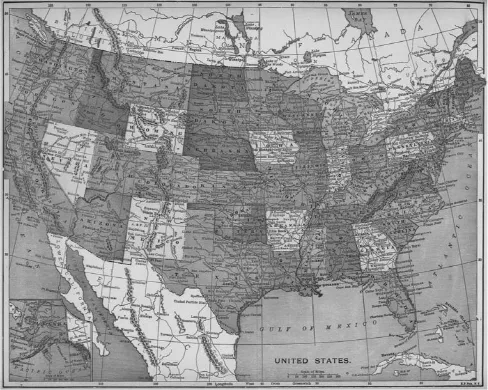
The United States of America occupies the central portion of the North American continent. It extends across four time zones from the Atlantic Ocean on the east to the Pacific Ocean on the west. It comprises forty-eight contiguous states of various sizes, as well as the large peninsula of Alaska, adjacent to northwestern Canada, and the islands of Hawaii, located in the mid-Pacific Ocean. (Alaska and Hawaii entail two additional time zones.) It covers an area of 3,718,685 square miles or 9,631,420 square kilometers (Essential World Atlas 2001, vi; http://en.wikipedia.org/wiki/United_States).
The population of the United States exceeded 300,000,000 in 2006, most of whom lived in urban metropolitan areas. The United States has nine cities with an excess of 1,000,000 inhabitants, and four of its cities (New York, Los Angeles, Chicago, and Houston) are considered global centers, cities which serve as commercial, technological, and transport hubs in the world economic system (Abu-Lughod 1999). The East Coast is the most densely populated area of the country; although there has been an increasing movement to the warmer climate of the south and west (known as the Sun Belt) over the last generation.
A nation of immigrants, the United States has a diverse racial and ethnic population. More than 74 percent of the population (215,300,000 people) identify themselves as white with German, Irish, and Anglo ancestry predominant; while 14.5 percent (41,900,000) claim Hispanic heritage; although some Hispanics identifying themselves as white. African-Americans or blacks comprise 12.1 percent of the population (34,900,000); Asian-Americans 4.3 percent (12,500,000); Native Americans 0.8 percent (2,400,000); and Native Hawaiians or Pacific Islanders make up 0.1 percent (400,000). A small percentage claim a mixed race ancestry. The largest number of immigrants in the past decade came from Mexico, China, India, and the Philippines (Wills 2005; http;//en.wikipedia.org/wiki/ United_States).
Owing to the particular historical evolution of the country, both race and religion remain major factors within American society which influence values, politics, and lifestyles decisively.1 Almost 80 percent of Americans profess to being Christians. Of the many Christian denominations, Catholics claim 25.9 percent of the population, while a wide variety of Protestant sects account for the remainder. Among the Protestants, Baptists are most numerous with 17.2 percent, most of them living in the southern states, which are referred to as the Bible Belt. Evangelical Christian groups, though they represent only a small fraction of the population, wield an inordinate amount of political power as lobbyists and pressure groups. Jews make up 1.4 percent of the population; and Muslims, Buddhists, and Hindus each account for less than 1 percent. A growing number (15 percent ) of US citizens are agnostics or atheists. As the US Constitution stipulates the separation of church and state, the non-believers have won several court cases relative to the public display of Christian symbols, such as crosses or Christmas nativity scenes on government property, and the teaching of religion in public schools. Still, they are considered to be an anomaly in the United States, which adopted the slogan “In God We Trust” as an official motto in 1956.
Figure 1.1 US map, 1902 (Northrope 1902, VIII)
In the US population, females slightly outnumber males; women enjoy a life expectancy of over 80 years compared to 75 years for men. Although women have become the majority of college students and comprise the largest number of college graduates, men retain most positions of power in the government, commerce, and society.
The country has a 99 percent literacy rate, with mandatory attendance for school-aged children. Public schools offer a free education; however, 12 percent of children attend private, mostly religious schools, and another 2 percent are home-schooled by their parents, often for religious reasons. Slightly more than 27 percent of Americans have obtained a college degree, with 9.6 percent granted a graduate degree (http://en.wikipedia.org/wiki/United_States).
Economically the median income for American households is over $46,000 (over $67,000 for two-income families, which have become common since the 1960s). Twenty-five percent of Americans earn more than $77,000 annually, and 13 percent of Americans fall below the poverty line of $20,000 for a family of four. Racial and social class distinctions are evident; Hispanics earn, on the average, slightly more than $34,000; and blacks are paid an average of slightly more than $30,000. The latter two groups also have the highest unemployment rates at more than 9.4 percent for African-Americans and 14.6 percent for Hispanics.
The United States had the world’s largest economy with more than $13 trillion in gross domestic production in 2006. Despite such wealth, economic inequality is more apparent in the United States than in European countries. One percent of Americans hold 33.4 percent of the nation’s wealth, and 10 percent control 69.8 percent. The other 90 percent of the citizenry has declined in relative worth over the past decade (http://en.wikipedia.org/wiki/United_States).
GOVERNMENT
The federal government of the United States is comprised of three branches: the executive, the legislative, and the judicial. The executive branch is made up of the president, the vice-president, and a group of appointed administrators of various departments known as the Cabinet, who act as the presidential advisors and policy-makers. The president must be a native-born citizen of the United States, at least 35 years of age, and resident in the country for at least fourteen years. The president is elected for a term of four years and cannot hold office for more than two consecutive terms. He is the chief executive of the government and also serves as the commander in chief of the military forces. The vice-president succeeds to the presidency upon the death of a president or any other circumstance in which the president cannot fulfill his or her duties.
The legislative branch of the government is the Congress composed of two houses, the Senate and the House of Representatives. The Congress creates the laws which govern American society. The vice-president presides over the Senate, and the citizens of each state elect two senators, insuring a measure of equality regardless of the size of the state. Senators serve a six-year term in office and may be re-elected indefinitely. Election to the House of Representatives is dependent upon the population of each state. More populous states get more representatives than less populated areas. Representatives are elected to two-year terms, but may be re-elected to office for an indefinite period. Either house of Congress may propose legislation; but both units must provide an affirmative vote before the proposed measures become law.
The judicial branch of the government is composed of a Supreme Court, which consists of nine judges and one Chief Justice, and a system of lower courts. Federal laws supersede the laws of the individual states. Supreme Court judges serve for the duration of their lifetime or until self-imposed retirement. They are appointed by the president and pass judgment on the legality of statutes and actions.
The federal entity created by the Constitution is the dominant feature of the American governmental system. But the system itself is in reality a mosaic, composed of thousands of smaller units – building blocks that together make up the whole. There are 50 state governments plus the government of the District of Columbia, and further down the ladder are still smaller units that govern counties, cities, towns, and villages.
( http://usinfo.state.gov/infousa/government/overview/ch7.html)
The United States has two major political parties, which provides limited choice for citizens. Both parties court celebrity (such as Hollywood movie stars) and corporate donors that supply the ever increasing finances necessary to run media dependent election campaigns.
The Republican Party is considered to be more conservative, favoring commerce and big businesses, as well as advocating right-wing social and moral issues (anti-abortion, private gun ownership, military expenditures). The Democratic Party is generally more liberal, supporting expenditure on social welfare programs and education.
POLITICAL ISSUES
One of the most debated issues in the US is welfare. In the US, each state has the authority to decide about its welfare politics.
In practice, the US is pluralistic, rather than liberal. There are significant departures from the residual model – e.g. state schooling . . . In addition to federal and state activity, there are extensive private, mutualist and corporate interests in welfare provision. The resulting systems are complex (and expensive): the guiding principle is less one of consistent individualism than . . . “decentralized social altruism”.
( http://www2.rgu.ac.uk/publicpolicy/introduction/wstate.htm)
Welfare means a social commitment of the majority of the American population, as the following figures indicate:
About one million non-governmental, non-profit organizations are dedicated to welfare; more than 80% of all American citizens claim to be part of at least one such organization; about 60% of all American citizens do voluntary work in such organizations. The majority of Americans are against an expansion of the welfare state, but they want increasing efforts to fight poverty on a private level.
(Murswieck 1998, 42–45; http://tiss.zdv.uni-tuebingen.de/webroot/sp/spsba01_W98_1/usa1.htm)
Further issues confronting the populace are unequal educational opportunities and access to health care. Public schools are funded by real estate taxes, meaning that wealthier (often suburban) districts provide a greater budget and resources to their local schools than do small, rural, or inner city districts that accommodate poor neighborhoods. Thus poor children lack the same resources and opportunities for better schooling, higher education, and ultimately, social mobility in the American society.
Deficiencies in health care services afflict the poorer citizens, the elderly, and an increasing number of workers who lack health insurance and adequate pension plans. Infant mortality in the United States affects 6.37 of every 1,000 births, a figure higher than Western European countries. Likewise, teen pregnancies, at 79.8 per 1,000, supersede European figures. With two-thirds of Americans rated as overweight and one-third judged obese, both obesity and type 2 diabetes strain medical resources (Nye 2008; Orsega-Smith et al. 2008; http://en.wikipedia.org/wiki/United_States).
In addition to educational and health concerns the unique American gun culture represents a distinct difference from European societies. The American Constitution guarantees the right to private ownership of guns and the National Rifle Association is one of the most successful lobbyist organizations in the United States, dedicated to maintaining that status. Proponents for and against guns debate whether such weapons promote or protect against criminal activities. The US murder rate of 5.6 per 100,000 inhabitants in 2005 was much higher than the rate, for example, in Germany (1/100,000). The United States also has the highest rate of imprisoned individuals among the world’s developed countries (468/ 100,000), with an inordinate number of the prisoners being African-Americans, as the sentencing of criminals exhibits clear differences along racial lines. Blacks are often incarcerated with longer jail sentences than whites. Of the fifty states, thirty-eight enforce a death penalty for the most heinous crimes (http://en.wikipedia.org/wiki/United_States;http://www.gibbsmagazine.com/blacks_in_prisons.htm).
Despite social inequalities and the lack of a universal welfare system immigrants continue to flock to the United States in search of the American Dream. Unlike other nations of the world, which have a distinct national culture based on common traditions, American culture has been described as a “melting-pot” or a “salad bowl” in which migrants, ethnic, and racial groups retain elements of the cultures of their home countries as they integrate and finally assimilate into the American mainstream. Although a relatively young culture, the United States exports its ideology and images throughout the world by virtue of its global entertainment enterprises, such as Hollywood movies, television, radio, music, and sports (Wills 2005).
AMERICAN HISTORY – AN OVERVIEW
Colonization
Prior to the European “discovery” of North America the continent was inhabited by numerous indigenous tribes of Native Americans. While many were hunters and gatherers, others practiced agriculture and lived in villages. Coastal communities proved adept at fishing. As communal societies with strong kinship ties, government took the form of tribal chieftains or a tribal confederacy among allied groups. They traded in a barter economy, practiced natural religions, and lived according to seasonal rhythms (Countryman 1996, 19–21).
Utilitarian sports, such as running and archery games that enhance hunting skills, were prominent among all tribes. Numerous ball games, especially lacrosse, were widespread throughout the continent as training for war, and a means to settle disputes with rival tribes. Gambling on such activities added interest and importance. Sports and games were often played in ceremonial contexts, and had religious meanings and significance for the social cohesion of the tribes (King 2004).
The arrival of Christopher Columbus in 1492 and the subsequent colonization of the Americas by the European powers decimated the ranks of the Native Americans and signaled a fundamental change in the indigenous cultures. The Spanish settled in the Florida peninsula in the southeast and moved northward from Mexico through southwest and coastal California, imposing the Catholic religion on subject peoples. The French took up residence in New Orleans at the mouth of the Mississippi River that drained central North America and brought the fur trade to the native tribes. French priests converted the “Indians” and lived among them in missionary outposts throughout central North America and Canada. The Dutch founded New Amsterdam (New York) before an English takeover in the seventeenth century. The British proved most influential, establishing colonies along the East Coast and the Atlantic seaboard (from the current states of Maine to Georgia).
The Jamestown colony, founded in Virginia on the mid-Atlantic coast in 1607 as a commercial enterprise, introduced the British class system to America. Many immigrants were sons of the aristocracy; they refused to work and whiled away their time, as they had done in their home country, at sport and gambling, to the peril of the starving colony. In...